Search the Community
Showing results for tags 'buwizz'.
-
 BrickController2 is an Android and iOS application that allows you to control your Lego models using a compatible gamepad. It supports the following devices: - SBrick - BuWizz 1-2 - BuWizz 3 (basic support) - Lego Powered-Up devices: Boost, PUP HUB and Technic HUB (or Control+) - PF infrared (on Android devices having infrared emitter). Features: - Multiple profiles for a single creation - Multiple motor (or output) assignment to a single controller event - Different types of devices can be used at the same time - The same motor (or output) can be assigned to multiple controller events - Different joystick characteristic settings - Different button modes: normal button, simple toggle, ping-pong toggle, carousel toggle, ... - Train mode on joysticks - Normal and servo mode for the new Control+ motors - Sequences (like for flashing light) BrickController 2 on the Google Play Store: BrickController2 android BrickController 2 is also available on the Apple App Store. BrickController2 iOS Video tutorial created by @kbalage (many thanks for this): And another great video by @kbalage: Older versions: BrickController Android application. It lets you to control Lego creations via Lego infra-red, SBrick and BuWizz V1 and V2 using any Android compatible game controller: Current version: BrickController 0.6 User guide: BrickController User Guide Minimum system requirement: Android 4.4 and bluetooth low energy support on the phone (or tablet) Video on the older SBrickController application:
 -
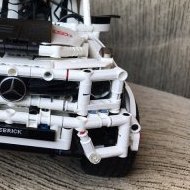
 After almost 1.5 year, finally finished studio model and instruction. Can find on my rebrickable page. WIP topic Specifications 1 Buwizz 3.0 2 Buwizz motor for driving 1 C+ L motor for steering 2 PF light for headlight 2 PF 20cm extension cable Functions Automatic headlights and working L4 engine when driving forward/backwar Working steering wheel linked to front wheels Front MacPherson Strut independent suspension Rear swing arm independent suspension Opening hood, trunk, and doors (with spring locking mechanism) Image I think shape is pretty accurate. Hood is little higher than original car but it because front macpherson strut take space. I tried to recreate original car's strut bar inside on hood. Headlight off. Because 2x2 round tile on clear is to rare I use half circle tile. Rear part Open door, trunk, hood Created using main image and chatGPT.
 -
 Hi! It's time to upgrade one more shelf model (the previous one was the Batmobile https://www.eurobricks.com/forum/index.php?/forums/topic/180543-mod-motorized-batmobile-76139/&tab=comments#comment-3302360). Ferrari 42125 has a lot of free space, so I've inserted four buggy-motors and a few BuWizz receivers. The chassis is very simple, I've removed suspension, V8, driver seat and steering wheel :) And the bodywork is the same as in the original LEGO set. Here is the result: Thanks for watching :)
 -
 This is a small AWD Trophy truck that I was able to build thanks to the new components in the Skyline, specifically the 4L links and the 4L CVs: The biggest challenge with this model was in finding a solution for the FWD which would allow for high suspension travel and a good steering angle while being limited to 25 degrees of movement of the CV joints. I decided to bring the front suspension arms closer together, therebye creating the following suspension geometry which forces the front wheels to move in an arc: This in turn has several advantages: Reduces the angle the CV joint has to carry the power on the outboard side Allows for a higher steering angle Increaces the ground clearance on the bottom As such the front suspension is supported by 2 soft shock absorbers. Notice how the L liftarms hold the suspension together, supported by a white bar that goes through the cross hole: The rear suspension uses the normal equal length parallel arm design and it's supported by a combination of a hard and soft shock absorber which are placed at an angle to simulate a progressive setup: The front axle also uses double steering rack simillar to 42160 with 4 steering links to keep the front steering system as accurate, robust and stiff as possible (Please note, there are no 4L link yet available in LDD): Originally the driveline used a 12:20 gearing from the motor to the main shaft and than the 20:28 to the wheels. I used a couple of bevel 20 tooth gears so that a 5x11 panel could fit under them to protect the gears. But during video shoot, the solution proved to be a weak point, so I redesigned the driveline to use a pair of 16 tooth gears and a 12:28 diff combo which gives me the same gear ratio, yet with added strength: The only weakpoint left were the small CV recepticles: But after reducing the current limtiters from 2 to 1.5 A, I have yet to suffer a failure, even when suddenly changing directions. You can see the model in action here: I have to say this is a really compact, fun and almost indestructible model and I'm really happy how it turned out. Now if only LEGO could come up with a 4L version of the large CV joints...
 -
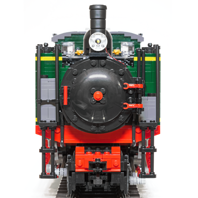 Dear AFOL trainheads, After almost six months of designing work, another five months of construction, countless bursts of temper, and being relieved of a small fortune, I am very proud to present my latest locomotive MOC. This time, it’s a 2-10-2T narrow gauge (760 mm) steam locomotive, class 600.76, of the Bulgarian State Railways (Balgarski darzhavni zheleznitsi, BDŽ). Basically an enlarged version of the German DRG Baureihe 99.73, the first five locomotives of the class were built in 1940 by BMAG (formerly L. Schwartzkopff) in Berlin for hauling all kinds of trains on the mountainous Rhodope railway from Septemvri to Dobrinishte. Delivering about 850 hp, the engines were extraordinarily powerful by the time’s standards for single-frame narrow gauge locomotives. They were so successful that the BDŽ were keen to acquire more, but after the Bulgarian Tsardom had turned into a communist republic at the end of WW II, it became almost impossible to buy industrial goods from German manufacturers. Thus another 10 engines were delivered in 1949 by Fablok in Chrzanów, Poland. These Polish-built locomotives were technically identical to the original Schwartzkopff ones, but could easily be distinguished from the first series by the combined steam/sand dome casing and the odd-looking smoke deflectors, which seem quite ridiculous on an engine with a top speed of no more than 45 km/h! From 1966 on, after new diesel locomotives had arrived at Septemvri, all class 600.76 locomotives were relocated to Cherven Bryag in northern Bulgaria. Several have survived until today, albeit most of them in desperate condition. One engine – No. 609.76, however, is in operational state (now stationed in Septemvri again) and regularly used for excursion trains. My model portrays a locomotive from the second series as it ran in the late 1960s, some years after the whole class had been equipped with compressed-air brake and supplementary oil firing. As opposed to the drawing, it therefore has a shortened right side tank (to make room for the air compressor), air reservoirs below the rear tank and an extended coal/oil bunker. The model is in accurate 1:22.5 scale except for the track gauge, which according to G-scale standard is always 45 mm regardless of the prototype’s actual value (as mentioned before, class 600.76 has 760 mm, or 33.8 mm in 1:22.5). Therefore, it matches LGB garden railway track and rolling stock. Dimensions and height of the coupling bars are designed in a way that they work with LGB link-and-pin couplers. Three PF L-motors working on the central driving axle are responsible for propulsion, with the other drivers (BBB XL) being coupled by the side rods, just as in the real thing. One BuWizz brick allows to remote-control running direction as well as speed, and serves as a power supply for the lights (separately switchable front/rear headlights, combined cab & running gear lights). The LED equipment was purchased from Brickstuff; valve gear parts and main rods were supplied by zephyr1934. The running gear layout proved to be quite a challenge. The leading and trailing axle are of the Bissell type and can swing out by 9°. Of the driving axles, the second and third one are blind, while the fourth one is slidable laterally by +/- ½ stud. With this configuration, the engine is running stably on straight track, yet also able to negotiate LGB R3 curves and switches (1195 mm radius). The model consists of more than 3200 parts and weighs about 2.2 kg. Enough said – enjoy the pictures! Some views of the engine frame. For reasons of stability, I had to fill the prototypic cutouts with trans-clear plates and bricks. You can see the steam inlet pipes running to the cylinders on the outside, as well as the exhaust pipes inside the frame, leading steam to the exhaust nozzle in the smokebox. Underneath, the brake rigging is also reproduced: The leading/trailing trucks. The tongue connecting the truck to the main frame is free from load, which means that it could be kept prototypically thin; the engine weight is supported by the axle bearings via the 4x4 tile on top. Fully detailed cab interior, including a tiltable ”Marcotty“ type firebox door and functional folding seats: Complete smokebox interior as well. The exhaust nozzle, spark arrestor, smoke stack bottom, boiler tube openings and superheater tubes are visible: Plenty of water in the side tanks: Some boiler details, among others showing the generator hidden behind the smoke deflectors: The combined oil/coal bunker can be removed to give access to the power button and the charging socket: The three magnetic switches for the lights are hidden in the rear toolbox: Posing in front of a historic BDŽ crest: The cab lettering: The lights: Some matching, albeit non-purist decoration (1:24 GAZ M20 Pobeda by Yatming, 1:22 [sic!] VAZ/Lada 2106 by Avtoprom)… A short video, showing the valve gear in motion. Note that unlike many conventional model locomotives, the valve stem is really pushed back and forth. A video of the engine pulling an LGB G-scale train will follow as soon as possible. As always, you can download the lxf file here. Also, more and much larger pictures can be found in my Bricksafe folder. Finally, I’d like to say special thanks to Sergio Monai, who with his fruitful feedback and proposals kept me stimulated to achieve the best possible result! Comments are of course most appreciated – thanks for stopping by! Best regards, Sven Edit: New video here!
 -
 Hello there, it's been a while.... I wasn't entirely inactiv in the last couple of years, but I had a technical difficulty to make videos. Without videos there's no point to post anything, so there it is,a big chunk of can't do attitude... However it has changed. The subject of this topic is on an exhibition now and I was forced to overcome my lazyness and make that camera roll again. To the subject: How did I get this low? I've bought 2 sets of this Audis back in the day as I've found it being a good value for money as a partpack. As a sideproduct I had enough of the curvey panels to get physical on an old idea, the barrel like structure you see on the thumbnail above. Luckily my past granted me an unlimited supply on connectors. As long as it existed only in my head, I was quite sure it is too flimsy and fragile to bare any load, let alone to coop with the centrifugal force that comes with the rolling motion. While rolling around the empty barrel on my desk I figured I could use a somewhat symmetric structure to apply an inward tension on the barrel and that's gonna keep it from falling apart. The fact that the barrel made out of 16 panels made it kinda obvious what symmetry should I use. I put my bet on a 4 spoke solution. The barrel would give a 15.5x15.5 stud square to work with, so I've used a 15x15 structure to reach that inward tension. It is well within the reversible flex of abs, yet enough to keep the circle from pulling apart The next challenge was the attachment of the wheelhub. There is an interlocking frame that holds the sprocket wheel in the center of it.... And so to prove the concept, I had to build a whole chassis around it. For those of you who can benefit from a studio file, here it is: https://drive.google.com/file/d/1uX-avOl3x6DPfGcx_IF1nKzRtAwWqvu6/view?usp=sharing As a sidenote, the io model is a simplified version when it comes to the chaos I've built in the mid section of the frame to avoid the twisting of it. Also I took advantage on the natural flex of the connector body which could not be replicated in the rigid studio enviroment. But I can assure you, no parts were harmed. Some of the data: It is about 70 cm long and 50ish wide, has the ready to run mass of 2.7kg. Uses 4 buwizz motors to drive, a PU L motor to steer and 2 buwizz 3units to get the sparks. Originally I've built it using the slow outputs but on the 2nd testrun I had to try the fast outputs on the motors and it took it like a champ. Although it altered the driveshaft geometry slightly, it had next to no effect on the practical usage. I can't emphasise enough that this car is only a tool to prove the concept of the wheel here. To keep the buwizz units from shuting down, the max output is reduced to 92 percent. This setup gave me fun to play dinamics and a very generous 10 minute + runtime. Way more on both than what I've expected at the begining. The chassis I suppose speeks for itself, nothing out of the ordinary. The lower wishbones have a wider base towards the chassis to deal with the frontal forces. No drivetrain -no loss of efficiency on gears. One thing to mention to fellow builders: I had so much room to work with inside the wheel, when I was building the front suspension, I couldn't stop smiling how effortless to do a "proper job". Meaning caster, camber, and ackermann geometry... Nothing else really comes into my mind, but I'm sitting on this for a half a year now,so I might just be numb about otherwise important details. I'm happy to answer your further questions. Thanks for your attention and feel free to give a honest feedback. My psychiatrist prepared me for situations like this. PS: If you find the panels on the wheels looking suspicious, that's the tape I applied on them to save them from the scratches (as much as possible).
 -
While brinstorming ideas, I came up with a really wacky idea. Why not build a classic, but give it a twist? With that in mind, I decided to build a 1:12 scale DeLorean with tracks for wheels and the following functions and features: Motorized drive and steering using PF L and 1 PU L motor Powered and controlled by a BuWizz 3.0 AWD Independent suspension on all.. Tracks? Tiltable track bases Working steering wheel Working V6 fake engine Openable gullwing doors Fully detailed interior with 2 seats Accurate shaping using a 3D reference This is the result and the current WIP status: As with all my replicas of real models, I found a 3D reference model, edited out one of the doors so that interior is better visible and imported it into LDD: As you can see, the model follows the reference quite well given it's scale, I even went into the detail of slightly tapering both bumpers. Of course the wheel arches and before mentioned bumpers had to be slightly cut to fit the tracks, but the model should still be instantly recognizable. So now it's just the matter of building it from real bricks, I will post WIP photos as the project progresses.
-
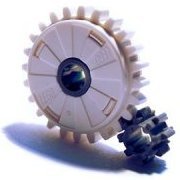 Hello EB friends! Today, I'm getting to work on a new project - a 4x4 rock crawler to compete in our upcoming Toronto Truck Trial in August. I've always wanted to try my hand at a rock crawler, but somehow never came around to it until now. It seems like the perfect opportunity to make the best offroad vehicle - faster than a large 6x6 or 8x8 trial truck, but still having excellent offroad capabilities with large ground clearance, huge suspension travel, oversized wheels, and the perfect excuse to omit bodywork entirely and make a light, nimble machine. To make the best rock crawler I can, I'm going to draw inspiration from a couple of my past creations (the parts of them that went well) as well as from some other builders' MOCs. First of all, I'm going to reuse the general axle design I used in my Praga 6x6 Trial Truck, which was inspired by @Attika's design in his offroader: To power this crawler, I want to get the best power-to-weight ratio I can. Since I'm limited to 2 x buggy motors and a BuWizz 2.0 - that's all I've got and I don't plan to invest more money at the moment - the only solution is to keep the truck as lightweight as possible. In my latest RAM pickup truck I was very pleased with the performance it achieved in low gear using 2 buggy motors and planetary hubs. Because I will be using larger crawling tires, I will reduce the ratio further for this build compared to the pickup, using the same 12-tooth bevel gear, 28 tooth bevel gears pairing as in my Praga at the axle, for a ratio of 2.33:1, rather than the ratio with the 20-tooth bevel gear, 28-tooth differential, as on my pickup, which has a ratio of 1.4:1. Overall, because my 3rd party crawler tires have about double the radius of the 62.4 x 20 tires on the pickup, and so double the circumference and double the speed, the ratios will more or less cancel out and the crawler will have the same speed and torque as the pickup, which was plenty. Indeed, it may be a bit faster, but it will also be lighter to account for it. If I got any of that math wrong, please feel free to correct me, but it makes sense to me that the speed is proportional to the wheel circumference and therefore the wheel radius, by the formula 2 * pi * r for circumference. Next, I'm going to just omit differentials entirely. I think the truck should be light enough to not need them, although the grippier tires may slow it down in the corners where diffs are necessary. For the suspension, I want to try my hand at building a four-link triangulated suspension, partly because it looks fun, and partly because it offers the advantage of being able to connect the axle to a small body, that doesnt need to extend all the way over the axle to accomodate a Panhard stabilizer rod. I think I will take inspiration for that from @PunkTacoNYC's awesome Chilli Crawler: In summary, then, here are the current specifications, ideas and goals for this build: 2 x buggy motors mounted in the body for drive, PF servo in the front axle for steering; BuWizz 2.0 for power Lightweight build overall to keep weight minimal and improve power/weight ratio - little to no bodywork, and short wheelbase Triangulated 4-link suspension to enable a smaller, lighter body, using the suspension links on the front axle to create a mild caster angle Planetary hub live axle suspension, as from my Praga truck, inspired by Attika - I just can't think of any way to improve on these, they're so simple, robust, and elegant, and have very precise steering and great ground clearance The first step is to adapt the front axle for this build. I will make it two studs wider to account for the larger tires, and I have to figure out mounting points for the suspension links and shock absorbers. Other than that, I will leave it untouched, as it just has it all. The planetary hubs and bevel gears together create a mechanical reduction of 12.6:1, which is excellent for how compact it is. The hub + defender rim combination keeps the pivot very close to the center of the tire, making the steering more effective. Attika's clever design gives it excellent ground clearance. And, importantly, mounting the servo on the axle gives it excellent precision with return-to-center steering, something rare for a heavy-duty axle, and it is very robust with the double-racked steering mechanism - I can't remember who recommended that to me in the past, but it's brilliant. Here, then, is the beginning of the front axle, widened by 2 studs: I'm excited for this build - I think it's going to have some nice performance! As always, I'm happy to take tips and suggestions from you guys - please pitch in! -Teo
 -
Hello everyone! It's been a little while since I last posted; things have been busy with school, some health problems, and other things, but now I'm back with a fresh MOC, a RAM pickup truck, powered by BuWizz and 2 buggy motors! Here's a video of the model: I was fairly satisfied with the result. In low gear, this thing generates a ton of torque and still maintains decent speed, although the open differentials and low ground clearance make it struggle off-road at times. In high gear, the truck achieves decent speeds, but only on very flat surfaces. The biggest issue in high gear is that the whole drive train spins very fast, to compensate for the gearing down of the planetary hubs, and so a lot of energy is lost to friction. In summary, the features are: • 4x4 drive with 2 x buggy motors • Planetary wheel hubs • 2-speed gearbox • IFS and live axle rear suspension • PF LED headlights Here are some more photos of the model: The full photo album is on my BrickSafe here: https://bricksafe.com/pages/Teo_LEGO_Technic/ram-pick-up Overall, it was a fun little experiment. For my next MOC, I'm planning to build a rock crawler to compete in a local truck trial competition here in Toronto (If anyone is interested, please reach out, we will gladly take new contestants ). Hope you guys enjoy it! Any constructive criticism is much appreciated, as always, although I will say I'm done with this MOC and won't be making any changes, but I can use ideas on future builds.
-
It's been a while since I posted a personal MOC here, so it's about time to fix that! After the competition we had in Cluj in Romania last year, I decided to make an AWD version for my next competition car and to include the lessons I learned from the Sterrato, Mustang GTEX and others. For this version I used a single BuWizz motor to drive the model, which is realistically placed behind the rear axle. It drives a 28 tooth reinforced differential via a 12 tooth bevel gear from the fast, inner motor axle: Rear differential also drives and axle that in turn drives the normal differential in the front, providing front wheels with power. An L motor steers the front wheel to the maximum angle CV joints can provide, 25°. Exterior is loosely based on the 911 Dakar edition, though some details had to be omitted/recolored due to lack of small panels in white color: I also had to simplify the rear section a bit in order to fit the motor, but it still features details such as LED bar, lights, exhaust and a skid plate: Dimensions: 29 x 12,5 x 8,5 cm Part count: 595 pcs (actually very low for a motorized model at this scale) Weight: 650 grams Thanks to the redesigned front axle which uses the normal diff, I also managed to increase ground clearance to almost a stud, allowing the model to be driven over rough terrain as you can see here: As usual, the LDD file of the model can be downloaded here (remember to update LDD first): https://bricksafe.com/files/Zblj/116-porsche-911-dakar/1 to 16 Dakar 911.lxf While not the fastest or most powerful 1:16 model I've ever built, it sure is one of the, toughest, reliable, robust and simply fun ones to drive so far. To conclude, I'm also really happy with the looks, thankfully Porsches are quite easy to build with Technic and I think it's a good representation. Even kids recognized it as a Porsche while recording the video, which I think is a good sign.
-
 Inspired primarily by the Opel Manta 400, I've made my own RWD rally car. It features independent front suspension, and a rear live axle using the big ball joint and a metal U-Joint. Its propelled by 4 buwizz motors and steered by one C+ L motor. Some late WIP photos Earlier WIP photos Problems Because of the narrow wheelbase and relatively high center of mass due to high up buwizz units, the model easily rolls when driving at high speed and cornering. I was lazy with the design of the suspension; the front is too soft and the steering is inaccurate because I am using Instead of the newer parts with longer arms for steering links. This allowed me to fit the wheels inside the body, though. The rear suspension is too hard primarily because I got lazy and wanted it done, after about 8 hours on the model I was getting bored. The bodywork has some parts that could be white if I had the parts in white, but those parts are quite small. If you have any questions, feel free to ask. As of right now I still have the model assembled. Thank you for reading.
 -
[TC27] Lowrider
Zerobricks posted a topic in LEGO Technic, Mindstorms, Model Team and Scale Modeling
Here's my entry for the TC27 - the physical model is also completed and tested, but I'm stil waiting for the 2x C frames (3167) to arrive (for testing purpose I just 3D printed my own pieces ). Anyway, I wanted to build something unique and different this time around. I've been thinking of building a motorized lowrider for a while now and this challenge was the perfect excuse to realize it. With this model I wanted to realize the following functions: Motorized suspension Steering mechanism connected to the steering wheel Working fake engine driven by rear wheels Openable (suicide) doors, hood and boot Proper, clean and spacious interior Along with those functions I also managed to squeeze one more additional function, which makes the car a convertable. Here's the end (digital) result: So as you can see, it actually uses the correct tires and rims which I think is a good start! Here's how it looks like all opened up - notice the inline 4 fake engine: Here's a look from the rear, showcasing the large rear typical of lowriders, which is also used to house the two BuWizz 2.0 bricks. I took great care to give the model some fins, proper brick-built lights, bumper, exhausts, etc... Looking at the underside you can see that the L motors are also structural, both axles are designed around them: And here's how the Driveline, Steering and Suspension system are integrated into the model: As mentioned before this is also a convertible which means that the roof can be unfolded and raised: Now for a little of backstory. Originally I tried using PU L motors to make this model a bit more intelligent and capable of holding the wheel suspension positions automacally. Unfortunately PU motors have a very sensitive current protection and were simply not capable of holding the weight of the car even though I'm using shock absorbers to help carry weight. Worth mentioning is also that suspension arms are shorter in the rear to compensate for extra weight. I could have added extra gearing, but that would make the model even bigger and suspension slower. So I took some L motors I had laying around from the Go-Kart project and used them in place of PU ones. Thanks to their shorter size I even gained some additional space and reduced complexity. During testing I decided to double up the BuWizz bricks. I did that for two reasons, first to increase the weight in the back for higher front bounces and secondly to supply the needed power to actuate 4L motor at maximum speed at the same time (each motor draws some 2 Amps when stalled in Ludicrous mode). I hope that's enough details and media for now, I will post photos of the real deal once I get the missing parts and I will of course record a proper video. -
I usually don't really post much of my work here, but sometimes I'm too proud of a certain model... Like this one. Designed in colaboration with a Slovenian GM racing team, I present you my interpretation of a 1:10 scale Ford Fiesta RS WRC Rally car. The realized functions and features are as following: 4x BuWizz motors for all wheel drive - one for weahc wheel, powered by the outer output 1x PU L motor for steering Independent high travel suspension on all wheels Working steering wheel Powered and Controlled by 2x BuWizz 3.0 Inline 4 cylinder engine driven by the front motors Opening doors, bonnet and rear hatch - the rear hatch usues shock absorbers in a bi - stable mechanis to keep it closed or opened Custom 3D printed wheels for 62.4 mm tires Detailed interior with a rollcage and bucket seats Built out of cca 1650 pieces As usual in such projects, I use a 3D reference model which is imported in LDD in order to create the most accurate representation: Here's the final virtual model - ready to be realized from physical bricks: You can see one BuWizz 3.0 under the bunnet in the front, powering the front wheels and the blue cylinders (half pins) of the inline 4 engine: Rollcage is designed with a mix of liftarms and links and it is actually structural. You can also see the second BuWizz in the rear: Anotehr view of the opened up model: Bottom view, showing layout of the motors - Front motors are just behind the grille, it was a really tight fit: Once the digital model was done, it was time to build it from real parts, 3D print the wheels and apply custom stickers. Here's the final result: I'm really happy about the shaping, there are almost no staright lines, almost all the panels are at an angle, for example the curved 3x11 panel above the rear fenders: As mentioned before, the steering wheel is connected to the steering motor (the blue clutch gear moves it). The steering wheel can also be adjusted using click hinges. Also notice the red fire extinguisher on the passenger side: Soft grey shock absorbers keep the rear hatch closed/opened: Inline 4 clyinder engine is powered by the front motors from the fast outputs via blue rubber belts. They can slip when needed while cornering: And finally here's a video where you can see it in action along with more details: To summarize, thanks to the 3D reference the body is very accurate with almost no straight lines and I'm getting really good at sculpting complex shapes. Great care was also put into keeping the car as light as possible so it reaches over 15 km/h, yet has enough torque to drive/jump over bumps, hills, etc... Thanks to the Audi's hubs, the suspension has a lot of travel and a single (black) hard shock absorber per wheel is enough to support it and absorb the hard landings. To conclude, I'm really proud of this model, it's a really nice balance of aesthetics, performance, robustness and fun!
-
This is a model I've been working on for a few months for the BuWizz gathering and now it's finally time to showcase it. The rules required a 1:10 scale model built after a real vehicle with a working gearbox, steering wheel and fake engine powered by a maximum of 2 BuWizz motors. I also managed to squeeze additional functions and features as following: 2x BuWizz drive motors 1x BuWizz 3.0 for control Working steering wheel actuated by a PU L motor 2 Speed motorized gearbox controlled by a PU m motor All Wheel Drive using planetary hubs Independent double wishbone suspension on all wheels with around 2 cm travel Working fake V12 coupled directly to the drive motors Detailed interiror with tilting rear seats to access the BuWizz Detailed exterior with opning doors, bonnet and tailgate Built out of around 2850 pieces 47 x 21 x 18 cm Weighs around 3 kg As usual with my representations of the real vehicles, I first started with sourcing, editing and importing a 3D reference into LDD. Here's how the digital model looks compared to the LEGO version: And here's the LEGO version without the reference: I hid the doors, bonnet and the tailgate in order to show the detailed interior: The driveline is very compact and efficient. Two BuWizz drive motors are placed right behind the rear seats and power the 2 speed gearbox and an (oversized) V12 engine directly. As with the real vehcile, suspension system is independent at all 4 corners. Steering system is actuated by the steering rack directly and geared up. Gearbox is activated by a PU M motor via a linear clutch and a wave selector: So that was the theory... After a few small fixes and corrections, this is how the finished model looks like in real life (oops, I lost my license plate): Rear view showing the spare tyre, detailed lights, guardrails and exhausts: Doors, bonnet and the tailgate can open up to reveal the massive V12 engine and front shock absorbers: Interior features an adjustable and working steering wheel, 4 fully detailed seats, console and a transmission tunnel. Rear seats can be tilted individually to access the BuWizz 3.0 for charging; Here's a view of the back with the opened tailgate. Thanks to the central motor placement, there's a lot of free space: One of the design goals was to protect all the gears and drive axles from dirt and to keep the bottom as flat as possible. I think I did very well, it's smooter than the real vehicle in that regard: And finally here's a video where among other details you can see how well it performed at the competiton: If you want to have an even more detailed look, you can download the LDD file here: https://bricksafe.com/files/Zblj/lamborgini-lm002/Lamborghini LM002.lxf To summarize I'm really proud of this model. It looks, performs and just feels good and hits all the right spots. One thing's for sure, I'm keeping this one assembled, as I trully believe it's one of the best models I ever designed.
-
Hi Eurobrickers! I'm back with the new MOC - this time it's a new Mammoet SK 6000 crane! Current configutation is Mammoet SK6000 + Mammoet SK350 Fixed jib (which is compatible in real life) Original ring crane was just recently released by Mammoet in Netherlads! This is fan work. For built used only open source resources from WEB! Ok, also this MOC was built with unofficial consulting with Mammoet engineers, because it was a lack of the info in WEB, so I have to ask some thiings to match the real masterpiece crane. UPD: I was invited to the real crane's world presentation on last (or prevois) Friday to the Netherlads with my Crane MOC to show it at the mass media day near the real SK6000! Unfortunately I was on vacation that time and lost this once in a lifetime chance.. How it works: Centered counterweight is fixed and non movable, around it there are two train racks (imne are almost 180 degrees), so the crane is rotating arong the ballast. Real SK6000 does not have it, but from SK350 I took the jib which was surprisely fix and not luffing - it has no adjustments. Machine is able to lift 6000 tons and lift 2000 tons at the lenght of the footbal field from the basis !! The main feature of this crane is that it does not use winch to operate the boom - it uses special mechanism with chain, so I implemented this also :) Please enjoy the video first: Built with genuine Lego technic parts + 3rd party strings + 2 BuWizzBrick 's. I refused using trixbrix curved rails because found a solution with genuine lego parts. The model has 7500 parts which makes it the biggest MOC in my career! It has 8 L motors for smooth operating, powered by two buwizzes. Crane weights 8,3 Kg excluding power sources (battery boxes) and counterweights!! And the height is about 2.3-2.4 meters. More images are available: https://bricksafe.com/pages/Aleh/mammoetsk6000 Building instructions already available. Built took 1760 steps, which required a lot of effort to prepare it. https://rebrickable.com/mocs/MOC-195537/OleJka/mammoet-sk6000/#details
-
 Hello again, Back in March 2023 I started my YouTube channel with my Raid Buggy. Granted, it look somewhat crude and it was quite slow, but it was my first model with BuWizz motors and bricks so it has a special place my heart. Recently it was the 1 year anniversary of it, and I decided to make a remake of it to prove some how much my LEGO building skills have changed and to honor the original model and channel. So enough with the backstory, let's get to the details: Features 4 Wheel drive with a 2-speed gearbox steering with double steering racks Soft double-wishbone suspension Working gear stick Bodywork built to resemble the original model One of the things that I wanted to show with this model was that you don't necessarily need 4+ BuWizz motors in order to make a good fast off-roader. For this, I decided to make use of a 2-speed gearbox, which has a low gear with the same gearing as the Raid Buggy V1 and the high gear which is some 67% faster (6.2 km/h). The gearbox design was heavily based off @Zerobricks's excellent Simple Off Roader but modified to fit my needs. Another benefit of this is that it has a neutral gear, which is very useful for downhills. From then, I finished it off with the axles of my Monstermog and the chassis was done! from there, I had to build the bodywork, the part that I had been dreading the most For me the body was a very important part, as I wanted to make it reminiscent of the original yet it would have a more sporty look and a stronger construction. Just like the first model, it uses many connectors in @Attika's characteristic style. In the end, the bodywork suffered many changes but I consider them for the better, as it now has a more imposing look and a much more sturdy connection so it can be rolled over without having to fear of breaking it. And now a few more images: The model ended-up being a very good off-roader, with a somewhat high speed (6.2 km/h) yet with some torque left for harder off-road. I pretty much had no issues with it, except the front open differential which sometimes got in the way when off-roading in the low gear. It's otherwise a model more focused on high-speed on uneven terrain so I'm happy with it If you would like to build this model, you can download the .io file at rebrickable here. And as always, here's a YouTube video containing some off-road footage, functions showcase, and some nice Punk Rock music Feel free to post a comment about what are your thoughts about it, and see you in the next one!
 -
Hi guys! As some of you may know, I'm a huge off-road fan. I never really saw the potential in on-road, and sometimes found it boring. But then, I watched a few drifting videos and instantly saw the potential to make a LEGO drifter. I got in touch with my friend @N1K0L4, which is an on-road fan and has experience in the field, and sent me a couple of chassis designs. I obviously chose the most overpowered one You can check out N1K0L4's chassis here, and the full rebrickable post here. Now, let's go with the details: Features RWD with 2 BuWizz Motors Steering with a C+ L motor Realistic looking bodywork resembling Ken Block's Hoonitruck All fueled-in with a BuWizz 3.0 unit For me, one of the most important functions is the drivetrain. It's built in a very clever way with the 2 BuWizz motors leaving just enough space for housing the BuWizz 3.0 unit. It's RWD, which isn't true to the real-life counterpart, but N1K0L4 is working on a new version with AWD and it's looking very promising! updates about the AWD version will be made in this topic. To finish it off, the steering was added, using a rack and pinion setup to have as little slack as possible as that's a key factor in mini-racers. It's steered with a C+ L motor as said earlier, with this being my first time using C+ electronics. I have mixed feelings about it, but more on that later. The bodywork was an interesting one. I wanted it to be as accurate as possible to the real deal, but I had to use white mudguards as LEGO for some reason doesn't produce them in black. Still, they didn't spoil too much the body for it to be recognizable, so I'm happy with it. Still, it was somewhat flimsy and would tear to pieces if I hit a jump wrong. Still, N1K0L4 has also addressed this while still making it more accurate. I guess union makes strength For the video, I wanted to use a different setting in comparison to my other videos, as it's a very different model to the previous ones. I chose to go to a skate park, as it had some smooth concrete sections for drifting, and ramps to do some jumps, which is exactly what this model was built for. The model handled excellently in spite it's RWD, although I'm not used to models this fast, so I hit jumps wrong dozens of times. There are some included in the video, but many weren't included, but I'm considering making a bloopers video. How would you guys feel about that? However, the parts didn't like the skate park, as concrete is very abrasive to abs plastic. The splitter was melted and torn to pieces, and the tires lost most of their thread in the process, up to the point where I had to use to sets of them to record the video. I guess I'm a bit of an aggressive driver, but you should be aware of that if you build this model. About the C+ electronics, I'm not fully sold out. They do have some pros, like the more convenient shape of the motors or the faster response, but they show some disadvantages when taken into closer inspection. The steering trim was a pain to get right, and even when that was the case, it still veered ever so slightly to one side. I think it has to do with the fact that the 0 position is digital and not physical. Still, I'm considering using them in future build mostly because of the easier integration, but will probably stick to PF servos for faster models as they return to center more accurately. Feel free to post a comment about what your thoughts are about it, and see you in the next one!
-
 Hi, I would like to present you my first MOC prepared especially for official LugPOL Truck Trial Championship. MOC is based on very famous, polish truck with good off-road capabilities - Star 266. I choose polish truck to introduce some local technology to the competition dominated by soviet machines. Instructions are free of charge, so if you have parts and some time, you can enjoy off-roading with this model pretty easy. LINK Here are my priorities when designing this truck: to fulfill LugPOL Truck Trial Championship rules and to provide truck which will be accepted by judges to prepare truck with good off-road capabilities to build it to make it recognizable Couple of LTTC rules: scale: 1:12 to 1:14 number and type of axles true to the real machine type of suspension true to the real machine must be RC and all-wheel drive the truck's cabin true to real machine, with roof, seats, steering wheel, floor and with openable doors All above rules were fulfilled, below there are couple of more details: scale: 1:12 drive: 2x PF XLs coupled, if necessary, each wheel can harness power of two XL motors steering: PF L motor weight: ~1990g dimensions: W x L x H: 25 x 64,5 x 32,5 studs (width without wheels and tires) Star is powered by Buwizz 2.0, but since it uses only PF motors in very simple configuration, it can be powered by anything you have Truck was designed to work with 96mm Tamiya CC01 tires, and those tires you will see on the video. But in the instruction I used the closest in case of size official Lego tires. You can of course put bigger tires, like Lego tractor tires: 107mm, but some rubbing during extreme off-roading is possible. Couple words on the truck itself: Star 266 took part in two competitions in 2023, so it is well tested, any minor issues were eliminated and I'm convinced, that it can be used in hard terrain without any worries. It is rather simple construction, to reduce the weight. Details are there mostly to be able to fulfill competitions requirements. The truck is the mix of many ideas I had during designing and I wanted to test during proper, official competitions. Some of them proved to be hard terrain effective, some of them, not. So this is for sure not the ideal trial truck. But it is not afraid of outdoor obstacles, mud, dirt, stones etc. Pros of Star 266: high ground clearance (7 studs with 96mm tires) high approach, break over and departure angles highly response suspension with long travel to fast and precise surface adaptation each axle is connected directly to coupled 2 PF XL motors, which allows to stable, equal speed of all wheels and provides (when needed) all available power for the wheel which needs it the most steering is done with PF L motor for speed and strength, possible steering angles are > 45 degrees per site Cons of Star 266: turntables used in each wheel introduce friction, quite a lot of it, I highly recommend to try to reduced it as much as possible (I advise to use a bit of sanding or lubrication, or both) due to lack of any shock absorption, stability is only on decent level truck's cabin shape and location is not the best in case easy passing the gates during competition, but this is my personal opinion Internals of the MOC, so drivetrain and steering with motor on front axle More photos: https://bricksafe.com/pages/keymaker/trial-truck-star-266
 -
 Hello everyone. This is a story of my mid-scale RC baja truck called “Phantom”. The beginning. I always had a strong desire to go fast. For that reason I made my Red Roadster powered by Buwizz motors (See my Profile for dedicated post). But this sport car has one significant disadvantage - it requires a very smooth road! So I decided to build a trophy truck. I learned a lot about trophy trucks made with Lego. Best of them had 2 Buggy motors for propulsion with a direct connection to the rear wheels. So I decided to build myself a similar setup. First trophy truck I designed in big scale (~1:10) but Buwizz motors were struggling with a load from big wheels (and that is not a problem of motors, but a problem of construction). So I made a portal reduction and the problem was solved. After that I build an ultimate dune Buggy “Dragonfly” with independent suspension driven by couple of Buwizz motors. The result was great, Buwizz motors allowed to drive it very fast on 85 mm wheels. So I decided to build a trophy truck with them. Such wheel size is the smallest one which could be used outdoors. Smaller wheels does not provide enough of ground clearance to go full speed on bumpy terrain. Photos. Front axle. I started the build with the front suspension. A technical task was the following: - to use big Lego wheel hubs - double steering rack - positive caster angle - ridged suspension arms I took many ideas from the front suspension of my Dune buggy and tried to make it smaller. Dune buggy used 9,5 L shocks so I decided to change them to 7 L shocks. Also I was able to avoid ball connections, since they struggle a lot at bumpy roads. Here is the result. The steering motors should get connected to the vertical black axe (on the first picture). The key idea was to place steering arms horizontally and in a slight diagonal way. Such placement caused some friction in the steering system, but from the other hand it reduced the wobbling to ZERO! Also there is a 3 studs distance from the connection of steering arms to the wheel hub and the pivot point of the hub (see picture 2). It reduces the maximal steering angle, but strengthen the steering system and make the control smoother! Rear axle. A technical task was the following: - direct mounting of Buwizz motors to the rear axle - Long suspension arms and long travel - Suspension with progressive hardness I decided to make it simple without any articulation, though there was some provided by bending of plastic parts. There are two sets of springs used. Small vibrations of the rear axle get absorbed by a soft 9.5 springs, while hard bumps compress the rear axle stronger, so the set of 7 L springs does their job. Finally, there is a couple of Lego rubber elements which play a role of fenders. So there are three stages of compression. First stage. Soft settings. Second stage. Hard settings. Third stage. Rear axle touches the frame. Frame of the car and bodywork. A technical task was the following: - two layers of frame - use the roof of the car as structural element - minimalistic bodywork The space frame of the car consist of two layers. Roof of the car tighten the upper layer in order to bear the load from the rear springs. The middle compartment is dedicated to power sources. The "new" cross-beams (15L and 11L) were very helped a lot. The bodywork is made with several panels which can be easily detached for servicing the electronics. Electronics. On photos above you can see a custom Lego-compatible RC unit equipped with two high power cells 18650. It provides more power comparing to Buwizz 2.0, but it is not enough for two Buwizz motors. It get overheated quite fast (5-10 mins). One may ask me, why I use it. Actually, the first version of the Phantom was powered by two Buwizz 3.0 units, which provided a plenty of power to the car. But I managed to drown the car at first outdoor driving test! So I bought replacement for them since there was no possibility to purchase new Buwizz units in Russia. Here is the video of an accident: This month I bought a different Lego-compatible RC electronics from a Russian AFOL, it is called "Wixy". It plays a role of the controller for RC motors and allows to power my cars with 3S Lipos! WIth 3S Lipo I forgot about lack of power and was able to ride the Phantom for miles and miles... Conclusion. The car Is made for outdoor driving. It has a decent speed and a good control. Though there are several weak places of Phantom which can not be fixed with plastic Lego parts. The dust is very annoying, especially on county roads! It fills all holes of the car, most importantly plastic wheel hubs. I destroyed all the wheel hubs I own and there is no way of fixing the problem... Also the car has slight problems with ground clearance - it is acceptable for city roads but too small for stony surfaces. Finally, the Truck can not go trough the tall grass with such small wheels and RWD.
 -
After building the 1:8 scale Spano GTA, I wanted to make something more compact, yet even more functional for the BuWizz camp 2021, which got postopned to 2022. The rules behind this model stated to build a 1:10 scale representation of a real existing car, which has to have a working gearbox, fake engine and working steering wheel. After researching different types of super and hypercars, I chose the Acura/Honda NSX since it had several good pros compared to the more famous brands like Ferrari or Lamborghini: The real car has a smaller profile, which means a lower weight It uses a hybrid AWD system, which would come in handy for the LEGO model for accelerating and braking on all wheels Engine powering is a V6, which doesn't take as much space as the typical V8, V10 or even V12 Since it's a less known supercar, my LEGO version could be the first one in such scale I used a simillar technique as with Spano GTA where I imported the 3D model into the Lego Digital Designer and used it as a 3D reference. Using this technique I ended up with a really close representation, and it really shows: As you can see in the gif above, not only does the model look very good, it's also full of functionality: 4x BuWizz motors for driving All wheel drive 2 Speed gearbox Working fake V6 coupled directly to the drive motors Working steering wheel 2x BuWizz 3.0 for control Double wishbone suspension on all wheels Dimensions and weight ended up as following: Length: 45 cm Width: 20 cm (without mirrors) Height: 12.5 cm Weight: cca 1,5 kg Here is how the model's underside looks like, drive motors are driving two independent gearboxes in order to evenly spread the mechanical load. This kind of a setup also cancels out any side forces on the central drive axle, thereby reducing friction and wear: In order to cram all the powertrain components in the rear the drive motors are placed in a V shape. This way there is just enough space between them for a functional V6 engine and a PU medium motor which switches the gearbox: Thanks to the compact powerline and driveline, the interrior is very spacious and both seats are almost 1:8 scale sized, measuring 6 studs wide. There are even stoppers and interrior details on the doors themselves: ž The end performance of the model is higher than what I expected, there is enough torque to freespin all 4 wheels, jump over ramps and top speed in high gear is almost 20 km/h! You can see how well it performs the video: To conclude, this is my first 1:10 scale supercar which also ended up extremely compact, functional, robust and good looking. I also think a 1:10 scale may be beneficial when it comes to reliability and robustness, since models tend to weight half the weight of their 1:8 counterparts while still incorporating a simillar level of functionality and details. Having said that, this will not be my last 1:10 supercar and I think for the next one I will ditch the gearbox and simply drive the wheels directly from the motors without any weak differentials.
-
Here's a model I actually completed a year ago in order to be unveiled in time for the BuWizz picnic back in 2021, but we all know how things went... Anyway since the picnic did happen last weekend, I decided to unveil my most powerful offroader. The basic design is based on the Wildcat 4x4, but this version adds more power, a 2 speed gearbox and a third axle to the formula. As with the older version, each axle has independent suspension, plus the entire axle can pivot or swing, effectively giving this model double suspension setup. Indepedent suspension is great at absorbing small bumps when driving quickly, while the axles pivot along the terrain when crawling. The driveline was quite a challenge. In order to transmit the power from 12 motors to the wheels, each wheel ended up having it's own dedicated 2 speed-gearbox. The final driveline is extremely compact and efficient, with only 3 gears engaged at any given time. There are also no differentials or perpendicular drives, so nothing that can break or skip. Each gearbox is actuated by a PU M motor using worm gears, which prevent any unwanted skipping out of the gear. This way each wheel is powered by 2 BuWizz motors via a dedicated gearbox: The following gif shows how the front axle is designed along with the whole model: Here you can wee, how the front axle tilts in order to adjust to the terrain: The rear axles are made in the same way as the front axles, minus the steering. Rear axles are also designed to work in tandem, when one goes up, the other goes down. When one tilts left, the other tilts right. This way the rear suspension is extremely flexible: And finally here are some specs of this beast: Length: 52 cm Width: 26 cm Height: 20 cm Weight: 2,5 kg Top speed: 15 km/h (rounded up) To complete the presentation, here's a video of the model in action, a big thanks out to @braker23, @Sariel and @kbalage for the footage. Final thoughts... this is my most potent offroader to date. The sheer amount of power, torque and speed is hard to wrap your mind around for a model made entirely of small plastic pieces. Having said that, I think there are still few areas to improve: Tendency of the front wheels to fall off at hard bumps - A lighter version would help to reduce stress on the hubs and wheels. Could use a higher steering angle - Would have to find a way to integrate steering racks inside the transaxles. Protection againt depbees and dirt entering the drivelines - Something that would also not reduce the ground clearance, tiles might work.
-
Hello everyone! I am glad to introduce you my new Lego MOC. It is called "Wilde Beast" and it is a 1:10 scale 4-wheel drive pickup truck. Technical characteristics 1:10 scale, 1.630 kg of total weight All wheel drive with 4 x Buwizz motors powering each wheel separately 2 x Geek servo for steering 3S Li-Po for power RC radio + Wixy units for control Full independent suspension with customizable hardness Custom wheel hubs with metal bearings RC wheels 90 mm (12 mm hexes) Metal U-joints in the transmission Robust 3D-printed steering bones Positive caster angle on all wheels Back to the beginning The main Idea behind the build was inspired by real e-cars. This cars has no gearbox, and each wheel gets connected to an e-motor independently. I tried to replicate this principle with Lego bricks and some custom parts. Bodywork This car has is a 1:10 scale pick-up truck body, Though it is a bit too short for a normal pickup. The body was made to be light and it is build on the chassis with a half-stud off-set in order to make the wheels seating symmetrically in wheel arches. (It was an obligatory decision due to the positive caster angle). There are many things that can be improved in the bodywork, but the current one perfectly satisfy my needs: it is light but make the car somewhat recognizable as a car. Hope to find white fenders to the front wheels some time! All the driving elements are located in the lower 5 studs of the car, so it is very stable. Suspension Wilde Beast has a full independent suspension with positive caster, which is very unusual for pickups. Moreover it was made to be customizable for different purposes. 9L shocks connected to the lower bones of the suspension play main role. At the same time upper bones of the suspension has their own set of shocks which can be customizable! Custom wheel hubs provide a natural King-Pin Inclination. Transmission "A good transmission - is no transmission"... This was my main philosophy for this car. The car has 4x Buwizz motors for propulsion, each motor is connected to one wheel of the car via half-axle (which uses metal U-joints). "Gear Ratio": Slow output of Buwizz motor -> 95 mm wheel. Such solution has its own positive and negative aspects. Positive: extremely low friction stiffness fast cornering (e-differentials) High maximal speed (over 13 km/h) Negative: Too big stress on motors (a smaller wheels would work well) Car does not go straight due to the difference in motors Let me explain the last "problem" in more details. The motors used in the car are "the" same from the view-point of a lego builder. Though they are "different" from the physical view point: each motor has individual characteristics, such as resistance, max power, max rotation speed and so on... This difference can not be seen in slow models (with max speed under 7 km/h) but they became critical at speeds over 10 km/h. As the result, car is always turning to one side and the driver need to correct the trajectory with a steering. There are only two ways to fix this problem: either to make a mechanical balancing via differentials, or to test each motor separately, and make individual power curve to it. A steering system with build-in hygroscope might also help. Controls The car is controlled via RC radio. The whole system is very similar to RC car setup. 3S Li-Po is used for power, it powers controllers for driving motors (called Wixy). The controllers provide the power to Buwizz motors by a signal of receiver. The model is steered with 2 x GeekSevo, though one would be enough here. To see a detailed description of the system, see here: Conclusion The Wilde Beast was a great research project for me. I tried to replicate a real e-car layout and my goal was achieved. Car is very fun to drive, but the driver needs to pay a careful attention to the road. The main problem of the car is the lack of the e-brains which would allow to calibrate the driving motors... P.S. I will definitely make another car with same chassis on smaller wheels to reduce the load on motors.
-
 The specs: - 12 legged walker - Driven by 2 Lego Technic Large angular motors - Powered by Buwizz 3.0 - 1 Technic L motor powers the deployable spinning Lego buzzsaw - 1 Technic S angular motor to power the Lego arrow shooter Sorry Lego purists, but I had to use some non-Lego parts in this design: - 4.7mm aluminum tubes front run the width of the robot providing lightweight articulation of the legs in lieu of plastic axles - Stainless steels axles are used throughout the driveshaft due to the inherent limitations of backlash and breakage caused by the Lego plastic axles - Small nuts are threaded onto the upper leg pivots to maintain the connection as Lego bushes simply cannot retain the axles given the duty cycles.
 -
Hi, I present my newest creation – off-road truck KrAZ 255 version 2.0. This is successor of my first public MOC – KrAZ 255 to which free instruction are available here. The goal in version 2.0 was to improve basically every aspect of predecessor and to pay respect to this awesome off-road truck. And as usual, most of the features are based on truck Tayga 6455B available in game Snowrunner. This truck is also the next part of my Snowrunner series started with Chevrolet CK1500. On the video below you can check what details and functions I was able to put into this MOC and how KrAZ 255 v2.0 deals with off-road terrain and against obstacles. Extensive list of features, details and interesting facts about this creation you can find below the video. Enjoy! Instructions: LINK General details: scale: 1:23 dimensions LxWxH: 42,5x13x16,5cm weight: 1525g Features: 1. RC front axle steering (C+ L motor) positive caster (click) Ackermann geometry almost perfect pivot point (click) PF servo friendly - 180 degrees of movement for steering input 2. RC 6x6 drive (2 x C+ L motor) independent drive input for each front wheel (click) (for this idea I would like to thank @Fluwoeb and this topic, this is because of you! ) rear wheels driven by two independent inputs (one for 2 left wheels and one for 2 right wheels) (click) front wheels driven by one differential and rear wheels driven by second differential (click) both differentials coupled together to harness power of two C+ L motors both differentials coupled with lock mechanisms (click), controlled separately and manually from the cabin (click) and equipped with visual color indicator of diff lock on/off status located behind the cabin (click) power train equipped with new big CV joints - cardans and old CV joints limited in drive of the front axle and completely removed from drive of rear axles 3. RC winch with place to lock the hook (C+ L motor) 4. RC front and rear lights (Lego LEDs) 5. suspension for all 6 wheels (click) front wheels on live axle suspension with shock absorbers (click) and a big range of movement (click) rear wheels located on independently oscillating arms with rubber suppressors controlling the movement (click) rear suspension without shock absorbers - no side leaning and no bending under the load (click) 6. three studs ground clearance (click) 7. bottom of the truck armored with panels to secure crucial mechanisms and improve dealing with obstacles (click, click) 8. two hooks for connecting trailers, front and rear one, both equipped with lock/unlock mechanisms 9. openable doors, hood, tool box, first aid kit, sideboard bed with separately openable sides, each one with two locks 10. working V8 engine with fan which can be easily removed “for maintenance, repairment or for swap” located in detailed engine bay with a grill via which working engine can be watched (click) 11. detailed two seats cabin with openable and usable glove box (click) 12. working steering wheel 13. modular construction (axles, cabin, additions can be easily disconnected) 14. powered by Buwizz 3.0 but also prepared to be powered by standard C+ Hub (click) 15. prepared to be built also with PF motors and PF servo without significant changes and to be powered by Buwizz 2.0 (click) or even standard PF Battery box with IR receivers (click) 16. "disk brakes" in front (click) and rear wheels and many others small details (click, click, click) 17. equipped with many additions from the game Snowrunner, like bull guard, exterior roll cage, roof rack with fuel canisters and spare tire, double snorkel, sun protector (click) Interesting facts, designing decisions and details: driveshafts for front axle are connected in a way that the longer, more “smooth” CV joint part are connected closer to front axle, so lower to the ground, which corresponds with the idea to prepare bottom of the frame smooth and resistance to sticking out objects which can immobilize the truck (click) most of the motors are placed symmetrically at the center of the truck, which is good for weight distribution, but Buwizz unit is localized off centered, closer to the left side of vehicle. To balance that, motor from winch is placed also off centered, but closer to the right side of truck (click) all wheels can harness power from both C+ L motors, as they are coupled, but rear axles, which in general generate more load for motor, are connected closer to the right motor, that is why V8 engine is connected closer to the left motor, which is connected closer to front axle, as the front axle generates less load than rear ones (click) additionally output for V8 engine has the same speed as motor output - which is higher than rest of the drivetrain - for better visual and sound effect (click) there is a „biscuit connector” placed in rear wall of the cabin to increase ways of location and connection and types of power source which can be used to power up the truck (click) to avoid widening the whole truck, only hinges for sides of sideboard bed are located outside of the sideboard bed to allow opening sides to vertical position, which makes loading the cargo easier (click) positive caster present in front axle has (apart from being next feature adapted from real cars, apart from dealing with not very high tolerance of Lego parts, which causes negative caster and apart from being the force which steers front wheels strait when driving forward) a function of forcing front wheels to stay on axles when driving forward (I think this is the answer you were looking for @AutoBacon in this post ) and many more details you will discover, if you decide to build my truck I would also like to thank @nico71 for his great video series related to Western Star 6900 Twinsteer. It helped me to prepare more realistic grill, hood, roof elements and I believe overall better body of the KrAZ than in my first version of this truck. Thank you! Attention! Two C+ L motors with decreased speed 3 times, so with torque increased 3 times, generate a lot of force which needs to be handled by rather advanced drivetrain. That is why there is a risk for 12T gears to skip or even be destroyed if wheels come across too much resistance due to very rough terrain. Please keep this in mind and happy off-roading! Photos: (click) Here you can see the original KrAZ-255 (1211 parts, 991 grams), the new KrAZ-255 v2.0 in standard configuration (1632 parts, 1220 grams) and the fully equipped and ready for everything version of KrAZ-255 v2.0 (2091 parts, 1525 grams): Internals of the MOC, so drivetrain with differentials and diff locks connected with V8 engine, steering with working steering wheel and the winch I hope you like it, if you have some comments or question, please ask. I will happy to answer.
-
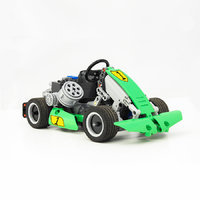 After a while without a new MOC (because of my studies ^^), I'm back with a new model! It was made for BuWizz. The aim was to make a model in the continuity of my cross kart. I wanted to get rid of the torque effect on the rear axle (as it was a suspended axle on my cross kart), that made the behaviour unsymmetrical in corners. So I used 2 BuWizz motors as wheel hubs instead! The rear suspension was made so the rear shock absorbers generate friction, in order to have a slow rebound. On my cross kart, the suspension was extremely reactive, but the kart was "jumping" on gravel. On this new buggy, having a slow rebound helps the wheels stick on the ground to gain adherence. However, I wasn't able to do the same thing on the front axle. Why a police buggy? I have never seen this before, I thought it could be nice. I wanted the design to be as agressive and massive as possible. I wanted the design to be close to Polaris or Can-Am, looking heavy, indestructible but fast in any situation. People had to fear seing it in their mirror. You may have seen that the main part of the bodywork was made with 2x5 panels. This was a very useful part to achieve the shapes that I wanted, and to have simple assemblies (no one uses complex building techniques). The BuWizz 3.0 has got 2 PF ports and 4 PU ports. The 2 BuWizz motors are connected to the PF ports while the PU L motor for the steering (acting as a servomotor) and the LED lights are connected to the PU ports. The performance is really great! It is absolutely impossible to use more than the half of the power into a house! And outside, the suspension works well. You can go almost everywhere without being stuck or loosing grip. I also had some crashes but nothing was broken nor fell apart! Little video: And the instructions! https://rebrickable.com/mocs/MOC-132106/Anto/police-interceptor I hope that you'll like this model, and see you soon for the next one!