Search the Community
Showing results for tags 'offroad'.
-
 Stranger Things Chevrolet K5 Blazer Model Info Size: 35L x 16W x 17H cm Weight: 997 g Parts: 1322 Video Features 4x4 Working V8 engine Opening doors, bonnet, tailgate Solid axle spring suspension Locking rear differential 2 speed gearbox Working steering wheel Instruction: https://rebrickable.com/mocs/MOC-267926/paave/stranger-things-chevrolet-k5-blazer
 -
9398 Sherp Another 9398 alternate MOC I made, for this time the "Sherp" offroad vehicle Check the video to see some fun drive! Video Features 4x4 L motor for each side drive Opening roof Modular construction Thanks @nico71 for the chassis fix tip, literally saved this project, all works fine now Roof cover opens for easy battery access Made it free style, so it's more like replica than a copy model Instruction: https://rebrickable.com/mocs/MOC-247166/paave/9398-sherp
-
 Hi guys! Today I am pleased to present new MOC - RANCHER 4x4. The basis of this model was a completely new chassis, the creation of which took me almost two months. The model is based on the support frame mounted with its two L motors, and a small battery pack. To fasten the frame of continuous two gantry axles - which significantly increases the reliability of the transmission. Servo motor is mounted directly on the front axle. As I chose the stake so beloved by all, but it is quite rare on the Tumbler wheel - 81,6x44 mm. I think this is one of the best wheels from LEGO, along with 94,3x38 from the Unimog. And I'll show you how to use it to modify the set LEGO 10248 Ferrari F40 :) Specifications and features: Four-wheel drive, portal axles uncut; Tires 81,6x44 (Tumbler) 2L motors - the drive motor; Servo motor - steering; 3xLED - lights; Small battery pack; Modular design - a body attached to the chassis by 4 points; Opened doors, hood and door body
 -
 Full Album: http://imgur.com/a/YdL5x Specifics: 4x L Motors RWD (Geared Up 1.2x) Full Independent Suspensions 6x Shock Absorbers 2x AA Battery Box 2x V2 IR Receivers Frontal Led Lights Differential Weight: 1250g (with batteries) The Idea is to create an Heavy-Weight Buggy with good performances using no expensive pieces (Buggy Motors, SBrick..). The final speed is acceptable, the torque has some difficulties in uphill but for the plain is sufficient, and the maximum speed is reached quickly. I called it Fury Road because it reminds me so much the style of Mad Max vehicles. I know it's a little be "naked" but I like it in this way. I putted in it some lateral exhaust pipes, a little spoiler, a cabin and some lights to improve the aesthetics. I tried to put the IR receivers in a position that seems a big engine that comes out. Hope you like it! ;)
 -
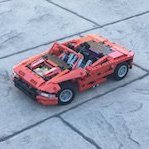 Current: Just scroll down, it's not that far! (Just kidding! This will be updated soon!) Hi! I have another WIP car that I am building! I am still not sure what to call it, but it kind of reminds me of the newer Toyota RAV-4. Here is the chassis and part of the front end! (Sorry for bad pic) I borrowed the shaping from my Supercar X for the front panels. It is powered by a buggy motor and a servo. The newer battery box with new batteries and V2 receiver work great with the buggy motor! Here is a shot of the rear suspension: Thanks for viewing! -TechnicRCRacer
 -
Hi, I've built a stupid simple truck. As you might have guessed already, it is largely inspired by iconic Soviet-Russian truck Ural. Driven by two L-motors and steered by a servo, it doesn't have any other motorized functions. The fifth wheel rotates in 2 dimensions and has a simple locking mechanism as seen in a recent 42078 set. However, I doubt it will function properly due to natural tendency to lean backwards under the towing force. Overall, this project is a failure. The initial goal was to built a 6x6 truck with differentials and none-ball-joints suspension. Although the goal was achieved, the front axle turned out to be a complete disaster. First, I had to swap a 6-link for a rather awkward system in order to make the front wheels steer for at least a bit . Second, this truck can't overcome even a tiny obstacle, cause the driving gear in the front begins crackle hysterically. This happens because I don't have the new 6145859 wheel bearing parts, so in order to fit the steering bar with the old ones I had to elevate the axle center 1 stud above the 5x7 frame. And the result simply do not sturdy enough to hold the affecting forces. However, I'm going to figure out a better design later in LDCad. Hopefully this MOC will mark my return to regular building, so I'm looking forward for your comments.
-
 I' ve decided to make an alternative model for 42054 CLAAS XERION 5000 TRAC VC set. I' ve wanted to design something different from all those excellent c models already made, so I made a truck capable of off-road conditions, with crane and many other functions. The result: Functions: rear axle drive with 4 piston engine steering live axle suspension side outriggers cabin tilting rear PTO (power take off) crane arm rotation crane arm 1st stage elevation crane arm 2nd stage elevation grabber closing/opening Please watch the video to see this machine in action and for more details. This model is powered by one m motor with rotation direction selection. It powers main selector, crane selector. and PTO. Main selector switches between worm gear powered functions and arm rotation. When worm gear functions are selected, there is another switch to choose between outriggers and cabin tilting. The crane selector switches between 1st and 2nd stage elevation. I had to use some interesting (I think) solutions because of parts selection in 42054 set: Piston engine There are no piston engine parts in the set, so i made them from some connectors. You can see it working in the video. Suspension There are no shock absorbers or wishbones too. So I' ve made a suspension based on twisting axles: Every wishbone is suspended independly. 3 of those connected to axle make a well-working long travel soft off-road suspension: Grabber There was a grabber in original set, but when building the grabber I've already used the worm gear for more important functions, so I' ve designed a different locking mechanism: Turning the green axle makes the red grabber frame move up and down and becouse of engaging the blue knob gear with h-frame opening and closing blue grabber. Instructions Instructions are already available here on rebrickable! I hope you liked this model.
 -
 LEGO Tatra trucks are dime a dozen, but whenever I see them, they are either very large, complex and sluggish, or they are small but don't really have the unique Tatra suspension, nor drivetrain, nor steering. So I set out with a simple goal: make the smallest Tatra model I can that has it all: the suspension, drivetrain and steering just like in the real Tatra truck. This is the result:
 -
A model I've been working for a little while, not much to show yet but pictures soon. 6x6 truck with locking rear diffs and 2 central diffs in the 6x6 drive making for a combination of power delivery choices, similar to the drive train of the mercedes amg 6x6. Using tires from 42054 so its, big near half a meter or so now. Rear live axel suspensions front independet fake v 10 soon to be geared in, possinble addition of 4 speed gearbox and 4 xl motors for drive. with fully rc gear and diff lock control and who knows what else?
-
 Hello! My latest MOC is a re-creation of unusual Jeep model. Jeep Mighty FC Concept -Weight: 2125g -2 XL motors for propulsion -Servo motor for steering -M motor for 2 speed gearbox -M motor for locking rear differential -M motor for winch -3 LEDs for front and rear lights -2 SBricks powered by one rechargeable battery box -Portal axles -Openable doors and tailgate -Shallow bed with fold-down sides -Detachable roof -Alternative tube doors The chassis is not realistic, but has decent offroad capability as heavy Lego model. My goal was to make a sturdy and powerful crawler having propulsion motors and gearbox on the center of its chassis. Which means the drivetrain contains two universal joints - weakest points - for transmitting the torque to front and rear live axles. To save U-joints from damaging, I adopted two stage reductions after differential on both axles. The gearbox is similar one to my previous FJ40 Crawler. I doubled the pair of 8T/24T gear for higher durability. High gear is three times faster than low gear. You may wonder why rear ball joint is connected lower than front. That is for avoiding body roll caused by high torque of hard-coupled XL motors. Seeing from the gearbox, the rear output rotates in opposite direction to the front one. So the front and rear axle are equally forced to rotate in opposite direction to each other. Thus the center chassis with heavy body does not easily roll left or right even when climbing steep incline. (...at least on paper. I admit the complete body is a little bit too heavy to prove the theory above.) Steering angle is good, but turning radius is not so good. Because of the lack of center differential, it cannot handle different rotating speed of front and rear axle in tight turning. On slippy surface, like in the video, it can be steered without any problem. Rear differential can be locked instantaneously. The role of 8T gear on top of red changeover part is to make a tiny gap between 16T clutch gear and driving ring in locked position. Thanks to the gap, 16T gear is not pushed against outer structure. That helps to decreasing the friction. Front winch is powered by M motor geared 9:1. I used two pairs of 8T/24T gear instead of worm gear. It is smoother and surprisingly powerful. The hook can be manually pulled out by switching the lever under right seat. The body looks a bit squarish comparing to the real Mighty FC. Maybe I could replicate trapezoidal shape of its cabin. But I thought angled pillars and roll cage would be wobbly. So I decided to build simple yet sturdy. Instead of realistic appearance, I managed to realize easily detachable roof and doors. Although the whole MOC is built for using Unimog tires, Claas tires also fit well. But the maximum articulation of axles would be smaller because bigger tires possibly touch the chassis and fenders. It would be necessary to limit suspension travel or slightly modify the chassis. I hope you will like it! I will make building instruction. But I have to finish the instruction of Pickup first.
 -
 Hey guys I wanted to test out the unimog suspension but I forgot how it was set up so I tried what i remembered of it into this buggy's rear axle: But I think I somewhat messed up What are the principles for live axles? And on a completely unrelated topic, does anyone have tips to make driven and suspended front wheel drive? Thanks Update: Just took it apart, probably gonna use the advice to make something better.
 -
Well, I was not really 100% happy with the buggy I made and in that post I asked for advice on drive axles. Unfortunately as I mostly only have old pieces (pre dark-ages) I could not make most of the suspensions So I tried one that I could use (I originally wanted to make a mini front wheel drive car) and made a mini car with what I could. I'm really proud of what has turned out, the truck looks like a jeep/hummer as is so freaking cute I designed the chassis so that the bodies are interchangeable. I think that a competition where everyone is to make a body for one type of chassis would be really cool, but i'm not famous so it seems far fetched Thanks guys, <forgot to add> The reason this car is a little slow is that my family forced me to purchase rechargeable batteries meaning that the output is 7v not 9v. I would get a buwizz but that is expensive
-
 Hello everybody! This is my first post on EuroBricks! My Flickr: Silvavasil_Lego Jurassic Park Jeep PF: Light - Servo -Lipo - XL LDD: Jurassic Jeep Instruction Look and like my Jurassic Jeep on Rebrickable please! ;) This is '90s Jeep Wrangler from legendary blockbuster Steven Spielberg's "Jurassic Park" As a child i feel in love with this movie. Now i have put together two of children's hobbies - lego and dinosaur!) This is lego technic rc MOC Powered by Lego LiPo battery, remote control drive and steering (XL & servo motors) all wheel drive, suspension, working headlights, opening doors, hood and tailgate, and a folding windshield. Photo by me too) Adventure 65million years in the making! Good text from the Brothers Brick: Incredible LEGO Jurassic Park jeep looks right at home in the jungle And Lego Car Blog: Jurassic Jeep
 -
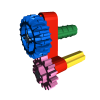 I'm not really a regular truck builder, but I like to think of new systems that do not exist in real life yet but that do improve the life of, for example, truck drivers. When something like a big tarmac machine has to drive onto a trailer to go to the next building site, the slope of the trailer should be very small. That small slope is nowadays achieved by making very large ramps that fold up vertically for transport, causing massive air resistance and therefore unnecessary fuel consumption. A way to make these ramps shorter is to decrease the bed height, because that asks for smaller vertical ramps. The second option is making the wheels below the bed smaller. But decreasing the wheel diameter increases the rolling resistance. Another way to solve the problem is placing the bed betweeen the wheels, so that it can be much lower, but that limits the cargo width: the tarmac machine can never be wider than the bed width, which is not handy if truckdriver x has to transport many different tarmac machines. Read the rest of the story and how I solved these problems with my my DAF CF with 3-axle trailer on http://mocpages.com/moc.php/421622 Or watch the video here: To give an idea of the model, I have posted one photo below, the others can be found on http://www.brickshel...ry.cgi?f=560197 in a better resolution.[/font][/size]
 -
Hello! Today I am pleased to present to the general public of the two brothers - Lego Technic Suzuki Jimny Trial Custom and Lego Technic Suzuki Jimny Trophy Custom. They are united, above all, not just a long name, but also a common chassis, all-wheel drive and compact size. I was inspired to build a Suzuki Jimny sample 2001-2010 years. They are often prepared to take part in various off-road competitions, and that I thought - why not? And that's what came out of it. Enjoy ;) Models are made in the off-road style, and have all its attributes - extra lights, safety railings, stingers high clearance More photos and building instructions you can find on my lego technic blog here
-
We all know that the Dark Knight has a Vehicle for every Terrain and for each Environment. Now he also have one for Offroad Purposes.With those large Steel Panes he can plow through everything and the sharp Angles of the outer Shell was inspired by Stealth Bombers to obscure Batmans Ride from the Enemy Radar. Hope you like my newest Creation... I know,a Batmobile needs Fins,but i think they would just destroy the overall Look. I made the Car in yellow,black and grey to match the Microfighters Batman. Maybe the Roof will be switched one Day (because i need it for another MOC)
-
Hello everyone! Since TLG released 76023, I had been waiting for affordable Technic set which includes so-called Tumbler Tires. So I jumped at 42050 Drag Racer. I also bought some extra tires separately, then revived old project which had failed three years ago. Avtoros Shaman 8x8 Building instructions: Rebrickable Weight: 2550g - 4x L motor for 8 wheel drive - 2x Servo motor for 8 wheel steering - M motor for switching steering mode (AWS and crab) - M motor for winch - 3x LED for front and rear lights - 2x SBrick powered by 2x 8878 rechargeable battery box - Independent suspension for all wheels - Working steering wheel - Openable hood, doors and roof hatch Back in 2013 As you may know, real Shaman is which can go through almost any kind of terrain. It has three steering modes and can scale 45-degree incline. On top of that it is amphibious. Seeing pictures and videos, I instantly fell in love with it.When I started the project, I was too ambitious to realize all features above. Sadly I could not build even steering mechanism while keeping all wheel drive and independent suspension. So I changed the project to building another 8x8 vehicle. It ended up as my Tatra 813 Trial Truck, but that is another story. Focus on characteristic features Two months ago, I suddenly came up with an idea that enables both normal AWS and crab steering. In the case of four-wheeler, you can do it by switching rotation of second Servo motor for rear axle. But in eight-wheeler like Shaman, you should change turning radius of second and third axle. In normal mode, the steering angle of inner two axles is smaller than outer axles. But in crab mode, all axles should be steered at the same angle. This is the basis of steering idea. I used the way of fixing/moving pivot of steering linkage. A: There are two 7L steering racks connected to 7L beams. Front rack is connected in the middle of beam, rear is one stud backwards. Both ends of beams are connected to steering arms of each axle. B: In normal mode, rear rack is fixed by 12T bevel gear. So the fixed pivot of 7L beam is its 5th pin hole. Which makes front end of beam moves twice as rear end does. That means the steering angle of 1st axle is twice as 2nd axle. C: In switching crab mode, 12T bevel gear moves one stud forward and fix front rack. Fixed pivot is 4th pin hole of beam. Which makes both ends of beams move equally. That means the steering angle of 1st axle is the same as 2nd axle. And there is one more twist. D: I put main steering rack (moved by pinion gear) on one stud forward of 7L beam's front-end (which means 9L beam’s front-end). Seeing from the pivot point, this rack is connected to farther than the point of front steering arms connected. So front steering arms always move slightly shorter than main rack does. When Servo fully turns 90 degrees, pinion gear moves the rack in one stud sideways. Steering arms move less than one stud. This was necessary for keeping CV joint (connected to steering hub) rotate smoothly even when fully steered. Challenge and compromise First of all, this MOC is NOT amphibious. It is too heavy to float. And because of driving motors of low position, chassis is not waterproof at all. So it is not recommended driving it through even shallow water pool. My aim was to achieve decent crawling capability. But I had to lower the bar because there was no room left for portal/planetary hub reduction. Without them, heavy load from 81mm tires directly goes to 12T half bevel gears. First attempt was using two XL motors geared 25:9. I put each motor for left/right side of axle. The result was unsatisfied. Even when climbing over small obstacles, bevel gears often slipped and got damaged. So I replaced them with four L motors geared 3:1. Each one drives a pair of half axles. Thanks to their good speed and smaller torque, new drivetrain proved to be more reliable. Although bevel gears were still slipping a bit, I accepted overall performance. The picture above shows two L motors for driving right side of axles. The power functions switch for changing rotation of rear Servo motor is synchronized with moving steering pivot mechanism. In crab mode, rear 4 wheels steer opposite the same direction as front wheels. As always I used few of non-Technic parts. Big roof tile was used for saving weight, curve slope parts were better choice for filling the gap. LBG axles sticking out the roof are visible indicator for steering mode. They are mechanically connected to switching mechanism. In the video you can see how they work. Instructions available at Rebrickable. Building it in red is possible by using red parts instead of white. I hope you will enjoy building!
-
Well Guys, i finished my newest MOC,the well known red Pickup from GTA V Character Trevor Phillips.The Canis Bodhi might be one of the most iconic Character Cars from GTA V because it`s a unique Vehicle and it has an interesting little Feature mounted on the Grill. Yes,Trevor had some good Times with Mr. Rasberryjam so the little Bear has to come everywhere. I tried to recreate the Car as good as possible and even added some Gimmicks like a Gun, a Shovel (to dig Holes for Bikers) and an Axe for....well chopping Stuff to Pieces. I also tried some detailing under the Car like the Driveshaft and a Pair of Exhausts. To complete the Pickup,i also tried to make two Minifigs of Trevor himself and Nervous Ron. I hope everyone likes my newest Creation,feel free to Comment and Like. 20161110_154908 by Christian Weber, auf Flickr 20161110_154924 by Christian Weber, auf Flickr 20161110_154931 by Christian Weber, auf Flickr 20161110_154946 by Christian Weber, auf Flickr 20161110_154957 by Christian Weber, auf Flickr 20161110_155029 by Christian Weber, auf Flickr 20161110_155038 by Christian Weber, auf Flickr 20161110_155054 by Christian Weber, auf Flickr 20161110_155119 by Christian Weber, auf Flickr 20161110_155137 by Christian Weber, auf Flickr 20161110_155434 by Christian Weber, auf Flickr 20161110_155442 by Christian Weber, auf Flickr
-

[MOC] Rock Crawler
Dalafik posted a topic in LEGO Technic, Mindstorms, Model Team and Scale Modeling
Hi, I haven't posted anything here for a long time, because nowadays I build very rarely due to health issues. But finally I managed to complete this model - the Rock Crawler. The idea was to improve the perfomance of the 9398 set while retaining the same power scheme: a L-motor on each axle for driving and one servo to steer both axles. I also wanted to bring model's appearance closer to reality (9398 looked more like a monster truck to me). However I wasn't sure until the last brick placed if fixed gear ratio 5:1 would be enough to achieve rock crawling capabilities. And, as you can see in the video below, it seems that the model is slightly heavy for this setup. Well, at least it looks like a proper rock crawler (note: the overall simplicity of design and heavy use of panels was determined by the effort to keep model strong). Oh, and that black panel 5x11 at the back should be white (no more left in my stock). So, what do you think about it? LDR file can be obtained here (please read notes there before downloading). And some more pics: -
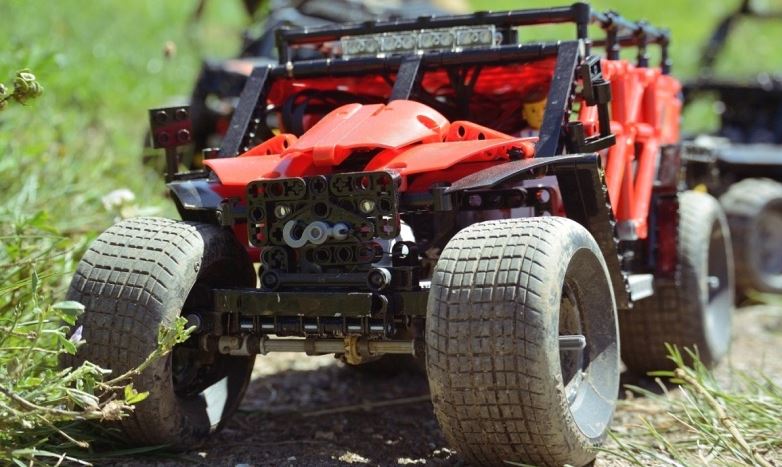
Hello Eurobricks AFOLs, I am Engine and this is my first post here on EB forum. My friend HorcikDesigns told me, some of you here want to know more about my last MOC. My pleassure! Original Vehicle: As some of you noticed, my MOC should be scale model of Ghe-o Rescue. It is a Romanian rescue vehicle designed for extreme terrain, with a capacity of up to 11 people. Dimensions are: 5.2 m length; 2.7 m width (even wider version exists); 2.4 m higth (without rooftop carrier). The weight is 3.2 tons. Under the bonnet, more engine types can be monted, with the most powerful one with 500 hp. Live axles are used for suspension, both equipted by lockable differentials. There are also built-in water tanks for 620 liters for fire extinguishing. Another specialty is the possibility to mount tracks to rear wheels or pneumatic "pillows" on wheels for floating on water. Tires are also special. It is Arctictrans 1300x700-24 (diameter 1300 mm and width 700 mm). The manufacturer shows off an independent test in which they won over Avtoros and Trecol manufacturers. Here you can see several cars built on them. And because the tire diameter and width exactly match the 1:16 scale to the LEGO "Tumbler" tires Ø81.6x44, the scale of the model was decided. So far I do not know any other LEGO cration of Ghe-o Rescue. MOC: The MOC was designed for Kostky.org Trophy Competition, organized by our technic race event guru Peter. And the task was to build a drivable, remote-controlled, off-road vehicle that would be able to travel about 3 km. And at the same time, it should be as beautiful as possible and with design matches to original vehicles. Terrible task. The dimensions of the model are: 332 x 168 x 168 mm (41.5 x 21 x 21 studs), weight 1.2 kg. The drive is permanently 4x4 without differentials. Axles are not sprung. But thanks to the torsionally soft frame of the vehicle, decent axle crossing is achieved (some LEGO trial experience here). Inside, there is a functional winch with a length of 2.5 m. Good lighting is a necessity for the expedition special. The control is provided by sBrick. The propulsion is made by 1 x PF XL motor with a total gear ratio of 1: 1. Schizophrenic steering is provided by the PF Servo. The winch is driven by a PF M motor via a worm gear (8: 1 ratio). Five pairs of PF lights really shine in front of the car. Electrical source is a battery box with 6 AA batteries. The whole MOC is pure LEGO exept of: sBrick receiver, high strength thread as winch rope, threaded cardans and event mandatory stickers. Drive ability: Drivig speed corresponds to a pleasant walk. Off-road capabilities were adequate to the track. Tire traction did not limit offroad capabilities, but a small power of e-motor did. Then the winch becomes useful, that is able to lift the entire weight of the vehicle. And if it was still not enough, the other "competitors" were there to help. A minor issue was the steering. Thanks to the loose in steering mechanism and occasional insensivity in the mobile app, sometimes I sent it out of the way. A major issue was energy consumption. Within 1.5 km, I drained out three sets of batteries (2x alkaline GP Ultra Plus, 1x rechargeable GP 2700). And yet I do not know how to solve it. But most likely it is caused by PF Servo motor, as we disscussed after the event with other partipiciants. ----- Thank you for comments and questions. Pictures are here in my gallery. Original post on Kostky.org.
-
I' ve made a scale model of this russian all terrain vehicle. I've tried to make it as detailed as possible. Video: Functions: - 4x4 driveshaft with differentials (XL motor) - Steering: brakes that block wheels on one side of the vehicle. (M motor) - Working differential lock (M motor) - Working LEDs - Tires from 42054 - Openable front and rear hatches and windscreen, working wipers Everything is controlled remotely using SBrick. The drivetrain with differentials and portal axles: The steering mechanism is, I think, more interesting. Wheels on one side of the vehicle may be blocked using the driving ring. Than differentials transmits all the power to wheels on the other side. (that red connector represents driving ring) And the differential lock. The driving ring connects right and left differential outputs. And photos of side without wheels and the underside: Please watch the video to see this machine in action and for more details. I hope you liked this model.
-
 Afte the success of the Jaguar XJR19 Le Mans prototype (of which I will still to the photos of the complete model, and instructions) I decided to do a new WIP. Again it's a model I've prototyped over the last month and will now do the second, hopefully better buildup. And again, I will use a photo of an existing vehicle as my inspiration, but it won't be an exact scale model. I use the photo as inspiration and will deviate where needed for the functions (and it will be needed, because i want a 4-function switch box similar to 8258). It's this truck. It's called Foremost Delta 3 Wheeled Carrier and it seems to come in several configurations, one of which has the crane below. On this picture, it's not finished, because outriggers seem to be missing. Several other pictures of the same model show that it has one set of outriggers near the crane. My other source of inspiration will be set 42070. I want to make something with a similar size, which will be in a way "my own take on that set's theme", i.e. "off-road truck with crane". (That's all I will use from that set). So I'm thinking of something in the range of about 2000 pieces. (In practice though, it will always turn out to be more.) Another thing: the colors will be very different. My first prototype was obediently yellow, but when I arrived at the cabin I wanted to deviate a bit, so I threw some less-used colors in the mix, and went for Dark Turquoise with Black for the cabin, and consequently also for the crane and bed. The chassis will be Dark Gray and for the body I am torn between Yellow and Red (main reason being the colored axles I want to use, for example for the ladders). I will be copying the crane from 8258 (with different colors), because that one seems perfect for the scale and type. But everything else will be different. I will be using Tumbler wheels. The profile is not exact but the shape and size seems fine. Also, currently I have only 4, so I will temporarily be using someting else for the front (interestingly, the Porsche wheels have the same diameter and width). I started with two important modules: The one on the left is the 4-function gearbox and crane base, and the one on the right is the rear axle unit. What I like personally is how a 4-way gearbox and outriggers using the new gear rack pieces introduced in 42043 fit in a pretty compact module. Here's the gearbox unit from below. The dark-gray axle joiner is the motor input. I plan on using my newly acquired L-motor. Here's the rear-axles module: Each axle is mounted on two 1x5 suspension arms and two 1x6 links. These 4 keep the axle in place and nicely horizontal. The free ball-sockets near each wheel will connect to the springs. Also, as you see, with the parts used, doing this part in dark-gray seems impossible... Of course, the 15L beams will be replaced by the chassis. It will be a challenge to get this strong though, because the gearbox module has some gears in the way, so little room to connect things firmly. The functions I want to have: Manual steer and drive (so no RC) Electric crane rotation Electric crane first boom element Electric crane second boom element Electric outrigger horizontal deployment Manual outrigger vertical deployment (similar to many sets) Suspension It's not as impressive as 42070's six electric functions in three modes and four nice large-range outriggers, but instead of that, this will have suspension. Next up will be connecting the two modules, and doing the front axle and steering modules.
 -
 Hello everyone. This is my first MOC that I am not ashamed of showing;) Ural 4320 on a shortened 4wheel basis. - 2 XL paired for driving - m motor for steering - m motor for 2step gearbox - m motor for rear differential lock - openable hood and doors - live axles with portal hubs - flexible flat body-chassis - powered by Buwizz 2.0 Total weight is 1800g. Length - 0,52 meters. Width - 0,26 meters. The idea was to make a trial truck in a bigger scale but still capable of handling heavy offroad. The model was inspired by Madoca's Jeep Concept and has the same general idea. Including paired 24x8 low gear and a 16x16 fast gear. Plus the portal hubs. But it is 4 more studs wider and ~10 more studs longer. It has live axles and a flexible body which results in a really stable construction. As of a few hours of heavy outdoor testing it didn't roll over once. As it was the first MOC I focused on the functionality rather than on design. Feel free to give me a punch for scarcity of design;) It looks odd but drives really well on a low gear. On a faster gear the 2 paired XL motors start chewing on the gears while offroading, On the flat surface it's fine though. Originally it just had a straight m motor to the 8x24 gear for steering, but due to heavy tension the gears or the motor were going off its clips. So I decided to make a steering through the small line actuator fixated in every possible way. As a result it was super sturdy and stable. The chassis (looks pretty compact without tractor wheels): Gearbox: Hope you like it Let me know what you think of it!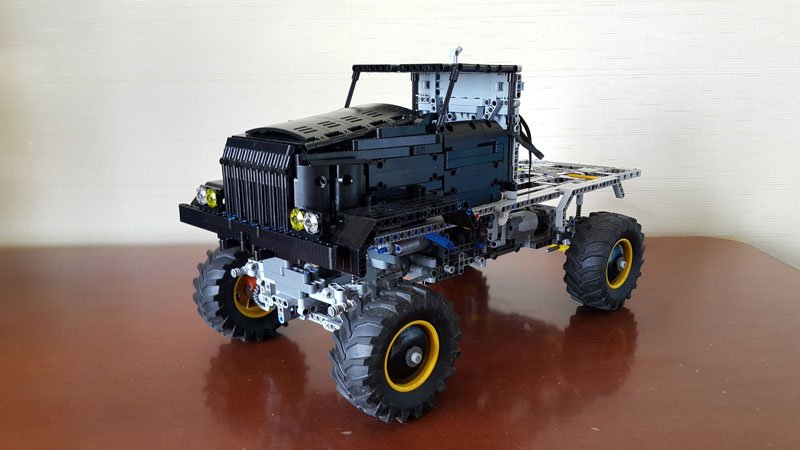
-
 Hey Everyone! Here is the successor to my Lego Technic Chili Crawler, the Cactus Crawler It took about half of a year of design and revision to reach its current state, of which I am proud of. THE VIDEO: youtube Features: - 3 L-Motors for drive (two in the rear axle, one in the front) - M-Motor and a small linear actuator for front steering - Rigid, triangulated 4-link suspension for the front axle, with large, soft, black shock absorbers - Extremely rigid 2-link rear suspension with ball-joint pivot point on top of the axle, similar to that found in the RC "Mantis" crawler - 100% Lego-legal custom curved rear links that, with how the main cab is shaped, provide exceptional ground clearance towards the rear of the crawler, allowing it to climb up relatively large vertical structures such as street curbs - Very minimal, light bodywork - BuWizz for extra power and SBrick for a great, custom control scheme Note: By the time I finished designing the cab and it's battery enclosure, BuWuzz had not yet come out with the update for their iOS app that allows a single joystick/slider to control multiple outputs, so I was forced to use an SBrick with the BuWizz, providing the extra power from the BuWizz, but with the ease-of-use and great custom control profiles of the SBrick. When used with the SBrick, the BuWizz does in fact still provide more power than the standard Lego 8878 LiPo battery box. - RC4WD 1.9" Krypton scale tires - Two green pieces so that I can call it the Cactus Crawler ;) LXF hopefully coming soon, the tires can easily be found with a quick google search of their name. YES, I know, there is no body. This is meant for performance, meaning I made the cab as small, light, and rigid as possible. I will be able to reply intermittently throughout the day. I figured I'd put this up now anyway! pt
 -
 Hi, ___ EDIT __________________________________________________________________ __________________________________________________________________________ HERE ARE INSTRUCTIONS FOR CURRENT VERSION: (description later in this topic) https://rebrickable.com/mocs/MOC-28281/Horcikdesigns/offroader-for-overland-adventure/#bi ___________________________________________________________________________ ___________________________________________________________________________ This is my latest attempt at building offroad car. JEEP Wrangler Expedition by Horcik Designs, on Flickr Introduction and Motivation I built it for the Kostky.org TROPHY, adventurous event and AFOL meeting that is inspired by Camel Trophy series, and was held by Kostky.org (CZ+SK LUG) at 5th August 2017 for the very first time. It was awesome day, and I hope that there will be more. Here is the the official video from the event. There were really great cars there. The car itself The car was built to fit the rules of the competition. That means reserve "fuel" in the car during whole race before refuelling, remote control (no wire connection between truck and controller, S-bricks allowed) and representative appearance. So I decieded to go with the force, and installed two XL motors for the drive, geared down in 3:5 ratio, and two L motors, each for the winch (1:8) and steering (mini LA). I also reduced gearing to the minimum, due to minimal energy-consumption. (I nearly did the whole race to single Li-Po BB) The car is not perfect, it is very heavy (approx. 1500g), so it does not allow to use CV joints in the front axle for smooth wheel rotation. They managed to withstand the race, but in the finish (before the big uphill from the first video) they were strongly damaged, mostly because of big steering angle. Well, I hope that the video will say enough, if you have any questions, feel free to ask me. :) Photos: JEEP Wrangler Expedition by Horcik Designs, on Flickr JEEP Wrangler Expedition by Horcik Designs, on Flickr JEEP Wrangler Expedition by Horcik Designs, on Flickr JEEP Wrangler Expedition by Horcik Designs, on Flickr JEEP Wrangler Expedition by Horcik Designs, on Flickr