Search the Community
Showing results for tags 'train'.
-
My attempt at a Highspeed bullet train was based on the usage of an aeroplane nose and some minor parts of it. Based on ideas of the Shinkansen 0-series. 1 - engine-passenger (2-second class) 2 - passenger (1 and 2-second class) 3 - diner-car (as some bonus wagon) Link to Bricklink Stud.io preview and download
-
 For this MOC (my second attempt at this subject!) I have taken 2023 Harry Potter set 76423 - Hogwarts Express and Hogsmeade Station - and modified the steam engine portion of the set quite a bit. I stretched the model out a bit into a 4-6-2, specifically Gordon from the Thomas and Friends TV show / The Railway Series books. In fact, I changed so much of 76423, that there isn't much of the original engine left! The four passenger cars are in the style of 2009 set 10194 - Emerald Night, but are four studs shorter and in the colors of the 2026 CITY set 60511 - Vintage Train. Each car has a removable roof and inside seating. The car closest to the camera is a brake coach inspired by this Rebrickable MOC. Gordon in both books and TV show is based on the London and North Eastern Railway A1 steam locomotive class. The last real world survivor of the A1 / A3 type in the real world is Flying Scotsman (LNER loco Nr. 4472) which is Gordon's brother in both written and visual media. The rear of the loco. The tender is my own design, and uses a sliding center wheel to keep it from binding. These are three identical express coaches. All the doors of this train open, and the middle roof sections come off for access to the inside details. Here is the brake coach, where passenger's baggage is stored and the guard has a bit of space to rest and keep an eye on the train's progress. The three coaches have identical insides, and the brake coach is mostly the same, up to the halfway point where the luggage area and guard's seat are. Thoughts?
 -
Here we see Henry the green engine running along the line pulling the Flying Kipper fish train, as seen in the Railway Series books and Thomas and Friends TV show. This train consists of five goods vans filled with fresh fish, and a break van for the conductor. Before anyone says anything: Yes, I know Henry is in his post-accident shape, which is inaccurate for the specific story that introduces the Flying Kipper train. However, as Henry regularly pulls the Kipper after his rebuild, this isn't really a issue. To create Henry in his latter form from the Thomas and Friends TV show / The Railway Series books, I took set 76423 (Hogwarts Express and Hogsmeade Station) and modified it quite a bit. I revised the boiler design, added two plates to the cab height, devised working pistons, up-sized the front bogies' wheels, and changed around the tender a tiny amount. Recently I rebuilt his front bogie to be a bit shortened in length, along with the area around the headlamps also being shortened. The rear of the tender, which now features a sliding center wheelset, which makes it much easier to roll compared to the old, fixed-in-place 4.5v / 12v era wheels I originally used. The doors on the five identical goods vans can open to load things inside. Just a regular British break van from back in the days of steam. There's not much else to say about it, really... Thoughts?
-
Well, it's that time of year again and with the new 60508 Police Train Heist just leaked, I suppose it's time to start this thread. Here's the usual list of recent years' sets - 2019-2021 have been removed as all sets from these years have now been retired. Standard Train Sets 2026 60506 Beachside Tram 60508 Police Train Heist 60509 Harbour Freight Train 60511 Retro Steam Train 2025 10361 Holiday Express Train 60470 Explorers' Arctic Polar Express Train 60469 Central Train Station 2024 60423 Downtown Streetcar & Station 2023 21344 Orient Express 76423 Hogwarts Express & Hogsmeade Station 2022 60335 Train Station 60336 Freight Train 60337 Express Passenger Train 76405 Hogwarts Express Collector's Edition 10308 Holiday Main Street (trolley/tram) 2018 75955 Hogwarts Express 60197 Passenger Train 60198 Cargo Train 60205 Tracks 60238 Switch Tracks Sets in bold are those confirmed for 2026 Sets with a strikethrough have been retired Sets in italics are ones expected to be retired in 2026. Let me know if I've missed any! Bricklink Designer Program Train Sets At least one train set is confirmed in the Bricklink Designer Program, but that has its own thread elsewhere in the Train Tech. Discuss below, and as usual @JopieK maybe pin the thread?
-
This UK style train station is inspired by 2023 Harry Potter set 76423 - Hogwarts Express and Hogsmeade Station. I added a back to the building, changed up the color scheme from red to green, added a removable roof and second floor. (The reason I added second floor to the model is a nod to Goathland station - AKA the first station to be used as Hogsmeade Station in the Harry Potter films.) The station's location name of St. Cleve is fictional - there is no place with that name anywhere in the UK, although I can't take credit for it: I got the name from the cover art of the 1972 Jethro Tull album, 'Thick as a Brick'. The platform side of St. Cleve railway station, which features: twin benches, two lampposts, a couple trashcans, and a few fire buckets. There is also a clock and arrival / departure board mounted to the wall. The street facing side of the station with phone box and statue of a local historical figure. The Stationmaster's office is on the second floor, and features a desk with swivel chair, coffee maker, and fireplace. The ground floor features a bathroom on the left, ticket counter in the center, and on the right is a luggage holding area with each part having features such as toilet and sink in the bathroom, counter and cash register in the lobby, and various crates in the luggage area. A clock and fireplace are also on this level. This classic K6 type telephone box is placed right outside the station. It is inspired by the one in 2022 set 76403 - The Ministry of Magic... but unlike the one in that Harry Potter set, the inside of mine can't fit a minifigure. All the separate sections of this MOC, together with minifigures of the station master and ticket agent. Thoughts?
-
I usually only post “finished” MOCs on Eurobricks. Today, I’m making an exception. This topic came up in another thread, and I don’t want to hijack that thread. So I’m starting a “work-in-progress” thread here for my truck loading project. I've been building a lot of little RC trucks over the past two years, even though I'm actually a Lego train enthusiast ;-) But of course, I don't do that without a backdrop.... My goal is to establish a functional system for loading trucks onto trains based on the system developed by the French company Lohr: Modalohr Okay, it sounds like a pipe dream, and it is. I came up with the idea in the summer of 2023. I started by experimenting a bit with the train cars and then focused on the trucks in 2024. My project history: First prototype of the waggons (Sommer 2023): First test run waggons (version 1.0) at BSBT 2023 with "dummy" Trailers: Prototype test truck (Autumn 2023): finish first trucks (Version 1.0) and trailers in spring 2024: rework waggons (Version 2.0) (autumn 2024): public test run for the waggons at Bricking Bavaria 2024 in Fürth / Germany (November 2024): Start of terminal technic development (winter 2024/2025): Start of building the terminals (winter/spring 2025): 4 Terminals with one side road almost done (spring 2025): first public test run at NLGM 2025 in Wörrstadt / Germany (April 2025) Construction of the entire road, the second terminal street side and the access ramp (Summer 2025): Second public exhibition at BSBT 2025 in Schkeuditz (August 2025): Video: After the first exhibitions, the technology was revised. First for the trucks (Version 2.0): improved steering, shorter wheelbase (Autumn 2025): and then I equipped all the Technic functions in all four terminals with worm gears and made them stronger and more stable (Winter 2025/2026): That was a quick rundown of the project's 2.5-year history ;-) If you’d like to know more about specific areas or topics, please ask—I’ll be happy to go into detail. The project isn’t finished yet; I’m hard at work building the truck and trailer. The next exhibition is the NLGM 2026 in Wörrstadt, Germany, in late April/early May. Thomas
-
This Santa Fe passenger train has been sitting around long enough that I thought I should get pictures taken and uploaded. So, without further ado, here is my Warbonnet styled Alco PA / PB led passenger train. Note: Please pardon the dust in some places.... as I said, these have been sitting out a while. These engines has been around in one form or another since 2011, when I saw a MOC of a freelance diesel by user 'valgarise', which you can see here. I made my own version of the MOC with an added B unit in black / red in 2012, but it was eventually (2017?) remade it in green and black instead. This previous version was disassembled in 2024 or so, and now I redesigned it totally to better match the actual Alco styling. With this latest update to the MOC, I added a sliding middle axle to each bogie, and a Warbonnet style paint job inspired by set 10020 - Santa Fe Super Chief - from 2002. The rear of the two units. They aren't perfectly aligned with the Alco style, but it's as close as I could reasonably get. The cab roof comes off to place a minifigure at the controls. (This is the only play feature on any of these models.) The baggage car. Three identical coaches. The observation car. The whole train together. (I apologize for this crappy picture, but I don't have a layout right now, and my available free space isn't big enough for the whole train to be on tracks.) Thoughts?
-
These two diesel locomotives of the fictional Allegheny and West Virginia Railroad (AWVR) are the star engines of the 16-year old 20th Century Fox film 'Unstoppable' which is itself loosely based on a real event from 2001. (this event just had it's 25th anniversary on May 15th of 2026) I'm' not going to get into the issues of the film and it's lack of realism in certain areas. *cough cough 'Stanton curve' climax sequence* I'm just here for the LEGO MOCs. Speaking of which, here's the breakdown on what's what with these MOC's, but please note - they aren't meant to be hyper-accurate models, but more CITY play-scale versions of their film counterparts. As usual; for me, both of the models are unpowered as well. This is the runaway locomotive from that film, 777, (otherwise known as 'Triple 7') that the two lead characters are trying to catch up to in their engine. (1206) Triple 7 is based on 2026 LEGO set 60508 (Police Train Heist). Being a brand new LEGO set it uses a lot of new parts not available in my last-updated-in-2019 LDD program, so it was very interesting designing the loco that way - it looked more like Swiss cheese than a train at some points with all the holes I had to fill! I updated the livery to match 777 as much as possible, though the windscreen should really be red - but there is zero chance of that happening due to it's absurd price! The rear of Triple 7. This is the locomotive driven by both Denzel Washington and Chris Pine's respective characters in their effort to stop the freight train led by 777 by coupling onto the rear of the runaway's consist. The LEGO model of 1206 is a real hodge-podge of ideas and sets. First there is the color scheme of 2014 set 60052 (Cargo Train), the cab from 2004 set 10133 (BNSF locomotive), bits of 2011 set 10219 (Maersk Train) and the same bogies from 60508 (Police Train Heist) as used on 777. The rear of 1206. Thoughts? UPDATE 5/19/26: Real world pictures added of the locomotives, with freight cars to come later next week.
-
Trying to make a steam train with a train motor as a base of motion. With mostly common and cheap parts (I hope) Type-442 'Cobalt' from BrickLink Studio [BrickLink]
-
-Mini.thumb.jpg.03594ed3626ab4a4b625a32af4d03d5f.jpg) (Click to skip to the post with the latest photos) The Backstory: For years I've wanted to be able to display my 12v collection at shows/exhibitions/libraries or wherever, but the wiring is a challenge - I reckon on my last full layout there was 250 to 300 feet (75-90 metres) of the stuff, which on a static layout is one thing, but one built in modules for transport is a challenge. Three or four months ago I came up with a solution (more on that below) and the dreaming started. After much playing in Bluebrick, and nostalgic posts appearing here about older era trains, I settled on a plan. I still had a bunch of my old blue track from the 4.5v era, but no motors. Off we go to Bricklink then! The Layout So, here's the plan. Ten years ago I had a small portable layout on 4 modules, each 3x5 baseplates, and over the years have simply added more of these. Following my Bricklink spree, I now have 2 working 4.5v motors, so rebuilt the loco from set 183 and I have the loco from 7720 in progress. These 2 will feature on the 4.5v loop below, which is 3 of those modules. Next to the 4.5v loop will be the showpiece, the main 12v loops. 12v Lower by andyglascott, on Flickr And on the right of the layout will be the 9v loops. Unlike the other 2 eras, I will have 9v track left over, so this is likely to be expanded in due course, particularly as @michaelgale releases motors, power supply etc. 9v Loops by andyglascott, on Flickr Lastly, there will be another 12v loop, elevated, which will run across the back of all three eras. 12v Upper by andyglascott, on Flickr Putting all of those together looks like this (the white baseplates are roughly where the mountains, tunnels etc will be for the elevated sections. The green and grey sections are simply so I could keep track of where the 3x5 modules were to try and avoid having curves/points on more than one module. When it all comes together, in most likely a couple of years, I'll be able to run 6 trains at a time. Whole Layout by andyglascott, on Flickr The Beginning After all the planning, and clearing away of my last (incomplete) layout, I've finally started building the first module, part of the 4.5v loop. I decided to start here as this will be the quickest era to build, and to a large extent, each era can also be displayed as a stand-alone smaller layout. These three modules will be countryside/farmland, and the trains will reflect the farming side of it when they get built. Module 01 Pic 02 by andyglascott, on Flickr The 12v Wiring The solution that I've come up with is fairly simple, but does involve taking a drill to some baseplates.... At each of the 12v points or signals I'll drill a small hole through the baseplate and the wood for each module, thread the wire through and attach either the original Lego plugs or a quick connect/release plug/connector so that when the layout is set up I'll use already measured lengths of wire to go from that point to the control panels, which will be on their own module. This is going to be a heck of a journey, and build, I'll post updates from time to time, particularly at landmark moments such as completing an "era". I always said, growing up, I was keeping my Lego for my kids. It was really only an excuse, and I'm really glad I didn't sell my old blue track even though I didn't, for years, think I'd use it. Sadly my original 4.5v motors, battery boxes, lights and even signals are long gone, but I was only 7 or 8 when I got 7720....
(Click to skip to the post with the latest photos) The Backstory: For years I've wanted to be able to display my 12v collection at shows/exhibitions/libraries or wherever, but the wiring is a challenge - I reckon on my last full layout there was 250 to 300 feet (75-90 metres) of the stuff, which on a static layout is one thing, but one built in modules for transport is a challenge. Three or four months ago I came up with a solution (more on that below) and the dreaming started. After much playing in Bluebrick, and nostalgic posts appearing here about older era trains, I settled on a plan. I still had a bunch of my old blue track from the 4.5v era, but no motors. Off we go to Bricklink then! The Layout So, here's the plan. Ten years ago I had a small portable layout on 4 modules, each 3x5 baseplates, and over the years have simply added more of these. Following my Bricklink spree, I now have 2 working 4.5v motors, so rebuilt the loco from set 183 and I have the loco from 7720 in progress. These 2 will feature on the 4.5v loop below, which is 3 of those modules. Next to the 4.5v loop will be the showpiece, the main 12v loops. 12v Lower by andyglascott, on Flickr And on the right of the layout will be the 9v loops. Unlike the other 2 eras, I will have 9v track left over, so this is likely to be expanded in due course, particularly as @michaelgale releases motors, power supply etc. 9v Loops by andyglascott, on Flickr Lastly, there will be another 12v loop, elevated, which will run across the back of all three eras. 12v Upper by andyglascott, on Flickr Putting all of those together looks like this (the white baseplates are roughly where the mountains, tunnels etc will be for the elevated sections. The green and grey sections are simply so I could keep track of where the 3x5 modules were to try and avoid having curves/points on more than one module. When it all comes together, in most likely a couple of years, I'll be able to run 6 trains at a time. Whole Layout by andyglascott, on Flickr The Beginning After all the planning, and clearing away of my last (incomplete) layout, I've finally started building the first module, part of the 4.5v loop. I decided to start here as this will be the quickest era to build, and to a large extent, each era can also be displayed as a stand-alone smaller layout. These three modules will be countryside/farmland, and the trains will reflect the farming side of it when they get built. Module 01 Pic 02 by andyglascott, on Flickr The 12v Wiring The solution that I've come up with is fairly simple, but does involve taking a drill to some baseplates.... At each of the 12v points or signals I'll drill a small hole through the baseplate and the wood for each module, thread the wire through and attach either the original Lego plugs or a quick connect/release plug/connector so that when the layout is set up I'll use already measured lengths of wire to go from that point to the control panels, which will be on their own module. This is going to be a heck of a journey, and build, I'll post updates from time to time, particularly at landmark moments such as completing an "era". I always said, growing up, I was keeping my Lego for my kids. It was really only an excuse, and I'm really glad I didn't sell my old blue track even though I didn't, for years, think I'd use it. Sadly my original 4.5v motors, battery boxes, lights and even signals are long gone, but I was only 7 or 8 when I got 7720.... -
Hi there ! I’m back again to present another train. I briefly mentioned it when I showcased my Flying Scotsman, and here it is now: the Small Prairie. This locomotive was operated by the GWR (Great Western Railway) (yes, another British one !) throughout the first half of the 20th century. First of all, I produced building instructions for all of these if you’re interested. Small Prairie instructions: https://rebrickable.com/mocs/MOC-251026/Sebulba56/gwr-small-prairie/#details French‑style flatcar (Free): https://rebrickable.com/mocs/MOC-248565/Sebulba56/french-style-flatcar-wagon/#details American‑style flatcar (Free): https://rebrickable.com/mocs/MOC-250918/Sebulba56/american-style-flatcar-wagon/#details It’s a tank engine, particularly useful in situations where you need to run in both directions without turning the locomotive around. This one is among the larger tank engines, with a 2‑6‑2 wheel configuration. Below is a photo of the real engine, followed by my MOC. For my LEGO reproduction, I decided to go with an 8‑stud-wide build (unlike my Flying Scotsman). The main reason is technical: I wanted to fit all the electronics required for propulsion inside the locomotive. Aesthetically, this scale also allows for a more accurate and detailed model. It was a real challenge to cram the huge Powered Up hub and the L‑motor inside without ruining the overall look. I had to design the whole structure around these two components, which actually ended up playing structural roles: The motor supports the boiler and provides the half‑plate offset needed for a clean connection between the boiler and the side tanks. The hub is anchored inside the cab and helps keep it stable. This design choice does, however, come with two major drawbacks: Accessing the electronics is particularly complicated. That is pretty annoying when you need to replace the hub batteries. It’s impossible to add any cab interior details, since the hub takes up all the space. In the end, despite these inconveniences, I think this design approach is quite relevant. The loco runs very well and has plenty of power thanks to the significant weight on the driving wheels. Its compact and well‑balanced shape allows it to handle tight LEGO curves smoothly. It can therefore pull fairly long and heavy trains without much trouble. I posted some videos of it in action on my Instagram (@sebulba_creations) if you're interested. I also took the opportunity to build two small wagons to go with it. One is in a rather French style (the two‑axle one), and the other more American (the one with bogies). Both can carry a variety of loads thanks to their configurations. The French one even has folding sides, making it suitable for transporting bulk materials. As for what’s next, a BR Mk1 coach in white/dark blue livery to go with the Small Prairie is coming soon : I’m currently waiting for my Bricklink orders. The Shinkansen project is also still ongoing; I’m making steady progress. I’ve been experimenting a lot with the various slopes and wedges released in recent years, and I think I’m finally on the right track (a glimpse of the WIP down below). That’s it for me, see you next time !
-
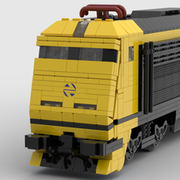 Hi, After just finishing the S-130 Project I´ve already decided to start a new one. In this case this is going to be the Renfe Class 309, a small 3 axle shunting locomotive from the 1980s. This quite a big contrast with the S-130 but I think is a perfect little project. This is the train in question: The main challenge on this project is how to power it, in this case I´m thinking about using Circuit Cubes to power the three axles. For the running gear design I decided to based it in the one made by @jtlan for his TP56 Switcher Locomotive as is one of the only examples of a 3 axle shunter that I found. Even with this base as a starting point is not easy to do this as my design is just 7 stud wide so I need to offset everything. This is a rough assembly that I have done for now: As it can be seen, the motor will be placed on the front and the battery is going to be right behind, the idea is to use them as counterweight for the heavier cab which is located on the rear just behind the last axle. And now it comes the part in which I ask for some help: Even though I have the design mostly figured out (I might need to make a prototype to see if it can work through R40 curves) my main concern is with the Circuit Cubes Motor and their power output and speed. This is a shunting locomotive so it´s not going to be as fast as the S-130 but even then, it seems that they are quite slow and might require a 1:2 gear ratio which can be simply added onto this design. My concern with this is that is going to become severly underpowered and wont be able to pull any load. I´m not expecting to pull something as massive as the S-130 cars but I would love for it to be able to maybe pull at least one of the passenger train cars that I´ve already designed (although I´m not planning on building them any time soon). This cars are massive with a weight of 1kg each, but those were the real load for this locomotive on the past. I´ve already tinkered with the idea of adding two motors but that will require a much complex redesign as I need to keep the middle axle powered through a worm screw to make it able to work through R40 curves. In this case I think there is enough interior space for me to not worry about it: I would like to know if anyone has done a proper test of the Circuit Cubes motors and knows their maximum load and speed. For now I´m going to continue working on the one motor design and make plans to order pieces for a small prototype. Imanol
 -
This late-1860's wood burning-style 4-4-0 steam locomotive model is modeled after the engine in LEGO set 7597 (Western Train Chase) from the Toy Story 3 line. I made the tender based on ideas in my head, and added working pistons and a swiveling front bogie truck to the engine. The four green coaches are also styled after the one in 7597 (Western Train Chase) but with cues from My Own Train set 10015 (Passenger Wagon) in several places. The whole train rounding a curve. The front of the engine. The rear of the loco. The four brand-new passenger cars are all identical except for the last one (the car closest to the camera) as it carries the train's rear marker lights. NOTE: Unlike the original sets this is based on, the cars have no interior details and the roof sections are not designed to be removable.
-
Hi everyone, I present to you my second version of the Renfe S-130 like Ferro-Friki did some time ago. I wanted to remake this train that I made first in 2018 with not the best result so I now made this version in 7 studs. LEGO Renfe S-130 DEF [MOC] by Imanol, en Flickr The set is heavily detailed even in the rear of the power cars and end cars LEGO Renfe S-130 Testeros Interiores [MOC] by Imanol, en Flickr I have made a reduced train set of only 7 cars instead of the 11 that has in real life but it has one of each of the different cars that form the real train with detailed interiors. First the "Preferente" end and "Preferente" LEGO Renfe S-130 Lateral Extremo Preferente [MOC] by Imanol, en Flickr LEGO Renfe S-130 Lateral Preferente [MOC] by Imanol, en Flickr The interiors of "Preferente" cars LEGO Renfe S-130 Interior Preferente [MOC] by Imanol, en Flickr The "Preferente" adapted car and it´s interior LEGO Renfe S-130 Lateral Preferente PMR [MOC] by Imanol, en Flickr LEGO Renfe S-130 Interior Preferente PMR [MOC] by Imanol, en Flickr The cafe car and it´s interior LEGO Renfe S-130 Lateral Cafeteria [MOC] by Imanol, en Flickr LEGO Renfe S-130 Interior cafeteria [MOC] by Imanol, en Flickr And the Turista cars which are the same as preferente but with 2+2 seating arrangement LEGO Renfe S-130 Lateral Remolques Turista [MOC] by Imanol, en Flickr LEGO Renfe S-130 Lateral Remolques Turista [MOC] by Imanol, en Flickr And now that I presented it I want to ask for help to build it as it will be my first lego train in real life. The car coupling mechanism that I have installed is only for aesthetical purposes and will not work in real life. Another problem is that i have seen many models in which all of the rear of the locomotive or power car pivots and I don´t know if it could be necesary to do in this case. Lastly I want to know how to motorize it, being so long I would suppose I would need the two power cars to provide power but I don´t know. Anyway, I hope you enjoy this project as much as I enjoyed designing it
-
Hey fellow train fans, I'd like to present my very first train MOC: the Yellow Delivery Train! My parents bought me the red passenger train (7938) when I was a kid, and I loved it, but unfortunately I missed out on its “pair”, the 7939 yellow cargo train. This MOC is mainly inspired by that set, but I used the updated design from the 60098 heavy-haul train set, and I also built some custom wagons inspired by the fantastic yellow delivery truck (60440). So this creation is a mix of all those sets. I hope you like it! :)
-
This steel frame locomotive shed is based off a digital MOC I made twelve years ago in March 2014, which was itself based on a technique I saw on a MOC by Eurobricks user @lightningtiger who made a smaller shed circa 2010 or so. The colors / look of my LEGO version is based off the two engine sheds at the Museum of Transportation in St. Louis, Missouri. While the real Roberts shed at the Museum has eight (maybe more?) tracks with a fancy clock tower in the middle of the roof, the Abbott building has just three tracks and is more plain-looking. Thus, my LEGO version is an amalgamation of both sheds. (sadly, I don't have comparison photos of the real sheds vs. the LEGO model, as they are just too massive to even attempt to get a proper picture of.) Side view. Yes, the (rather bright) red roof is prototypical for the Roberts shed. Looking down the length of the building. The two stall shed is just a hair over four tracks long, meaning all my currently-built engines fit under the canopy length-wise except for my 2-10-4, which is just a few studs too long. Sadly, there are also a scant few steam locos that are too wide to clear the roof support pillars... the BTTF time train is one that comes to mind here, although there might be more that I've forgotten. Here is my temporary current layout that features the train shed and my mountain tunnel in a arrangement somewhat resembling a tiny portion of my local train museum. This WIP version features almost all the trackage I have room for at this point... in fact, the rails end just out of frame to the right! Thoughts?
-
Hi there! This is my debut publication and let me present to you this Swiss Electric Locomotive, reproduced as faithfully as possible from the SBB Be 4/6 locomotive. This is a minifig-scale model. The model has a removable roof. Inside the model are: two electric motors, transformer, tools (4 pieces), compressor (x2) and a tool suitcase. The set includes a figure of a train driver with a briefcase: Inside the cab Front view New design of pantograph - first variant: ... and second variant: The first variant is not pretty enough, but it allows the pantograph to fold. The second variant is more elegant and plausible, but does not allow the pantograph to fully add up. This model can be motorized with the 1x 8809 and 2 x88013 Powered Up kit. Model info: Length: 50 cm (45 studs), Width: 9 cm (6/7 studs). Total parts: 1140. If you like this model, you can support it on LEGO IDEAS Thank you for your attention! I hope you enjoy this locomotive!
.thumb.jpg.2591aed2a8c1883a12eab08e25d2d586.jpg)
-
Presenting another of my Danish State Railways’ (DSB) trains redesigned to 8-wide and digitally rendered (with a bonus livery)... DSB IC3 The Danish State Railways’ (DSB) highly successful and innovative InterCity 3 aka IC3 passenger train was co-developed by Siemens -Duewag in Germany and ABB Scandia in Denmark. The train is operated by DSB in Denmark and Sweden, by Renfe Operadora in Spain and by Israel Railways in Israel. Amtrak in the USA and Via Rail in Canada have tested the train in the past. A trainset consists of three units; two diesel motor units (Litra MFA and Litra MFB) and one intermediary unit (Litra FF). Up to five trainsets can be coupled together. 96 trainset were built for DSB from 1989 to 1991. All are still in service today. My model: Original white and red livery used from 1989 to 2002. Fictionally named “Jørgen Vig” with the crest of Billund added. Scale: 1:48 Length: 157 studs (MFA: 55 – FF: 47 – MFB 55) or approx. 122 cm Width: 8 studs Bricks: 2.948 (MFA: 1.040 – FF: 861 – MFB 1.047) Locomotion: 2 x 9v or 2 x PF/PUP train motors Power: 9v, 2 x LEGO AAA battery boxes or 2 x BuWizz battery boxes Control: 9v, PUP, SBrick, PFx Brick or BuWizz Designed: 2022 Conversion of my 7-wide model from 2017 to 8-wide with more accurate dimensions. Very high setting render from Stud.io with custom decals added in the PartDesigner tool. Its able to navigate R40 but looks rather silly doing so: Interior with seats for 83 minifigs: Decorative side design for the bogies - a combination of parts and the molded decorative side for train motors: The coupling part can be change to a Liftarm Thin 1x7 (BL#32065) when combining several trainsets. Technique used for the sliding doors: Removing the 1 x 4 Tile as shown enables the door to slide open as a play feature. The fixed outer doors are a necessary part of the construction otherwise the very long body breaks too easily due to the roof being removable. However, they are designed to be rebuilt open when needed and the trainset stationary on display: The trainset is (fictionally) named Jørgen Vig with the crest of Billund added: Free building instructions: Option 1: https://open-l-gauge.eu/dsb-ic3/ Option 2: https://snakebyte.dk/lego/instructions/trains/diesel_engines/dsb_ic3_(8_wide)/index.php Bonus livery: Livery when Amtrak tested the IC3 Flexliner DMU (Diesel Multiple Unit ) in 1997:
-
This rail vehicles is a type of railcar called a Galloping Goose, and is slightly inspired by seven real vehicles built and used by the cash-strapped Rio Grande Southern narrow gauge railway back in the early 1930s. This tiny railroad couldn't afford to run a single steamer in the worst part of the Great Depression, so they made the Geese to deliver the mail, supplies, and people to the silver mines / camps around Durango and Ridgway, Colorado. In fact, the lucrative mail contract is what kept them afloat - when that went away in the early 1950s , the railroad was torn up. Six Geese still exist in original form, with one being a reconstructed replica. These machines are really something Doctor Frankenstein would love - a bus body or boxcar welded to a road vehicle (usually a Pierce Arrow limousine) for the front end, with train wheels added underneath. This is my third interpretation of this type of passenger doodlebug, which is numbered eight in my rail fleet, and was never owned by Rio Grande Southern. (The seven real-world ones originally had boxcars on the back for freight service as well as having seats for passengers up near the driver.) The rear of the rather odd-looking vehicle. As a play feature, you can open the doors to the drivers compartment and place a driver at the wheel. The back half of the vehicle is not meant to be accessible. My version of the Goose is slightly inspired by the front half of the second one made. As you can see in this 1940 picture, the railcars were referred to as Motors by the Rio Grande Southern. This was true up until close to the end of the first careers, about ten years after this photo was taken - though the public has seemingly always called them Galloping Geese. You can read more about these fascinating railcars here on Wikipedia. Thoughts?
-
This early-2000's style Wild West / 1860s 4-4-0 steam locomotive was heavily inspired by pictures of @SavaTheAggie's 4-4-0 from 2007 to which I then added a tender inspired by another Sava loco (his 4-6-0, also from 2007). I made the tender a bit longer. made the front bogie actually connect to the front of the loco, (whereas before in the original Sava design it was totally free-floating and loose) among several other structural / style tweaks here and there to make it my own. The engine is intended to go with the four My Own Train green passengers car (set 10015) MOD's that I own. The front of the locomotive, which is modeled after a coal burning type rather than the wood burner you usually see in Western scenes. The rear of the engine. The printed '10' piece is the dime part from the Minifigure vending machine, and it works rather well here! Much like real a 1860s locomotive, there are not many details inside the cab. The baggage car which is completely my own design. Two of the three coaches. The third coach carries the red marker lights for the rear of the train. Thoughts?
-
This LEGO model is my attempt to create as accurate a replica as possible of the Medway 1907 locomotive, part of the Alsthom 1900 series, built at 1:45 scale. The model is fully motorized using LEGO Power Functions with BuWizz and features working LED lights. It is built from roughly 2,000 pieces and weighs around 1.2 kg. This is the third version of this locomotive that I have built. Earlier versions included a test livery (EVA) and a version in the original CP orange and brown colors. Each rebuild allowed me to refine both the appearance and the mechanical layout. This project was created purely for personal enjoyment and learning, with the intention of achieving the closest possible representation while keeping the model fully functional. Kudos to Gerbrand (Raised) for the Nez Cassé nose design that I'm using for the 5th time
-
Nine small 1950s freight cars of seven designs. Each was built to a length of about 16-18 studs per car with two bogies per vehicle. (Originally they had just two fixed axles when originally built, but this was recently fixed to be more prototypical for American freight cars.) The whole train going into a tunnel. These freight cars are (Left to Right): - cattle car - boxcars (x2) - flatcar with bulldozer load - Octan petroleum tankers (x2) - flatcar with load of rails - bathtub gondola with coal load - caboose This livestock car was heavily inspired by the one in 2014 CITY set 60052 but with a roof for more realism. I can now understand why LEGO left it open top in the set, but I managed to make it work. The roof (which was designed with the same look as the boxcars) is even removable and the ramps fold down so you can take out the cow. These two identical boxcars were inspired by set 7597 from the 2010 Toy Story 3 line. They were expanded in length and had the roof trapdoor removed. Here we see a small 1950s-looking bulldozer on a flatcar. The construction equipment was inspired by CITY set 60140, except in yellow with 46 technic links as the caterpillar tracks instead of red with rubber one-piece tracks. Other things such as headlights and gears (for the treads) were added, and the blade was shortened in width by two studs. These two oil tanker cars came from my own imagination, and are made in Octan livery. This is an older MOC of a flatcar loaded with rails updated to have bogies instead of two fixed wheels. This bathtub gondola with a load of coal is entirely my own design. This caboose model is slightly inspired build-wise by the Katy Caboose (as in, "The Caboose who got Loose" from the children's book) model I copied in late 2021 from @zephyr1934's MOC. Thoughts? EDIT: Post updated 12/14/25 with two new freight cars and revised first picture - bathtub gondola and flat car with rail load are now added!
-
Our first three types of custom train tracks are ready and available in our Bricklink store. The goal is to make an extended track system for LEGO trains so you have a much higher flexibility in building your layout; just like we did for the monorail. Let us know if there are any other types of track you would like to have... FYI: the tracks are printed with a custom developed Dark Blush Gray abs filament so that our tracks match the color of the LEGO RC tracks: the cross track below is 3D printed, the straight track below is a genuine LEGO track.
-
Well, here it is! My first train MOC that I've ever made, the Orient Express! Including a large Pacific class style locomotive similar to the Emerald Night, a tender, and a passenger car, I cobbled this together from several Bricklink orders and the LEGO Constitution Train Chase. ( I was very sad to take it apart, but it was for the greater good!) The passenger coach features opening doors, and I was able to put two lights into the roof, so it can light up at night! Here's the official story on this MOC: -Oh no! There's a Mummy on the Orient Express! Join dashing, adventurous Arthur Rutledge as he travels across Europe with several priceless artifacts to be delivered to the Louvre Museum in Paris. But be careful, his evil nemesis Cad Goldwater is also aboard, and will stop at nothing to acquire the relics. Will Rutledge be successful, or will the Orient Express be stopped by the nefarious plans of Cad? It's up to you! You can also see more photos of this MOC on the Orient Express Thriller page on Flickr: https://www.flickr.com/photos/150692089@N03/albums/72157676895085431/with/31865151642/ This project is also on LEGO Ideas to support! https://ideas.lego.com/projects/162979 We would really appreciate the support! Thank you. :) A couple extra pictures!
-
 Sioux.NET on Track presents the Ticket Dispenser Unit (TDU) Two articles about the Lego Dispenser Unit can be found at our blog: https://siouxnetontrack.wordpress.com/2016/09/28/ticket-dispenser-unit-reader/ In this article you can read how tickets are read using a four-color based number system. This article was written before the dispenser part was created, so it is only about the reader part. https://siouxnetontrack.wordpress.com/2016/12/28/ticket-dispenser-unit-complete-version-2017/ In this article you can read about the upgraded version that will be used at Lego World 2017. Click on the following picture to see more pictures: A video of the working TDU 2017 can be found here:




.jpg.0f1e2a30948a73b2270ce858547d25e3.jpg)