Search the Community
Showing results for tags 'shunting'.
Found 3 results
-
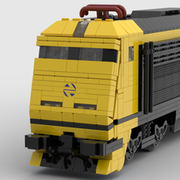 Hi, After just finishing the S-130 Project I´ve already decided to start a new one. In this case this is going to be the Renfe Class 309, a small 3 axle shunting locomotive from the 1980s. This quite a big contrast with the S-130 but I think is a perfect little project. This is the train in question: The main challenge on this project is how to power it, in this case I´m thinking about using Circuit Cubes to power the three axles. For the running gear design I decided to based it in the one made by @jtlan for his TP56 Switcher Locomotive as is one of the only examples of a 3 axle shunter that I found. Even with this base as a starting point is not easy to do this as my design is just 7 stud wide so I need to offset everything. This is a rough assembly that I have done for now: As it can be seen, the motor will be placed on the front and the battery is going to be right behind, the idea is to use them as counterweight for the heavier cab which is located on the rear just behind the last axle. And now it comes the part in which I ask for some help: Even though I have the design mostly figured out (I might need to make a prototype to see if it can work through R40 curves) my main concern is with the Circuit Cubes Motor and their power output and speed. This is a shunting locomotive so it´s not going to be as fast as the S-130 but even then, it seems that they are quite slow and might require a 1:2 gear ratio which can be simply added onto this design. My concern with this is that is going to become severly underpowered and wont be able to pull any load. I´m not expecting to pull something as massive as the S-130 cars but I would love for it to be able to maybe pull at least one of the passenger train cars that I´ve already designed (although I´m not planning on building them any time soon). This cars are massive with a weight of 1kg each, but those were the real load for this locomotive on the past. I´ve already tinkered with the idea of adding two motors but that will require a much complex redesign as I need to keep the middle axle powered through a worm screw to make it able to work through R40 curves. In this case I think there is enough interior space for me to not worry about it: I would like to know if anyone has done a proper test of the Circuit Cubes motors and knows their maximum load and speed. For now I´m going to continue working on the one motor design and make plans to order pieces for a small prototype. Imanol
 -
Finally, I built something too small to motorize: This is a Breuer Lokomotor, or shunting tractor. This tiny vehicle was made for moving rolling stock around stations that for economic or logistical reasons could not have a full-sized shunting locomotive. They were powered by inline petrol (and in later models, diesel) engines mounted transversely in the body, connected to a manual transmission and powering the wheels through a chain drive (!). The tractors themselves don't weigh much; to get enough working weight, each end of the tractor has a screw jack that lifts the wagon it's attached to, thereby "stealing" some of its weight for traction. The Type 3 Lokomotor differs from the Type 4 in that it doesn't have an enclosed cab (hard to build at this scale...). The Type 4 is also rated for higher pulling power. At the scale of this model I didn't have room to include magnets, but it's possible to connect the screw jacks on the model to the "new" buffers with a few plates: The short wheelbase of the Lokomotor means that this arrangement will traverse switches and curves, despite the fact that, properly, there should be another joint in the connecting link. Unfortunately, it's not powered. Full Brickshelf gallery here, and instruction gallery here. Thanks for reading!
-
Hi all, I present my second train creation in bricks here An invented shunting engine to power my RENFE Bed-car 9600 Series This is not a nice, or real shunting engine, but works well and have enought torque to move the cars without problem. and work in all Lego train curves The motor is a 88002, that have more power that I thought, the tip is to put weight on it to prevent slippage of the wheels. Is full PF with a custom Li-Ion battery (2500mAh in this case) Detail of the custom PF Li-Ion Battery Pulling the Bed-car The No-Conventional coupling A Conventional Old-magnets coupling I hope you enjoy it