Search the Community
Showing results for tags 'engine'.
-
 The Frisco 1522 loco is a 1926 oil burning 4-8-2 "Mountain" type, (4 leading, 8 drivers, 2 trailing) that was made surplus in 1951, donated to the Museum of Transportation (in St. Louis, Missouri) in 1959, and restored to working order in 1988 by the St. Louis Steam Train Association (SLSTA) for it's excursion career. It's new lease on life lasted until 2002 when rising insurance costs made the engine enter it's second retirement, which will be probably be forever. When the engine was running in it's second career, the SLSTA had four train cars (one of these MOC's is a fictional fifth car to beef up the train's length) in it's excursion support role. They carried parts, tools, merchandise to sell, and crew members not on duty. After re-retirement of the 1522, most of the cars were eventually sold to Milwaukee Road 261 organization and were renamed and repainted into a different paint scheme more suited to that group. This may not be the best interpretation of the Frisco 1522, but it seems to be the one of the few I've seen built out of Lego. The model you see here has been my dream ever since I was 5 or six years old and rode behind the steamer on one of it's last public trips. (I don't remember much of the trip, but I do remember the sense of awe and respect for the power of steam after seeing the loco pull past us on it's journey back to the museum and into what looks to be permanent retirement.) The rear of the (newly remade in 7 wide) locomotive. The cab walls on both model and real engine have the name of the railroad (Frisco) on it's side, while the number of the loco (1522) is on the tender sides. Inside the cab. I chose the classic printed slope with the knobs and gauges seen here a throwback to my first train MOC from the early 2000's. One half of this baggage car (named 'Black Gold' after a train the 1522 used to pull) housed tools, spare parts, lubricants and a fire hose or getting water for the loco, among many other things. The other half (usually closest to the engine) had the souvenir shop with shelves and tables for fundraising merchandise selling. The car is now repainted and named 'Golden Valley'. It has been used with Milwaukee Road 261. The 'Firefly' was the crew car. It was also named after a train the 1522 used to pull. The car has been sold to be used with Milwaukee Road 261. It sits in storage currently. This coach is NOT based on any SLSTA car. It was added to the train to beef it up to normal amount of five passenger cars. It is named 'Meteor' after an actual Frisco train like the others just to look accurate. The diner-lounge 'Chouteau Club' wasn't owned by the St. Louis Steam Train Association (SLSTA), but by a private individual who was a member of the club. It now is stored / owned by Illinois Transit Assembly in Madison, Illinois, sidelined by side sill rust. The 'Bluebonnet' was a business car and brought up the rear of the train. It was also named after a train the 1522 used to pull. The car has been sold to be used with Milwaukee Road 261. It has been renamed back to it's first name of 'Milwaukee' and repainted into the proper colors for that railroad. The real engine is publicly displayed at the Museum of Transportation in St. Louis, Missouri. The Lego model of the loco is sitting on the front of the loco, just above the cowcatcher. This official Frisco 1522 website gave me invaluable info and pictures of the excursion cars and the loco itself. This page in particular was very helpful in getting the window amount / spacing / 'look' of the excursion cars right. NOTE: Yes, I had a thread made in 2016 for the loco only. That thread was last updated in 2017, and I didn't want to mess with the moderators by bumping it. Thus, this new thread was created. I hope that was ok! EDIT: 11/26/25: Revised real world photos added with fifth passenger car and remade 7-wide steam loco + tender.
 -
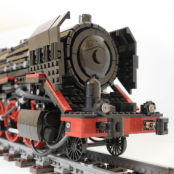 Hello everybody, I am glad to introduce you my last big project : a pneumatic steam locomotive ! I think it's one of the firsts pneumatic locomotives, using only Lego parts. First of all, the YouTube video and some photos: The idea with this model is to replace the steam of a real Locomotive by compressed air, and this for as much functions as possible. Here are the main functions : Movement of the train : Using 4 pistons, 2 on the sides, and 2 inside, the train can move forward. It works like a classic LPE, with 2 pistons shifted 90° from the others. 4 pistons consume a lot of air, but they guarantee enough power to move the whole train. To make the rotation smooth, a free wheel is hidden inside the boiler part of the locomotive. Its rotation is 25 times faster than the wheels of the train (40t/8t x2). The train isn't moving very fast because the pneumatic elements aren't modified. However, it's fast enough to make it interesting to look at the connecting rods and wheels moving. The breaks : On a real locomotive, compressed air is produced by a compressor (powered by steam) and is used to press some brake shoes against the wheels. Here, the same technique is used : a small piston is filled with compressed air, and thanks to some rods, brakes shoes are pressed against the wheels. It's cool but...it's not enough. Plastic against plastic isn't very efficient to stop the train's movement. Therefore, another rod is connected to the brake system and press another brake shoe against the free wheel. Because its rotation is faster (and therefore, with a low torque), it's is way easier to stop it. The Whistle : A system that I love in this locomotive is the whistle. Currently there isn't any whistle produced by Lego that could be used in the locomotive, so I had to think a little for finding something working. This whistle is activated by a switch in the cabin. The Cabin : Nothing much to say except that in contains 3 switches for the 3 main functions (whistle, wheel movement and brakes). There is also a pressure gauge showing the pressure coming from pumps. The train moves with a minimum of 1 bar. A 2-2.5 bars, the movement is faster. The air supply : There are several possibilities for the train : we can directly pump with Lego pumps, or store the air into 6 to 8 airtanks or produce the air with Lego motors and small pumps. For instance I use 4 pumps side by side, linked to some air tanks, but I don't what the final model should work. Maybe some motors and pumps could be cool ? The design : The hard part was to make the boiler of the locomotive. It's a little hard to make cylinders with Lego technic parts but, with flex axles passing through Technic beams, I managed to make something satisfying. Some details are visible on the locomotive, I tried to make it look a little crowded like a real locomotive with fake air/sand tanks, fake compressors and mechanical elements. It's probably possible to make it look better, but for instance I am happy with it. The rails are "homemade" with Lego bricks. The locomotive is too big of course to work on Lego railtracks. The wheels aren't perfectly flat so the train is "blocked" in position inside the rails. Therefore, the train can move foward cur cannot go out of the railtracks (which is great for a train). Finally, as a bonus functions, there are some bumpers at the front and back of the locomotive to imitate the real bumpers used to absorb small chocs on a Locomotive. That's it for now, I hope the model is interesting to you and if that's the case, don't hesitate to support it on Lego Ideas ! Click Here to support :) If you have any question or comment, please reply to the post, I'll be glad to discuss with you !
 -
The mechanical detail is more aesthetic than plausible. Yet, there are elements taken from what an early steam walker should have looked like, besides the vibrant colours. Most of its inhards are shown, there are very few largue pieces of metal, structural elements take over shape design. It is somewhat outlandish, taking a mechanical shape similar to that of many tin toys. Even if it seems to be something rather decorative, there are a few tricks to make it more resistant than it seems. Legs rest directly over the axle pillar and the superstructure it hides. Feet are also anchored to the base to avoid deformation.
-
Like many people, I regarded steam locomotives as rather dark and monstrouos machines untill I first saw their early iterations. It was a novel technology at the time, so embelishing them for the amazed crowds and potential contractors should have been appropiate. The mechanical detail is more aesthetic than plausible. Yet, there are elements taken from what an early steam walker should have looked like, besides the vibrant colours. Most of its inhards are shown, there are very few largue pieces of metal, structural elements take over shape design. It is somewhat outlandish, taking a mechanical shape similar to that of many tin toys. Even if it seems to be something rather decorative, there are a few tricks to make it more resistant than it seems. Legs rest directly over the axle pillar and the superstructure it hides. Feet are also anchored to the base to avoid deformation.
-
The prime method of transportation to and from the North Pole for children is now arriving at your front door! So, grab your robe (but don't rip the pocket in your haste to get outside!) and head on the adventure of your life... "Well, aren't you coming!? This here is the Polar Express!" What happens to the steam-hauled Polar Express when the steam-era parts suppliers eventually go out of business in the mid-to-late 1960's? Elves know toys inside and out, but steam locomotives are a bit out of their wheelhouse. Enter 1231, the newest locomotive-set in the Polar Railway's repertoire of railroad vehicles / rolling stock, used as a eventual replacement for 1225, and current freight loco. Built by EMD in December 1959 as a FP9 for the cab unit and a regular F9 for the B unit, these engines use small steam boilers to heat the heavyweight passenger cars, just like the 1225 before them with it's (obviously much larger) boiler. 1231 is currently assigned to freight duties at the North Pole awaiting it's turn at the head of the Polar Express. (eventually) The whole Express train, headed by steam locomotive 1225. This steam engine began life based on my design of the Frisco 1522, a 4-8-2 Mountain type, which I had built into a 2-8-4 Berkshire for my Polar Express. I then saw a far superior model by @Plastic_Goth over on Rebrickable, as seen here. It was then purchased, and I added my own wheelbase to it from the pervious Frisco 1522-derived version as I try not to use those small friction wheels for the front pony truck, as it squeals too much. (as used by Lemon_Boy in his version) Then, I took the open bottom cab and added mine back in, albeit in 7 wide. I redid the tender to be seven wide as well, while shortening my passenger coaches by four studs. (I will put them on a 24 stud train-plate instead of 28 for each car.) this will give me nearly enough parts to add a firth car as a third identical coach. I kinda took inspiration for the Emerald Night for the firebox. Simple and elegantly held on by technic pins, it makes a good converter from the seven wide cab to six wide boiler. The tender retained its ladder to the deck, albeit on a smaller scale - about what I did for my Emerald Night tender MOD. This is the saddest car in the film: the recycled toys baggage car, which thankfully is empty here, but in the movie was full of tangled marionettes and broken toys galore. This car features a sliding baggage door in addition to the usual opening regular doors. (which in turn were styled after the Emerald Night's coach's doors) These two coaches feature opening doors on each end. The color scheme chosen for the cars was inspired by @SavaTheAggie's Polar Express, and not the movie. (Dark red windows and medium blue train cars are accurate, but way too expensive!) This is the observation lounge car, and features a viewing balcony on the end of the car. From left to right these people are: - Narrator child - Engineer (I'm calling him Max) - Fireman (now named Joe) - Conductor (named Charlie, as far as I'm concerned) - The mysterious ghost hobo (who I'm trying to write a story linking him between the movies Emperor of the North and Polar Express. It will explain how he got onto the Express, and how he died at Flattop Tunnel. Based on a deleted scene from the Polar Express.) Everyone knows about the Polar Express passenger train, but what about the other half of the railroad business: FREIGHT! Well, this problem is now solved with the "1231" Electro-Motive FP9 diesel cab + booster locomotives, along with boxcars for toy materials, hot cocoa tankers, coal cars (for naughty children and the hungry 2-8-4 steam loco 1225), and flat cars with varying loads, this one being Santa's backup sleigh w/ reindeer! This model originally was inspired by the EMD FL9 in the "Lego Train Projects" book from No Starch Press. I made it shorter and added a B unit, while changing up the color. I also make them into a regular diesel powered F-units instead of the dual electric / diesel powered FL9. The chosen color scheme is of my Polar Express train which, as you most likely know, is usually headed up by 2-8-4 steam loco 1225. Well, here is the backup / freight loco number 1231. NOTE: This idea of a later-day diesel hauled-Express is actually not new, as I've seen it in blue-and-dark red Lionel models for a while now in several Hobby shops... they even have a Polar Railroad GP-7 as a model too, according to my Google search! The engine will feature (once built) feature printed letters on the A-unit's sidewalls saying "Polar Railway", and closer to the nose, will have the "1231" as the loco number. The rear has a doorway to the first passenger car. The boxcar seen above is for for carrying toy-making materials, such as wood, and barrels of plastic pellets. This flat car is supposed to have three hay bales in front of Olive (the other reindeer, who is usually omitted from the regular team pulling the A-Sleigh because of his bad habit of calling team leader Rudolph names and being generally unpleasant while playing reindeer games.) Olive pulls the backup sleigh instead. This hopper car is for carrying naughty children's coal, which also happens to fuel the 2-8-4 steam loco 1225. A simple Hot Cocoa tanker car.. be careful, it really is hot! The last car in the freight train is a caboose. The letters "PR" (standing for Polar Railway) go on the side wall studs. As usual, any comments, questions or complaints are welcome. There is only so many days until Christmas, and then this train becomes relevant again, so I'm building this REALLY soon! EDIT 4/22/21: Added freight cars to the post.
-
The Messerschmitt Me 262 was the world's first operational jet-powered fighter aircraft. A historical documentary I saw on TV inspired me to build this aircraft in particular. It features retractable landing gear and just enough space to fit a minifig head inside the cockpit. The main colour of the fighter is Dark bluish gray while the underside of the plane is mostly done in Light bluish gray. by legomanijak, on Flickr by legomanijak, on Flickr In order to retract the landing gear a small hatch has to be removed first and afterwards the landing gear has been retracted the hatch can be returned to it's position. by legomanijak, on Flickr by legomanijak, on Flickr by legomanijak, on Flickr by legomanijak, on Flickr by legomanijak, on Flickr by legomanijak, on Flickr by legomanijak, on Flickr by legomanijak, on Flickr by legomanijak, on Flickr by legomanijak, on Flickr by legomanijak, on Flickr by legomanijak, on Flickr by legomanijak, on Flickr
-
To show off engine I've built for TC18 entry constructed this mini-MOC - an engine trolley. Moves like a real one where paired wheels have 360 degree rotation, so it is easy to steer and place an assembly.
-
 I wanted to build a Mazda RX 7 FD ever since I finished the NSX...but a RX 7 needs a rotary engine... So I was forced to make one :) I have been working on this little guy way too long, and when I finally got it working today, I literally had tears in my eyes Its still WIP, but I am so happy right now. Hope you enjoy. Gray Gear
 -
 lego engine 2 by michael waterfield, on Flickr lego engine 1 by michael waterfield, on Flickr lego piston head by michael waterfield, on Flickr About 2 months ago I started building said engine, single cylinder 4x4 bore 5 stud stroke (no glue), for the ignition I used a system made for model engines with magnetic based timing and powered it via the Lego rechargeable battery / wire from a dead motor. The first incarnation used gate style valves but they where sticky and lost a lot of pressure, so I switched to using technic caped axles through lego system which is amazingly air tight and looks/works like a real engine (4 valve total arranged in a flat head configuration). The valves originally had variable timing via two diffs but I later removed it not due to the resistance but retiming the engine every time got tedious fast (the ignition magnet was driven by the same gear train as the valves (1/2 from the crank, 12 tooth too 24). Now for interesting part the running, the area behind the valves is in a open top box and its this I spray the fuel into. O don't use solvent of any kind, with gas type lighter fluid lego holds up with no sigh of damage after a few minutes of inconsistent firing, but I ran out and due to crippling stupidity/laziness I just grabbed the next most flammable thing I had - a solvent spay. After less than 10 seconds firing on the starter motor (two xl gear up x5 about, 42 8) the engine slowed and when I opened it up both the exit valves had their caps melted and there was some waviness to the piston top. After replacing the axles and getting some more lighter spray I changed the flywheel from a geared up Unimog wheel to a aluminium pully about 8 cm across and 2cm deep. With this configuration the engine runs for a few seconds (yes without the starter connected) a few seconds after fuel is added no matter what I try I cant get the engine to run without these gaps in ignition, It seams like there is too much fuel and after a few cycles the fuels concentration becomes low enough for combustion, this is where I believe the most improvement can be made and yes I mean a working lego carburettor, or at least something better that my box method. While running the engine sounds like some of the first ic engines made, probably due to the bad burn and merely non zero compression. . Now I imagine most of you are curious how I got useable pressure containment and no hang-ups with a lego cylinder/piston without glue, gaskets or any modification to the lego , well unfortunately that is hard to explain even though it is ldr friendly its a bit unorthodox, but you can see in the pics. But during building the cylinder I put the piston in and blew in the other end and the piston went 4 feet across the room consistently. I plan to make a video as soon as I get more than a few seconds of ignition out of it (first running lego engine hello youtube gold). O and finally I made it four stoke due to it being easier to run at low rpms and my ptsd from nitro cars has yet to leave me. Any advice/interest? (hopefully I added pics correctly)
 -
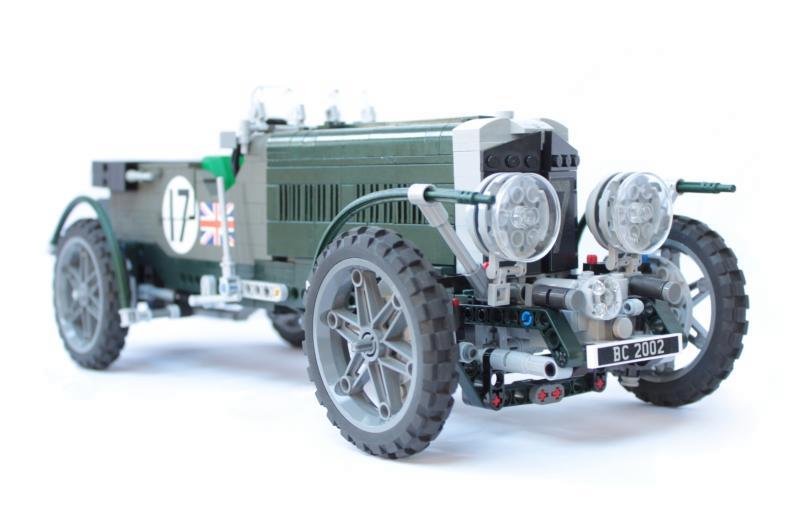
Hello everyone, I have built a model of one of Britains classic race cars, the Bentley 4.5l ‘Blower’, a project that was never actually approved by W.O Bentley (company founder) but nonetheless took part in the 1930 Le Mans 24hr race and French Grand Prix where it finished second behind a much more agile Bugatti type 35. Its claim to fame was not through racing victory but through its racing stories. The model has working ‘worm and wheel’ steering and a removable bonnet to expose the 4.5 litre, 4-cylinder supercharged engine. Accuracy and realism was key right from the chassis frame and the parts were spray painted to give two new green colours. For more info and images please Click here to take a look at the project on Lego Ideas. Many thanks...
-
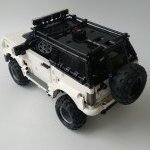 Designed model is based on the Ford Bronco revealed in 2020. During creation of this model, modular build concept is used to simplify the building process by splitting the overall process on three stages. Follow me on Instagram @anton.kablash Instruction you can download here: Ford Bronco InstructionDimensions: 16 x 38 x 19 studWeight: 738 gFunctions: HoG (detachable) Working steering wheel in the cab Front independent suspension Rear 3 link suspension Working engine Openable doors, hood, trunk Detailed exterior and interior Adjustable seats Modular building More photos in the Ford Bronco Album
 -
Hi ^^ I want to build 6x6 (first axle steering) trial uphill truck (outdoor fun in mountain) and i have two question. Tyres used: 107x44 (15038) Estimated weight: 2.5kg 1. Engine used I have 3x XL motor, and i think how design drive train: 2 or 3 motors drive all wheels (like normal car) 1 motor to front axle 2 motors to rear both axles 1 motor per axle Which will be the most effective? 2. Gearing I don't wanna use any gearbox, and i think about 3:1 or 5:1 (or maybee less could be too?) Thanks for help
-
Hey guys! I have a new MOC to share. This was a commissioned build that will be turned into a full kit for bricktraindepot.com. Will be doing additional full kits for Nickel Plate #765 and Pere Marquette #1225 as well. Pre-orders for all three kits will open on September 1st! If you purchase the C&O kit, $100 will be donated to Kentucky Steam to help with the restoration of #2716. Anyways, about the engine. The Chesapeake and Ohio Railway's K-4 class were a group of ninety 2-8-4 steam locomotives purchased during and shortly after World War II. Unlike many other railroads in the United States, the C&O chose to nickname this class "Kanawha", after the river in West Virginia, rather than "Berkshire", after the region in New England. During the 1940s, the C&O K-4's were being built to haul heavy freight services and were used mostly for high speed freight and passenger services throughout the north-eastern regions of the United States and part of Ontario, Canada by the Pere Marquette Railway. C&O Class K-4s were one of the few recognizable 2-8-4 (Berkshires) classes in North America along with the Pere Marquette Class N (road numbers 1201-1239), and Nickel Plate Road Class S (road numbers 715-779). Both the PM Class N and NKP Class S were manufactured by the Lima Locomotive Works in Lima, Ohio. NKP 779 was the last standard-gauge Berkshire to be built in the world, and the last steam locomotive built by Lima Locomotive Works. My model features 2x L motors in the boiler with custom battery box in the tender and all specialty wire custom finished, 3D printed XL drivers, BrickTracks wheel in roller bearings, custom side rods by TrainedBricks, and decals by OkBrickWorks. I've finished the physical build and have been doing testing while waiting for OKBrickWorks to print my decals and wheels. Hope you enjoy the renders for now. More pictures will be coming soon! Left Front by Jeffinslaw, on Flickr Right Front by Jeffinslaw, on Flickr Getting close! by Jeffinslaw, on Flickr Additionally, be on the lookout for other train cars from BTD such as the AAR 50 ton hopper in C&O livery as well as an update to our TOFC to include a C&O flat car and some Railway Express Agency trailers. Let me know that you guys think! -Jeffinslaw
-
Hello everybody! This is the first MOC I present on Eurobricks. My most popular MOC yet is the 3 speed auto gearbox (https://rebrickable.com/mocs/MOC-33711/lbrix/3-speed-auto-gearbox-overworked-version/?inventory=1#comments). But now to this gearbox: At first ask yourself this question: Which sense has a normal D-N-R gearbox in a manual technic car? It has no sense. It makes no difference if you are in the forward gear or in te reserve. But with this D-N-R gearbox it makes a difference, because if you are in the forward gear, you can not push the car backward and if you switch in the reserve gear, you can not push the car forward. If you want to build this gearbox into a technic car, you have to connect the grey connectors to the wheels and one of the black ones to the fake engine. For more information check out this MOC on rebrickable (maybe it is not approved yet): https://rebrickable.com/mocs/MOC-47985/lbrix/alternative-d-n-r-gearbox/?inventory=1#comments No I wanted to ask you, what you think about this D-N-R gearbox? Here is an video of my gearbox:
-
Hi! This is my first comment on this forum. I started to make real 2 stroke motor and almost everything is ready but i have problems to make ignition system. I don't have much resources to build them and i thought here i could get tips where to get easily materials like wires and tips how I should make that ignition system. If everything goes well i can put here some pictures and videos about that motor.
-
This is my own creation of a Mercedes-Benz G550 4x4² SUV. Check out my Rebrickable post for instructions which you can download for free: https://rebrickable.com/mocs/MOC-43865/BrickHugger171/mercedes-benz-g550-4x42/?inventory=1#comments
-
Top view with locations Impostor Green is waiting for red... The Reactor and upper engine. Upper part of the ship including the cockpit at the front below the arch. Views Side View The accessories of the characters can be easily swapped around and shared between them creating impostor and non impostor versions as well as looks of different skins, like in the game. Added a ghost version of the famous red player design. If you like it, it is also a set on LEGO ideas: https://ideas.lego.com/projects/29f9ebe5-b5a0-4fdb-bbaf-86f9e96d0865 http://tinyurl.com/amonguslego
-
I recently finished building a LEGO City/Minifig scale plane that offers more details than your usual airliner. I have submitted my creation on LEGO Ideas. See more pictures and vote for it here! My model also has its own display stand which can also be used to display the minifigs. This plane is built using brick-built solutions instead of relying too much on pre-fabricated plane pieces. This plane has quite a nice cabin on the inside and can accommodate many minifigures. To see pictures of the Economy AND Business class cabins, please see my LEGO IDEAS project page.
-
It is the early 1930's. The dark days of late 1929 has worsened into a economic depression of truly epic proportions. Worse, the drought starting in summer 1930 (lasting until above average rains stopped it in 1941) caused the dreaded Dust Bowl and the mass migration of (most) of an entire generation of farmers and their families westward. This time frame also led to the rise of hobos, wandering, jobless people trying to use the one mass transportation still running across the dusty, windswept nation: The freight trains. The backstory on this train is as such: The engine, number 6519, runs daily from Lawrence, Kansas yard to where it finally services the Rust-eze factory in Moberly, Missouri. The line branches off and curves to the left in Columbia Missouri, while the main goes straight on to St. Louis. The rest of the regular freight is worked at the Columbia yard, expect for the acid tanker and the two marked generic boxcars. That tanker goes to the factory too, as it's a chemical component for Rust-eze. Rumor has it that the Rust-eze plant will be moving closer to St. Louis, or even shutting down soon, maybe by early 1934. The engine used to be a heavy-hauler out on the main, but has been relegated to branch line work, as it's 1898-vintage pistons are wearing a bit thin and she is overdue for a overhaul. Unfortunately, with the current depression, she has been reassigned to light branch work with a limit on her speed. Hopefully, they will scrape up the money to get her in the shop soon. This early 1900's-era engine model was first designed as a 2-8-2 Mikado before having the front pony truck removed and a 4 wheel bogie from set 10194 (Emerald Night) added instead, turning it into a 4-8-0 Mastodon - type. The rear pony truck was removed as well, with the 79111-style boiler shortened and cab re-arranged. Then, as of late September of this year, I completely rebuilt her from the wheels up to use the Disney engine boiler you see here. The running gear was originally a Scotnick invention from his 9F, but now comes from my MOD of the Constitution Train Chase set. So, basically, the only thing original left is the tender. Together, these several different engines from four different eras and five separate builders come together to create this one steam engine, which I have numbered 6519. The coal tender was inspired by Anthony Sava's Pacific 4-6-2 model's oil tender with the letters "BRS" added in the middle of the tender using printed 1 x 1 tiles. I was inspired by this photo by JB Lego to build this boxcar as seen here. They are made to haul pallets of cargo, specifically Rust-eze chrome restorer in 55-gallon drum containers for commercial packaging at this facility into smaller containers. Inspired by the green tractor trailer from CITY set 4204 (The Mine), this bathtub gondola is carrying boulders from the mine destined for the gold refinery where they will be opened up and the metal extracted to make coins and ingots. This drop side flat car was first part of set 2126 (Train Cars), but it didn't really have a purpose. It was hauling uprooted evergreen trees in the set, but that didn't look very good, so I changed it to generic freight. (My layout's resident hobo and his trusty guitar usually catch a ride on this piece of rolling stock.) The hobo is trying to get home to his family, which lives in Glenncoe, Missouri. Sadly, he picked the wrong train, as this only get's him halfway there. He's going to have to ride the blind of a steam engine tender on a passenger run to get home. (that's the area between the first car and tender, it's very dangerous because you're balancing on the coupler!) This dangerous liquid tanker was modeled after a real tanker car you can walk through in the Museum of Transportation's collection in St. Louis, Missouri. The real deal hauled hydrochloric acid for Monsanto starting in 1940 up into the late 1960's. I'm backdating the car ten years to fit into my mid-'30's freight train. I have adapted this UK inspired model of a brake van by Fireglo450 (see it here) to once again be a more American-inspired caboose. The caboose has no interior, and the red marker light can go on either end of the model to represent the end of whatever train it is being hauled behind. Here you can find other topics of interest mentioned in the text, or that are similar enough to be placed alongside time frame-wise I have this passenger train, that goes along with the freight train in this time period. (No, the hobo does not ride this one home.) and this branch-line station that is from the same late-1890's era, and on the main line from the San Francisco to New York (via St. Louis, of course!) Here we see the (100% fictional) Moberly, Missouri, Ruste-eze Factory. It seems to have made it to better times, with this picture taking place in the early 1950's. Any thoughts, comments, or complaints?
-
This rotary plow-fronted train is ready to keep the other trains running in the worst winter weather using good old-fashioned steam power! 100% fictional history of the steam engine type (and the whole train, really): In late-1929, Thomas Carter was Chief Mechanical Engineer for Brick Railway Systems (BRS), and on vacation to visit family in New Zealand. He was about to get on the train in Christchurch, when he was passed by a new NZR "G" class 4-6-2+2-6-4 Garratt steam engine. Remembering how he was having problems getting the next "big thing" built back in America, and that he was having a steam power crunch when it came to rotary snow plow duty up in the Rocky Mountains, he contacted the engine's manufacturer, Beyer, Peacock and Company, and talked about a possible contract in America using the New Zealand "G"class as a starting point. Once he got home to BRS company HQ in St. Louis, Missouri, he got the upper management's final okay, and began final design on the new "DC" class of Garratts. (DC standing for Double Consolidation, as it is really just two Consolidation 2-8-0 type loco wheel-set's back-to-back with one boiler.) All in all, six of these (assigned numbers 4834 - 4840 by the railroad) were made as a trial run in 1930, but the Great Depression worsened in 1931-33 so no more were ever ordered. (originally, 10 locos more were planned for general freight service but were never built, which would have brought the grand total up to 16 engines.) Six engines were permanently paired off of with a dual snow plow team: two DC engines on each plow, with each engine team working the two track main line, one team per track, one way, until they met at the halfway point of Continental Divide (also known as the town of Summit Point), which was a vital steam-era crew exchange and refueling point near a inter-state highway. The third team of two engines and it's plow (The one marked YO seen above) was used as replacement engine for the two crews already mentioned, and were only used if another rotary crew was down for regular maintenance or due to an accident. After diesels came on the scene to replace the steamers (plows and engines alike) in the mid-to-late 1950's, the only two steam engines left of the DC type in North America were pushing the spare steam rotary plow YO. One of these locomotives (no. 4840) was found to have a severely rusted water tank and front engine frame, and was thus kept for spare parts to keep the other loco (no. 4839) running. This severely impacted the surviving engine's ability to push the rotary plow hard enough to make it through the dense banks of Colorado snow. After a few unsuccessful modification attempts to keep the 34-year old engine going, it was decided to send the entire train (plow, engine, and caboose used for the train) to a railroad museum in Missouri. They would also be sent with all the remaining parts from engine 4840 as it might be prudent to re-steam the engine in the future. So, in 1963, the YO and 4839 were sent to National Museum of Transportation in St. Louis, where it still sits today. (The following part of the story is actually true!) This steam powered rotary snowplow was inspired by the real-world Denver and Rio Grande's narrow gauge plow "OY", as now seen on the Cumbres and Toltec RR in New Mexico / Colorado. I've decided to name my plow "YO" in tribute to my inspiration, using a 2010 Toy Story printed part for the "YO" designation. Oh, and yes, the front "blade" does spin around, but is not motorized. This model has been updated since the last time I uploaded this, with a better plow shroud because the old one would fall off when I looked at it funny. This one is not upside down on the bottom half like the old one, but it is MUCH more sturdy. (I was inspired by @dr_spock's rotary snowplow to build my own plow. Take a look at his Flickr as he's got a bunch of cool designs there!) The rear of the plow features the coal tender with a ladder from the water tank-top down to the magnetic coupler. (Before anyone says anything about Garratt loco's not being ever sold into the North American market, I'll say this is not from our reality, this is my own railroad mirror-world and does not follow our history as closely as it could. I mean, I've got steam loco's running into the 1970's on main lines hauling premier passenger trains for goodness sake!) This engine was originally inspired by two SRW locomotive works products. (Both were Garratt models made by @SavaTheAggie and formerly available on Bricklink until LEGO sadly removed his instructions) I reworked the model from Sava's 4-6-2+2-6-4 to a 2-8-0+0-8-2. I also added the forward water tank and aft coal bunker from his 2-4-0+0-4-2 Garratt, a custom boiler designed by me and medium Big Ben Bricks drivers to make it from a fast passenger loco into a slow freight hauler. (or in this case, a snow plow pusher!) The engine is flexible to a degree more than this, but not by much. It goes though R40 curves and switches just fine, though. A simple caboose, for the protecting the rear of the snow plow train. I used a pair interesting windscreen parts for the cupola windows. Inspired partially by 2001 My Own Train set 10014, (Caboose) but in blue. NOTES: Finally finished 10/7/2020!
-
 Hello there! Even though TLC finally stepped out of using big blocky engines, the newest rendition of fake engines isn't very good. Mostly due to the ugly long brown axles and big "crankshaft". Now, it is possible to use the ovaloid-shaped liftarms as the crankshaft with 2l axles and half-bushes, but the entire assembly still occupies a lot of vertical space, specially the Ø3L crankshaft. Now, making something smaller with Technic pieces wasn't possible, so I resorted to System parts. 1x1 plates with 1x1 round plates were the solution looked for. Even though the "pistons" don't have much vertical movement, the engine still sounds great and both inline and v-shape setups can be made, theorically with infinite cylinders as the crankshaft isn't limited by maximum Technic axle length but by how many 1x1 plates can be stacked together. Advantages: Small volume - 3 studs vertical by 2 studs width Little extra space required - approximately quarter of a stud around the crankshaft (Technic axles can be placed alongside it) Produces sound as well as other fake engines V-shape or Inline engines possible Disadvantages: small vertical piston travel Crankshaft doesn't use Technic pieces so can be difficult to correctly space (stacked plates height vs Technic stud width) and might break if too long or abused too much Here's a video showing both setups and sound (e-motor is very quiet so the engine can be heard)
 -
These are typical "concrete" steam locomotive coaling and water towers of the mid-1900's for North America. Both models feature lowering chutes / spouts, for the imaginary fuel to flow down into the waiting engine below. (Which in this case is a 0-6-0ST switcher locomotive that has been built for some time. You can see it in it's own thread here.) For the coal tower, I was inspired by the website LGauge. However, unlike my more recent smaller versions of said tower, I have gone back to the larger 2014 version with it's odd-stud dimensions. This means it's a lot taller, wider and has a ton more pieces than before. It also has two chains to hold the new chute at the optimum height to clear the roof-top's of locomotives, while not being to high to look silly. The rear of the coal tower. The girders in the rear are supposed to "hold" a conveyor bucket system to get coal to the top of the tower to replenish the supply inside the structure. Of course, since it's Lego, this system is imaginary. With the brand-new water tower design, however, I was inspired by my Father's work with a smaller version of the same basic idea. I enlarged the basic dimensions dramatically and used castle wall-top pieces to boost the structural integrity of the now 14 stud-wide model. The rear of the water tower. What you see above is what you will get in the ldd file, which is available here at Bricksafe. It's a slightly older model, but all it's missing is the two 16-L chains and the two 32 x 16 base plates. Enjoy the file, and as usual: comments, questions or complaints are always welcome!
-
Both of the models featured in this thread together. This 2-10-0 'Decapod'-type freight locomotive was built by Baldwin Locomotive Works in 1918 under contract with Imperial Russia as part of an 1,200 strong order. Needleless to say, after the Communist Revolution the last 200 or so locos were not deliverable. Twenty of these orphaned engines were subsequently purchased by the St. Louis - San Francisco Railway (also known as the 'Frisco') - including this loco, 1621 - and modified from Russian 5 foot gauge to the standard 4 foot, 8 1/2 inch gauge, among other changes. After working on the Frisco for many years it was purchased by Eagle-Picher Industries to haul lead ore to it's smelting plant in Oklahoma, before eventually being donated to the Museum of transportation in St. Louis, Missouri as a static display in 1961, where it still resides today. The 1621 also has a operational sibling (1630) you can see / ride behind at the Illinois Railway Museum in Union, Illinois. My LEGO model of the 2-10-0 is 7 studs wide, and is not lettered for Eagle-Picher like the real engine is currently. I have instead chosen to label it how it was before the recent remodel, with the only road name visible being Frisco. Truth be told, I borrowed a lot of the design for the 1621 from an earlier loco of mine from this same museum, a 2-8-2 lettered for the Chicago & Illinois Midland. I stretched out the engine's frame, added two more drivers, removed the rear pony truck, and revised the tender and cab quite a bit. (The boiler is brand new however!) The rear of the engine. Sadly, this will most likely be my last loco using small drivers, since Big Ben Bricks is closing / going away at the end of this month... and before anyone asks, I refuse to use 3D printed parts! A view inside the cab. This is a LEGO model of an St. Louis - San Francisco Railway (also known as the 'Frisco') wood-sheathed caboose from 1942 that used to be at the Museum of Transportation in St. Louis, MO. Not much about this rolling stock is known (or at least I can't find any info!), as it was scrapped in place in 2012 due to being totally beyond saving. This model is an approximation of the former caboose based on pictures from when it was scrapped and pictures of other Frisco cabooses from the 1940s, as I've been unable to find pictures of this specific car in it's glory days. NOTES: The 1621 steam loco MOC has spurred the re-model of it's stablemate, 4-8-2 'Mountain' type Frisco 1522, into 7 wide with some accompanying upgrades. Keep an eye out for this revised model, coming soon! Thoughts?
-
Belgium Franco Crosti’s Absolute unit Belgium Franco Crosti’s Absolute unit from BrickLink Studio [BrickLink] and a set of steam turbine locomotives with an "industrial look" Behemoth based on the Norfolk and Western 2300, "the Jawn Henry" Behemoth from BrickLink Studio [BrickLink] Leviathan based on the Chesapeake and Ohio class M-1 Leviathan from BrickLink Studio [BrickLink]
-
Fifteen years ago, I bought instructions for @SavaTheAggie's '2-8-0 Consolidation' six-wide steam locomotive. I never really used them beyond learning techniques for useful building steam engines that could actually take curves - unlike my own late 2009 4-4-0 MOC that worked well only on straight track! You can see Sava's original 2-8-0 model here (in red / yellow with oil tender) at his new online home for his awesome instructions at Brick Train Depot. This older model got an additional axle on the new front bogie, making it a 4-8-0. The loco features a non-Sava tender, pistons, and cab. The only things that survived from Sava's instructions are some portions of the boiler. As for the coaches, they are inspired by 24-year old set 10015 (passenger wagon) from the 'My Own Train' series. I made a baggage car and three passenger cars for this train using as many new parts as possible - except for the doors, as I had no good alternatives for that part. The front of the steam engine, which was a 2-8-0 until a few weeks ago. The rear of the loco. Inside the cab. The baggage car which is half my own design and half inspired by 2001 set 10015. Two of the three mostly-identical coaches. The third coach carries the red marker lights for the rear of the train. Thoughts?