Search the Community
Showing results for tags 'ship'.
-
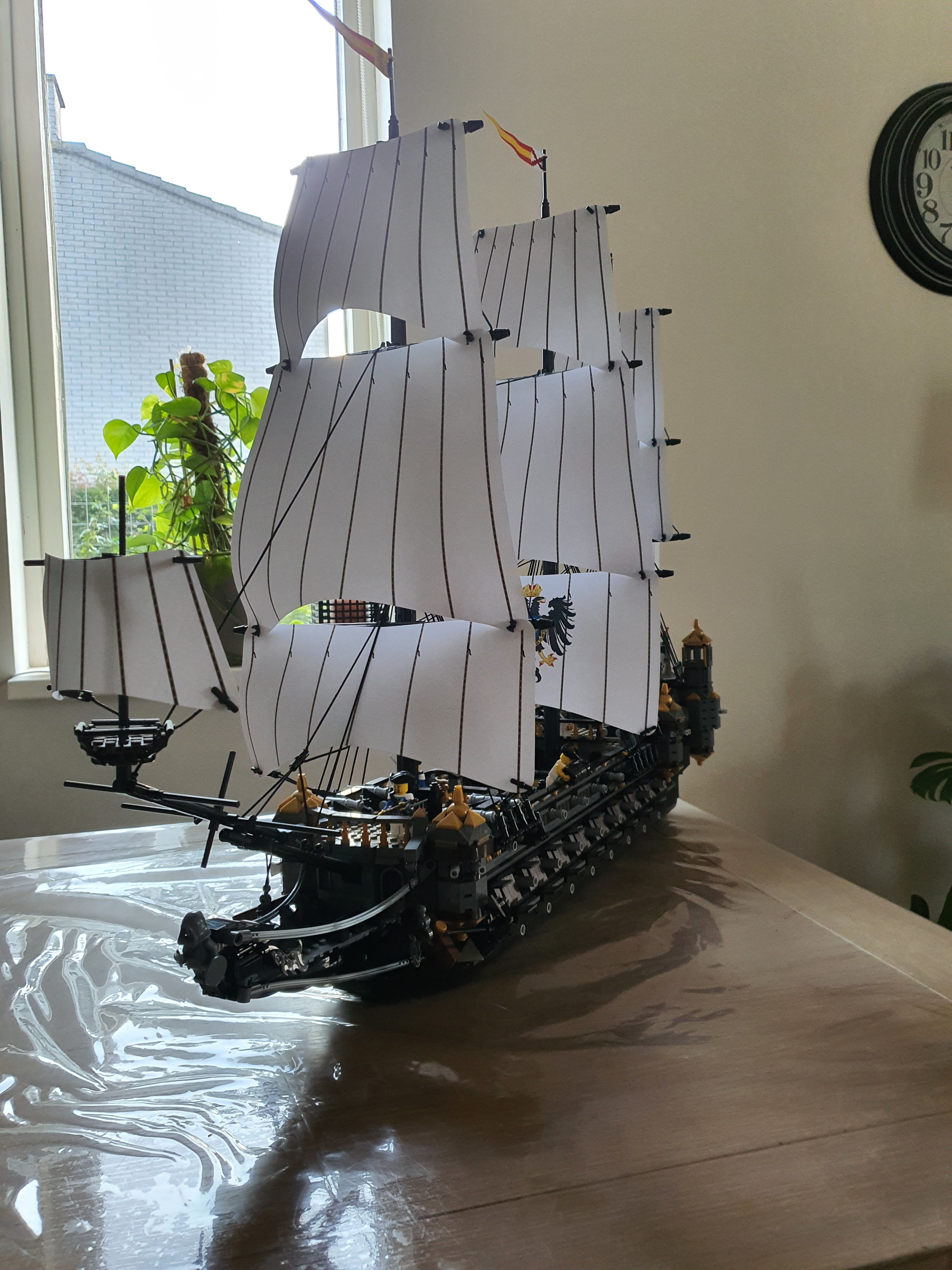
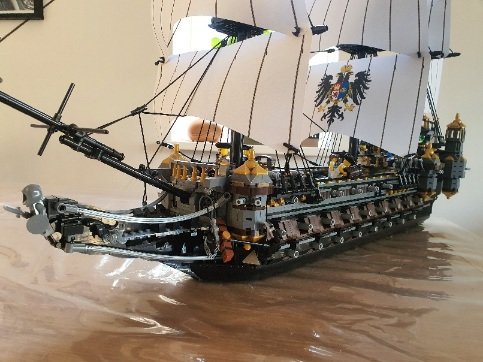
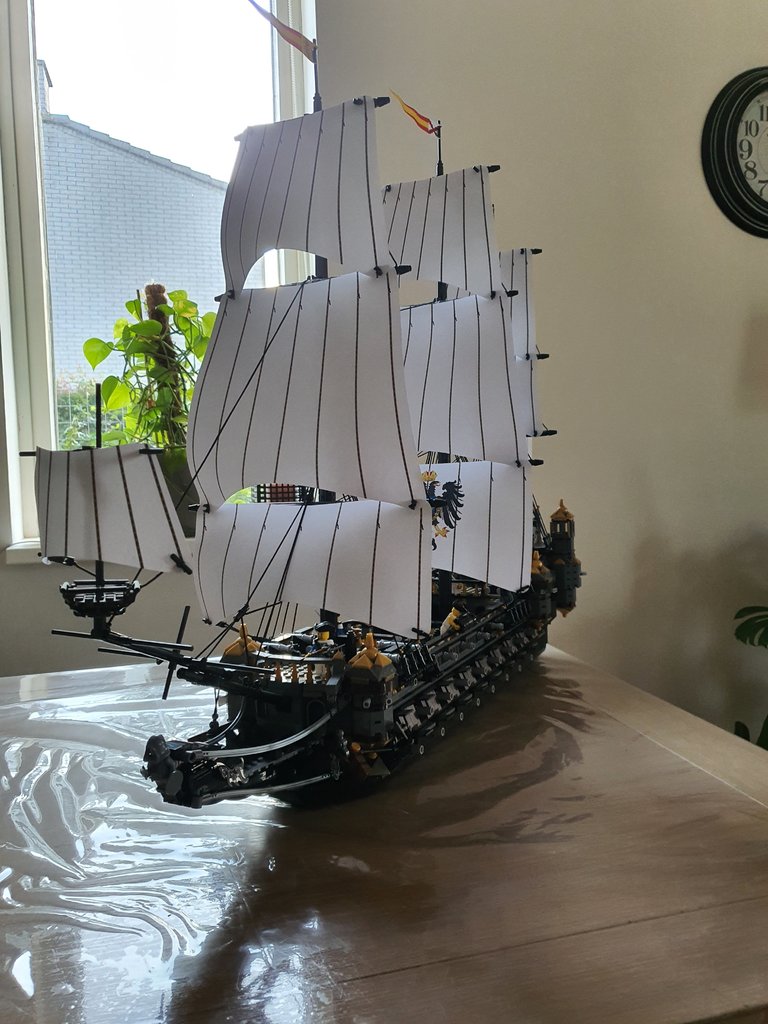
I have come to point where I'm starting to run out of parts. The design I have in mind is grande, a rough 15 procent larger than what I'm showing now. I wanted to wait as long as possible with buying additional bricks and that was a good thing because I see there's quite some space for improvement already. Anyway, this is what I've build so far: She's a bit longer than my Black Pearl, taller but about the same width. Either way she's an improvement compared to my first version of the Flying Dutchman. Back then I was under the impression that you can't build a ship without prefab hull parts The color sheme stayed mostly the same though I think the grey looks rather boring. personally I'm disturbed by the long black line along the ships' side, I would have prefered grey or dark grey instead but I didn't have enough parts. Incase you were wondering, the black line is what makes the angle on the side, I used hinged car roof plates you see, they make a less agressive angle than the hinge plates as used in Captain Greenhairs' Frigate. I did that because the FD is much taller compared to a frigate. I left one side of the ship open, you might find that cool so you can view the interior but the actual reason was that I don't have enough parts for a complete ship. On that note, you don't see the port side in the movies anyway. Anyway there will be an interior I had to reduce the size of the organ in order to make it fit in the captains' quarters, this might sound strange considering my previous Flying Dutchman was smaller yet it had a bigger organ. However, in the previous version the whole captains' quarter was situated on the gun deck, not where it is supposed to be. I think the new organ looks nicer than the old one though. The stern still needs a lot of work, there's no place on this ship where part selection is more critical. But the bow needs the most work of all, apart from the fact that she's missing her "teeth" she could look a bit more elegant. Now, I'm gonna have to order parts but I haven't made up my mind wether I'll finish this ship or start building an improved version right away. You see I found a colorscheme that could work: A combination of old grey and dark grey, dark tan, trans. yellow and some dark green and trans. green accents, actually I'm not so sure about the trans. green anymore. Oh well. C&C is appreciated. I'm under the impression that the Flying Dutchman is a Galleon, correct me if I'm wrong on that and while you're at it I'm also confused about POTC Queen Anne's revenge, a ship I would say she's also a galleon.
-
My entry for Series 11 of the BrickLink Designer Program - please vote if you have a moment! https://www.bricklink.com/v3/designer-program/series-11/5033/Armada-Galleon-Esperanza Legendary for the amount of gold that they carry, the treasure galleons of the Imperial Armada are also heavily armed in order to fend off any daredevil Pirates. Esperanza features an integrated mechanism to run out the cannons on each side. In between the cannons on the gundeck is the massive cargo hold, that is filled to the brim with gold! I worked hard to ensure that Minifigures can still stand below deck and the interior is fully accessible on both the gundeck and the great cabin above it. The pilot house contains a functioning steering mechanism - using a historically accurate whipstaff instead of a ship's wheel: Galleons were built before the ship's wheel was invented (around1700), so they all would have been steered in this fashion:
-
I would like to present my take on the Ninjago subtheme Sky Pirates theme. I have designed an airship mothership for the Sky Pirates in small Midi-scale for ease of display. It takes design cues from Japanese architecture and ancient war ships, mixed with Diesel Punk. It measures about 2 feet long and comes in at around 2300 parts. It features 4 main engines to keep it aloft, and has sails for that extra wow factor. It also has a flight deck for aircraft to takeoff from to launch Ariel attacks on their enemies. I kind of took inspiration from the Misfortune's Keep, so I named this the Misfortune's Dreadnaught. The ship is designed to be built in 3 modules which then attach together and sit on the base. There is also some modest rigging(not shown) I have built this MOC in real bricks, I will add some more real photos to share a little later once I get around to photographing! The last image is a mini fig scale version of the small attack ship that fits on the mothership. I would love to design a mini-fig scale version of the full ship someday, but it will be ridiculous. This is a much underrated sub theme (in my opinion) that I wish Lego would expand upon some day, but until then I will have to do my best to come up with some more vehicles :) I forgot to add a link to more picture on Flickr: https://www.flickr.com/photos/201489097@N08/albums/72177720332706987 I have made instructions for both of these builds on Rebrickable if there is any interest, you can PM me.
-
Hi everyone It has been a while since I posted something in here but I want to share my version of the Silent Mary I found on YB created by Moc my Bricks. I've added approximately 2500 extra bricks on his build to make the ship more realistic and more detailed. This is the first big ship I've made and here are the mayor things I've added or changed: * I've added an extra lower gundeck * The wide of the rear is increased by 2 studs to add 6 rear guns * The weapon on the backside is changed, I've tried to make the 2 lions holding the shield. * There's a galley below the upper gundeck * All guns have been redesigned to make them more realistic * There are 2 triple barrel guns hidden on the front of the ship * The captain quarters is having a full interior now and there is a secret storage below his desk. * The main deck is drastically changed, it's having chairs to the lower and stearing deck and a few other items changed. In the link you see all photos I've made and I hope you guys like it and if you have any other ideas to improve it even better please let me know. Link to my Bricksafe page: https://bricksafe.com/pages/Raymember/silent-mary-moc
-
INTRODUCTION The Jolly Roger was a three-masted galleon anchored around the coast of a faraway island of Neverland. It served as a base of operation for Captain Hook, Mr. Smee and the rest of the pirates. We all know the story, but do we know the ship? First images, then details. INTERIOR & DETAILS To ensure maximum playability and allow easy access to the ship interior, the ship features a removable quarter-deck, a fully furnished captain’s cabin, a separate captain’s sleeping quarter, a spacious crew quarter, a prison cell, a kitchen with a rat, and one deadly gun deck. QUICK INFORMATION Parts: 3751 parts (without minifigures, ropes and sails) Dimensions: W: 25.9cm L: 75.6cm H: 58.7cm Weight: 2627 grams Difficulty: Hard Build (+14 years) Type of set: For Display & Super-light Play IMPORTANT: Model does not float ABOUT THE DESIGN I decided to go against a remake of a ship featured in one of Peter Pan's motion picture movies. Partly because building a brick-built version of a real ship puts considerable constraints on creativity and freedom to play, and partly because none of the featured ships in those movies looked half as interesting. With that settled came the daunting question: what should Captain Hook's ship really look like? In short, it must be a three-masted galleon, and it must look menacing, and that was my guiding line. INFLUENCE& INSPIRATION The initial idea for the stern came from the skull panel on LEGO 6286 Skull’s Eye Schooner, which was quickly toppled by Captain Barbatos Charon Chest (read more about it HERE). I think @Barbatos did an amazing design, and the idea of the ship with a "skull" stern stayed with me for several years. So I began with only a rough idea of what I wanted, a three-masted galleon with a huge skull on its stern, but no cut-and-clean way of how to get there. The start was slow and discouraging, but parts kept on coming, and at some point the ship took a life of its own, came alive, so to speak, and I was left there only as a mere spectator of bricks and plates coming together. VIDEO TOUR BUILDING INSTRUCTIONS AVAILABLE

-
 This small ocean going vessel is inspired by several sources, chief among them being the look of the old Adventurers products like 1999's set 5976 - River Expedition, and 2000's set 5975 - T Rex Transport, along with my six-year-old model of a American Missouri River towboat. I combined these ideas and came up with this model of a small steam ship for my Adventurers crew to use. I am planning on naming the ship after Zephyrus, the ancient Greek god of the west wind. The rear of the ship, which is currently missing four parts. The letters for the name are also currently not on the ship from near the bow. Inside the bridge of the ship. It still needs a bit more fleshing out, with maybe a engine telegraph near the rear wall. The lower deck area is empty for now... I'll figure out what to put there later. Parts are being found for this MOC as I type... hopefully it will be done at some point next month. Thoughts?
 -
 When people ask me what is my favorite LEGO set, I always answer with the 1991 set, 6542 Launch and Load Seaport. The set has such high playability, so many fun vehicles (though it could use a Unimog), and stories that never end. I have always wondered what it would look like to update this set in the world of Technic. The ships, the crane, the truck, and all the containers moving around with more technical functionality. What would a fully integrated Technic version of this set look like? What features would I add? What scale could it be? About two years ago, I was fooling around in Studio, wondering what a bigger version of the set would look like. I considered the size of 42062 Container Yard (7 wide), but it looks clunky, and didn't really seem to add anything from the original set. So I went a little bigger, thinking 11 studs wide for the containers would be nice. This seemed out of scale of many of the builds I do, and would be a weird truck size. So then I tried the Mack Anthem scale (roughly 1:21, and 15 studs wide). This seemed to work well, and could integrate well with other LEGO 1:21 MOCs. I built a little mocup in Studio, using my Vintage Tractor, to try out the idea. I liked the idea, but the full build would be huge. Roughly 4 times bigger than 6542. I'm not sure I am ready to commit to purchasing all the parts needed for the full project. The dock alone would need 250 5x11 LBG panels. This image is about 300 studs wide, by 190 studs deep, by 90 studs high. But I am curious to see where this will lead. I love integrated projects, and this is certainly that. Each container will need to be the same size, moveable by both crane and forklift, and rest on a truck and ship. I think I'll be able to build all the containers and the truck, and I think I would like to get the ship done. We'll see what else I complete. I hope to keep the feel of the original set consistent, but the look may be updated a little bit to work well with scale and current vehicular design. For instance, making a mockup for the trailer, two axles looked silly, so I went with a three axle design. Right now the trailer is done. The trailer has working front support, and two locking mechanisms to lock the containers to the bed. Each axle has a simple suspension. It also fits the Mack Anthem Standard. The container standards are set, as this was crucial to get size, lifting, locking, and cargo standards set, so I'll post more about those soon. The White Boxes are about done, as is the Tractor (Thirdwigg Farm Approved!) container. With each update, I'll post the current full build. Today we are at 2782 parts. We'll see where this goes, so feel free to follow along. Maybe we'll even find a way to include a Unimog!
 -
Hello everyone, this is my MOC of USS Constitution. I estimate it to be between 5-7000 pieces. I will eventually rig the ship fully as well as add minifigs and longboats. I am currently working on the Guerriere for a battle diorama. If anyone has any feedback or changes I should make, plea feel free to let me know. more photos at Uss constitution - Imgur
-
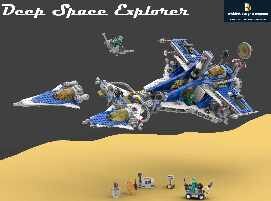
The Deep Space Explorer is my latest submission to the Bricklink Designer Program Series 10. The design, colors, and parts used are based on Classic Space sets, mostly up to 1987. This ship is comprised of 21 separate components that assemble into 1 main ship or can be assembled into multiple ships and land bases, all using the original connection style from Classic Space of Modified Bricks with Technic pins and Technic Bricks. You can support this submission through the link: https://www.bricklink.com/v3/designer-program/series-10/4036/Deep-Space-Explorer
-
I have begun works on my new version of the Flying Dutchman. While I was trying some things for the Captain's Quarters, I decided to break out and make a separate vignette. The key pieces are the pipe organ and stern window of course. These will go on the ship. Though I'll replace the starry purple bricks by transparent yellow and orange. Interesting fact; in At Worlds End, there are two broadside cannons in the captain's quarters, however, there's no opening in the hull to accommodate them. Ah yes, if you study the movies and source material as much as I did, you'd find lots of inconsistencies. These wouldn't be a bother unless you're trying to build an exact replica . I hope you like it. At some point I'll attempt to cram all of this into a ship.
-
Hello, I'm here again. after my first Pirate's MOC ("Taverna") today I want to show you all my first ship EVER. This is my version of a classic imperial guard ship , iconic set 6274 Caribbean Clipper. Now I show you step by step, how I built it. Please, sorry for my bad english, I hope you can understand me. Enjoy and please, leave a comment and give me a lot of advice on how to improve because I've never done a sailboat before. I saw extraordinary work on this forum, you are all very good, real master builder! P.S. sails, unfortunately, are NOT original!
-
"I spy, something... white." Even though it only appeared in for about one minute in the Ninjago series pilot, I've always thought that this ship was really neat, and it definitely was a lot of fun working on replicating it in the brick! A few close-up shots: A small interior: And the ship by itself: This ship is found at the very beginning of Pilot Episode 3 (or 2, depending on how it is counted), King of Shadows, and the only purposeful deviation I've made from the original ship itself is that the bottom is reddish brown here instead of dark brown, since that was, well, essentially impossible given my bricks! This is also a warm-up to the theme as Kai and I plan to do a large-ish Ninjago collab shortly. Credit goes to Grant Davis and Eli Willsea for the water technique! A last couple of shots: Thanks for viewing, C&C are welcome!
-
Hey all, it's been quite awhile since I was last able to build, but I just couldn't miss the Colossal Castle Contest - especially with a warship category this year. So, Instead of building a handful of rushed entries, I decided instead to pour my heart and soul into a single entry. (Pictures link to Flickr) I decided to revisit an idea I had when I built my first ship a couple years ago. I hadn't managed to make it work then, but I have come a long way as a builder since then. The technique ended up working even better than I had hoped, allowing me to build a sturdy, frustration-free hull with multidirectional curvature and minimal attachment points. This enabled me to make the sides of the hull removable, and to add an interior. The walls you see belowdecks are actually attached to the backside of the ship's frame, meaning that no matter which side is removed, the cabin will always appear as a complete cross-section. In addition, the entire ship is modular, allowing for the removal of the mast and rigging, forecastle, stern decks, hull, and even the main deck, which slides up over the mast. I really wanted to go all-out this year, and, inspired by JKBrickworks' working torsion-spring ballista, I decided to add a functional artillery piece to the deck. This was very challenging, as JKBrickworks' model is over 16 studs wide (much too big for mounting on the ship). Effective torsion springs took up too much space, so I instead lashed together flex tubes and built a scaled-down winding/ratcheting system that is similar to JKBrickworks' original design. It worked, and the ballista you see will wind, hold, and launch multiple projectiles across a desk. Finally, the ship features a working rudder and tiller, all-LEGO rigging (including the rat-lines, which are cut and sewn-together nets), deployable anchors, three projectile types for the ballista (bolt, harpoon, and ball-and-chain), crow's nest mounted crossbow, working doors and hatch, and a full crew including the VIP passengers, captain, navigator, sailors, cook, naval warfare officer, ballista crewmen, marine detachment commander, marine boarder, "Leatherhead" marine sharpshooter, and expeditionary marine. I hope you enjoy this build as much as I enjoyed building it! As always, comments and criticism are welcome and appreciated, and there are (and will be) more pictures on Flickr. Happy New Year!
-
One micro scaled project, you can see the pictures with small descriptions in my imgur gallery if you're interested
-
Harr me harties! I mean ahoy maties! I'd like to present you my new ship. I really wanted to do something with my white hull, but at first I thought it was not going to be used. The white and black tops looked so pixelized, I had to do something. So I covered up the black with white tiles. I also got really inspired by Kurigans red walls on the inside of his new brig, but I don't like the use of electrical tape. So I took a look at the brig made by Andersen T. and got the idea of using tiles on the side. This might also be done with the new small 1x2 rounded slopes, but I like the planked look the tiles have now. I haven't put figures on the ship yet, I need to think of a captain and all that but I don't have the DB's to license her at the moment anyway. So I might do that later on, but for now; enjoy the pictures!
-
"Persistence" - Exodus Fleet Mobile Construction Yard Persistence by o0ger, on Flickr Length: 105 studs Number of parts: not a clue This is where most vessels in the Exodus fleet are constructed and repaired. The mobile refinery supplies the construction yard with refined metal from nearby asteroids. Persistence - Details by o0ger, on Flickr Currently a batch of fighters are loaded up for testing in the main hangar. In the mid ship construction dock a new Attack Frigate is under construction. This is my SHIPtember SHIP for 2016. My goal was to use that big yellow Duplo part, and use some kind of lighting. The ship's interior is somewhat lit up by a EL-wire and the construction dock is lit by lifelites. Persistence - Side by o0ger, on Flickr
-
Stop Motion of 6277 Imperial Trading Post https://www.youtube.com/watch?v=4pZpQte5yH4 Year: 1992 Pieces: 608 Minifigures: 9 Brickset Bricklink
-
http://www.us.lego.c...dd5c8cb?index=1 I improved my 3-masts and 10-guns pirate ship. I'll try to take better pictures and upload them in LEGO Ideas. Is it worth trying? I need your opinion and hope the moderators will put its picture as before because I couldn't find it in your archives. Many thanks. My favorites Lego pirates is my favorite series, that’s why I created my own version of a battle ship with 3 masts and 10 guns (LEGO always gives twice as less guns as gun ports. I improved that, as many fans like it). My ship is based on a combination of Skull’s Eye Schooner 6285 (1993) and Emperor’s Ship 7416 (2003). All my gun ports are classic pirate flags. The main idea The Pirates series once included lots of ships but none had 3 masts. I used mostly big LEGO bricks to make it medium difficult to build. Besides people of all ages love pirate ships, children, men and women alike, all over the world. The deck is removable and there is a large cannon deck. The set includes only 2 mini figures – the captain (series 14) and a classic pirate monkey in a crow’s nest because I’d like to know what mini figures my fans would like in his crew. Comments, criticism and suggestions are welcome. There are additional weapons. This adds to playability. There is a crane for treasure chests on a mast. It rotates and can move up and down. Designing sails, LEGO teams often use Lego scalps and bones. I like that idea very much. But in MOC the sails are red and scalps black as in Queen Ann’s Revenge (4195). The deck and captain’s cabin are removable and you can easily look inside and hide treasure there. All the masts have shrouds to get to crows’ nests. I always try to be attentive to such details. Interesting details: I used Ursula (a Disney mini figure 2016) as a ship figure. And the black dragon wing is used as wheel. The front mast with a triangle sail moves to the right and left. It was easy to do and added realism. Besides Jack pumpkin head is its lantern. And the black Knights axe is its decoration. You can easily look inside the captain’s cabin from the stern. The captain’s cabin has doors to the deck and to the stern. If you like the MOC please have a look at my other creations in LEGO Ideas and here. I Know that it's better for a ship to be longer but necessary parts aren't send to Russia on-line, alas.
-
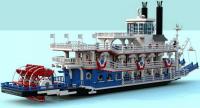
Ready for an incredible journey on the Mississippi aboard the vessel "Mississippi Princess"? The paddlewheel steamboat has 4 bridges: -The lowest includes sessions for passengers, a sofa and the engine room with the 10-cylinder diesel engine 20000HP -The first deck includes 1 suite, 1 double, 1 twin bedroom, 1 shared bathroom and the emergency room and service. All cabins have windows with portholes. The bathroom has a toilet, sink and shower. The second deck is home to the central control of the funnels and the terrace He sees the presence of a service area equipped with 2 high power LED headlamp for lighting at night and "the BELL ". The last deck on the other hand has a small rooftop and the cockpit. The control center is equipped with radar, sonar and computer. The vessel is equipped with two drawbridges for the boarding and alighting of passengers, both controlled by articulating arms and driven by pulleys. In navigation access to drawbridges it is controlled by gates. The paddlewheel is equipped with 8 blades for pushing. I published this project on LEGO Ideas, where you can find more detailed picts.<p>I used LDD to build and Bluerender for rendering. I hope you like it <span style="color: #76787A"><span style="font-family: arial, helvetica, sans-serif"><span style="color: #222222">
-
Harr, yargh! Err....I mean hello good friends of BOBS! Here is my new ship, La Santa Catalina: Captain Green Hair and some of Eslandola's finest are ready on deck to go get some booty: More about this model can be read here, I will license her as a 3T2. She does have different flags and a different name in that topic though.
-
Tags: Science, SpaceshipMission Log Recording - "This is Dr. Steven Quin Livingston with my twentieth weekly mission in Andromeda. I have been asked to perform a scientific study on one of the outer system (which one is top secret at the moment). I have been given control of the science labs aboard the new scientific cruiser, Kagaku (Science in Japanese)" Bridge: Main Deck: Secondary Science Lab:
-
This model is basically two different "okay" fire boat sets smashed together to make a "better" ship. The features I'm talking about are modern upper decks with plenty of fire-fighting power (represented by CITY set 7207), and a brick built hull like from the early series of ships. (as seen on set WORLD City 7046) As a side note, The printed parts are from another Fire Station from the 4 Juniors theme. (4657) With that in mind, I built a whole new hull for the ship out of mostly 2 x 10 and 2 x 8 bricks with a few fancy bow parts from set 7046 thrown in. The rest of the ship comes from set 7207, but with a few tweaks here and there. (such as adding a smokestack and rear water tank) The rear of the ship features an extendable and rotatable water cannon arm to get deep inside the burning hull of the imaginary ship this vessel is fighting to save. You can also see the smaller cannons scattered around the ship in several locations. The top of the ship's bridge flips open to reveal the command center of the model, with the steering wheel and several computer readouts telling of power supplied to the engines and of radar detected objects in the ship's path. The lower deck consists of the galley (or kitchen) and a quite large computer terminal array. The forward flip-up section features water pressure monitor controls. NOTES: The upper deck (the bridge) is grouped separately in the file because it is removable to access the ship's lower level. Also, I originally made this for my brother, but he changed his mind on it, so I'll be (eventually) building it instead. And thanks to user BrickWild who provided the LDD file to begin this model in the "official sets made in ldd" topic: http://www.eurobrick...showtopic=41226 LDD file: http://www.moc-pages...1470680805m.lxf PRINTED PARTS: The smokestack should have two of these: http://www.bricklink...Color=5#T=C&C=5 The water tank should have this print: http://www.bricklink...Color=5#T=C&C=5 The forward flip-up window section should be this part: http://www.bricklink...Color=5#T=C&C=5 As usual, comments, questions, and complaints would be very welcome! EDIT: ship majorly updated and LDD file amended as well. Enjoy!
-
I've recieved the message that my shipyards have finished another ship for me! We need to get there as quick as we can to check it out! And there we are! Isn't she a beauty? Finally a really fast ship that should help us to buy even more ships! That's what we call a Schooner my friend, and this one is a large one! Lets go around to the Stern: She is actually a lot larger than you might think, so I decided to command the Dragon's Revenge here, which is, albeit being bulkier, quite a bit shorter, as you can see from this bird: I also noticed that the Pride of Elysabethtown was around too, so I decided to send my bird up to these vessels too! I think it'll be a while until we have a ship equal in size to the Pride besides the Margot! I also tried to take a picture which includes all of my still standing ships, but that proved to be rather difficult - the War Dwarf/HMS Kent/Justicia (which hasn't recieved a new paintjob as the real model just yet) is to big to be in the forground and way to small in the background (you might be able to see one mast:D) - and all these ships just take up so much space (I don't even want to know how much space these minifig-scale first rates take:D)... So, a quick Overview over the facts: time spent building - no stopwatch running, but I started 1 1/2 days ago 6 swivel guns 4 longguns Captain Ronald Scourie Owner: Jerome Monezterrell (me) Build by the Monezterrell' Shipyards (might be coming at some point in the future :P) Tradecompany: MAESTRO Crew: at least 12 men Rating: at least a class 5F. not sure if it might classify for a 6F. I want to hear what you think! How it all started:
-
Thanks everyone that's supported my Lego Wonder Cruise Ship on Ideas! https://ideas.lego.com/projects/128153 - it's made it to 1K - 10% of the way there, and a time extension :) Check on the updates for more pix and fun stories - this ship was built on the real Disney Wonder and came back to our house in the Captain's cabin! The Mini Wonder is still there as a thank you for bringing back our big Wonder.
-
After some time around these newly explored islands we noticed that some stronger defence on the water would be needed; many Sea Rats and even some unidentified creatures which attacked our man on their small boats were around and causing our man to lose confidence that it would be a good idea to stay around these islands. Some even said they were cursed. This made it clear that we need more to defend our island than just a few man with sticks in rowboats. I decided it would be a good idea to sent a letter to one of the best shipbuilders of Eslandola if he were interested in building some sloops to defend the area. He agreed to the contract and went ahead to build this one; I've named it Arkady for its wild nature and, for its size, good armament. It even has some space to carry along some goods, which I really appreciate. Hereby I present you, Arkady, a class 2WR sloop: I sure hope his aggressive bow keeps those Sea Rats under control! And lastly, a picture of Arkadys starboard side: Not exactly relevant for this challenge, but I still feel like it is relevant, the Arkady with the rest of my fleet (including the HMS Kent/War Dwarf which is now owned by Bregir). Captain Anco Liconardo commands this vessel.