
Search the Community
Showing results for tags 'pf'.
-
 BrickController2 is an Android and iOS application that allows you to control your Lego models using a compatible gamepad. It supports the following devices: - SBrick - BuWizz 1-2 - BuWizz 3 (basic support) - Lego Powered-Up devices: Boost, PUP HUB and Technic HUB (or Control+) - PF infrared (on Android devices having infrared emitter). Features: - Multiple profiles for a single creation - Multiple motor (or output) assignment to a single controller event - Different types of devices can be used at the same time - The same motor (or output) can be assigned to multiple controller events - Different joystick characteristic settings - Different button modes: normal button, simple toggle, ping-pong toggle, carousel toggle, ... - Train mode on joysticks - Normal and servo mode for the new Control+ motors - Sequences (like for flashing light) BrickController 2 on the Google Play Store: BrickController2 android BrickController 2 is also available on the Apple App Store. BrickController2 iOS Video tutorial created by @kbalage (many thanks for this): And another great video by @kbalage: Older versions: BrickController Android application. It lets you to control Lego creations via Lego infra-red, SBrick and BuWizz V1 and V2 using any Android compatible game controller: Current version: BrickController 0.6 User guide: BrickController User Guide Minimum system requirement: Android 4.4 and bluetooth low energy support on the phone (or tablet) Video on the older SBrickController application:
 -

GBC General Discussion
Jim posted a topic in LEGO Technic, Mindstorms, Model Team and Scale Modeling
Great Ball Contraption (GBC) - General Discussion and Index This is a topic used for GBC general conversation, questions, hints, tips, etc. This first post will be used to maintain an Index of GBCs here on Eurobricks or other websites. Eurobricks topics LEGO GBC 8 + Building Instructions (5 modules - 2 motors) New Akiyuki GBC Instruction Index Other sources Greatballcontraption.com -
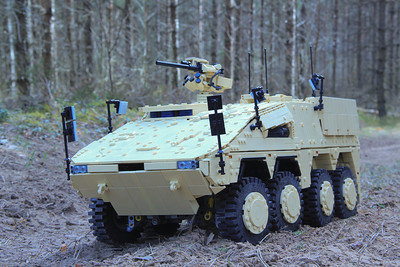
For the last couple of years I've been secretly working on something different than my previous cars and trucks. This here - I present to you Boxer - Infantry fighting vehicle. It's the same scale as my other car MOCs. But boy oh boy - it is a beast compared to those tiny cars. This one here is larger than the famous Abrams tank in real life. So imagine that this one here is like a heavy duty truck. Full with as many details as I could possibly find in the internet. It may sound silly that I mention it so, but... those military vehicle details, especially when it comes to the interior details and gadgets, those pictures are very hard to find. Probably for a good and secure reason, so - can't really blame anyone for that. Would love to see one of these up close in person. Some day, maybe. Till then - enjoy this one. Hope you like it, couse I sure do :) Oh, did I mention? It has all wheels double spring suspension, all wheels drive with PF (2 x XL) and 2 x front axle steering (1 x M). See full album on my flickr account
-
 Hi, I hesitated if I even should post this MOC here since it is so simple but at the end here I am. I created this truck mostly to have some fun outdoors. It has minimal amount of features and its main goal is to drive over not so pleasant terrain, like sand, mud, snow and even quite deep water. And I can do that without fears, that drivetrain will jamm, gears will skip, motors will get wet and at the end I won't have desire to clean all this mess up. I also very like the closing mechanism of "differentials" covers. It is simple, effective, works like a charm and has satisfying click when closing. This Truck is also testing ground for a couple of solutions I wanted to try out, like drive shafts connected to the axles at the angle, steering controlled by rod or way of suspension for both front and rear axles. Nevertheless please enjoy the video, use the instruction and check some details below if you want to know more. Instructions: https://rebrickable.com/mocs/MOC-136120/keymaker/trial-truck-6x6-rc/#details Some details and main functions: dimensions LxWxH: 37,5x13x15cm weight: 1132g 6x6 drive (3xPF L motors) steering (PF servo) suspension on all axles completely secure bottom of the truck with panels easy access to all "differentials" via openable covers Couple of highlights why this truck can be fun to build and to play with: Drivetrain - it is very solid, so you won't hear skipping gears, if wheels aren't spinning, then you either broke some part or stalled motors. It is also super easy to use different gear ratio or different number (1/2/3), type (M/L/XL) or even technology of motors (PF/C+). What is more, removing all electronics takes only couple of minutes and truck is ready to taking the shower to clean all evidence of you off-road madness Construction - it is very rigid and solid, you can lift it up by almost any part of the frame and body Off-Road Design - all gears are protected so you don't have to be afraid that they will jamm due to sand, mud, snow, stones etc. And even if something get inside "differentials", it is super easy to open covers and clean this up. Last but definitely not the least - ability to drive through deep water - UP TO 8CM! It over half of the height of the truck. 8cm of water and your electronics is still safe. Internals of the truck: P.S. I know it is rather ugly, but it brings fun! :)
 -
 Skid steer off road vehicle. The PF elements are fully protected from snow, and it actually works on harder snow. Driven by two PF L-motors, one motor per side. As a power source can be used BuWizz or any other 4-port battery box (not in the parts list). Building instructions+parts list: https://reb.li/m/95837
 -
 There are no many creations with the blades, so here's mine: Bell 206 Helicopter Features: - Main rotor collective pitch control - Rear rotor pitch control - Opening doors - Rotating propellers - PF: M-Motor, LiPo battery. Video: More photos: Building instruction: https://rebrickable.com/mocs/MOC-98383/paave/bell-206-helicopter/#details
 -
Just began another baja/ trophy-truck project, the other 2 (or 3) being ”canceled”. I managed to put 2x L motors and 1x servo motor, both Power Functions; it also has positive caster-angle, independent suspension in front and solid axle suspension on the rear, (at least) semi-detachable body and the headlights can be be lit (there are 4 pin-holes for installing lights). Heavily modified version of this
-
 Hi Yes, again but with a lot new features! This Toyota Hilux 4WD / Pickup Truck in its most basic version with a simple cab and the largest possible cargo area is a typical workhorse One more extra body will be in the end;) You can use youtube autotranlastion functions to understand something:) Or just watch review and test drives. Common specs Solid axles Front suspension 4 link Rear suspension 3 link Openable doors, bonnet, tailgate 2-seater saloon LED front lights (option) Removable pickup bed and cab Wheels: 62-68 mm Power functions chassis Control: PF IR / Smart Brick (SBrick) / BuWizz Drive: PF XL motor, 4x4 transmission with axle differentials and rear auto-lock Steering: PF Servo motor Control+ chassis control: Control+ (Powered UP) / BuWizz 3.0 PRO drive: Control+ L motor, 4x4 transmission with axle differentials and rear auto-lock Steering: Control + L motor FACELIFT The exterior has been slightly redesigned and optimized, including the use of new elements and techniques that have appeared in recent years. However, I haven't given up on some simple and solid tech-style solutions in favor of smoother slicker solutions like in the Back to the Future Extra Detail version. The doors now have latch locks, since the old locks on the small cab cannot be implemented. The number of basic system elements has been reduced - now the front bumper is made in a technic style with a small nuance - the mounting of the lights in the bumper is illegal and orange tile parts can fall out and get lost. The interior uses a new steering wheel with a diameter of 4 (for PF cersion). If you do not have one, use the old one with 3. In order to prevent using boring monochromatic paints, retro-style colored stripes are added. You can refuse them in favor of plain assemblies. Initially, there are two color options - white and black. Maybe there will be other colors in the future! I believe you can build red, orange and blue versions with minor mods. CHASSIS: PF and C+ The chassis in PF version still runs on Power Function elements, despite the fact that they have already been discontinued by LEGO in favor of the new Powered Up - Control +. Power Functions are quite common among fans, in the secondary market, as well as in the market for third-party parts and electrics, which, at relatively low prices, makes the model affordable for assembly with low budget. On the results of operation, a number of important improvements have been made to chassis: A fairly common reinforced differential of a new type was used. This diff has a larger gearing of 12-28 versus the old 20-28, giving the model more torque at the price of speed. This is important when using larger wheels, both 68mm and 75mm. But more importantly, the new differential significantly decrease load the universal joints. When using standard 62 mm wheels and standard power, the cardans held the load well, however, with the increase in wheels and especially when using third-party more powerful power sources like BuWizz, the cardans could break. The new differential partially removes the problem, but if you modify the model by installing larger wheels that are more tenacious and using more powerful power sources, I advise you to also buy steel universal joints. In general, you can get by with the old differentials, but with standard 62mm wheels and standard power. By the way, in the rear axle drive, instead of a cardan, a reinforced new CV joint is now used. The second important point is the redesigned front axle mount to increase the front clearance by 0.5 STUD. This update is linked to the first improvement. For larger wheels, you need to mount the axle further from the frame. Moreover, during the operation of the front suspension, the longitudinal displacement of the axle is significantly reduced due to the longer levers and the angle of their attachment. Due to the use of a new steering servo differential, the motor had to be reversed And finally, new function! Rear differential with automatic locking in case of diagonal misalignment of the rear axle. Significantly increased off-road performance of the model will make you happy! The locking mechanism prevents loss of grip during diagonal hanging. The mechanism uses an orange wave shift clutch. The idea was adopted from idea of @Madoca 1977 . The rear axle design can also be used with older type differentials. In addition, you can build a simple and reliable old axle without a lock (but with a new differential), in case you need simple construction. Finally, I decided to upgrade to the new Control+ / Powered UP LEGO motor system. It was a matter of time, because new original PF elements are harder and expensive to find. This is especially true for the SERVO motor. New LEGO fans usually have Control+ elements only. First of all, C+ «bad» for its dimensions: all motors are larger in size. The 4 port HUB is severely limited by the layout of the model due to its large size and weight. Installing a hub in a model of my size while saving the interior will negatively affect the weight distribution and off-road performance of the model. Specifically, in this model, the Hub will be difficult to hide behind seats without adding a body cover. In the end, a compromise solution was made - to place the unit inside the cabin as low as possible. I had to sacrifice seats, but I managed to leave the backs and the instrument panel with the steering wheel. If you do not open the doors, you may not even notice that half of the cabin is occupied by the hub. Therefore, from the outside, the model looks like a regular PF. It should be noted that due to the low location of the hub, it was necessary to make the frame as thin as possible at the point of attachment of the block, which negatively affected the torsional rigidity of the frame. However, the HUB is integrated into the frame in such a way that it is an element of rigidity, and at the same time is quickly removable for battery replacement. The drive motor is now located behind the cab, flush with the luggage compartment floor. Using a flatter motor (instead of XL) now allows different main gear ratios 12-20 (standard), 16-16, 20-12, (even 8-24 and 24-8). On the PF chassis, only non-alternative 24-24. Due to the transferase shifted back, the lengths of the drive cardans have changed. The bending of the front cardans has decreased, which unloads a little. However, this low location of the lead motor made it impossible to use reinforced CV joint like in new PF chassis. In general, the weight distribution of the C + chassis is more successful compared to the PF, which is noticeable when driving on uneven surfaces and uphills. The steering L motor is mounted directly on the front axle. The front axle and its connection to the frame are made new. Control app You cannot use the existing profiles in the Control+ app to control the model (the profile from 42124 buggy has a limited steering angle) so you need to use the LEGO Powered UP app, BuWizz app, Brickcontroller2 (only with a gamepad) or Controlz (recommended): Android version. iOS temporary unavailable. The model is still modular, which makes it easy to assemble, disassemble, repair and modify. OLD BODIES You can use new chassis with old bodies and vice versa. May require minimal modifications. if possible, I will modify previous models to the level of this in terms of body and chassis. More about previous Crew Cab and X-tra cab BTTF: AUSTRALIA MOD Any aussies here? A custom tray, bumper, roof rack and snorkel available as mods. Australians will especially like these accessories. See pictures below: Could you count number of storages here? Accessories include: - Chrome Headlights (Designed by NikolayFX and borrowed from EXTRA DETAILED BTTF Toyota Truck) - Power Bumper (You can get it for free here) - Custom Tray (Inspired by Australian manufacturers) - Roof Rack (2 versions) - Snorkel (2 versions) - Fuel Cans (Big and Small) BONUS In the end I've promised one more body - kind of Dakar Rally Offroader Body is 100% alternate of 42093 LEGO Technic Chevrolet Corvette. You only need a chassis from Hilux (PF/C+). This Instruction is free. thanks @FX6000 for Instructions and cool renders Thank you and happy building more photos https://bricksafe.com/pages/rm8/toyota-hilux-single-cab-pfc-4x4- https://bricksafe.com/pages/rm8/-toyota-hilux-single-cab-pfc-4x4--custom-australia https://bricksafe.com/pages/rm8/rally-off-roader--alterante-body-from-42093-chevrolet-corvette my rebrickable account Chassis Bodies Mods MEGA PACK (7 in 1)
-
 Hello all, I have recently built a model that might actually deserve a post. This is a working, running (albeit only on R104 curves) 1:48 scale model of the Pennsylvania Railroad Q2 duplex. PF or PU motors power all five driving axles, and the design uses no third party parts besides #11 drivers. See the video for a more detailed description.
 -
 I again wanted to go big on this build. Like BIG. So I went 1:16 scale the best I could. I started with an existing design from a failed build. The plan is to have 2 PF-L motors for the drive, PF-XL for the boom, and PF-M for the rest. Please note that I'm almost done with the build, but I am making minor adjustments to the build to help with function and/or weight support. I will be posting here to "show my work" of sorts and get feedback. I have been busy catching up on other things and building the excavator. (not much free time for posting/commenting on here) This was the first version of the bottom: And the start of the upper: It was looking good, sort of, I had to redo all of it as I add the battery boxes and arms it had a weak structure and was "clunky" in functions. I have remade all of the above and will post more in the morning to not have too many pics in a single post.
 -
 Some might still remember this offroader I started sometime ago in 2019 and showed earlier versions in the 8081 mods thread a while ago. Well, I finally "finished" it now and created digital models for it. I call it the COMMANDO and it is "sold" by MM (Mars Motors). People that follow my Turbo Racers series and my series of 42093 scale cars with swappable engines should already know MM. To show its capabilities I made a trip to a special location and examined what it can do there. Have a look into the video to see what it possible: The configuration in this video has all axles locked and uses the drivetrain variation #2 (see below). The COMMANDO started as the glorious 8081 A model and went through lots of modifications - especially to the front and rear axles and also to the outer hull - on the way to the final result. I created three versions so far: with 1 x PF AA battery box with 2 x PF AAA battery boxes with BuWizz 2.0 ...from which the BuWizz one was used during the video and also most of the time I drove it so far. Here are a few more detailed pictures showing it in that terrain: Here are two pictures showing the chassis construction (click to magnify): ...and here are the three drivetrain variations that can be used (click to magnify) More variations are possible and the gearing can be changed with relative ease, as the motors are not an integral part of the construction: #1 is used for the PF versions and #2 is used for the BuWizz version. #3 can be used to examine the effects of open differentials in offroad situations. The COMMANDO can use various tyres and clearance should be good enough for all of them: 45982 81.6 x 38 R Balloon tyres 18450 81.6 x 44 R (Tumbler) tyres 69912 81 x 35 Tractor (Zetros) tyres I have also already designed a few addons that will be released at a later time - need to create the digital models first - and I have even more ideas for it. So far I have available: front winch rear PTO exploration gear tracks So stay tuned for additions. I hope you like the COMMANDO and I hope it is a worthy successor to the 8081 A model. If you're interested, the - free of charge - digital models (Studio files with detailed steps and submodels) and more pictures are available on Rebrickable: https://rebrickable.com/mocs/MOC-111591/johnnym/mm-commando/
 -
 I already planned to open this topic back in March or April, but I got caught up in work and stuff. Recent discussions in the 42129 thread makes me feel that inow is the good time to start it. My vision for this thread is that it will be a directory that contains the PF conversion mods for all of the Control+ sets so far. I have created a few mods myself as well. And I'll try to keep the information organized by updating this first post. If you have any mods, feel free to contribute. This thread can also be the directory for Studio models for the C+ sets, so that anyone with a mod idea can give it a try. ------------------------------------------------------------------------------------------------------------------------------------------- 42099 Available PF mods on Rebrickable: https://rebrickable.com/mocs/MOC-28766/olivierz/4x4-x-treme-off-roader-42099-power-functions-base/#details ------------------------------------------------------------------------------------------------------------------------------------------- 42100 There is currently no PF conversion mod available on Rebrickable. I've designed two PF mods for this set in Studio, but I haven't published yet because I haven't made the mod instruction. They will be published later this year. The mods are: - Full RC PF conversion: This mod replaces two hubs with two PF battery boxes, replaces all motors with 7 L motors, and adds 4 RC receivers. - Motorized PF conversion: Because a big empty box with 7 motors engaged in direct transmission is boring, I want to add something more Technic-ish, more mechanically interesting. This mod removes all hubs and motors for the base, which makes slewing and driving manual, and add 1 PF battery box, 1 L-motor, and a gearbox with 4 multi-directional switches for the functions of the super structure. Thanks efferman for sharing the base 42100 Studio file. ------------------------------------------------------------------------------------------------------------------------------------------- 42109 My free mods: - L-motor steer: https://rebrickable.com/mocs/MOC-84883/nguyengiangoc/42109-pf-conversion-l-motor-steer/ - Servo-motor steer: https://rebrickable.com/mocs/MOC-84884/nguyengiangoc/42109-pf-conversion-servo-motor-steer/ ------------------------------------------------------------------------------------------------------------------------------------------- 42114 My free mod: https://rebrickable.com/mocs/MOC-85933/nguyengiangoc/42114-pf-conversion-servo-motor-steer/ ------------------------------------------------------------------------------------------------------------------------------------------- 42124 My free mods: - L-motor steer: https://rebrickable.com/mocs/MOC-84954/nguyengiangoc/42124-pf-conversion-l-motor-steer/ - Servo-motor steer: https://rebrickable.com/mocs/MOC-84955/nguyengiangoc/42124-pf-conversion-servo-motor-steer/ ------------------------------------------------------------------------------------------------------------------------------------------- 42129 My free mods: - L-motor steer: https://rebrickable.com/mocs/MOC-84984/nguyengiangoc/42129-pf-conversion-l-motor-steer/ - Servo-motor steer: https://rebrickable.com/mocs/MOC-85004/nguyengiangoc/42129-pf-conversion-servo-motor-steer/#details ------------------------------------------------------------------------------------------------------------------------------------------- 42131 My free mod: https://rebrickable.com/mocs/MOC-92919/nguyengiangoc/42131-pf-conversion/ ------------------------------------------------------------------------------------------------------------------------------------------- 42160 My free mod: https://rebrickable.com/mocs/MOC-161275/nguyengiangoc/42160-pf-conversion
 -
This is my MOD chassis for the LEGO Technic Land Rover Defender 42110 with motorization using PF motors. Features: - fully RC for driving, steering and gear selection - working V8 fake engine - driving by 2 PF L-motors - steering by PF servo motor - 2-speed gearbox (LO/HI), controlled by PF M-motor - AWD with a centre differential, including differential lock - the centre differential lock is auto engaged by the LO gear I hope you enjoy the video :-.)
-
 Good Day everyone! After completing MPATEV-01 (video&LDD file coming soon) and not able to progress on Saber, decided to build something from my bucket list. And there was 8258 B. After a somewhat boring build process the final result was not very satisfying, so my first idea was to motorise it. However keeping the model as it is would be extremely boring, so the whole chassis and rear part were dismantled, leaving only the front, bonnet and hoods . Next a 4X4 (AWD probably but you've been clickbaited mwahahah ) with open diffs was made. No reduction from the XL motor but the one in-between driveshaft and diffs. On front there are two gray (old gray - undetermined type) springs and on the rear a leaf axle out of 9l links (idea by ZBLJ). Of course that horrendously enormous fake motor was kicked out and substituted with a cute mini V8. Interior is as crude as the original but now with even less foot space and a switch under the dashboard. Steering through M motor and hockey spring combo, M motor-powered winch controlled with the LBG connector on dashboard. For power I opted for a "classic" PF receiver and custom wired 9V battery neatly fixed with a net in the bed. Overall not the best performance but it's quick yet (relatively) powerful. Front winch is detacheable to improve climbing angle (approximately 50 degrees maximum). I haven't named it a MOD because most of it was made from zero, and the N2 is because this is a successor to one of my early RC MOCs - pickup N1 https://www.eurobricks.com/forum/index.php?/forums/topic/127500-moc-4x4-off-road-pickup-n1/ (my imitation of 9398 as I couldn't afford one and still can't) LDD file DOWNLOAD Video: (sorry it's 30° outside, batteries died and I ain't frying myself 2 times for some offroading outside ) Have a nice weekend, Cya later!
 -
Book Review (Review by Thorsten Benter) Almost a year has passed since initial publication of this book. There are a number of on-line reviews available – this one on EB seems to come in a bit late. Well, I don’t think so, in contrast. This book is a comprehensive how-to-build-a-train resource rather than a compilation of what is out there. And this sets the book aside from so many others. It will be up-to-date as long as The LEGO Company produces bricks and sets. Plus, with the arrival of the Powered Up system, more space becomes available inside the train body as compared to comparable PF functionality: The dedicated receiver becomes obsolete and no line of sight is required for communication creating some additional space – space for sophisticated building techniques! This books tells you everything you need to know about the historical LEGO train theme development at TLG, about scales and widths, about pivot points, microstriping, SNOTing and offsetting, and so much more with relevance to train building! (Note: A PDF copy of this review with higher resolution pictures will be shortly available at Holger’s website) Summary: A must-have for every LEGO train fan, for people entertaining the idea of getting into LEGO trains, and for people who still don’t know that they will become train fans after reading the book Superb photography of LEGO models, outstanding renders of CAD models In-depth analysis and assessment of the different LEGO train eras Demonstration and teaching of advanced building and design skills My personal LEGO book score: 10/10 About the book: Author: Holger Matthes Published: Oct. 2017 by No Starch Press Inc., San Francisco, CA, USA. Hardcover, 135 pages + 90(+) pages reserved for 4 full building instructions (ICE train, gondola car, Swiss Crocodile, and a vintage passenger coach), 150+ most relevant and educational figures (excluding the beautiful chapter openers or page breakers as well as the set building instructions), 20+ tables including bulleted lists. ISBN: 1-59327-819-5 Price: € 14 (Kindle edition, Amazon); € 23 (Print edition, Amazon) both as of 9-2018. $ 19 (ebook only), $ 25 (ebook and print edition, nostarch.com) both as of 9-2018. The present English edition published by No Starch Press is based on the initial German edition “LEGO Eisenbahn – Konzepte und Techniken für realistische Modelle”, which was originally published by dpunkt Verlag Heidelberg, ISBN: 978-3-86490-355-7. The initial German edition of the book based on Holger’s manuscript composed in 2015/16 caught the attention of foreign publishers: It began with the present English edition in 2017. It then took a bit longer until the Chinese publisher “Posts & Telecom Press” (who has already published a bunch of LEGO books written by fans) very recently released the Chinese version: http://www.ptpress.com.cn/shopping/buy?bookId=0ed0cd68-ca59-41fc-9bf9-193b06089996 (ISBN: 978-7-115-48419-2): After publication in 2017, No Starch Press’ English version became the reference for further translations. In summer 2018, the Spanish (“LEGO TRENES”; LEGO TRENES https://www.amazon.es/TRENES-Libros-Singulares-Holger-Matthes/dp/8441540179) and the Italian (“TRENI LEGO”; https://www.amazon.it/Treni-Lego-colori-Holger-Matthes/dp/8868956411) editions became available. And the Russian version is on its way (sorry, Holger couldn’t tell me any further information about its availability): (Note that the Russian cover on the right is purely made up by me – Google translator says the Cyrillic headline reads “in preparation” – but who knows …) About the author Holger Matthes is a hobbyist who has been building with LEGO since 2000. He was involved in the creation of various official LEGO projects such as the Hobby Train set #10183 and frequently presents his models and gives workshops at LEGO exhibitions worldwide [copied from Amazon website]. Table of content of the book (short version) Part 1: Overview and history Introduction A history of LEGO trains Part 2: Building your own train models (My own creations – MOCs) Basic principles Designing your own models Case studies in design Part 3: Building instructions A note on the included building instructions Appended to the body of the book, you’ll find four high quality and carefully composed instructions in addition to two free online instructions: Inter-City Express (ICE; driving and trailer cars, PF motorization, windshield designs) Gondola car Swiss electric Be 6/6 “Crocodile” Vintage passenger car Steam Engine BR 10 (as bonus online available at http://holgermatthes.de/bricks/en/br10.php) Steam Engine BR 80 (as bonus online available at http://holgermatthes.de/bricks/en/br80.php) There is further information available online. Holger directs you to https://www.nostarch.com/legotrains; but most of the very valuable stuff is actually hosted on his website. I highly recommend to visit his site: http://www.holgermatthes.de/bricks/en/index.php. You will find a wealth of background information, tips&tricks, how-to, and much more. The Book Let’s face it: Almost one year after initial publication, Holger still sets the stage with this book for LEGO train fans. It will be tough to get it much further; not on 135 pages (not counting the instructions pages), not with regard to the topics covered, not with regard to the width of the audience addressed. This book provides diverse perspectives on the art of building LEGO trains, coaches, and rolling stock – and is at the same time always determined, focused, and addresses most relevant “issues”. Train builders repeatedly face tough challenges: A train is not a building, which simply resides in all its beauty; rather trains are work horses – either hauling heavy cargo loads or endless passenger coaches, or switching rolling stock for hours and hours in a train show – or on your personal layout. At the same time, a LEGO train is “beautiful” and “esthetic” in the recognition of a train fan - as a building is for City fans. However, to be able to render real trains into LEGO models, regardless on the scale used, requires some serious knowledge about the myriads of LEGO bricks available, about advanced building techniques, and even electrical wiring skills. There simply isn’t much space in a LEGO train. Space as in “Space … is big. Really big. You just won't believe how vastly, hugely, mind-bogglingly big it is. I mean, you may think it's a long way down the road to the chemist's, but that's just peanuts to space.” [Douglas Adams, The Hitchhikers Guide to the Galaxy, 1979]. It is usually >extremely< packed inside a LEGO train model, particularly when electrifying it. Shaping the outer appearance with advanced building methods such as SNOT or angled and carefully secured pieces usually eats up all the space inside the hull. And lastly: Trains need to be sturdy. They not only haul heavy loads – they also have to run endless distances on track – in the best case on long stretches of straight track and smooth curves, here and there a bit bumpy – in the worst case negotiating endless and sharply bent curves and switch points in complex rail yards. This is exactly what Holger addresses in his book: How to achieve a sturdy, reliable, and at the same time esthetic and beautiful train. And we should just get it straight from the very beginning: Stickers are frequently recognized as the “icing on the cake”. And this is certainly true. BUT: Believe it or not, you can also legally “build” tiny lines, sloped coloring, narrowly split windows and much more when using advanced building techniques! And that sets aside this book from so many postings, building instructions, and other resources: Holger shows us how to accomplish “brick-built stickering” by using the endless variety of bricks and plates to build streamlined and nicely accentuated and smooth surfaces – rather than using the bulky, essentially non-LEGO-philosophy-but-by-TLG-released ICE #55768 nose with stickers attached all over it … There is so much more in the book. This is what I am trying to highlight in the following. Holger’s book is a must for us all: Beginners, advanced builders, as well as Train Tech gurus! And those who believe that they already are. One more thing to add: Photography and CAD image rendering. Or: A picture is worth a thousand words. Holger says: “The biggest thank you goes out to my old friend and master photographer Andy Bahler, without whose pictures this book would have been useless. His commitment, night after night, was above and beyond expectation …” The pictures are spectacular – you will notice right away. Organization of the book There are three parts in this book, although there is no such explicit assignment in the table of contents. Holger tells us on page 2 though: “The first part of the book gives an overview of LEGO trains over the different eras, covers some history, and answers questions about how to combine old LEGO trains from the attic with today’s kits. The second part of the book is about building your own LEGO train models, also known as My Own Creations (MOCs). Using my many years of experience building LEGO models, I’ll show you how to create proper train models, covering both the possibilities and the limitations. Finally, the book ends with step-by-step building instructions for several models.” Usually, the table of content is a good starting point for the organization analysis. However, this book is extremely focused and self-contained in each of the chapters of the three parts. This is very helpful (and also very different from other books), as the LEGO universe, including train worlds, is as diverse as it possibly gets. The number of pieces alone currently available through TLC’s official channels such as LEGO sets, PaB, and LEGO stores – or even more so – through the uncountable BrickLink stores around the globe is truly mind-boggling. Well, it is not only the sheer number, but more so the endless combinations possible – and what you achieve with such. Chances are: One gets rapidly lost and a little frustrated. Exactly this is NOT happening when “reading” this book. OK. We do it differently – as it seems appropriate for a “different” book: We walk through, as the very nice and focused organization of the book simply allows that. Part 1 “INTRODUCTION Decades ago, the toy designers at LEGO likely never imagined how durable their work would be. Today, parents can dust off their childhood LEGO trains and play together with their children who have just received their first brand-new LEGO train set. And fans of all ages can revive older sets and parts to create entirely new models.” In order to prevent such an almost natural “disorientation” or lost in parts and ways to connect them, in part one the book begins with a review of on-line resources. Information-, instruction-, and brick-availability-wise. Holger lists only the most relevant internet locations. Start here and progress further on your own. It makes your building life so much easier. As with every printed book, online references may become outdated at some point in time. Holger names thus only most reliable web portals, which will most probably exist for a long time. “A HISTORY OF LEGO TRAINS Let’s explore the evolution of the LEGO train systems from the earliest set to the present.” Next, there is a historical review of which type of train system was available at what time defining an era. This is rather significant. First of all, this approach results in a theme classification rather than a temporal evolution of sets: The blue, grey, 9V, RC, and PF era. As the pieces from different areas are naturally largely interchangeable (otherwise it would not be LEGO!), you may mix them as you see fit. Nevertheless, each era has a certain typical appearance – if you want to capture that, you need to know what was going on during that particular era. As an example, people in love with the grey (12 V) era often capture the look and feel of that time – for example studs everywhere, not many curved bricks/diverse slopes (as they were not available at that time) – rather limited colors schemes, black, red, and yellow ... The reader learns what has been produced when and in what color scheme. There is also ample of information on the technical features of each era – it appears as if the author is deeply involved and well connected in the LEGO train community – all the way up to participate in the design of selected sets. Holger shares his knowledge with the reader – always in a concise and focused way. It is pointed out that Holger is not even attempting to compile a complete list of sets available within the different eras – in contrast, he is summarizing the unique era characteristics and features. He focuses on power sources, tracks (including switches and crossings), and other elements (wheels, baseplates, in addition to unique features, such as trucks, couplings and buffers). The grey (12 V) era sections stands out of course, as this was the most diverse and most creative train theme ever (IMHO, of course!). Here you will find an – again unique – compilation of “remote-controlled accessories”, “windows and doors”, “light bricks”, “weighted bricks” … What I personally find extremely useful – and it must have been a considerable effort – is i) a summary table, listing the most important features of each era, and ii) Holger’s evaluation of these features he headlines as “Seen from today’s perspective”. Even long-time and experienced train enthusiasts will surely find valuable information in this chapter! Part 2 “BASIC PRINCIPLES Let’s dive into the world of LEGO elements and explore the endless ways to connect them.” Now that one knows the individual features of the different eras, Holger opens part two of the book with a compilation of relevant LEGO pieces for train building. It is really surprising how many there are! I have built trains myself – seeing all the various elements nicely grouped and organized makes it so much easier to get an overview of individual pieces, select the ones you may want to try out – and compare them to other options. This section is extremely helpful when you start off with a new model – or when you want to overhaul an already existing train. In the following section, Holger introduces typical train specific building techniques (although you can use many of them throughout the entire LEGO universe!). And is not surprising that there are eleven dedicated pages on SNOTing and fractional-plate offsetting in all three dimensions. These are the most crucial techniques when shaping the look of a train. SNOT (studs not on top) is a powerful technique and has become very popular among train fans. Originally rather restricted to a few elements, which allowed to “reverse” the building order, the LEGO Company has released a broad variety of SNOT elements over time. These are of course also shown in the preceding chapter on relevant LEGO train pieces. I’d say that this chapter is extremely important for beginners and of great interest to experts as there are various approaches shown side-by-side. At least for me this chapter is highly inspiring. The same is true for plate offsetting, i.e., building with only one half stud or even less displacement off the stud grid. First, the look of a train becomes much smoother even when not using curved bricks; secondly, this technique allows you to literally “build” colored surfaces with fine structures and even thin stripes (called microstriping). Without using stickers that is … Ever used minifig guns to create pantographs? Or ice skates as door handles? No? Well – Holger shows you! “DESIGNING YOUR OWN MODELS You might be wondering if you’re ready to begin making your own models. Which train should you build? Maybe you should start with the commuter train that takes you to work every day, or a freight train? And who hasn’t dreamed of a beautiful steam engine in LEGO?” Now we are getting down to business. The following two chapters of part 2 are not about “building a train” – they are about “how to do it right”. We are talking about scaling and modeling rather than “pushing along”. Before Holger goes into details though, he points out the importance of thoroughly choosing a scale. This is an extremely important decision to be made when attempting to model a real-world train. How much detailing is required? How much abstraction is allowed? Citing Holger again (page 73): “Building a recognizable model isn’t about scaling every part exactly, although proportion matters. Intentionally omitting some details or exaggerating others is usually necessary. Scale modeling with LEGO is a bit like drawing a caricature: the end result may not be an exact likeness, but it is recognizable and undeniable.” We learn about model scales (1, L, O, HO …), alternative approaches (scaling by wheel size) as well as choosing a model width (6-, 7-, 8-stud-wide). Don’t mix these up – almost any scale may be used for any track width! There are so many diverse examples here on EB. Holger narrows the scope of widths covered in his book to 6 - 8 stud wide (see cover page of the book), as these are the widths most builders choose – in addition to the official 6-wide LEGO models. He discusses the advantages and downsides of each of these widths in detail. A very important aspect when designing and building a LEGO train – regardless of the model scale – is the official LEGO track geometry. Maximum distances of fixed axles, alleviation of this rather restricted distance using articulated single trucks (a theme repeatedly discussed here on EB), sliding middle axles in three axle trucks – you will find all the answers in this book. When it comes to attaching cars to each other – even more design aspects have to be considered, which are all discussed: Pivot points vs car distance, additional pivot points to reduce car distance, the effect of pivot points on design issues, to name a few. And then: Steam engine design: 7 full pages! As far as I am concerned, steam engines are the most challenging models to render in LEGO. To say it with Anthony Sava’s words: “I'd buy a set with a steam engine in it, but I have little interest in buying a box on wheels.” (EB Forum, April 2nd 2018). Holger shows us all the challenges and caveats. The remaining sections in this chapter are: Power and Control, discussing mostly the implementation of PF elements, Modeling Details, and Track Design and Layout. Again, extremely valuable information and guides are given. One comment on third party suppliers: At the time of writing this book, both SBrick controllers (as a replacement for PF receivers, featuring wireless Bluetooth connectivity) as well as ME Models (as a supplier of wider radii curves) were actively present on the market. As of now (i.e., August 2018) though, the new LEGO Powered Up system introduced lately makes SBricks for trains almost obsolete – and Me Models have gone out of business some time ago. There are a good number of very good 3rd party alternatives for additional track pieces – large curve radii, complex switch point geometries to name only a few. They come as superb injection molded pieces which are almost indistinguishable from original LEGO track, as well as 3D printed varieties. I believe that a book of the format Holger has chosen simply does have to deal in-depth with such developments as they are much more volatile than almost any LEGO product. Taking aside the LEGO RC interim solution of course. But again, Holger gives a full account of why RC happened at all and why its lifetime was even shorter than that of many 3rd party small businesses. I really enjoyed this section very much. Regarding very recent developments by TLG naturally not covered in the book (the original German manuscript was written in 2015/16): The introduction of the Powered Up system leaves much more space within a train engine so that all the building tips and tricks provided in Holger’s book become even more intriguing! It appears as we can even more freely combine advanced power/remote control options with the present advanced building instructions. Which makes this book even more valuable! “CASE STUDIES IN DESIGN Armed with the tools and knowledge about LEGO modeling covered in the previous chapters, we’ll now take a closer look at the actual design process using some of my own builds as a guide.” This chapter needs to be explored – interpreted – by yourself. This is – as far as I am concerned – the heart of the book. Here you will learn how to begin designing a model. I find this part the most difficult: How to begin – looking at the all the bricks, plates, slopes, clips, there are so many of them … so we should take this to our heart: “Designing a model is a creative and personal process: there’s no right or wrong way to build a successful model. The guidelines in this section are meant to get you started. You’ll certainly develop your own strategies along the way.” Along with: Decide on a scale and choose the width: 6-, 7-, or 8-wide? Decide how the train will be powered and what type of track it’ll run on. Choose a target audience: should it be a realistic, recognizable model, or are play functions more important? You will notice: This is about >you<! Nevertheless, you will also learn a lot in this chapter. Holger has chosen a regional express train (Bombardier double deck train), a powerful electric locomotive (Siemens Vectron engine), and a (well, Holger is German after all …) steam engine (BR 10) as case studies. This is a very clever selection – as the techniques he shows apply to almost every engine I am aware of – including American diesels as well as American steamers … or all the various European trains, Emanuele (EB member LT12V) is currently presenting here on EB … And finally … Part 3 “BUILDING INSTRUCTIONS! Get inspired with these step-by-step instructions for building an Inter-City Express, a simple gondola, a Swiss Electric Locomotive Be 6/8 “Crocodile,” a vintage passenger car, and a steam engine.” From page 136 to 227 you will find first class, high(est)-quality building instructions for the above referenced models. There is nothing more to add. As said: This book is a must … Play Well! @Jim Thank you very much Jim for giving me the opportunity of writing this review for EB - it was a great pleasure. And for sending me this wonderful book! @HoMa Thank you Holger for writing this book. And for all the additional information you gave me when writing this review and for your comments! Thanks for reading, Thorsten
-
 Backstory: Ever since I emerged from my dark age I was mesmerized by Designer Han’s models – especially dragline excavator. I like all kind of excavators so I was slowly gathering pieces for it to buy instructions and build it. I have realized over the time that building from instructions is not entertaining for me and that I can build almost anything if I have the drive (and parts). I still admire Han’s models, but I know that I would be disappointed because of his design choices. Don’t get me wrong – I still like his work, but I don’t want to build it anymore. Long story short – I wanted my own dragline excavator with truck transport. Preparations: First of all I had to pick a reference machine, in this case Sennebogen HD 670 tracked crane. Why this one? Sennebogen because it is not very known and because of this fantastic die cast model: http://www.cranesetc.co.uk/library/rosreviews/203/203review.htm . Such models are very good because you can see the machine from a lot of angles and you can replicate small details from them more easily. The model is however 690HD and I have picked smaller 70 ton 670HD. This is because of whole concept with transport truck. The scale is dictated by wheels, in this case by wheels on truck and wheels on excavator as well. Since TLG is making only two wheels for tracked vehicles it is simple choice. With bigger tracked wheels the scale is 21,5:1, meaning that 49,5mm tires for truck are perfect fit. 690HD with the same wheels would be closer to 23:1 and we do not have truck wheels for this scale. Features: Undercarriage Real crawlers have either retractable tracks or dismount them completely when transported. In order to achieve that I had to place all motors to superstructure and use single battery box. As you can see from datasheet, the tracks can be retracted so they are not wider than body. To replicate it I have built it in such way that both tracks are very easily detachable from central piece that can be swapped for narrow one. Replacing this central piece doesn’t take more than few minutes, it is only necessary to take apart two liftarms on each side as seen in the picture. Another stud or two narrower tracks would be probably better, but I would certainly lose the ability to swap it easily. All four wheels are driven by two shafts from superstructure connected to M motors; final ratio is 9,265:1. Wide track Narrow track IMGP5236 Superstructure The superstructure holds six motors (4x M-motor and 2x L-motor) – two M motors are for tracks, 1x M motor is for slewing via worm gear on turntable (56:1) and rest are for winches. Slewing gave me quite a headache because of the desired gear ratio. The real machine can rotate up to 4 revolutions per minute so I wanted to replicate that. In the end the only viable solution was to use older turntable driven by worn gear without further gear reductions. I use train PF remote to start and stop smoothly. The usage of older turntable meant I had to shorten boom because of its less stability as it bends significantly more than new type. The A frame is fixed – the boom is raised by pulling floating pulleys with attached ropes. Bigger machines uses movable A frame where the angle between A frame and boom is fixed. The A frame can be folded down when the crawler is transported. A frame is Pythagorean triplet with beams length 29-21-20. There are 3 winches for boom raising, bucket lifting and bucket drag. All three are equally geared 5:1. Counterweight is detachable as on real machine, it of course holds standard Technic battery box. Cabin features opening doors and foldable walkway. IMGP5220 IMGP5222 Ready for work side by side Boom Booms on real machines are made out of several truss elements bolted together. There is usually lower boom section that stays on crawler when transported, then are intermediate sections in various lengths (2,9m, 5,7, and 11,2m) and then headpiece section. I wanted to replicate this kind of boom so I focused on correct shape of each section and size as well. This mean that the lower boom section is pyramid-shape: 5x1 studs wide at crawler side and 9x9 studs at opposite end. I guess not all connections on it are TLG legal, but everything fits nicely without any stress and thanks to it truss-like constructions it is very sturdy. The same principle follows at intermediate section, in my case the shortest one (2920 mm => 17 studs). Boom ends with headpiece that is quite similar to lower section but ends with two pulleys. They are of course not real pulleys as TLG doesn’t make anything free-spinning in that size but size was more important to me. The drawback of such modular boom is its weight; it is almost double the weight of boom that would be built in one piece so I had to stay low with total length. There are also two pulleys serving as fairlead so the rope dragging the bucket goes to winch from top, the fairlead pulleys are mounted on lever so they stay in same position regardless of boom angle. Headpiece side comparsion boom Bucket It is brick-build and its size is only guessed from pictures and its volume, I was unable to find any datasheets with buckets. Bucket Greebling, look and difficulties As usually I pay a lot of attention to greebling like railings, mirrors, cabin shape, lights and other small details. I really had fun with this model as it is quite packed with it. The biggest obstacle during the build was constant lack of parts. Together with truck and low-loader it is reaching 4000 pieces and I was even running low on both 2l and 3l pins once. I had selected yellow color at the start, green would be certainly better for Sennebogen, but I already had some yellow parts and green technic is very expensive. Beside that I have seen pictures of Sennebogen machines in various colors like yellow, red and blue, so I think it is fine. The whole internal build is very symmetric; the only asymmetric is gearing on left side for slewing and gearing on right for drag winch. IMGP5223 Playability Honestly, playability sucks. There is one important feature of real dragline omitted – free fall winches. Without it you can place bucket too close and drag it only few centimeters. Grabbing anything with the bucket is also very difficult. Drive and slew works very well though. Truck The truck is very loosely based on this real counterpart: http://www.ditzj.de/html/en/trucks/scania/wiesbr500.html i.e. 8x4 tractor with short wheelbase, 2 steered axles, high cabin and tower behind it. It is driven by L-motor and servo is used for steering. Both steerable axles use the same configuration like in my previous truck – 5l steering arms and hubs with 3 ball joints. There is of course Ackermann steering and different angle on both axles. Rear axles are connected to fake V6 engine. Cabin features two seats, IR receiver between them and steering wheel. Whole cabin can tilt to reveal engine. Gear ratio from L motor is 7:1 because it is meant to haul quite a lot of weight. The truck can be easily modified to low cabin version as the high roof is only held by four pins. The tower is too high then so it is replaced with bare battery box. The whole truck is quite heavy on front and it have sometimes trouble with driving when it is without load so it is possible to add ballast box on its fifth wheel. There is also coupling for draw ball trailer, but it is not meant for pulling. I think the most difficult part of design was not to copy my previous truck. The cabin is still quite similar, I’m aware of that, but in the end I’m happy with other small details that makes it different – flags on front, mud flaps, detachable roof, etc. IMGP5248 IMGP5249 Working fake engine Low cabin Ballast box Low-loader Low loader with detachable gooseneck is based on Motomat’s trailer because in the end you realize there is only one viable way how to build it – two technic beams with plates between. A little challenge was how to mount wheels without using single axle for both sides. The frame between wheels can be only 4 studs wide meaning the axle can be supported by 2 studs. I have used 8L axle with stop supported by thin liftarms. In the end the wheels are supported enough, they can rotate freely and you can take them apart without axle. IMGP5260 Lowloader with detachable gooseneck Instructions I have made instructions for dragline and truck as well. Lowloader will follow soon. Both will appear on Rebrickable soon, I will add link here later. Due to amount of work it took I will sell instructions for dragline for 10€ and truck for 5€. Lowloader will be free as it is not something trully mine. Both instructions are as usually PDF generated by LPub3D. Especially the dragline is compressed into as few steps as possible, with only 115 pages (~2400 parts), so if you don't like TLG instructions for beeing too easy this might be something for you. Dragline rebrickable link: https://rebrickable.com/mocs/MOC-17193/Ivan_M/dragline-excavator/#parts Video & gallery Whole gallery is here: https://flic.kr/s/aHskDJiTT8 And one crappy video for end:
 -
I know there is a lot of buzz about Chineese clones nowadays, but this is not a clonning brand and the product is very different from BuWizz, only sharing its form factor with it. I have discussed it with @Jim and he gave me permission to make this topic. Please refrain from meaningless post that you hate anything from China and that you wouldn't buy this. Thank you I have stumbled across a very interesting piece of hardware recenty - rechargable battery with four motor outputs AND remote controller - CADA remote control. The most interesting feature is indeed dedicated controller, unlike buwizz/sbrick there is no need for smart phone. I guess video (taken by František Hajdekr) is better than words: I can only say FINALLY, the need for smart phone is what makes buwizz/sbrick unusable for me, I just want plain controller, ready in 1 second and recharchable battery. The biggest question is of course what kind of hardware is inside the BB. The only info is that the battery inside is Li-ion, no info about capacity. I'm also very interested in motor controlling chip. I don't expect it will be comparable in power with BuWizz, I expect it to be better verision of LEGO Li-pol battery. So if there is anyone here who already purchased it and is willing to open it to give us some details, I would appreciate it.
-
 Hello, I present you my latest model: Starting from the 42053 set, I decided to add some improvements and make it remote controlled with linear actuators and PF. The undercarriage is very similar to the original, with manual functions. Main mods are double wheels, and some aesthetic adjustments. The Power functions components are located in the upper-structure, except one motor which is in the boom. 1M motor for rotation of the upper-structure 1XL motor for the main boom 1M motor for the third section of the boom 1M motor for the bucket There is also a fake linear actuator to adjust the second section of the boom. I used this solution because this adjustable boom is more common in the real EW160E. Changeable buckets with quick-coupler: Access to the battery box: Power button with easy access: More photos: Video coming soon!!
 -
Hi, I would like to share my minifig-scaled remote controlled truck. It's completely made of LEGO parts and features not only driving and steering, but also working head- and rearlights (trailer only). The driving motor is a PF medium one, located at the back of the trailer but actually powering one of the truck's rear wheels. The other wheel can rotate free, therefore creating a "differential gear" effect, allowing very narrow turn circles. Steering is done by 9V micro motor, sitting at the back of the driver. Battery box and PF receiver are placed in the trailer. There is also a short video of it "in action" on my flickr page. best regards, cubo
-
 Hello all around here! I'd like to present you one of my latest MOCs - "The fireplace". More photos: https://flic.kr/s/aHsmxKvMeC PF: 1 x 88000 batbox 2 x pair of LEDs 1 x M-motor Features: - "burning flame" effect; - easy access to batbox; - easy changeable back-walls; - base's module structure. You can find BI here: rebrickable Thanks for watching!)
 -
Hi all, I'd like to show you a little thing I made 6 years ago for my daughter...and then became unused on the shelf since it was "retired" by Duplo trains. It was a sort of DB E69, used to transport frogs and penguins (all made with Lego Basic sets instructions). After she saw the real 7720 she liked the whole set. So I created a newer "clone" of the 7720 locomotive. This weekend I decided to revamp it a bit to make it work again. So I modified the roof, the handrails, the pantograph (which now is very similar to swiss ones) and made it a bit more "studless". The battery car is now blue instead of Yellow. It was - and still is - powered by a Medium PF motor, since it was not Infrared controlled and the standard PF train motor was too fast. Instead of IR receiver, it kept a "vintage" solution to be started. I used the PF lever the same way the 7720 used the red lever on battery box car. The IR receiver can be put inside the battery car if needed. As you can see, I have the same 7720 inverters placed on PF track...and the result is the following (sorry for the video quality, the phone cannot do better than this). The cat likes this "reversing" feature a lot! Next steps: two long two axles wagons resembling the 7720 ones, and the white doors on blue wagon created in SNOT mode (or a simple sticker, if I fail ) It is a silly train, but I hope you like it!
-
 Hi Everyone, I have a pretty heavy model that I would like to put on treads. The final model will probably weigh something around 12-15kg. The model is also supposed to move at a certain speed (around 10cm per second). As a result I think I will need to combine several PF XL motors to get the necessary torque and speed. In my opinion I have 2 options: Option 1: Adders + Subtractor I would connect several PF XL motors via adders for torque and then a subtractor for steering. I think I would need to heavily (9:1) gear up each motor before the differentials because the small 12 tooth bevel gears in the differentials (for adders and subtractor) don't handle torque very well. So I would first gear up and then, behind the subtractor gear down, so that I get more torque again. Advantage: Model can go straight (thanks to the subtractor); No hard-coupling (motors won't suffer) Disadvantage: A lot of power from the motors gets lost because there are so many gears. I'm not sure how fast lego gears and axles can spin for a long time without breaking (PF XL motor 200rpm with 9:1 gear up = 1800rpm) Option 2: Several PF XL motors on each tread I would have multiple sprocket wheals for each tread that is driven by a PF XL motor. Advantage: Simpler construction; less power loss Disadvantage: Hard-coupled motors (coupled through the tread links); model never goes straight because all motors won't turn at exactly the same speed. My question is, do any of you have experience with very heavy treaded models? What's the best way to drive them? (so that they can go straight) How many PF XL motors would I roughly need for a 12-15kg model? Thanks for your help and let me know if my description of the problem doesn't make sense :)
 -
 Edit, repaired post. Wow, how far i have come... **WARNING LONG POST** One of my largest creations yet: the Mobile Crawler Trencher! My goals: Reliable, kid friendly structure Easily carried Battery and motor (AA and M motor) Tracked, very slow and powerful Clutch gear (24z) and a reversible gearbox. Kid friendly speed, not enough to hurt (it makes it easy to stop, so it wont trench any hard things) Easily removable battery I am happy to say, all goals were accomplished. I believe 3 full days were spent constructing it, then i tinkered to get it just right. I got three opinions on it, all were positive so far, i hope you enjoy looking or commenting on it. I will not post a picture of any other trenchers, because i didn't take much inspiration from them. The features: Motorized: 2 function, reversible gearbox Driving tracks (forward only (1:15 gears) Bucket trenching spikes + sifters M motor geared 1:3 through a clutch gear (24z) Others: Guardrails Driver area (Left side) Lifting or lowering the bucket wheel Well, now the interesting part of all. Easily seen operator areas. Control area. Battery removal and reversible gearbox. Enjoy your day, or post away!
 -
 Hello everyone Today I will show you my new creation, security camera. This is a little different creation. It is build from 99% Lego bricks. Only non Lego part are phone (Sony Xperia S), camera (Sony HDR AZ-1) and batteries. Camera is powered by 2 M motor, one for rotation and one for tilt. Phone and camera are connected via Wi-Fi. VIDEO:
 -
 What's your opinion on Power Functions 2.0, and the potential that we may or may not have a separate receiver unit for the new system? Do you want a separate receiver unit like what we have currently, or do you want a combo unit composing of both a receiver unit and a battery box? Also, how important is a separate receiver unit to you? (Shoot. It appears the poll isn't working.) My personal opinion is the following. 1: Sort of. 2: Sort of. 3: Sort of necessary.


