

gyenesvi
-
Posts
2,396 -
Joined
-
Last visited
Content Type
Profiles
Forums
Gallery
Everything posted by gyenesvi
-
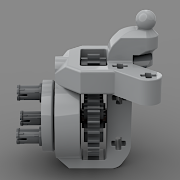 Nice idea, I have also been wondering how nice it would be to have a pin with one end frictionless and the other with friction. But it probably does not exist because you would have a hard time distinguishing which one is which :) Just like you'll have a hard time telling these modified pins apart from the unmodified ones. On the other hand, I realized that something like this does exist in lego, the frictionless axle pin: The axle end is a strong connection, the other one is frictionless, which is better than both ends being frictionless. It is often used it in steering rigs to reduce play. You can't put a bar through that one, the hole is narrower in the middle section.
 -
[WIP] Red Coupe RC
gyenesvi replied to Daniel-99's topic in LEGO Technic, Mindstorms, Model Team and Scale Modeling
Interesting shapes all over the body, I like the use of the mudguard piece as well, but agree that the color is not the best. It would look pretty good in black if it existed.. But the white could work out well too. You could render it in a few different color combinations to see what works best! -
This is soo cool to watch, very nice and functional models, thanks for posting.
-
Interesting wheel construction, at first I did not realize it has no rim.. but it still looks well shaped.
-
Thanks, I have to admit that looks was one of the main focus this time (the other was the gearbox). When a set has 2000+ parts, it's got a higher chance that you can get something interesting out of it :) and I was a bit surprised how good variety of panels and beams this one has, at least well suited for somewhat square models.
-
Thanks, I have just added a bottom view to Bricksafe, you can check it out on the link above! I will write up the details of the drivetrain, suspension and the whole design process in a separate thread once I finish it completely, still fiddling with some minor details.
-
Yet another Zetros alternate is coming: Jeep Wrangler featuring a 2-speed gearbox coupled with an RWD/AWD lock (high gear is RWD, low gear is AWD), well articulated live axles, and the obvious openables, detachable roof. More images on Bricksafe.
-
Stupidly Overpowered City Car
gyenesvi replied to piterx's topic in LEGO Technic, Mindstorms, Model Team and Scale Modeling
Looks cool, curious to see the video. I wonder how the steering system is done. I especially like the direction of making it small, though this may be an extreme case. But I have been thinking lately, that if official technic models weren’t so bulky as they are, we could have more performant and playable lightweight RC models.. -
I have been waiting to see what you come up with from this set! Really interesting drivetrain concept, and the implementation is quite elegant, the way the differentials are placed and driven, and the way the two drivetrains bypass each other. I like the bouncy suspension as well. Great work! As far as I can see, you did not use the 4th motor, right? So this can only be controlled with a custom PU profile? (though that’s a very simple one, and I guess the opposing direction of the two drive motors already rules out the stock profile..)
-
Grohl's Creations
gyenesvi replied to grohl's topic in LEGO Technic, Mindstorms, Model Team and Scale Modeling
I think the whole black bonnet is a characteristic part of KITT, so this version is definitely an improvement and makes it more recognisable, looking really nice now given the part limitations. It's great that you could keep the functional engine, even though it's flat now, I don't think it matters that much. -
I mean the diff and its frame would have to be integrated into one enclosed unit. I think it would be possible to make it 5 studs wide (with mounting points), 3 studs tall and 4 studs in length. The length would be 4 studs because if the actual diff inside is a bit less than 3 studs, then on the front side, the female part of the CV joint could be built in.
-
I keep dreaming of a small (3x3x3) differential :) probably doable with integrated gears like the planetary hub. But then the next problem would be driving it, as the driving gear and axle could be at most half a stud thick.. So the next step should be integrating it with a housing that serves as the axle center, and the female part of the driving CV joint, just as in the planetary hub. That could be the starting point for building thinner axles with more ground clearance.. Would have been nice if TLG focused on this instead of the diff lock that results in an enormous axle..
-
Wow, this is just another level of MOC-ing. Amazing build in itself, but the cooperation with the real car manufacturer just elevates it even more! Congratulations! 10 motors is just crazy, I mean how did you even arrive to that number? Was it like, you tried 8 and it wasn’t fast enough? :) Or was it like 10 was the most you could cram in there? +1 for that
-
Fair enough, which one is more advantageous does depend on the kind of usage. Sure, for fast cars the advantage may disappear. Do you mean with a non-proportional controller?
-
I wonder what environment you used for your comparison (though it's hard to do a really tough test with the Zetros on rough terrain). While I agree that in many cases the PF version could work just as well as the PU version, and even simpler to use with the physical remote, I'd say in case of a trial truck PU does have advantages; namely the position encoders allow for things that are not possible with PF: - for steering, the PF servo cannot turn small angles with high torque (the torque decreases as the angle decreases as it is modulated by the voltage), but the PU L motor can turn low angles with high power. In fact, PF RC rock crawlers often don't use a servo because it's not strong enough for that application on real terrain, while in my experience the PU L motor is pretty good for steering even on rough terrain. - for drive, the PF L motor cannot move slowly with high torque (similar reason, slow speed is achieved with low voltage), but the PU motors can move very slowly with full torque, and that's immensely useful for precision crawling, for example when climbing on a slippery slope, full throttle could make the wheels slip easier. I wonder what other people's experience is about this topic, as I feel that these details are often overlooked about PU motors.
-
Yeah, that's more than I thought based on the video, should be okay then, and I guess these cables are designed to take some abuse by kids anyway.. I can pretty much agree with all of this :) Though sometimes I do enjoy playing around a bit with offroaders, to test how much they're capable of, while making the presentation video.
-
Very good work, I love how all the electronics is incorporated into such a small body, especially that you were able to do the same both with PU and PF and even the old differential. And the bodywork and interior is very clean but detailed. The only thing I am a bit worried about is all those cables tucked in breaking..
-
Thanks, looking forward to what you come up with out of this set!
-
In the original build, it is actually attached on the same level as the upper arm, I guess that's why I observed less toe out in that case, than with the modified build. However, I think what you say is only true for non-Ackermann geometry, for Ackermann, still there's a very slight offset. Furthermore, the effect is only totally zero if the steering link is attached with a towball pin, so that the link can rotate on the pin and is not effected by the tilt of the hub.
-
No it's not, but it's really simple: the lower A-arm is simply rotated downwards as it goes out to the hub, its outer end is 1 stud lower than the inner one. As a consequence, it becomes shorter, and the hub itself is tilted inwards a bit at the bottom to reach the A-arm, so the wheel is not vertical, but this whole effect is so small that it's hardly recognisable (and part of it is kind of offset by the freeplay in the wheel mount). Unfortunately, this is the only way to mount these hubs with more ground clearance in the middle. I did not invent this trick, but learned it from others here. An unfortunate side-effect is that the vertically middle point of the hub also gets closer to the center. It's not a problem for the driveshaft (again because of some tolerances), but there's a very slight toe-out in the steering. But it's still a good compromise I think.
-
Of course not, haha But I thought the lack of diff would manifest itself differently, just slipping, since these tires slip quite easily (my test was done on a flat floor). So what counts as extreme need for you? On the terrain I tested this (and the Zetros), I found that it gets stuck quite easily with open diffs, that's why I decided to remove them. But I think it depends heavily on the capabilities of the suspension as well; with a suspension that's highly articulated, it gets by much better with open diffs as well; for example this build of mine has a more articulated suspension, and I found it still climbs still quite well with open differentials too. But it's good to know that the closed system may stress the gears a bit too much..
-
@Attika, you were right! I have popped in differentials to both axles (had to use older CV joints to make space in the driveshaft), and the jerkiness disappeared at high steering angle. Thanks, another lesson learned! I would have thought that these tires would just silently slip without me noticing it.. I have experienced that already with PU motors when geared up or when pushed hard off-road.. Thanks for the tips from both of you! I have also tested this, put 1x1 tiles on the half pins in the second steering link design, and it worked better than I thought; the resulting steering lock is not very bad, quite similar to the original design, and at that angle still there's no jerkiness (without diffs).
-
Thanks for taking the time to chime in! I actually enjoy the parts limitation sometimes, as it restricts the options and gives you some finite limits to build with, instead of the unlimited possibilities you would have otherwise, and also forces you to be creative with what you have available. But I understand you, nowadays I also want to push the limits and design build with all possibilities that lego allows, which is also somewhat limited. I've only read that anti-Ackermann geometry is used intentionally in race cars, that it has some benefits when cornering with high speeds. I guess that does not apply to crawlers though.. That's a good idea to test just to understand the situation, I'll give that a try, because the axle actually has space for the differential, so it should not be too difficult to test, I will only have to modify the driveshaft to use an older CV joint which is shorter. Thanks, haven't seen that video before, nice one, and good to know. Do you mean driving them with buggy motors? :) I just want to get some BuWizz motors, but a bit worried about putting wear on some parts with it. Does lubrication eliminate the problem? What kind of lubrication is safe to use with Lego? Yes, this is new behaviour, I have tested it with the original setup and it wasn't a problem there. I did think about those 1x1 tiles or plates, haven't tried it yet, but my guess is that it will limit the steering angle too much. Anyways, will give it a try. No it, was not deliberate :) Not sure if that could work as a compensation either, but there might be some explanation, just like in the case of fast cornering race cars in my comment above.. Exactly, agreed. I have also observed such a focus on the appearance by many comments, which is good as encouragement and appreciation, but as you say, the technical aspect should also be viewed and occasionally 'criticised' constructively. I'm totally glad that you did bring up this technical aspect, as I have already learned from it. And it's not just for this MOC, but also for others in the future, as I know I will use similar axle constructions in my future builds. So the reason I want to see possible solutions for this is because I want to understand how well it is possible to build such an axle. Unfortunately, as I see, it's really hard to build a proper steered and driven axle with a differential using any of the currently available joints and wheel hubs in an RC car in medium scale, even at large scale. You will have to compromise something, something will either be bulky, or some geometry will always be just approximate.. That's not too difficult as long as you are okay with a modest gear ratio, just check out how the hi/lo gearbox is in the Defender for example. And then remote controlling it is also simple with a PU L motor, for that you could check out the Volvo hauler's gearbox.
-
Thanks for the kind words guys, I really appreciate that! Well, I wouldn't say it's not possible to do out of these parts, but it would definitely take more space and hence would require a different form factor, for example something with a less space-hungry suspension. So in low gear the gearbox is 1:1 and instead of the diff there's a 12:20 gear mesh, and there's the 1:5.4 ratio of the hub, that's 1:9 in total. In high gear, there's a 20:12 up-gearing, so that's just the 1:5.4 altogether. I have added one more render from the front (I forgot that previously), where the mounting is well visible, does that do it for you? @Igor1, thanks a lot for bringing my attention to this thread, I missed this completely, although very interesting topic (I was actually on holiday that week, and the discussion only lasted two days, probably went out of view pretty quickly). I only saw the video from @kbalage about the resolution. Anyways, the whole explanation in there is really useful. And thanks for noting this! I'm not even sure why, but I never really took the time to think this inversion effect through properly. If I understand correctly, you are referring to the fact that if the steering rod is in front of the axle, then the Ackermann geometry reverses. I have been using this geometry because I saw it in many builds, from builders that I respect, for example in @keymaker's Hornet or even @Didumos69's Rocky uses it (although that one is a bit more complicated in this respect, because it uses two steering rods, one behind the axle with Ackermann geometry, and one in front with anti-Ackermann geometry (actually steered here), so not sure what the total result of those is, but I think it works in lego because of all the tolerances of the loose links). Not trying to point at people here, just quoted them because I am curious what they have to say about this matter. So this problem made me think for a while about how to resolve it. It's not enough to fix it by mounting the steering link further out on the hub as @Attika did (I adopted his solution to this axle, see the image below), because then the steering rack will be 1 stud in front of the mounting point, and that also creates a minimal anti-Ackermann effect in my case (in the case of @Attika, it creates a slight Ackermann effect, which is just what is needed, so that's really nice when behind the axle). So to resolve that, the steering rack would also have to be brought backwards, which then would collide with many other things (not just the motor, but the springs and some support as well). The thing is that routing the steering rack only two studs away from the center of the axle is pretty hopeless for a driven axle with a servo on it if you don't want it to be huge (for example, the solution of the Zetros would not fit into the short nose of the Unimog), as the towball liftarms need quite some support that's always going to be in the way. And a differential would just make things even worse (actually, this axle could house the differential, it's just that the driveshaft on the back would have to be moved back by 1 stud). However, using a 13L steering rack could elegantly solve the problem, because more link mounting options would be available there, but that's out of the question for this build as there is no such a part in the set. So while the solution below solves most of the anti-Ackermann problem, it raises another issue. Now the steering angle is more aggressive, because the mounting point on the wheel hub moved one stud closer to the axle. At that steering angle, the wheel starts to bump into the chassis.. So I had to insert a half pin to the steering link to limit the angle a bit (then the wheel does not seem to touch anything). However, even at this limited angle, I can hear that the angle sounds a bit too much for the CV joint. It starts to move slightly jerky at max angle; it is especially noticeable when reversing, or when moving slowly, the sound of the drivetrain is not uniform but bumpy. I wonder if that happens to the version of @Attika, did you test reversing or slow driving, observing the sound and see if it gets jerky? So at this point, I am not sure if I should update the model to this version. The steering performance is definitely improved, but I am worried a bit about complaints about the jerkiness and damaging the CV joint. You know, when selling instructions, it may be more important to avoid damages and complaints than to have the perfect geometry (obviously, if it was just for myself, I'd go for the better geometry). So let me know what you think about this possible fix!
-
General Part Discussion
gyenesvi replied to Polo-Freak's topic in LEGO Technic, Mindstorms, Model Team and Scale Modeling
Just saw an interesting one, at the center of a Rubik's cube :) Nice construction and mechanism as well.