

gyenesvi
-
Posts
2,396 -
Joined
-
Last visited
Content Type
Profiles
Forums
Gallery
Everything posted by gyenesvi
-
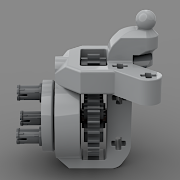 Hmm, that's a weird solution.. Not sure I understand what the 45 dergee rotation does, and why it's done at the same time as the shaking. And why the 45 rotation is undone before switching again.. Just to understand the problem clearly, is it that the driving ring could be tightly engaged with the clutch gear, and it would be hard to move the driving ring out of the clutch gear? In that case the 45 degree rotation happening in the beginning does not make sense to me. Or do you mean other parts of the driveline, such as tension around the LAs?
 -
I don't think there's a problem with the concept, I do believe it could be much better, kind of expecting switching time under 1 second. The Volvo hauler was that fast if I remember well, and it's the same thing, isn't it? At least I don't see any difference, and the L motor can be positioned fast and accurately. Furthermore, the simultaneous operation of functions should simply be disabled, the other buttons could be faded out, so that you see that you cannot press them while another function is being operated.
-
Been waiting for that video, thanks :) The controls do look complicated, but maybe it's like the real thing. However, I am disappointed by the gearbox switching, 4 seconds is dead slow, I'd guess the hardware can do it faster, let's hope it's just a software thing and gets better with the final release..
-
Axle Collection Thread
gyenesvi replied to efferman's topic in LEGO Technic, Mindstorms, Model Team and Scale Modeling
I think it does not matter for those applications above, as it is fixed in both planes since neither the suspension, nor the steering is implemented through that connection; steering is taken care of the joint above it, suspension by the floating axle into which it is built into. However, it's good to know, that means it would not work for my application, because I wanted to steer through it.. -
In the meantime, Zetros's little brother trial Unimog was born :) Thanks for the inspirations @dpi2000 and @Thirdwigg, feedback is welcome. Shorter wheelbase, softer suspension, larger articulation, more ground clearance, 2-speed gearbox, spinning fan, no differentials - no need to lock them :) More pictures on Bricksafe. Working on instructions. @Timorzelorzworz, what I am using at the moment in Studio is a scaled-down version of the large tractor tire, I made it in Studio part designer. It's not perfect, as the thread count does not match, but still much better than balloon tires. I guess you are using LDD, but I can share the .part file, is that something you could use? Does anybody know if the new parts are also available in Studio? I checked @Philo's page and did not find anything yet.
-
Thanks, so if I order one now, would that already come with the new batch of connectors or not yet?
-
Axle Collection Thread
gyenesvi replied to efferman's topic in LEGO Technic, Mindstorms, Model Team and Scale Modeling
This is really interesting, as I just had an idea (posted in Efferman's thread that includes another custom part as well) that would require a male CV connector with a 2L axle, almost what you discovered here. Imagine a planetary hub at the end: It's too bad that it does not go all the way into the hub part, as this use case would require that, I guess this would not fly, the cross connector would be too close, right? I don't have the old CV's female part to test (just ordered a few). How is the steering angle with that mate with respect to the standard one? The axle looks really promising by the way. -
Efferman's Custom Parts
gyenesvi replied to efferman's topic in LEGO Technic, Mindstorms, Model Team and Scale Modeling
I do like the part itself though, it doesn't look as off as I thought it would, thanks! I will play around with it a bit it Studio. -
Thanks for the info. So these seem like software issues that can be fixed. What's with the port not working issue? Did you manage to replicate/debug that? Is that possibly a HW issue? BTW, can the firmware be updated on a BuWizz? Is the application capable of doing so if needed in the future?
-
I am hoping for that too, although I am a bit discouraged by the comment on that small angular motor's description on lego.com that says "ideal for applications that require _low_ torque", or something like that. It could still work for smaller builds, but may be weak for larger ones designed for rough terrain (like rock crawlers), those do require some torque to steer properly. But I also hope they will arrive in technic sets as well (was kind of hoping that the Zetros would include something like that for the diff locker). As for the original question, I think the L motors are the most versatile (useful for steering as well, easier to build with), so sets with those may be better for a start.
-
I'd be happy to order a Buwizz 3.0 and a few motors, but I have been a bit discouraged by the issues people are reporting here (especially problems with steering, port not working). @Zerobricks, what is the status of these issues? Were they confirmed? Is it known if there are HW bugs, or only SW problems that may be fixed later? Does the app release contain some fixes as well?
-
Efferman's Custom Parts
gyenesvi replied to efferman's topic in LEGO Technic, Mindstorms, Model Team and Scale Modeling
That's a pity, I didn't know that. So if the one stud after the ball would be circular, that could help? That would also be okay for this use case and others too I guess (an axle joiner is only connected to the last stud). If I understand correctly, the middle part around the hole would need to be wider by half studs on both sides to make that possible. I guess that would be a strange part, and maybe not too useful for other use-cases. -
Thanks, I was also surprised how non-trivial the gearbox version is if you want to add more functions that a simple 2-speed one.
-
Efferman's Custom Parts
gyenesvi replied to efferman's topic in LEGO Technic, Mindstorms, Model Team and Scale Modeling
Thanks for making this! I agree, actually this was my first idea too, but as I started thinking how I would build with it, I found that the second crosshole could be in the way in a couple of cases, either for the steering, spring mounts or some cross-connections, that's why I simplified to the single crosshole version. However, I really like the pin-hole on the back of your version, that has some potential of using it to fix it more solid if it's needed, even if there's only one crosshole, for example like this: On the other hand, I started playing with your version, and came up with this construction, which could be a solid one, if there existed a male CV joint with an axle (have you tried that?), as the top and bottom bars could be connected in the center, close to the wheel (no need for more connections on the front/back side): What do you think about these? -
Efferman's Custom Parts
gyenesvi replied to efferman's topic in LEGO Technic, Mindstorms, Model Team and Scale Modeling
Thanks! Do you mean the part or the axle construction? Sure, I guess the part itself can be improved (and the axle construction obviously needs more connections to be solid). Sure, I can imagine that, but then the mounting becomes more problematic, and it protrudes more towards the center and you start losing ground clearance.. -
Efferman's Custom Parts
gyenesvi replied to efferman's topic in LEGO Technic, Mindstorms, Model Team and Scale Modeling
@efferman have you tried printing a part like this but with a towball socket in it instead of the pinhole? The closest I could make in Studio part designer is this: And I have been thinking about using it in an axle like this, where the width of the axle could be adjustable by replacing the thin 5L liftarms to 4L or 3L versions. Do you think that such a construction would be strong enough? BTW, I have checked out your Shapeways parts, lots of interesting stuff there. Was wondering if a diff with 20z gear is possible, it seems you have tried it already, although your desing is 2L wide, and I was thinking of a 3L wide version to fit into a 5x5 frame. How sturdy is that with those small gears inside? I guess they may be a bit weak for heavy-duty RC cars? -
Thanks! Indeed, I like that part on the real truck, especially that the bed side goes well under the wheel arch on the outside, it's kind of unique, and I thought that's pretty easy to replicate with the existing parts. Thanks, I'm especially happy that I could do a fairly performing motorization without the need for custom electronics (as often is the case with large and heavy models).
-
It's true that that model seems to turn better, but it's hard to judge from the video what constitutes to that. One thing is sure, the model is much shorter, the two axles being closer, that instantly results in a better turning radius, even if the steering construction is the same. But maybe the actual turning of the wheel is also a bit better. He may be just using the PU app to control it, or he changed something about the construction, but I don't think he used something like @efferman's trick to actually increase the angle. But now that I think about it, that trick may work well with the overly limited app, as @efferman's construction in itself would result in a radius that is too much for the joints, but with the app not taking it to the limit, it might just be fine :)
-
Hmm, I didn't even think of that, I thought the angle was small enough to start with.. It's sad, because it limits alternate builds as well (if used with the stock app), even if they are built such that the wheel could not touch anything..
-
Hello Eurobrickers, Finally I am ready to present my latest MOC, the so called Bruiser Conversion of the 4-door Jeep Wrangler. The real thing is done by JK Crew, it looks like this (more awesome pictures here): The conversion includes pimped up suspension, a longer body on the rear part, turned into a pickup, and larger wheels. As for the scale, the real Jeep Wrangler has around 80 cm wheels, and the conversion has around 110 cm wheels. I thought this would be an excellent material for an alternate build from the 42110 Land Rover set because of the color match and the available parts (like those rear mudguards), and the 80 mm wheels of the Defender, and the 107 mm Lego tractor tires result in a good 1:10 scale match. I thought it would deserve the large tires and a motorization, all available in the set 42099. So I ended up with two versions: - Manual version, pure alternate build from 42110, with an optional raised geometry and large tires - RC version that is a dual alternate with 42099 I will present both versions below. They are identical on the outside, they differ in the chassis build and the gearbox / drivetrain. Manual version (42110 alternate) I wanted to build something from the Land Rover that has a more aggressive suspension with large articulation. I have been playing with the idea of 4-link suspensions on both axles, and the 8 A-arms in the set are just enough for that. However, I had to do it with short springs only, so I used similar geometry as the rear axle of Grohl's stadium truck, but with longer lower links on both axles. Furthermore, I wanted to build it in a way that works both with the stock Defender wheels, and with larger ones. So I built a chassis in a way that the springs can be positioned in two places, and the suspension geometry becomes lower or higher. Along with this, the front axle is also moved one stud to the front, to make space for the steering of the front wheel (just like in the real version). As such a suspension requires a lot of space (if you want large articulation), the actual useful space in the middle of the model becomes relatively short. I wanted to preserve the same functions of the gearbox as in the Defender, so I had to compact it. Taking ideas from the Pimp my Land Rover project I managed to create a version of it that fits into the available space, keeping the same layout of the controls. Furthermore, I have included a functional V8 engine (the real one has a V8 Corvette engine). One part that I struggled with a lot was the HoG steering, as it was quite hard to bypass the gearbox and the front seats as well. Finally I managed to do it under the seats, but I could not fit a functional steering wheel as the chassis structure that holds the front suspension was just in the middle of its way. The interior came out quite clean and also replicates the real one quite well I think. The seats are similar to those of the Defender, but I had to make them shorter, as the roof is also shorter: On the outside one key point is that the real thing (at least this version) has its doors made of steel bars (which gives it a great look I think). This is good as the Defender would not have enough green panels to build 4 doors, but the bar doors could be built (at first I did not think I could get such a clean look, but I am quite happy with the result). On the front, I reused some ideas from my Willys Jeep, but changed it to a bit more modern look. On the rear part, the fender piece was an obvious fit, and I wanted to emphasize the bed with system parts, which also came out nicely I think. At first the A and B pillars and the roof was tricky to make solid, as it is only built from a few liftarms. But the final assembly is super strong, thanks to the column in the middle that goes through the gearbox (that was a key structural element to make). The model can be lifted safely with the roof. Some side panelling was also tricky to get into place, but I am satisfied with the overall looks. The doors, the hood and the tailgate are openable. The spare wheel fits nicely in the bed. One last feature I could add thanks to the Defender parts is the front bullbar with a compact functional winch (with rachet mechanism). Here are some side-by-side images for a comparison. I think it works well with both wheel options. More info, pictures and building instructions are available on Rebrickable. RC version (42110 + 42099 alternate) For the RC version I decided to use components from set 42099 as it has everything required: XL motors for torque, heavy-duty CV joints, planetary hubs, more A-arms and hard springs for suspension and the few extra parts in black color. First of all, I wanted to motorize it in a way that I keep the interior and the functional fake engine as well. Second, I wanted to add a simplified gearbox. The placement of the battery was obvious in the bed, the steering motor would go onto the front axle, but the space required for the two (coupled) XL motors was less obvious. Finally, I could squeeze them under the rear seats, and place the gearbox in front of them into the drivetrain. As for the gearbox, incorporating a 2-speed one (hi/lo gear) was simple, but I wanted to do something more with the available parts. Finally, I managed to add an RWD/AWD switch. For this, gearbox routing is a bit tricky, going through itself through idler clutch gears, and returning later. Furthermore, the front and rear parts of the driveshaft rotate in opposing directions, which is resolved later by the proper placement of the differentials on the axles. It was really challenging to brace the whole gearbox properly so that the gears cannot skip anywhere, I had to rebuild and test it several times (those two coupled XLs have a lot of power). On the downside, I suspect the relative complexity of the gearbox add some friction to the system. As I wanted to maximize ground clearance, the front axle was tricky to build, since the planetary hubs can only be connected with ball joints when steered. For this, I applied the trick used by other as well, that slants the lower A-arms a bit, resulting in very slightly non-vertical front wheels, but it is so negligible I bet you'd never notice. The resulting axle is fairly slick, I am happy with the result. As the steering motor made the front axle higher, the functional piston engine had to be minimized as well, and I could only do a mini V6 with the available parts. Unfortunately, this small construction does not run super smooth in a V configuration (sometimes the 2L liftarms in the main shaft kind of collide into the half pins that make up the pistons for a moment, instead of smoothly pushing them up; the inline configuration with the same technique works smoother). For this reason, there is some friction resulting from driving the fake engine as well. Here is the final chassis, and one more image about the ground clearance at the rear: Although the final gearbox construction is strong enough not to let the gears skip, there is one weak link: the driving ring can move out of the clutch gear under very high torque (although in my tests the model sooner went up the wall if not blocked). This is because the gear stick does not firmly hold it in place. However, it can be solved by fixing it into one position with a linkage coming out of the center column. This issue made me think how much more powerful it could be if the gearbox and the fake piston engine was bypassed, and eventually led to the construction of a heavy-duty variant (in which the gearbox is still kept, but instead controls the speed of the fake engine, when not in neutral). The heavy-duty variant is further geared down a bit to have even more torque. It can climb almost everything if the ground clearance permits, as you can see quite a few cases in the video. A few more images about the whole model: More info, images and building instructions are available on Rebrickable. Let me know how you like it! Cheers, Viktor
-
Well, I actually experience the contrary, I have built a lot from 42099, and never experienced this. I have a build right now, just checked it, and the steering rack is moved to the limit when it's on a flat surface (contrary to the Zetros, just compared the two on the same surface). Thanks, good to know. Have you by any chance reported this to TLG?
-
I agree with much of what has been said before: modularity can help with a cleaner structure that may resemble the real thing better, easier assembly and disassembly (yes, it's very useful when iterating on something building it again and again) even better building instructions. However, I do not try to enforce it just for the sake of it, especially when there is not enough space (like always) or when it would hurt structural integrity. This. Check my signature :) (no, I did not put it there now). I apply this a lot with Lego, and also in my work when writing software (I am a software engineer). It helps a lot to clean things up. And I agree with @nerdsforprez that the right way to understand it is to 'remove all superfluous structures'. (sure, some things are there for decoration..) But in general, this is where I stop with my models, when I achieved all I wanted (functions, looks), not more.
-
As I am trying to build something from the Zetros, I discovered an(other) issue with the steering calibration, wondering if anybody else has seen it too. I was experimenting with a different steering system (not based on gear rack, but on a linkage system), that would require turnig the motor 45 degrees instead of 90 as usual with the gear rack. However, I have noticed that after calibrating with hard physical limits, the motor actually rotates much less then the limits would allow, something like 25-30 degrees at most. I have also tested my build with a custom profile in the Powered Up app, and with that it works quite well, after calibration the steering motor moves all the way to the physical limits. I have gone back to rack based steering to see if it had something to do with my build, and I found that even with that steering mechanics, the motor does not move all the way to the limit after calibration, but the difference is less visible (I guess 15 degrees less movement is less noticable when starting from 90 degrees of limit than from 45 degrees). From this I conclude that this may be a bug, or there may be some sort of (over)protection in the Zetros C+ profile that makes it steer much less. That could explain part of the noticably bad steering radius of the Zetros (apart from the fact that the CV joint in the wheel hub cannot take a steep angle and that the Zetros has a long distance between the axles). Has anybody observed something similar? Can somebody confirm that he steeringg rack does not always move all the way to the limits? (Best seen when tested on terrain that puts some friction on the tires so they are more difficult tu turn than when moving freely in the air).
-
This will be done automatically by the Control+ app for you, so it does not really matter where the actual functions are positioned in the gearbox. Though I wonder how fast it will be to switch between functions. I wonder whether this is justified for example by the weight of the blade, would a faster gearing result in insufficient torque to lift it? BTW, thanks @kbalage for the compact review(s), I like that it only contains the really interesting pieces of info.
-
While it's true that in 42099 the steering rack itself is one stud closer to the center of the wheel, there is a limiter on the other side of the axle, which is one stud further (so exactly the same geometry as the Zetros), which limits the movement to 1 stud laterally, so the result is exactly the same angle as in the Zetros. It simply has a smaller turning radius because it has a shorter wheel base (the two axles are closer).