
Search the Community
Showing results for tags '4wd'.
-
.thumb.png.116032e930e483fb4ebbfdc62183bd34.png) I would like to present the result of my Winter-project. A big thank you to everybody who supported me in the corresponding WIP-topic and of course to @DugaldIC for challenging me! Instructions are available on Rebrickable. Features: Turn-table-based wheel-hubs with minimal slack 4WD by means of 4 L-motors powered by two BuWizz 2 units Fully independent suspension Steering with Servo-motor 30 degree steering angle with Ackermann geometry Caster angle Fake V8-engine driven by M-motor Can handle a rough ride Liftable by roof, nose and tail Everything in-system Stats: Parts #: 1844 Weight: 1980gr Length: 54 studs Width: 35 studs Height: 23 studs I hope this will pull @Blakbird back into Technic . Some stills from video-material. And finally a few short videos.
I would like to present the result of my Winter-project. A big thank you to everybody who supported me in the corresponding WIP-topic and of course to @DugaldIC for challenging me! Instructions are available on Rebrickable. Features: Turn-table-based wheel-hubs with minimal slack 4WD by means of 4 L-motors powered by two BuWizz 2 units Fully independent suspension Steering with Servo-motor 30 degree steering angle with Ackermann geometry Caster angle Fake V8-engine driven by M-motor Can handle a rough ride Liftable by roof, nose and tail Everything in-system Stats: Parts #: 1844 Weight: 1980gr Length: 54 studs Width: 35 studs Height: 23 studs I hope this will pull @Blakbird back into Technic . Some stills from video-material. And finally a few short videos. -
 The Fiat Panda is an Italian utility car created for all needs. It's known for its simplicity but above all for its ability to do almost everything. The 4x4 version, despite the 50 hp, is capable of climbing on various types of terrain, in fact it is also used for trials (just change the wheels). I wanted to create it in a small offroad version. The design is quite similar to the real model even if with some difference like the roof. I added a front bumper with 2 PF Lights, very useful for night rides, and a winch (you can see how it works at the end of the video). 1 PF L Motor for propulsion with a 2 speed gearbox and a 4x4 transmission without differential (I added a second reinforcement gear in the rear axle). The gearbox is compact and strong enough and the winch system is connected to it. The total gear ratio is: First Gear 1:3.33; Second Gear 1:1.67. Pendular suspension for good stability on rough terrain, even if the model is not high enough to work properly :(. The rear opening hatch and the small trailer are good for transporting small loads. The old model was very squarish and very low so I had to revise it more carefully.
 -
-kpia.thumb.png.a265cddff9575859eea3a4d2aad663c2.png) Power functions: 1x Servo motor 1x L motor
Power functions: 1x Servo motor 1x L motor -
 Starting work on my next project, which will be a lifted Nissan Xterra! Got a full set of RC4WD Rock Crusher tires (essentially the same tread as the popular BF Goodrich tires), and I've also started modeling a fully functional transfer case based around the new (to me) driving rings. New Tires and things! by VKTechnic, on Flickr The green axle is the motor input, orange is rear axle drive, and yellow is front axle. In the middle, the lavender and blue gears are for HI/LO, respectively, and as expected, the FWD can be disconnected as a 2WD/4WD switch. Fairly compact, as the geared part is only 5x5x7 studs! A couple of things are still undecided with this model, the first of which is how to activate the functions. Right now, the transfer case is actuated by mini LAs, which would mean that I would likely be using mini LAs to lock the front and rear diffs. However, there is the option to use small pneumatic cylinders, in which case the axles will be a little simpler to build (more on axles later). On the other hand, using pneumatics means integrating a pressure-regulated compressor and remote controlled valves (or a valve-pump combo), which could end up being bulky. I do have the option of manually controlling those functions, but what's the fun in that? The other undecided aspect is suspension. The Xterra I'm modeling after has A-arms in the front and leaf springs in the rear, so from an accuracy standpoint that is the way to go. On the other hand, 4-link live axles front and rear would be great for off-roading. The tradeoff with 4-link suspension would be space, as independent suspension in the front would let me cram the driveline components in front of the "firewall". TL;DR I've started on an Xterra, but I've got a lot of thinking to do...
 -
UPDATE: Changed the title of the thread, since people have already guessed the model! Hey guys! Feels good to be back with a WIP. This is one that I've been developing mostly digitally, since the Koenigsegg is still assembled, and I spend most of my days at uni. Anyways, if you follow me on Flickr or Facebook, you've already seen some LDD screenshots and perhaps this photo of the front suspension: Prototype Front Suspension by VKTechnic, on Flickr As you can see, the front axle has McPherson strut suspension with drive and Ackermann steering! Took a lot of tinkering to get the wheel hubs just right without modifying anything, but I'm happy with the result. Moving on to the rest of the chassis, I've decided to try a few new things. Inspired by the LPEPower E30, I've made the B-pillars and roll-cage structurally sound, so I can roll the model (and pick it up by the roof) without worrying about anything coming off: Virtual WIP by VKTechnic, on Flickr Over the past few days, I've been working hard on building a physical chassis, and similar to the Koenigsegg's WIP, I'm using odd-colored pieces to fill in the pieces I'll need to order in white: Mystery WIP! by VKTechnic, on Flickr At this point, the chassis is driveable, and the majority of the functions are, well, functional. The rear suspension is another new one for me: proper trailing arms! I've mounted two XL motors in the very rear of the chassis along with the batteries and receivers. There's also a manually locking central diff, and a fake engine that I've removed for the photo (it'd spoil too much ). Front end is in the works, but I may have to do the rear end first to minimize spoilers
-
 Hello, Today I am here to show my new creation, a 4 wheel drive truck. Here is the link to Rebrickable. Please Like it! Thanks to @JJ2 for helping me with the front suspension. It has 2 L-Motors for drive, a Servo for steering, 2 lights, and a SBrick. It has 4 wheel drive, which was the main purpose of this. I have lots of other photos here. Please tell me what you think! EDIT: Oops, almost forgot LDD!
 -
 This is my first WIP thread for a vehicle I've wanted to create for some time now. The most difficult part of this build so far has been the air ride. When Air ride is at its lowest or highest point, it clicks. This also lets you know when to stop lifting so it doesn't over rotate and jam the gears. I placed the 1X1 angled black system Lego on the L shaped beam, so the drop is only 45º on the axle. Then I noticed the weight of the car might not be able to hold the body work up so I added torsion bars to all 4 wheels. This design can be setup as 4 wheel steering, because the front suspension is exactly the same as the rear. (But the SUV I'm building doesn't have that function, so I opted out of it ) This beast comes stock with a V8 engine, air ride & torsion bar suspension, servo for steering, 2XL motors for drive 2M-motors for lift. I had to hide the servo in a different place as the axle for 4wd goes through the center. I am trying to get the steering wheel working but its tough... SUV framework for my new MOC by lachlan cameron, on Flickr I've been working on this frame for 2 weeks and am happy with how well it functions. I placed 3 pounds on the framework and the lift still works. SUV framework for my new MOC by lachlan cameron, on Flickr 2 M-motors are geared down before they turn 1 worm gear on each wheel to lift the whole vehicle.
 -
 Hi everyone! Today I want to share my new creation - Lego Technic Subaru Forester Specifications: SBrick for remote control 2 L motors on four wheel drive Servo motor on steering LED lights Small battery box Boxer engine Fully functional body More detailed model can be found in my blog
 -
 Hi Fellas, I've built a gearbox for 4x4 vehicles and it is rather space efficient. Hope you find it usefull. As usual, I'm being lazy and copy-paste the video description as it has all the basic info. Please feel free to ask, judge, or comment and I try to give my best in the reply It is rather small, I'd love to claim that it is the smallest of it's kind. (but I'm not sure, so I don't say that yet.) Help me find out. Dimensions: L: 7 studs W: 9 studs H: 5 studs Comes with the usual gear ratios: 1st gear 8/24 x 16/24 2nd gear 8/24 x 16/16 3rd gear 16/24 4th gear 16/16 The selector lever required some attention as the upper axles are 5 stud apart. I've been using some rare parts there: -Technic Ball Joint with Through Axle Hole http://www.bricklink.com/v2/catalog/catalogitem.page?P=53585#T=C -Bar 4L (Lightsaber Blade / Wand) http://www.bricklink.com/v2/catalog/catalogitem.page?P=30374&idColor=16#T=C&C=16 However this lever mechanism can do the shifting quite well, it still not "stupidproof" and need some attention while changing gears. The frame (housing) First. It is made so colorfull to help you dear watcher separate the parts on the video. For motorized version I recommend to rebuild the housing using studded technic parts. Input/Output Outputs are self-explanatory, two red axle ends sticking out from the differential. The input in the other hand is the axle with the 8tooth gear on the front. It is offset by 2 studs, but using a pair of gears it can be transfered to the center too. Whats more, it can be done on the front as well as on the rear side. Thank for your attention
 -
 Hi.. everyone.. I'm a new member subscribed last week. So this is my 1st posting here. Now I want to introduce my own renovation (or remodeling) of TECHNIC 42039 racing car that is capable of 4WD and 2 or 4 speed transmission features and so on... With a desperate that I need to go finish the TECNIC 42039 racing car renovation (or remodeling) going on for several months, I start a review about the result of my 42039 renovation version 3.0. First, through the video below we will introduce an overview of 42039 renovation version 3.0. The next additional video introduces the previous version 2.2 with features of 2WD and 2-speed transmission etc. The main feature included in renovation version 3.0 are listed below. -. RC engine room hatch opening feature of the original 42039 model -. Front axle renovation for 4wheel-driving (4WD) -. The reinforcement of power transmission path to the rear wheel axis -. Optional 2 or 4-speed transmission function In the following content introduces a modification information for each part. 2 or 4-speed transmission feature For the purpose of extended range, a four-speed asynchronous sequential shift gearbox option is added, 2-speed synchronous transmission as well. (With a minimum of effort adapted in accordance with the object, 2-speed vs. 4-speed selective transmission) In particular, our 4-speed sequential gearbox is inspired by the 4-speed compact transmission that is designed by SARIEL and that of TECHNIC 42056 PORSCHE 911 GT3 RS original model. In the video below, it shows the assembly of 4-speed sequential gearbox. (Sorry, the assembly of 2-speed gearbox is not ready yet) The pros ans cons of 2-speed synchronous and 4-speed asynchrosous transmissions described herein are appreciated as follows Division 2-speed synchronous 4-speed asynchronous High torque drive suitable inadequate Shift range narrow wide-range Shifting function stability low hight In conclusion, Choose 2-speed synchronous transmission, if you seek to improve the driving force Choose 4-speed asynchronous transmission, if you pursue a variety of speed and a technical completeness The challenge is 3 or 4 speed synchronous transmission upgrade. 42039 chassis renovated Sometimes with rear-wheel axis of the original 42039 models, transmission gears are impatient for a large force drastic departure or steep slopes in the progress of strong torque being transmitted to the rear wheel through a transmission shaft. So as to compensate for this problem in the renovated version, the rear-wheel axis structure has changed as the following video. The renovated 4WD front axis is at the heart of the renovated version 3.0. In other words, it describes the steering and front wheel drive shaft modifications as possible at the same time. The under-body of the renovated version compared to that of the original 42039 model is modified as follows -. Fake engine is replaced by 4-speed gearbox -. S- motor mounted under the hood -. Installations of the renovated chassis etc. In the video below you can see the renovated chassis production process using four L-motors. The final assembly process By combining each part-specific modifications result described above, the following video of the last shows the final assembly process of 4WD 42039 racecar bodywork. By finishing the renovation of RC motorized 4WD racing car, I could try another renovation with 42056 PORSCHE 911... I hope to introduce the renovated version of 42056 in the near future.. Thanks to you all reading this review to the end... Bye
 -
How about that little cross between mud and go on the rocks? Crawler 4x4 always ready for it! Still would! Its wheels are shod with tires RC Rock Crusher X/T 1.9, coupled with portal axles and two motors running by SBrick and LiPo battery box - we have an off-roader with excellent maneuverability, suspension geometry and a low center of gravity due to the unsprung axles. Crawler 4x4 built under the rules of the forthcoming Off-road trial competition in Moscow, at the same time. I tried to build the chassis in such a way as to achieve maximum throughput and maximum flexibility - namely, so this chassis can set the wheels of virtually any size from 62 to 108 mm. The body of the model removable. This allows the chassis to this every body, even though the truck, even an SUV. Get more photos on my blog of flickr
-
Hi, lovers of Lego! Today I want to show you my new 4x4 MOC - Nissan Datsun '1996 in D21 body. Specifications of MOC Model Lego Technic Nissan Datsun built on all-wheel drive platform, has a beam axle with unlocked differentials front and rear, steering - rack and pinion. The body and chassis are separate elements and are fastened to each other by 4 points. Opened doors, hood and door body. Electrics: LiPo unit XL motor on movement Servo motor - steering IrV2 - Remote control Just want to say that this story of this model, I did not finish and I want to continue it in the back of double cab body. It all began with the construction of low general pickup, its theme, you can see here on EB. By the summer I want to build a second pick-up and take over the full video on the outdoor. I do not really want to ride on the dirty snow right now.
-
Hi everybody, many post in the [TC12] information topic during the last few hours - @Milan had to move them to the pub It seems like some guys are really anxious for the results ... To make waiting easier have a look at this funny little thing: Regards Leonard Goldstein
-
I'm new to LDD and it's fun and easy to start with. Trying to design a 911 engine/transmission drivetrain with 5+R gearbox, shift linkage, 4WD and torsion bar suspension.. Which should be closer to the old air-cooled Porsche. Nothing really new and innovate here, just try to combine all the existed thing together. The final build should be slightly smaller than the official 911 RS (42056)
-
Hi, As a winter project I'm working on a 4WD RC buggy. It will be heavily inspired by @agrof's Class 1 Ultimate Buggy, for I very much like the behaviour and the looks of that model. With this model I will also deliver to my promise to @DugaldIC to make an RC model. I was planning on finishing this MOC without a WIP topic, but I simply can't work without the feedback . It will have 4 L-motors and 1 servo motor. No buggy motors, for I will be using current-date parts only. Control will be done with SBrick. Sofar I have been working on the axles. The rear axles are very much inspired by agrof's model, but this time everything relies on perfect fits. They rely on the Pythagorean triple (5,12,13). The front axles are my very own addition to this model: 2 L-motors are integrated in the double-wishbone setup. Making everything rely on perfect fits, is one of my main challenges. The second challenge is to make everything relevant form-locked. And of course the model needs to perform. All wheel hubs are turn-table/u-joint based: Sofar I have only been designing digitally, but I did check the most essential constructions in real life already. I will show progress when ever I have something to show. If you have any comments, feel free to reply. I'm new to motorized building so I can use some feedback.
-
Fellow Technic Builders, Let me share my first serious and almost finished MOC - possible the most recognisable Monster Truck of all times, Gravedigger. Firstly, let's start with the picture of the real ting, in case you are not as obsessed with Monster Trucks/Gravedigger as I am: And here my version (now with stickers) The idea of recreating it with Technic was what drove me back to Lego after my dark ages. Firstly I wanted to just do a simple MOD of 42005 with body and colour swap, but then we've got the Claas tires which are a perfect fit for this project, so it got bigger and bigger. Anyway, here we are after two years of building: 2XL engines for power, geared up 3 times (one engine per axle) 2 servos for steering PF switch controlled by a M engine for switching from crab steering to opposite LEGO Lights Weight: 1281g Dimensions: 44 studs or 35cm long 15 studs or 12cm wide (chassis) 27 studs or 22cm wide (wheels) 32 studs or 26cm tall Performance wise is runs 3:1 geared up XL engines powered through BuWizz which combined with low centre of gravity allows for a fun stuff like less or more controlled driving on side two wheels: And to be seen in a video: Plus a video of the steering switch at work: The model is not very mechanically realistic, e.g. it has portal axles while the monster trucks use planetary geared axles, but it is my first MOC and it was meant to be fun in outdoor, not off-road play and it is. There is a mention of the chassis being v1 in the topic. I want to improve it and develop optimal Monster Truck chassis and have a set of bodies to replace on the top. As such, I am recreating the model in stud.io for my reference and possible instructions and the renders of the powertrain are available in links below (I don't want to overburden the post with pictures, anyone who will be interested in them will surely click a link). Build time so far: 2 years. This is my first MOC, I know it is far from perfect (e.g no torque allowing to climb a ramp and have enough speed to make a decent jump) but is fun for me so far and overall I am happy with the result. https://ibb.co/mVecNT https://ibb.co/ew12p8 https://ibb.co/f8rDwo https://ibb.co/dinWhT I have also ordered a set of custom stickers for the details and they are on the way. Can't wait to hear your opinions, guys as the stuff being published here humbles me with cleverness and complexity.
-
It's a monster truck with a 4x4 trasmission and 2 speed gearbox powered by a SBrick. This MOC is very powerful because the first gear generates a great gear ratio. The chassis is simply and very strong and the suspensions are attacked to him. I couldn't use the "large hard shock absorbers" because i haven't them, so i used the "small soft shock absorbers". I added a V6 working motor, a rear openig hatch, and lights too! These pictures above are of the old version, in fact the axles and the position of the SBrick in the images are different from the current ones (below). The differential is removable to ensure more traction. The gearbox is very compact and strong (on that I worked a lot of time). The green axle is the input, while the red one is the output: the yellow gears are interested for the first gear and the blue ones for the second gear. The first gear has a gear ratio of 5:1 (very powerful), while the second gear has a gear ratio of 3.3:1 (balanced). The gear ratios were calculated by adding the gear ratio of the all transmission system, ie 3.3. And this is the outdoor video! I hope you enjoy my MOC! Leave a comment and a Like! ;)
-
 Hello everybody and let me present my version of a modified 42005 Monster Truck. It was my second set after my "dark age", that I've bought many years ago, after 42029 as supplementary set with a lot of useful pieces and planned to use for a live axle suspension and some other features for 42029 model. However, I liked the set as a simple and functional model and re-assembled it several times. Here is the model and later I'll provide the all details: A month ago, when I tired of infinite attempts to turn 41999 into a Muscle Car (the chassis isn't rigid enough, but I already did a great progress and hopefully will share it once) I returned to this model and set the task to motorize it adding 4WD, but keeping 4 wheels steering and current suspension (keep the original construction as possible as I can). First, I've analyzed the all existing attempts that I could find over EB, Rebrickable and YouTube and it happens that there were several MODs by different authors: First of all, it's @Splat’s MOD with all steered and driven axles (see topic here). I see no reason to duplicate its description, so let me just note that he saved the necessary features with adding Servo + L-Motor mounted under the hood and trunk. The chassis configuration is 4x4/4 or 4WD-4WS. It’s the best motorized model, I think, because of amazing simplicity and performance, but unfortunately it has a kind of “articulated” steering that isn't real, so was trying to made a "real" 4WD-4WS version, using this model as reference. Another one is Jan Dvorak’s (is he on EB?) MOD with all original features supplemented by on-axle L-Motor that drives the rear wheels and Servo for the 4WS. He added an additional 5X7 frame with differential that provided a necessary rigidness. The chassis configuration is 4x2/4 or RWD-4WS. Personally I don't like such a long axle sub-frame. However I've found a good idea of vertical gears inside the central shaft. The third one is @codefox421's MOD, inspired by Splat’s version, with the original front axle and non-steered custom rear axle with on-axle L-Motor. His custom rear axle, based on two portal hubs, is a quite compact and simple, but has no steering. The chassis configuration is 4x2/2 or RWD-FWS. It looks trial-ready with the portal hubs, but it's nearly impossible to add the steering here, so I got nothing from this model. An unusual @Tommy Styrvoky's MOD with an interesting feature: he modified the front axle, not the rear one, by adding a solid drivetrain with worm gear and on-axle M-Motor, so result is a front-wheels driven Monster Truck with oversized fake engine. The chassis configuration is 4x2/4 or FWD-4WS. Very aggressive! WRRRRR Daniel Wirasantosa’s (is he on EB?) MOD that differs from the previous ones by using of chassis-mounted L-Motor that drives the rear axle (that has a bit low ground clearance due to the 5x7 frame) and, moreover, he used a custom steering shaft that comes directly to the steering rack. The chassis configuration is 4x2/2 or RWD-FWS. Starting this version, I got a more or less defined plan: 4WD with off-axle (chassis-mounted) L-Motor that drives the both axles through the existing “drivetrain” (former steering shaft) and the off-axle Servo that steers the both axles through the custom steering shaft above the driveshaft. There were two more versions: Michael M’s stretched one and LEGOTechnic360’s solid-chassis version with no suspension, but they didn't help me with any new ideas. Nothing personal, guys, if you're reading it, I just had a full and consistent vision of my further MOD: Hull - the original with no changes. Axles geometry - original. I tried to save the all things like the wheels location, suspension mounting points, ground clearance, steering angles (that are even bigger a bit now)… And I still can't believe that made it, after a thousand tries! Suspension - original, with no changes. However I put the hard shock absorbers in the rear end, as the default ones were too weak to keep the BuWizz battery. Wheels - original. I decided to keep the original wheels and tires with no giant crawler ones or even Claas, that are too big even for a Monster Truck. Frame - mostly original, but possibly modified since it will have an L-Motor and Servo mounted above the axles (right under the cargo platform and hood). Drivetrain - it must be the ex-steering shaft that comes through the cardans inside the "big" ball joints to the both axles, connected to the L-Motor via the set of normal and clutch gears. Steering - for the all wheels, like in the original model, but the steering shaft comes above the drive shaft, in parallel with it and can slide a bit while the suspension moves. Enough the words...The most interesting part starts here. Following my plan, the bigger challenge was to modify the original axles - I tried several options, even trial-like with solid axles, but 4WS provides an amazing maneuverability due to big steering angles, so axle diffs are likely vital for such model (solid axles were making a permanent clicking noise in the transmission even with motor stalling sometimes) and I decided to make a fast Monster truck, not a slow crawler with a high torque. The drive train. There you can see how I did it: L-Motor rotates a set of 8T and 16T normal and clutch (required for the steering shaft) gears and then the main horizontal shaft, that were used for steering in the original model. After that the shaft rotates the 12T double bevel gears (ex-pinon gears from the original model), than 20T gears below, single-bevel 20T and the differentials. As result, the gearing ratio is 1:1.667 X 1:1.4 = 1.2334, and provides about ~100 RPM with 15.12 N.cm torque. The wheels connected by a wheel hubs, since I wasn't able to use the universal and CV joints with affordable steering angles, wheels position (I kept exactly the same position as in 42005) and rigidness. The steering. Here you can see the servo (mounted upside down in order to provide more space for the battery block above, steering shaft that goes above the driveshaft, 12T gears (pinions) and 13L racks joined to the wheel hubs. In order to allow the suspension travel, the gears has 1/2L offset from the racks and slides together with the shafts along the mounting points when the suspension compresses. It's a fully legal, but still allowed in LDD and works like a charm! The only mistake that the hubs must be from Claas, but they aren't presented in LDD unfortunately: Just to explain why I used the clutch gears (but with no gearbox actually, ha-ha ), the drive and steering systems intersects so hard, so followed TLG way and used the same solution that they did in the official models (42029, for example) - passed the one through the other. Green is a drive subsystem, blue - steering. The Axles. Here you can see how the steering shaft slides by 0.5L (notice the gap between the 12T black gear and LBG liftarm) - it provides about 1L suspension travel for the both axles. Other images, the story of a modified hull (by Phil), LDD file and instruction in PDF are coming soon...
 -
 Finished MOC Do you remember my Reform Metrac H7X ? Reform also produces the Muli: As the project of my Citröen DS doesn’t really progresses, I do this project in WIP, to compensate. ^^ The functions will be close to the Metrac ones: 4WD with a 4 cylinders fake engine Steering with 3 modes Front and rear PTOs And I add: A pneumatic pump to add pneumatic tools Central joint (it’s only the front axle on the Metrac) Openable cab with a lever and a pump actionning a pneumatic cylinder. The best function! But this MOC will not be manual, because there is not so much room in the chassis. (I think it’s possible, but the playability will be extremely bad) So it will be remote controlled, using the BuWizz. So: Driving by 1 XL by axle Steering: 1 servo by axle. To have the 3 steering modes: a M motors controls a PFs switch -> it changes the sens of rotation of the rear servo, or it stops it. The pneumatic pump is powered by a M motor That was the start: And now I’m here: On these two pictures, you can see the rear PTO. On this side, the pneumatic pump: And here is the mecanism which allows the possibility to get 3 steering modes: The chassis is very, very compact. I think you can put an elephant on it, it will not move at all. For the tools, I think I’ll make a pneumatic arm (The pneumatic cylinders of the Mercedes truck would be very helpful, but I don’t have this set) And for the front I don’t know, so if you have ideas, tell me!
 -
Rocky - 4WD Rock crawler buggy I would like to present to you 'Rocky', a rock crawler buggy with a body tilting angle that averages the angles made by the front and rear axles. My shot at a 42099 B-model. Instructions are available on Rebrickable. When I saw the first images of 42099, I noticed that the amount the body tilts sideways, is mostly defined by the rear axles angle, because that axle's suspension is the hardest - it carries the battery/control unit - and it's not pendular. That got me thinking; wouldn't it be nice to make a setup in which the body tilting angle averages the angles made by the front and rear axles? Just like how a Mars Rover averages it's body angle between it's rocker bogies - with a differential - but now sideways, not lengthwise. That way it should be possible to mimic the character of 4-link suspension, which is often seen in rock crawlers. So that was my objective with this B-model and the nice thing is that this model contains exactly the parts needed to build something like that. Axle articulation Here is the setup that interconnects front and rear axles. Like in rocker bogie suspension, you should regard the body as the differential house. The body tilting angle is defined by the two axles that point sideways. I used 4 gears in the differential itself to minimize slack in the system. There is some rotational slack of course, but this is even further reduced by 1:3 given the 20:60 gear ratio with the turntables. Center of gravity Besides the differential, the center module also houses the battery/control unit, because that unit includes the tilting sensor and I wanted the tilting sensor to show the tilting angle of the body. I also wanted to keep the center of gravity low and centered. However, putting the unit in this central spot did cause issues later on... The battery/control unit - not depicted here - plays an essential role in form-locking the whole center module. The battery/control unit can be slided out sideways after removing a few pins and parts. Spring suspension Besides axle articulation, I of course also wanted to include actual spring suspension, so I attached two main suspension arms to the turntables, one for the front axles and one for the rear axles. I suspended the main suspension arms with springs placed between the turntables and suspension arms. The springs are mounted differently to the front and rear suspension arms, giving the car a little more lift in the back, which adds to a nice inclination, or rake angle, of the whole model. The whole model nicely sinks into the spring suspension under its own weight up to about 40% percent of the overall spring travel. Drivetrain I wanted to have the most simple drive train possible, so the motors are directly attached to the frames holding the differentials. This is a crawler and with the new portal hubs, there is no need for any up or down gearing. The motors add to the stiffness of the main suspension arms. I also wanted to have a track width that is two studs wider than the stock 42099 build. After some playing around I found out I could use the new CV-joints the other way around to make that possible. Steering For steering I wanted minimal slack and double sided steering rods like in the stock 42099. I limited the steering angle to make sure the maximum angle the CV-joints make, does not cause any damage. I noticed the CV-joints start wobbling when the angle they make is too big. The steering rack assembly - as well as its back side counterpart - use a trick to minimize unintended movement (slack): The assemblies are 3 studs deep and incorporate 3L axles with end-stop. The end-stops are sticking out of the assemblies and make them slightly deeper than 3 studs. For this to work the end-stops need to slide along a smooth surface. This trick makes for a very nice fit with little play and still allows the assemblies to move very smoothly. Ground clearance To increase ground clearance I used a double wishbone setup, not suspended, to take advantage of the extra lift provided by the inclined wishbones. The rear wishbones are inclined more than the front wishbones, because there the CV-joints don't need to deal with the steering angle. At this stage I also added a set of minimalistic fenders ;-). Bodywork Finally, bodywork. This was the most challenging part for me. It needed to be removable, to provide access to the battery/control unit and I wanted it to live up to my foolproof standards. The whole model can be lifted by the roof or by the A(?)-pillars. At this stage I practically used all the pins that came with the set, so I had to do a lot of backtracking to get some pins available. I ended up using all pins, including the ones that came as spare parts. Interior RC don't have interior . When I wanted to test drive with a first bodywork attempt, I found out the hard way that I could not reach the on/off button of the battery/control unit. I had not taken that into account. Eventually I found a solution in making the roof openable, as if it were a hood, just by releasing two pins. The red 10L axle in the back can then be used to turn the controller on. After opening the roof, it can be removed easily, after which the sides of the body can be removed separately to access the battery/control unit. All together this has been a great experience. Especially the limited and pre-defined set of parts made it a real challenge. It forced me to revisit all constructions over and over again, and leave in only what is essential, without making concessions to my self-imposed building standards. I ended up using 828 of the 958 parts.
-
Hello All. This is my newest little creation. Intended to rip it up indoors on flat floors, which it does. Powered by one (off-brand) buggy motor and a buwizz 2.0. Has 4wd with open differentials front and rear, and solid axles front and rear. The lack of suspension allows for a robust chassis which handles the power delivery with no drama. Front tie rods can disconnect if you run into something but is otherwise very reliable, and fun to drive.
-
Good People of Eurobricks, let me present you my latest build that goes by the fancy name of "The devil in sheep's clothing". Giving this name appeared to be a good idea at 4 am when I've finished editing the video, so now I stuck with it. It's been built in a 10 day window around christmas time undisturbed. Beside the fact that few of us have the rare opportunity to dedicate as much time to this hobby, it is indeed a honest mirror on my social life too. So be careful, what you wish for. So to the subject. It is a non motorised (pushy-pushy) supercar (ish) build with the rough scale of 1:8. And now I let the video do the fair bit of my task: So if you still here, let's talk about the details: Involves a very reliable gemstone gearbox from the hands of our beloved @Didumos69. This is the 4 speed 4wd sequential from the Rugged supercar I've made a few modifications on it. Replaced the rubber rings to shock absorbers on the gearstick-centering mechanism, but I'm not brave enough to call this an improvement. Geometric barriers made me do that. The rest of the drivetrain comes with 4 wheel drive and a V10 engine as follows: I kept it simple, one might say it's a waste of space, it could be fitted with an 8 speed gerbox easily. Or 16. But no. Old school. And ther is the steering too. Same stuff I've used in the 8880 evo. Suspension: Somewhere along the way it became a pushrod suspension, but it wasn't always that. The former setup (pic below) wasn't cooping very well with the weight of the car. Had similar symptoms like the chiron so I've started over and got to this pushrod setup above. Has a lot of advantages strong, highly adjustable by changing geometry, but has a downside. The lower pushrods -made out of connectors and 5.5L axles- are relatively easy to pull apart. Not by it's own weight, but - let say- when wheels are changed, got to be careful while puting them on. Next bit is the roll cage, but it is pretty self explanatory. I figured I need some scaffolding anyway, the connector body demands it in this size, so I went a step further and gave it a proper sceleton. One more about the roll cage. The rear wing, or spoiler. As it shows above it has a dead simple spring loaded mechanism that provides two positions to adjust. Namely: up and down. Also comes with interior. Made out of connectors of course. Don't know if it's comfy or not. One of my favorite details (one of the dumbest as well) is the armrest bit on the door. It follows up nicely to the dashbord. Gives the illusion of completeness. Also just realised that I made about 58 million pictures and non of them is catching this feature at all. Good on me. The body: It's a hell of a lot of connectors and axles. Apart from the side bits and doors it's a single layer on the whole car, yet holds itself together surprisingly well. Allthough if you choose to give it to a 4 year old to play with it, he can dissmantle it in 58 second. Hope you enjoyed, any question, don't hesitate, hit me. There wil be instructions. Data shows, it takes an avarage two and a half years for me to make them so you may expect it under the christmas tree in 2022.
-
 Time to jump in this contest. I want to do a 4 wheel drive and steered car. I already have a chassis prototype : view from under. For now, that's it, it was really challenging to get a driven and steered setup that is 15L large I plan to add a V10 engine parallel to the wheels in front.
 -
want to make my 42111 4wd wthout lifting it can any one helpme . thanks
-
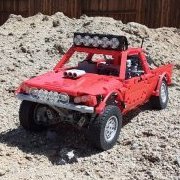
 Hello, everyone! I built 4WD off road pickup truck being inspired by the set 42029. It is not a copy of actual truck, but some details look similar to Ford Raptor and Toyota Tundra which I referred to. Weight: 1570g Features, 4 wheel drive with 3 differentials 2 XL motors for driving Servo motor for steering Working V8 engine Working front and rear LED lights via power function switch Suspensions Front: independent Rear: live axle Openable hood, doors and glove box:) Lockable tailgate Detachable bull bar and roll bar Double wishbone front suspension is the same as 42029. Which means that front axle has a differential and CV joints without portal hub reduction. They cannot handle much torque for offroad driving. So I put portal hub on rear axle. Gear ratio is 3 : 1. That can handle enough torque. This setting enables central differential to act as torque vectoring diff. Front wheels recieve 25% of torque and rear wheels recieve 75%. Thus this Truck has good offroad capability. Three differentials and pairs of CV joints works smoothly, and they did not break or snap. You can change body color, and choose the type of battery box: 8878 or 8881. Video: Building instructions and more pictures: https://plus.google....64977943/albums I hope you will like it! Edit: I forgot exhaust tailpipe in all pictures. This is the final version!