Search the Community
Showing results for tags 'railroad'.
-
 Both of the models featured in this thread together. This 2-10-0 'Decapod'-type freight locomotive was built by Baldwin Locomotive Works in 1918 under contract with Imperial Russia as part of an 1,200 strong order. Needleless to say, after the Communist Revolution the last 200 or so locos were not deliverable. Twenty of these orphaned engines were subsequently purchased by the St. Louis - San Francisco Railway (also known as the 'Frisco') - including this loco, 1621 - and modified from Russian 5 foot gauge to the standard 4 foot, 8 1/2 inch gauge, among other changes. After working on the Frisco for many years it was purchased by Eagle-Picher Industries to haul lead ore to it's smelting plant in Oklahoma, before eventually being donated to the Museum of transportation in St. Louis, Missouri as a static display in 1961, where it still resides today. The 1621 also has a operational sibling (1630) you can see / ride behind at the Illinois Railway Museum in Union, Illinois. My LEGO model of the 2-10-0 is 7 studs wide, and is not lettered for Eagle-Picher like the real engine is currently. I have instead chosen to label it how it was before the recent remodel, with the only road name visible being Frisco. Truth be told, I borrowed a lot of the design for the 1621 from an earlier loco of mine from this same museum, a 2-8-2 lettered for the Chicago & Illinois Midland. I stretched out the engine's frame, added two more drivers, removed the rear pony truck, and revised the tender and cab quite a bit. (The boiler is brand new however!) The rear of the engine. Sadly, this will most likely be my last loco using small drivers, since Big Ben Bricks is closing / going away at the end of this month... and before anyone asks, I refuse to use 3D printed parts! A view inside the cab. This is a LEGO model of an St. Louis - San Francisco Railway (also known as the 'Frisco') wood-sheathed caboose from 1942 that used to be at the Museum of Transportation in St. Louis, MO. Not much about this rolling stock is known (or at least I can't find any info!), as it was scrapped in place in 2012 due to being totally beyond saving. This model is an approximation of the former caboose based on pictures from when it was scrapped and pictures of other Frisco cabooses from the 1940s, as I've been unable to find pictures of this specific car in it's glory days. NOTES: The 1621 steam loco MOC has spurred the re-model of it's stablemate, 4-8-2 'Mountain' type Frisco 1522, into 7 wide with some accompanying upgrades. Keep an eye out for this revised model, coming soon! Thoughts?
 -
This VIP / railroad executives' train consists of several different late 1800s / early 1900s vehicles in a variety of color combos. I did the because I got tired of making a few passenger cars for one train all in one or two colors, so i decided to go with every color scheme I could think of that would work on a train from this era. Because of the multiple color schemes used, I dub this 'the amazing Technicolor train'. From front to back, right to left: - dark blue 4-6-0 steam locomotive + tender - tan / brown baggage coach - dark tan / tan sleeper - dark red / dark brown dining car - sand green / dark tan observation car This early 1900s / late 1890s-era dark blue 4-6-0 steam loco is modeled after the bones of the engine in set 7597 (Western Train Chase) from the Toy Story 3 line. I stretched out the frame slightly to include a third driving axle, added a loco tender of my own design, along with new pistons and new studs-up boiler. Rear view of the engine, which is numbered '9'. (To be honest, this tender design I made has been used quite a bit for my early steam locos... but if it ain't broke - don't fix it!) Inside the cab. The tan / brown combination baggage / coach is for my railway executive's train. This car's purpose and paint scheme is actually inspired by a car owned by the (fictional) Wasatch and Nevada Railroad in the 1975 Western / thriller 'Breakheart Pass', based off the novel of the same name by Alistair MacLean. This dark tan / tan sleeper car was great fun to design. Figuring out a good color scheme while playing off the other three cars in the train and deciding on the fancy woodwork near the base of the car were the highlights! The dining car. I already had the dark red in my collection, but the trouble was deciding on a good secondary color. Eventually (after much thought) I realized dark brown looked best for this car, and thus this model was finalized. This sand green / dark tan observation car was based off the same source material as the baggage car, which is the film Breakheart Pass. In the film, the car was named 'Fairchild', after the fictional Nevada Governor played by Richard Crenna in the film. As to why Abraham Lincoln is standing at the back of the car even though he is actually long dead by the early 1900's, I have but one answer: because I forgot to take him off the model before taking pictures! Thoughts?
-
This 2-10-4 'Texas' type steam locomotive MOC I have made has two older ancestor LEGO models that were both 2-8-4 'Berkshire' types by other builders. Parts / techniques / ideas from these two models were mashed together to design my own loco. For the first ancestor loco, we have to go back to 2012, when I bought @SavaTheAggie's 8-stud wide 2-8-4 Polar Express loco instructions. I then spent the next three years heavily modifying the model I made from them, eventually ending up enlarged into a 2-10-4 'Texas' type. This revised loco also had a very similar color scheme to my new loco, with an all-black look with red box on the tender. This original 'Texas' type loco was destroyed long ago for parts. You can buy the original loco instructions by Sava here. For the second engine, we move forward to 2021, when I bought some Rebrickable instructions by @Plastic_Goth for a 7-stud wide 'Berkshire', from which I took the boiler and cab areas and made the rest of the loco myself using principles and ideas gleamed from the first loco 9 years prior. this design was modified and used several times in 4-8-2, 4-8-4, 2-8-4, and more wheel arrangements over the years. You can buy the instructions by Plastic_Goth here. Now in 2025, I have designed a 2-10-4 based on a stretched Plastic_Goth boiler with the paint scheme of my modified 8-wide version of the Sava Railways engine and my own loco running gear + tender. I think I did a really good job mashing these ideas together and making it into my own MOC. The engine rolls beautifully without any major issues except one: when being pushed backwards the engine can collide with the tender. Grabbing the loco itself and pushing the tender back (instead of dragging the loco behind the tender by holding that) bangs the cab roof into the top of the tender. It's my design's fault, and I can't seem to sort the issue out, unless If making the cab roof shorter in length. (which I don't think looks good and won't be doing.) The rear of the loco. Apologies for the one tile not being pushed down all the way - it has since been fixed. The cab of the loco, with firebox and gauges. The engine is 7 studs wide from this point back through the tender, while the boiler is 6 wide, not including the overhang for the walkways. Thoughts?
-
This through-truss bridge design was originally downloaded by me (I don't remember the name of the original designer who created the bridge) from the LEGO Factory / Design By ME page in 2010-ish and was never built in real life due to questions about it's strength. I came across it again while looking at my MOCpage account's older files and made it into the version seen above using newer parts and a longer frame quite a while ago. (and as to those original questions about it's strength: It's built like a safe, yet I can pick it up with a single finger by the top.) More recently, I revised the deck where the track goes to be able to take the RC track up and be able to put down 9V down more easily. (We run 9V trains at shows in Gateway LUG.) In short, the track is now more easily removable to become 9V, 12V, or even a road bridge. The bridge fits any of my trains, and should fit all official LEGO trains except for double stack containers such as sets 10219 (Maersk Train) and 10170 (TTX Intermodal Double-Stack Car). Comments, questions, and complaints are always welcome! UPDATED 5/29/25: Sorry for the six-year bump, but this model has been torn apart to be made double track! Here we see how it will look when finished, as viewed in LDD. ...and here's the current progress on my double track revamp of my Western truss bridge. Most parts have arrived, but one of the orders is still out... not sure when that's gonna arrive. Thoughts on this new development? EDIT 6/29/25: Sadly, this project is dead. I tried to get it together and couldn't manage it (something was wrong with it), then I had to move and the box of parts got dropped outside. So this upgrade isn't happening. sorry everyone!
-
The railway crossings and signal boxes are quintessential features of the country's rail network, each with its own unique charm and purpose. Railway crossings serve as vital points where roads intersect with railway tracks, ensuring safe passage for both vehicles and trains. This crossing is equipped with barriers, lights, and warning signs to alert pedestrians and motorists of approaching trains. They stand as symbols of safety and efficiency, seamlessly integrating two modes of transportation. Adjacent to railway crossing stands the signal box, a humble yet crucial structure overseeing the smooth flow of trains along the tracks. Inside, a dedicated railway keeper monitors signals, switches, and track conditions, orchestrating the intricate dance of locomotives with precision and care. His watchful eyes and swift actions ensure the safe passage of trains, maintaining the rhythm of the railways day and night. Together, these elements embody the rich heritage and modern functionality of the railway system, weaving a tapestry of connectivity that spans cities, towns, and countryside alike. The model consists of 2435 parts and is build on two 32*32 baseplates. IF YOU LIKE IT YOU CAN SUPPORT ME WITH YOUR "LIKE" AND COMMENT ON BRICKLINK DESIGHNER PROGRAM PAGE. THANKS JopieK added the link to the actual page: https://www.bricklink.com/v3/designer-program/series-5/1568/Railway-Crossing
-
This double track train trestle is finally finished! The bridge uses four girder parts from City set 7900 from 2006 that I've had laying around for 18 years without much luck at making a bridge (despite several attempts) - until now! The bridge is ~30 inches long, and is designed to hang between two tables with the parts under track off the end of the bridge proper serving as feet, holding the bridge level and on the table top. Looking up track through the centerline of the bridge. There are 16 bricks of space from top of the rail to the roof girders, which means it can take double-stack Maersk container cars with a plate to spare. To pick the bridge up, you can grab anywhere but the roof lattice - those plates aren't reinforced enough to take the weight. The underside has been reinforced since the initial design stage... It's a lot stronger now, and *should* be able to hang between two tables without breaking while trains run over it. (I've not been able to test this with motorized trains as I don't own any.) Thoughts, comments, questions? Feedback is appreciated! EDIT 7/6/24: Please pardon my messy layout! I've really got nowhere to go with most of this stuff, but nevertheless I just managed to rearrange it around, moving tables and adding my bridge to the mix. The bridge works beautifully and hasn't collapsed yet which I consider a major win for my design skills! A digital look at what the layout looks like without the stuff in the way.
-
Hi everyone! This model represents the design of Pennsylvania Railroad's standard design two-story wood frame interlocking towers and is deffently a part of railway history. I was attempting to show admiration for this magnificent structure! It comprises 2600 parts and is constructed on a 32*32 plate. John, a railroad worker, oversees everything here. He is a devoted railway enthusiast, and everyone along the route is familiar with him. Therefore, whenever you hear a train signal, it's the engine driver saying 'Hi' to John :) And, as all my Signal Boxes, I devote this project to to my Grandfather (railworker) P.S. If you like it - you can support it in current BDP4 https://www.bricklink.com/v3/designer-program/series-4/1311/Interlocking-Tower-1885
-
For it's entire production run of fifteen million vehicles, made from 1908 to 1927, the Ford Model T came in any color you wanted... as long as it was black! These two Model T MOC's were inspired by a MOC by Calin over on Flickr. Each car seats one figure. Here we see two brand-new 1923 hardtop Tin Lizzies about to be loaded on a flatcar for delivery to a Ford dealership in Anytown, USA. Yes, I know this isn't how they did it back then, they actually loaded them in boxcars. But then, if I did that, then you couldn't see the cars! Thoughts?
-
(I was torn between Train Tech and Town forums for this thread, so if it needs moving - don't hesitate to move it, mods!) Recently a Flickr user named elijahleestewart commented on one of my riverboat pictures asking about me making a Ninjago ferry from season 4. I said I already had City set 60119 (Ferry) and was not interested in making another. But this conversation got wheels turning, and about two hours later I came up with this vessel you see here, which was made by tearing apart my original Ferry to revise it. The port / left side of the vessel. From here you can see the ladder to access the bridge. The starboard (or right side). The opening gates no longer fold down (as in the original set 60119), but they do split apart to allow train cars to be loaded two at a time. You can load two of the bigger cars (24 or 28 studs long), three 16-long cars, or a single 34 stud long depressed center car on this ferry or you can mix and match. (The last 34 stud long car type is too long to have two of it's kind on there, but it can fit one 34 long and another of anything shorter than that such as a 16, 24 or 28.) The roof section of the bridge is removable to place figures at the controls. Another source of inspiration was the Albatross, a former Vicksburg-area railroad ferry from 1907 that was converted to a St. Louis river cruising ship (one of the largest vessels ever on the river) called the Admiral in the late 1930's which then became a casino and then was sadly scrapped in 2011. You can read about the Admiral here on Wikipedia, and view a picture of the Albatross on Flickr here, courtesy of the Herman T. Pott National Inland Waterways Library. (You can loose a few hours perusing through steamboats on that Flickr page!) ...That's all I got. Thoughts, comments, opinions, and questions welcome!
-
I was fiddling around with an old car MOC found on Rebrickable (based on a vehicle from the LEGO City Undercover game), seeing what colors I could make it into when I discovered dark tan was possible. Me being me, I then turned the car into a rail mobile because I thought it would look cool on my railroad. Thus, it became Track Inspection Vehicle No. 4. It may sound odd, but during the 1970s, railroads in the US were cash-strapped, worn out and over-regulated - they were looking for cheap, quick fixes in every way in order to stay afloat, and this was a way to save a few bucks. If you are wondering why I chose this color - it is meant to be a dirty, ugly, strange color as the railroad isn't trying to impress anyone with this vehicle... and this kind of dark tan actually was a popular color in the 1970s! The rear of the vehicle. The car's roof comes off so one figure can sit at the wheel and the trunk opens. Thoughts?
-
This long journey started in November 2021 with a used copy of Toy Story 3 set 7597 - Western Train Chase - bought from a local Lego resale shop here in St. Louis. I quickly expanded the loco to have a tender, then working pistons, and finally rolling stock. I was then inspired by the original 1955 engines from Disneyland for a second coal-burning loco, (the C.P. Jupiter and U.P. 119 from the Last Spike Ceremony of 1869 was also an inspiration!) and then awhile later a 4-2-4T styled after the C.P. Huntington. (This became a 2-4-4T last December.) The 4-10-0 was originally 8-wide, and was built before I got the 7597 set in August 2021. I never liked it in eight wide, (I never even photographed it in that form) and when I was taking apart all my eight wide MOCs recently, I took pity on it and converted it into 6 wide to preserve it. Then, I took photos of all the locos... I still haven't finished some of the freight cars, so the rolling stock will be added later. (I promise it won't be three more years!) All rolling stock added 6/1/24! The trains all together, minus the rolling stock. This 4-4-0 pulls my passenger train This was the first engine finished. Rear of loco No. 1. It's styled as a mid-to-late 1860's wood burning loco. You could also say it is likened to the Jupiter and the Gov. Stanford of Central Pacific Railroad fame. The passenger cars were styled after three sources: the one in set 7597 - Western Train Chase, set 10015 - Passenger Wagon, and the Disneyland and Santa Fe 'Retlaw 1' MOC's made by @TJJohn12. This is my coal burning 4-4-0 (numbered 8), and pulls my railroad executive's train. The front of the coal-burning locomotive. This MOC is modeled after a early-to-mid 1870s loco, but it could be considered to partially resemble the Union Pacific 119 from the Last Spike ceremony of 1869. The combination baggage / sleeper car is for my railway executive's train. This car's purpose and paint scheme is actually inspired by a car owned by the (fictional) Wasatch and Nevada Railroad in the 1975 Western / thriller 'Breakheart Pass', based off the novel of the same name by Alistair MacLean. This private car was based off the same source material as the tan sleeper / baggage car, which is the film Breakheart Pass. In the film, the car was named 'Fairchild', after the fictional Nevada Governor played by Richard Crenna in the film. As to why Abraham Lincoln is standing at the back of the car even though he is actually long dead by the 1870's, I have but one answer: because it looks cool to have him there! The 2-4-4 tank engine I'm using as a switcher, and is seen here moving a cut of freight cars. In my fictional backstory I wrote, loco No. 4 was originally a 0-4-4 Forney loco that soon needed a leading two wheel pony truck to operate better at speed and keep wear down on the front set of driving wheels. Of course, in reality, it was first built as a 4-2-4T like the C.P. Huntington you can still see in the California State RR Museum, or at you local Zoo / amusement park, as smaller-scale replicas are made by Chance Rides for places like that. This coal-hauling hopper car was modified from 2007 set 10183 - Hobby Trains - specifically, it was alt model 28 - Gondola. The tanker car you see was inspired by part of the 1997 set 2126 - Train Cars. This green boxcar was taken directly from 2011 set 3677 - Red Cargo Train. The caboose was inspired by set 10014 - Caboose - and set 7597 - Western Train Chase. This monster of a steam engine hauls my freight train. This loco (No. 3) is modeled after the only 4-10-0 to ever run on US Rails. This, of course, was the 1883-vintage El Gobernador. (Spanish for "the Governor") The real locomotive was a colossal failure, but this one is (in my fictional backstory) built from the plans with the mistakes corrected, making the loco a good drag-freight engine. The rear of the engine, with it's tender being two studs longer than the others. The cannons on this flat car were inspired by 2013 Lone Ranger set 79106 - Calvary Builder Set. This drop-side gondola was inspired by the one in 2022 set 60336 - Freight Train. This red boxcar was lifted from 2006 set 7898 - Cargo Train Deluxe. The caboose was inspired by set 10014 - Caboose - and set 7597 - Western Train Chase, but done in yellow instead. This loco (No. 5) is a 4-6-0 wood-burning steam loco. The 'look' of the engine was inspired by the Baltimore and Ohio loco 'Thatcher Perkins' from 1863, but with a different, more colorful paint scheme. The rear of the loco, which does not have a train assigned to it... yet. Anyway, that's all I got. Comments, questions, and other things like that are welcome!
-
MOC: Railroad Service Wagon; Two railroad technicians are expanding the power network. 01_Railroad_Service_Wagon by Mathijs Bongers, on Flickr 02_Railroad_Service_Wagon by Mathijs Bongers, on Flickr 04_Railroad_Service_Wagon by Mathijs Bongers, on Flickr More on Flickr: https://www.flickr.com/photos/mathijslegofan/albums/72177720302493612 Hope you like it
-
I was inspired to build this industrial-looking old fashioned interlocking Tower by set number 60009 (Helicopter Arrest) and a number of old towers in my hometown of St. Louis, Missouri. In addition, the unusually-placed signal arm attached to the building is inspired by an mid-1960s WWII-set black and white film, (The Train) in which a French signal tower very similar to this one is used for some sabotage of a German train and is subsequently blown up in an Allied air raid... and yes, they really did blow it up - no miniatures were involved! Here you can see the chimney flue on the rear of the building. There is an abandoned OCTAN tank car also visible nearby. Upstairs is a heating stove for those cold winter nights, six lever frames for moving switches and a signal board for showing which route is currently aligned. The bottom floor features a (empty) gas tank, a chest for emergency flares and torpedo's, a trash can, plus a telephone. "This is getting out of hand... now there are two of them!" The one on the right is my original switch tower, while the one on the left is my Dad's (slightly different) copy. He paid for the model and I built it. I ordered the parts last Sunday (Feb. 12th), the three orders arrived Wednesday and Thursday and construction on the copy was completed last night. (the 16th) Thoughts anybody? EDIT: 2/13/23: Real world photos added!
-
This green 1930's streamlined caboose was inspired by a very similar real-world Wabash caboose (Katy didn't own streamlined cars like this as far as I know) located on the Katy Rail-Trail at St. Charles, Missouri. The caboose model is also inspired build-wise by the Katy Caboose (as in, "The Caboose who got Loose" from the children's book) model I copied in late 2021 from @zephyr1934's MOC, The one shown later in this post is my own version of that caboose, which you can read about in it's own topic here, or you can see his original version in his own topic. I was going to put MKT (standing for Missouri - Kansas - Texas Railroad, the same owner of Katy caboose, and from where she gets her name) on the sides of the new caboose where the printed brick is but in printed 1 x 1 tile letters, but the needed green 1 x 4 Technic bricks were problematic, as was the two letter T's that I don't have. Also, the doors to the inside open, but there are no interior details. There are a number of similarities between the two caboose models. However, they are more different than alike for several reasons. For example, Katy has A LOT more SNOT-work compared to her newer cousin. Why, you ask? Katy's walls are all sideways to better represent planks of wood (typical in caboose construction up until early-1910's), whereas her opposite number has only SNOT in the base of the body / stairs and regular bricks everywhere else to represent more modern steel construction. (I also left the mouth and eyes off the new arrival.) Thoughts anyone?
-
Nearly two years ago, I built this model in real bricks. I then promptly forgot to take pictures of it. Oh well, better late than never! This building provides a station for my LEGO versions of the rail-based Thomas the Tank Engine characters, and a place to put Bertie thus bus. The station was inspired by either a old Railbricks or an early Brick Journal article. (I can't remember which!) Here is the track side view, with a mail box on the platform. I named the station 'Davis' for two reasons: 1) It sounds British-like 2) I had the printed tiles lying around and wanted to use them somewhere. This MOC provided me a perfect opportunity! The street entrance has a small staircase to the station building, with the ramp allowing freight to get to the platform level. The inside features two rooms: the ticket office with stove (on left) and the quite small waiting room (right side). Three chairs are inside the public area, with more waiting space is outside on the platform. The model is modular, with two different size platform extensions, main building, and the roof. That's all I have on this one... Thoughts greatly appreciated!
-
Attention! The imminent arrival of the train is heralded by the descent of the crossing barrier and the resonant echo of a warning signal... A railway's essence is incomprehensible without the inclusion of a crossing and the presence of a signal box. Do you concur? I, for one, hold this conviction, a sentiment shared by my venerable acquaintance, Nicholas, the vigilant guardian of the signal box. Together with his loyal companion, Danka, they meticulously oversee the sanctity and tidiness of their domain, particularly when the inclement grasp of frost and snow endeavors to sow disruption throughout the entire railway expanse. "On my watch, none shall falter," declared Nicholas resolutely as he set about the task of liberating the rails from the clutches of snow. Every rail demands meticulous attention, for a train carrying the anticipation and laughter of children bound for the city will soon traverse this very passage. Subsequent to this job, the solace of a fireside respite, accompanied by steaming cups of tea, awaits, and the glow of festive lights adorning the tree shall be kindled. The Christmas approaches with celerity! Ho-ho-ho) P.S. Will appreciate your vote and comment: https://ideas.lego.com/projects/50a06fac-c940-406b-8d2c-3d4d82cb056e
-
This railway engine shed was mostly inspired by user @lightningtiger, who designed the basic Technic frame on his own smaller shed for his town in 2018, and I ran with the technique to create this wooden western-style steam locomotive shed in June 2022. It is also slightly inspired by by the shed used to store the replica Union Pacific "119" and Central Pacific "Jupiter" 4-4-0 steam locomotive's over at the Golden Spike National Historic Park. (link is to Wikipedia article on the site) located at Promontory Summit, Utah. The shed is 3 1/2 tracks long with a total of 56 studs from back wall to the leading edge of the baseplate, with injection molded 1/2 track pieces from Bricktracks used in the MOC. The building also features a cow skull on the front between the locomotive stalls, just to give it that Wild West flair. The model quite neatly fits both 4-4-0's I made that were inspired by set 7597. You can see the real world photos of the engines and more in this thread here. (sorry for the digital-only picture like this, but I can't get the roof off to take it in real life!) The rear of the shed features a personnel door for workers. The roof of the shed is not removable, but it can fold open a very small amount bit on clips on either side. (maybe a quarter of an inch at most?) I took the wood hutch from set 76428 (Hagrid's Hut - An Unexpected Visit) with the water tower design my dad made in he 1990's and a generic coal bin to make this refueling depot for my wild west steam locos. I also added a bathing mini-figure to the top of the tower (Petticoat Junction-style) and removed the sand green from the wood hutch roof. Another view from the opposite angle. ....And that's all I have! As usual, comments, complaints, and suggestions on this model welcome! EDIT: Main post updated with real world pictures of refueling depot as of 5/8/24!
-
This 1870's-style modular Western railroad station was originally inspired by set the Sheriff's office in 7594 (Woody's Roundup!) which I have re-named "Gold City", after set 6765 (Gold City Junction) from the Wild West theme of the mid-1990's. If this model looks familiar, your are not suffering from Deja-Vu... this model was designed and built in early 2016 for use as my original Fort Legoredo passenger station, but in a different color scheme more reminiscent of the Toy Story set that inspired it. It lasted in it's as built condition until mid-2018 when it was dismantled. (Being built of mostly reddish-brown at that time, it sadly shattered upon attempting to take it apart. ) In June 2021, I found the old LDD file and began working on it again, adding new windows, revising the roof sections and changing the overall color scheme. The street side of the station. There is a freight ramp at either end of the platform for hauling heavy items into the station proper. The main floor features the twin waiting rooms and ticket office, with a staircase to the employee's-only top floor. Upstairs is the stationmaster's office, complete with Telegraph key, opening safe, and scale for measuring silver nuggets weight / worth. Outside on this floor are two identical station signs (one on the front and on on back) along with the standard twin station clocks. The modularity of the station means the roof, second floor, main floor, and the two platform extensions are removable from each other as shown. NOTES: Here is the original model in 2016 as seen in the only photo series ever taken of it. This is not one of the best of that series, but it IS all in the shot! Also, I don't think it's going to get the newer one built in real life anytime soon... though it is 100% buildable according to BrickLink. (too many projects to build already, and it would be my fourth RR station at this current time.) The free LDD file can be downloaded from Bricksafe here.
-
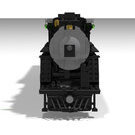 It has been almost if not exactly or more than a year since I created the Z-6 challenger. I originally thought I could not improve it any further, but it turns out I was wrong in more ways than one. The model you see before you is a MASSIVE upgrade compared to the one I originally made. It features new trailing truck and tender bogies which have been needed to be worked on for quite some time. Those bogies that were once on the original model were both blocky and incomplete at the same time. The trailing truck is now more gradually sloped and the tender bogies now look like they were off the prototype. I also was able to number AND letter the locomotive where it represents an MTH version of the model (The MTH version of the locomotive was the source of my inspiration to constructing this behemoth and how I became a fan of this design). If you have noticed the display track the locomotive sits on, I bet you can guess what is going to become of it. But to leave no one on a cliffhanger, I will say that it will be going to the Lego Ideas website to become an actual product. If you wish to have this model on YOUR Lego train layout, be sure to support it. I will let you all know when it appears on the Lego Ideas website when I update this topic.
 -
These two rail vehicles are a type of railcar called a Galloping Goose, and are slightly inspired by seven real vehicles built and used by the Rio Grande Southern narrow gauge railway back in the 1930s to 1950s, when the little railroad was torn up. Six still exist in original form, with one being a reconstructed replica. These machines are really something Doctor Frankenstein would love - a bus body or boxcar welded to a road vehicle (usually a Pierce Arrow limousine, though bus bodies were later used) for the front end, with train wheels added underneath. My interpretations of this type of vehicle are built in freight (red) and passenger (blue) versions, even though the real-world ones are all silver / light gray painted. (NOTE: This vehicle's front half was inspired by @hachiroku and his Indiana Jones "Raiders" staff car MOC from 2019.) The rear of the Galloping Geese. As a play feature, you can open the doors to the drivers compartment and place a driver at the wheel. The back half of either vehicle is not meant to be accessible. The free LDD file for both Galloping Geese can be found at my Bricksafe page. I'm currently building the blue Galloping Goose in real life, so keep your eyes peeled for that separate thread later! Thoughts, questions, complaints, and suggestions welcome!
-
I like the late-1930s car from 2015 San Diego Comic Con set 'Action Comics 1 - Superman', but didn't particularly care for the garish colors of green and yellow - or the insane price! So I used the instructions and built my own normal version in dark blue, then this black one with XS Big Ben Bricks train wheels instead of rubber tires as a railroad inspection vehicle. This rail mobile has a number of changes from the set, but it still seats one figure at the wheel. Speaking of which: the person in the picture is a division superintendent, and he is wearing green in tribute to the original colors of the SDCC set that inspired this MOC. The rear of the rail mobile. (apologies for the dust - I just built this two days ago!) Inside the vehicle, featuring the drivers seat. Thoughts?
-
The model seen here is originally based upon open-back instructions purchased in 2012 from Brick City Depot. The 'Winter Village Train Station' can be seen here and was first built in real bricks by me in 2017, but then torn apart only three years later in 2020. Well, I regretted that decision to dismantle the model from the moment I did so. Thus, I've rebuilt it using newer techniques and a few modifications. Some examples include (but are not limited to): two new ramps at the ends of the slightly-shorter platform removal of the second story seats have been redesigned vintage Coca-Cola vending machine added new signage, posters, and billboards station master mini-figure new chimney flue Here we see the track side of the station. Two benches are placed outside, and another is inside. Also visible is a chalkboard showing arrival and departure times from this station, along with each train's destination. Here is the street side of the station, with a Coca-Cola machine and a Radiator Springs poster visible. Empty bottles are in the wooden crate next to the soda machine. The inside of the MOC has a waiting room and ticket seller one one side, and a baggage room on the other. Shown here is the passenger waiting room. (yes, the clock is 90 degrees out of place. I didn't realize until after I had made the pictures that it was incorrect compared to the other two clocks) Here we see the baggage room, used for express freight, passenger baggage, and the mail. Two big sliding doors allow for cargo to be loaded onto the platform side, or out the street side and onto a truck. Here's the late 1930's / early '40's era station master of the small town Mount Clutchmore train depot, who I've named named Robert. Robert has seen a lot of changes in his 25 years of railroading. He's seen the Boys go 'Over There' to fight in the trenches, survived the Flu Epidemic of 1918 around when they came home, witnessed the golden years of the Roaring Twenties end with the economic Crash of '29, and saw masses of hoboes riding freights through his town, while sleek streamliners flash by. Now, another war is starting abroad and he's also seeing the diesel-electric locomotives for the first time as well. Simply put: the times keep changing and the calendar marches relentlessly forward. Robert isn't sure what tomorrow will bring, but he's certain the railroad will get us there. That's all I got for this MOC. Thoughts?
-
This is the fifth version of my modification of set 7997 (Train Station). Here are my notes to recap my progress from stock set to version five: I got the original set 7997 (shown above) in 2007, along with a double rail crossover for my Birthday. I wanted to make it a full building but didn't have the parts. By 2008, I had discovered Bricklink, but the station was in pieces by then and was not re-created until early 2012. The station was a stock set, while I searched for ideas. Eventually, I came across a build by a fellow Eurobricks user named Lazarus that incorporated a modular basis, a full building (street & track-sides) & a appealing design. I saved a picture of it and made my own design based on his. I included really neat features, (such as the arched lattice windows made with a fence) but I went too far and made it impossible to transport to train shows and LUG meetings. The platforms were very flimsy, and during the move to a new house in 2013, it shattered into small chunks. So, I went back to the drawing board, scrapping everything but the building itself. The 2015 version of the model was eventually scrapped in 2020 after it was accidentally dropped and destroyed. However, now in 2024 I made a red version of that model, with a few new parts added on. It has one platform, plentiful outside seating and a removable roof with second floor office. There are many other changes from the set, but the heart and soul of that 2007 set is still there. The name of the station is Edgewood, and it is staffed by the two figures standing on the platform. Here is the street side of the station, with the brick-built LEGO railway logo plainly visible. I decided on the swapped color scheme because of the similar yellow-to-red color swap sets 4554 - Mero Station / 2150 - Train station from 1991 / 1996 respectively. Upstairs is the station master's office. (Don't ask me how he gets up here - I don't know!) Here we can see the interior of the station's main floor, with ticket machines and refreshment stand. Here you can see the modular breakdown of the model, which includes the following: -Station building (lower floor) -Station roof and Tower control room (upper floor) -Tower roof -left platform section -right platform section ...Thoughts?
-
This early-1930's Duesenberg SJ is based off the car seen in Indiana Jones set 7682 (Shanghai Chase) from the 2009 Temple of Doom line. I changed the color from tan to black, updated the look with parts not available 15 years ago, and added a hardtop roof among other things. Oh, and me being me, I added some flanged railroad wheels to use the car an an inspection vehicle for railroad officials like the one shown. (Because why not drive the high iron in style?) I've always wanted to build one of these in black (since the set was released, actually), and now I've got one! The only problem is, it show dust WAY too easily, as you can see. ...It's the curse of building in black! The rear of the car. The car seats two figures inside the cabin. Thoughts?
-
Here is my XL turntable, which has 11 dead-end stall tracks and one outlet track. (though it can be reconfigured to be as many or as few tracks as needed). It is spread out over a 64 x 64 XL make-shift base plate size made up of of 4 regular (32 x 32) curved road plates with quite a bit of overhang due to the outlet tracks and tower. The re-purposed signal tower is now being used to control the turn table. This control building is modular, and has a roof and second floor that come off to reveal inside details. The studs on the sides of the building are supposed to spell out the the yard's name, but I haven't decided on a good name yet. If you have any suggestions for a name with 10 letters or less, please post a comment with it below! This table can handle a 4-track long engine (around 64 studs) with a bit of overhang at the ends, such as with my Frisco 1522 4-8-2 steam locomotive as seen above. Diesel A + B unit sets would have to be separated and moved independently, but that's okay and actually accurate for some real world locations / railroads. The basic workhorse of the turntable is this four track long framework you see here. The table's modular control tower features a lower floor that's empty except for the staircase. The upper floor features a machine to control the turn table, a wall clock, and a old-fashioned rotary telephone. The table easily glides on an raised outer ring of tiles, and turns on a central 2 x 2 pivot point. This whole thing can be mechanized, much more easily than a transfer table, but it still needs fine tuning to make it work right. The outer ring of tracks is only attached to the base plates at two certain points: every other spot is held on by gravity. (plates on tiles) This is basically a very much enlarged version of this model here. I was working on a seven-stall shed in the same style as the tower to connect to the turntable, but the angles and hinge bricks weren't working out due in LDD. I guess it will have to wait until the turn table is built in real life.... if it is ever built in the real world. Comments, questions, suggestions, and complaints are always welcome, as usual and thanks for stopping by!