

gyenesvi
-
Posts
2,396 -
Joined
-
Last visited
Content Type
Profiles
Forums
Gallery
Everything posted by gyenesvi
-
42159 Yamaha MT-10 SP
gyenesvi replied to Ngoc Nguyen's topic in LEGO Technic, Mindstorms, Model Team and Scale Modeling
So I guess you have not tried yet. Do you have a wave selector to try? If those two weren't compatible, that would be the biggest bummer of the year. I don't think they are that stupid at Lego to not make it compatible. Do you mean the wave selector could pop out from the groove? I found it quite impossible to detach for the applications I needed it. Of course the framing has to be sturdy (inseparable in that direction, on both ends of the gearbox). And the shorter driving ring just makes that build more sturdy, as the axle that holds the wave selector is shorter and can bend less. -
42159 Yamaha MT-10 SP
gyenesvi replied to Ngoc Nguyen's topic in LEGO Technic, Mindstorms, Model Team and Scale Modeling
Have you tried controlling the 2L driving ring with the orange wave selector (in case of a 2-speed gearbox)? First, I'd like to know whether they are compatible, second, that's what I'd use in an RC build, since that cannot bend like the orange hook, and it does not let the driving ring teeth pop out, at least in case of the 3L driving ring it worked reliably for me (though was not pushing it with 4 buggy motors). -
I have built the above axle and tested it on rocks. First of all, now it is solid, nothing falls apart. Second, I was pleasantly surprised by it's performance, a single L motor with enough down-gearing can do a lot of crawling. The tires are very slippery though, so I put some proper RC tires on it. I have even recorded a video of it but just when I started editing it, I realized that at this size, I could build it with planetary hubs as well :) So I went back, redesigned the axle again. Besides more down-gearing, this axle has slightly more ground-clearance in the middle, no 24T gear sticking out behind the axle. I went out again and tested it, and I was just blown. Plenty of torque from a single L motor. It practically never stopped, it was either spinning the wheel under itself, or flipping itself backwards (even with more sticky RC tires, if both wheels of an axle were on the ground). Besides that, the main limiting factor was the open differentials, but I did not want to close those as both axles are steered. Action video coming soon!
-
Your builds are getting technically really deep, and at the same time the looks are also improving :) I like this one, looks badass! Curious how it drives, waiting for the video! I agree with you that unfortunately, lately more focus has been on new panels than technical parts, though it's also true that this year brought us some nice positive surprises. But yeah, the selection of links and towball sockets for suspension and steering geometries is quite lacking, I always run into that while building.. Lately, I bought myself an RC pistol transmitter and an ESC to be able to control GeekServos. First I want to try it with PF and Buwizz motors (maybe test MouldKing ones, they seem to be more powerful). I'd love to get one of those motor housings for the brushless one as well, do you know where I could reach the guy? Do you know if he sells to other countries? I also wonder if there are smaller variants of those brushless motors that are not that crazy powerful, somewhere in the middle. It would be great to have something like the power of a Buwizz motor in the housing of an M or L motor for example.. I like the rear axle and the triangulation there, nice solution, and that differential is pretty cool too. Pity that I don't understand anything about these websites and cannot get my hands on this kind of stuff..
-
Oh thanks, I get it, the outer edge is straight on the Lego and curved on these Cada panels. Indeed that is some noticeable difference.
-
Thanks for the illustration, I get it now, really cool! That makes sense too, thanks! Which edge / in which direction do you mean? To me they seem they are curved the same way as classic (lego) panels. I can mainly see the difference in their tips being less pointy (more curved).
-
That sounds interesting, but it's a bit hard to imagine without having seen the parts themselves. Could you explain things more in-depth with some illustrative photos? I guess you have such parts already.
-
Generic Contest Discussion
gyenesvi replied to Jim's topic in LEGO Technic, Mindstorms, Model Team and Scale Modeling
I tend to believe that a restriction on length does make sense, in order to make entries more comparable and less dominated by long entries. I think it can even make sense in case of an RC competition, for example maximizing the number of wheels. Otherwise, such a competition could easily be dominated by trucks with more wheels, as opposed to trucks with good suspension for example. It all depends on what we want a competition to be focused on; brute force, or building skill. -
Generic Contest Discussion
gyenesvi replied to Jim's topic in LEGO Technic, Mindstorms, Model Team and Scale Modeling
Well, at least we've got technic toilet paper rolls for that.. :D I also like the truck competition idea with some wheel size (especially with PU), though I think it should be decided whether race trucks or functional / construction trucks are the goal. I also like the idea of possibly mixing the two to some extent with the constraint that it has to have at least one non drive/steer function. -
I don't want a programmable solution, but a hardwired electronic one. This should be something small that has an RC plug (soldered) on one side for the GeekServo, a PF plug (soldered) on the other side to connect to the receiver/Buwizz, and the converter circuit in between. And I'd want to use that with multiple GeekServos of course, so it shouldn't be too big :) If I get the signal from an IR receiver, then I don't need the Arduino, because the GeekServo can be controlled directly from the receiver. But I want to do it without an RC receiver.. Well it should be independent of the remote, but eventually I'd do it with a Buwizz + mobile phone / gamepad controller. I know that is possible and it's working for me as well, and agree that they are really useful for certain (more advanced) projects. But I'm interested in the possibility of using them in simple builds like RC cars, without requiring too much custom electronics (and a mess of wires).
-
Hope this question is okay here, and that there are some people with electronics background who might be able to give me some hints on this one. I have been thinking for a while now how great it would be to use Geekservos in my builds. They are quite small, seem to be strong enough, have bidirectional outputs and the housing is designed to be built into lego technic. I thought the only missing piece is that they have a standard RC servo plug instead of a Lego connector. First I thought that's strange, as it should be easy enough to swap. But as I read up on the subject, I realized that the problem is in the way they are controlled; they use a different PWM encoding than the Lego servo does. As I have read, RC servos nowadays use something called PWM frequency modulation (changing the frequency / pulse-width dictates their position, typically 0.5 ms - left, 1.5 ms - center, 2.5 ms - right), at 5-6V. However, the Lego PF servo uses PWM duty cycle modulation (the change in the duty cycle (PWM fill rate) dictates position, furthermore, 2 wires are required for the 2 directions), at 9V. This is probably because lego PF wants to use the same control technique for all their motors, and duty cycle modulation is what is used for DC motors typically, at least this what I gather, and this way DC motors and servos are interchangeable on any PF port. In fact, the lego PF servo is more like a DC motor with a rotary encoder that does the positioning somehow. So the question is if there exist (readily available) electronic circuits for converting from the duty cycle modulated PWM signal of PF receivers into the frequency modulated signal that a regular RC servo needs? I haven't found anything like that on the internet, neither in hobby electronics shops here, though I am not even sure what words/names to use for the search. The 9V to 5-6V conversion should be easy to account for I guess with a step-down converter. I am aware that another possible solution for incorporating GeekServos is to ditch the PF system, use a proper RC system with radio receiver and an ESC, and put the GeekServo directly onto the receiver and other lego motors onto the ESC. That works, I have tested it, but that uses a lot of non-lego electronics and results in a mixed system where DC motors run from ESCs and servos run directly from the receiver. Would be great if the GeekServos could work with standard lego electronics as well by adding some sort of converter in between.
-
It's got quite a few interesting new parts, I especially like the alternate use of the leaf springs! Has that appeared in any other set (as a leaf spring)? Is it possible to get those somewhere individually? CADA's individual part offering seems pretty random and small.
-
42159 Yamaha MT-10 SP
gyenesvi replied to Ngoc Nguyen's topic in LEGO Technic, Mindstorms, Model Team and Scale Modeling
Or you just haven't finished the build and it's not framed properly yet. I'd be curious to hear how it is when it's finished. -
Generic Contest Discussion
gyenesvi replied to Jim's topic in LEGO Technic, Mindstorms, Model Team and Scale Modeling
Yes, I get that the categories would be fixed in the beginning. As @SaperPL notes, this is why it is still not sound, because the weighting would change afterwards. And that can change everything. Another thing I find strange about your idea is that if the public votes for the criteria, they could actually do that without even looking at the models. After all, I can decide whether I value looks or functions more, without having any models in mind; it's a generic preference. This does not make sense to me as a public voting, where people want to participate in making a decision about the entries. That sounds like a weird twisted contest; hoping that the public has the same value system in terms of categories as I do, which is rarely the case for many very technical builders I guess. -
The end result is so cute :) Great to have a steered axle at such a small scale, I would have appreciated that a lot when I was a kid and played with this kind of lego!
-
Generic Contest Discussion
gyenesvi replied to Jim's topic in LEGO Technic, Mindstorms, Model Team and Scale Modeling
Honestly, I agree with @SaperPL that your system sounds quite convoluted, furhermore that it isn’t even sound, in the sense that what the competition is all about would only become decided after building the entries, because it would basically be decided by the public voting. That sounds very counterintuitive. Also agree with many generic principles put forth by @SaperPL throughout the whole discussion for the case of jury voting. For example that without some (short) specification and prioritization of criteria it just becomes a gamble. Which could be acceptable for public voting, but not so much expected for jury voting. I’d say that my max 3 points per entry proposal (for public voting) sounds practically much more possible to me. -
I wonder if the fact that there has not been melting problems with the Buwizz 3 and Buwizz motors is related to that the Buwizz had shutdown problems, meaning that it shut down before melting could have happened :) And what will happen now that the shutdown problem has been fixed. Though the problem has been fixed by limiting the power when the current goes high, so hopefully that still prevents melting as well..
-
Hmm, that's really interesting. So would that mean that Lego motors, which are designed to be run at 9V, should not be run from 7.2V rechargeable batteries? :) Or is this all about significantly lower voltages? Actually, I found this on lego.com, lol.. "The LEGO battery box works best with AAA batteries that provide 1.5 volts each. This is because the IR receiver and train motor require almost 9 volts (6x1.5V) in order to work properly. Rechargeable AAA batteries only provide 1.2 volts each, which is why we advise not to use them to power your train." Also, wonder if the Buwizz motors are designed to be run from 3s LiPo, so ~11V?
-
That’s just really cool! Not only the looks are spot on, but that fake engine elevates it even more!
-
Then the situation is somewhat better, but it still rubs. The problem is that in this axle, the steering linkage is coming from above, that's why it's in the way, and that's a key feature of this lifted axle. With a different suspension/steering mechanism the wheel hub and tire combination could work when used inside out, but not here.
-
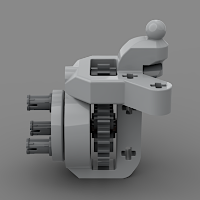
So last week I had the time to build and test the above RC version. The good new is that the build actually worked out fine, things don't collide and the gearing is good for a crawler. The bad news is that the axles don't hold up for the job, they fall apart quite easily when driving on real, somewhat demanding terrain (on flat terrain it works okay). The axles have 3 problems that were actually anticipated, and all of them manifested themselves quite quickly. For one, the 8T gears on the portal hub are only supported from one side, so they can crack, and the upper gears can slide off, and both happens. Second, the built portal hub, comprising of a 3x3 T beam held by pinhole-pins can slide off to the side, and as the model steers and the tires get caught up in rocks, it does slide apart. Third, the old CV joint has a 1.5 deep axle hole in it, but the 3L axle coming out of the differential is only 1 stud deep into the CV joint, so that 3L axle can slide out of the differential and into the CV joint, effectively detaching the drive, and it also happens after a while under some torque. So altogether because of these problems, these axles are not usable for an RC build in this form. Even one of these issues alone would hurt playability on the longer run, but the 3 together just make it pretty unusable. So I started to think about how this all could be fixed, and came to the conclusion that dropping the portal hub and using a regular wheel hub and widening the axle could solve all issues. However, these balloon tires don't play well with the regular hubs and rims, as the tires are too wide, they rub the steering arms. So it could only be done by changing the tires to non-balloon 68mm ones from the Batmobile. Also, dropping the portal hub lowers the model by 1 stud, and that way the wheels can slightly rub the fenders when the axles are steered and articulated to maximum. Nonetheless, I still thought I could give it a try, just to see how it works. But when widening the axles by two studs, I bumped into another problem: 7L steering links would be required instead of the current 6L ones, which does not exist. The only option is to build a 7L link from suspension arms, but that requires more space, which is already quite tight around the steering linkage. In the front I could find a way to make some space, but in the rear I could not do the same, as the steering servo itself is in the way and cannot be moved. In the end, I found a solution by making the steering asymmetric; the rear one steers a bit less. Here is the redesigned axle. At the bottom I used old 4L technic plates to fix the wheel hub without sacrificing much ground clearance. And here is how the complete model looks with them and the alternative tires. I think it actually looks cool, even though it diverges quite a bit from the original model. After indoor testing, it seems that the build is okay, the axles don't bind and can articulate and steer properly. Some outdoor testing will follow soon to see if they hold up. I am really curious how a single PF L motor for drive can perform with a good amount of down-gearing, it seems powerful enough at first sight!
-
[APP] BrickController2
gyenesvi replied to imurvai's topic in LEGO Technic, Mindstorms, Model Team and Scale Modeling
Oh yeah, that's cumbersome indeed! So +1 for that. -
Generic Contest Discussion
gyenesvi replied to Jim's topic in LEGO Technic, Mindstorms, Model Team and Scale Modeling
I don't think about this as a heated debate, just discussing options and pros and cons for various voting systems, and the ways people think about them, their thought processes when actually doing the voting. So it is great that you also express your view. Yes, it could easily be the case that one voter votes for 3 entries and the other for 10. And I think it is not a problem, rather the contrary, it is natural. All voters have the same opportunity to vote, but we don't need to force them to vote for equal number of entries. I believe this should be viewed from the point of entries, not from the point of voters. From the point of entries, the name of the game is who can attract more 'likes'. As if for every entry, we asked: who likes this one, hands up people! That sounds like a completely legitimate voting system for me. My system is just a generalization of simple likes (+1), in the sense that there are 'stronger likes' (+2 / +3) as well. For simplicity let's just consider simple likes (+1), and imagine that we force each voter to vote for exactly 5 entries. But it is very unlikely that a voter likes exactly 5 entries, so either of two cases will happen. If a voter likes less than 5 entries, he will have to give a vote for something that he does not really like. On the other hand, if a voter likes more than 5 entries, he cannot give a vote for some entries that he did like. Those cases do distort the opinions of the voters and hence the results, as they cannot freely express which ones they like! That is why I am against having a problem with max number of possible votes. I completely agree with you on this one, that is why I also expressed previously that I think contests with jury voting and public voting should be more different in terms of voting criteria. The simple system of max 3 points for each entry I am proposing now is for the public voting case. For the jury voting case, I'd be in favor of more elaborate criteria and in that case I think either a more elaborate scoring or a point distribution scheme could work better, because the jury's task is to consider all entries in more detail, not just the ones they happen to like by quickly flicking through them. I think this is the key difference between the two cases. -
Cool stuff, I have already seen someone building such a suspension before, maybe @paave? Nice experiments, I like that you did different variations. How solid are these axles? In the first version, what's the purpose of the frontal structure built from tubes and axles? Can't that slide apart? The steering linkage is behind the axle center, right? The scrub radius seems large though..
-
I guess they will want to use the newly developed gearbox parts though. I am hoping that the lack of supercars to choose from would mean that they will have to start using them in 1:10 models as well :) Hopefully with the new parts they can fit into smaller models.