

gyenesvi
-
Posts
2,396 -
Joined
-
Last visited
Content Type
Profiles
Forums
Gallery
Everything posted by gyenesvi
-
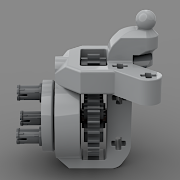 I'm rather hoping that if TLG makes small scale offroad stuff, then it will require some new special suspension part to make it possible on a small scale (like some small connector with towball socket, or shorter links).. But in reality I kind of suspect that they'll just go with good old stuff..
 -
[MOC] Beach buggy
gyenesvi replied to Jurss's topic in LEGO Technic, Mindstorms, Model Team and Scale Modeling
Thanks for the pics and the render. So the direction of rotation that you draw in here seems physically impossible given that the 5L LBG towball arm and the green pin are fixed relative to each other as part of the chassis (a rigid structure (the triangle of the trailing arm) could not rotate around two axes (so far away from each other) at the same time). So I quickly built this in real life and found that due to some inherent flexibility in pins, it does have some minimal range of motion, but of course stressing the parts along the way. Furthermore, as it travels, it incurs both camber and toe change along the way, which motion the drive axle probably can't exactly follow due to having only one flex point. I guess that's enough/no big deal for your case here, but is that intentionally built so? I guess that would not fly in an official build :) I believe a triangulated trailing arm should actually rotate around a different axis that is perpendicular to the chassis, not longitudinal as it is now. And for that you'd need two CV joints in the drivetrain to be able to follow the motion without stressing the drive axle. I'm looking into this because I am nowadays interested in (independent) trailing arm suspension, it's something that's rarely built in lego form but is used a lot in reality. -
[MOC] Beach buggy
gyenesvi replied to Jurss's topic in LEGO Technic, Mindstorms, Model Team and Scale Modeling
Thanks, yet I'd still like to understand where (around which axis / axes) it pivots, and how the drive train follows it, I can't see it on the images.. I only see one towball connection and that there is some triangulation.. Can you explain/show that? -
It's so great to see all those amazing looking and functional models together. These machines look so much better in the bigger context, be it other machines, warehouses, etc, looks so realistic as they work together :) Must be fun to see all that in real life!
-
[MOC] Beach buggy
gyenesvi replied to Jurss's topic in LEGO Technic, Mindstorms, Model Team and Scale Modeling
Wow, I love this, it looks really clean and cool (lime here is great), and under the shell it's interesting mechanically, great suspension solutions and execution! Does the rear suspension change camber of the wheel as it works? I don't see where the pivot point is, can you show more detail? Is that how a real one would work? -
Thanks for all the positive feedback! I used Philo's package, that he recently made. What I usually do when the program does not recognize the custom parts is that I open/import them in part designer and then export them to Studio :) That must be a cool workplace :) I like these kind of buggies, so it can easily happen in the future that I'll make other version of this without limiting myself to a single set, and maybe with more power :) Thanks, well stickered parts are often hard to reuse, and so I rarely apply stickers, but this one is a fairly generic one, so I decided to apply it just for making this model more detailed.
-
Technic General Discussion
gyenesvi replied to Jim's topic in LEGO Technic, Mindstorms, Model Team and Scale Modeling
I tend to agree with this. I think plus or minus a few of these sets to hand out for review cost only pennies for TLG. -
This looks interesting, so I do have a couple of questions :) - I'm guessing it's RWD, and the motor output goes directly to the rear diff? Can you show some close-up pictures of how the motor is mounted? - Are those complete RC wheels? Or lego rims and RC tires? It's a bit dark on the photos, but I am guessing the first. - Did you buy parts from Zene one-by-one or did you buy a package? - You seem to be using steered hubs in the rear axle as well, right? Is that on purpose, or is that because that's what you had from the Zene package? - The lower links on the rear 4-link suspension seem to have an pin/axle connection at the axle and a towball connection at the chassis end. That way the rear axle does not have much freedom to articulate (no towball connection there). I believe it should be the other way round. Even the towball connection at the chassis end does not help much in the articulation, because that would require tilting the link, but that's held straight by the spring, so it cannot tilt. So this way I'd predict that there is not that much articulation in the rear axle. Or is that what you are looking for intentionally, so that the car does not roll? I think the correct term is anti-roll bar. We want to prevent the car from rolling, a car does not row :) Of course I understand you are not a native speaker, but I just wanted to get the name right, so that we can explain the function correctly. Do I understand correctly that anti-roll bars are mainly for fast vehicles? It is supposed to kind of hold back axle articulation when cornering, right? It wouldn't be so useful on slow rock crawlers, where axle flex is higher priority, right? Also, I don't quite understand how it helps with fast starts in general? In a straight line start, isn't it the squatting of the vehicle that matters, instead of its roll? I'd think roll can be part of the equation in case of accelerating out of corners, no? Sounds nice in theory, but how do you do that in lego? You can't just make the upper arm wider, there is no such lego part in existence, and you can't even build it from smaller parts in a way that gives enough space for a large shock absorber. Guess that's why everybody puts the shock absorber behind the arms.
-
Technic General Discussion
gyenesvi replied to Jim's topic in LEGO Technic, Mindstorms, Model Team and Scale Modeling
I have also seen this popping up on FB today, and was quiet surprised to read it, sad indeed. I did also watch many of his reviews, even though I always skipped through the speed build section. What made me think is what could have been the reason, I wonder what's TLG's criteria? I know we'll never get a proper answer for that, so we can only speculate, but I can't think of too many reasons beside the hard criticism or maybe TLG finds other reviewers more popular nowadays? -
I am not a crane guy, but I really appreciate the dedication you put into this model. The source is a really good match, and I guess it must have been a lot of work, both designing and doing the instructions, actually I would not have believed that somebody would come up with such a meaningful B model for this set (I mean something that is different enough from the A model, uses the key parts and the electronics for good, even controllable from the Control+ app). Great job!
-
Yeah, that's what I calculated too, and just gave up there.. @Ryokeen, yes I know all that, I used to work in the field of computer graphics, that is why I believe it could be better. Basically, I'd be fine with non-raytraced, non-photorealistic renders for animations. Something similar to what is currently available in the main build view of Studio. Why can't I make an animation with that level of realism? Maybe even better lighting/shadow casting can be done, it would be okay to have 1 fps rendering instead of real-time, that could still give us reasonable times for short animations. But 1 min / frame or even 45 mins / frame is way too much and unnecessary I think. To me it seems it can use low poly meshes, you can set the detail level for the build view and if you set it low, it gets blocky. But anyways, sorry for the off-topic, agree that we should not go on here..
-
And how long does it take for you to do your animations? I am not willing to wait hours or even days for them to get done. Last time I tried on my laptop it would have taken so much. If I compare that to the real-time performance of games, it seems completely out of proportion. I don't need photo-realistic ray-traced rendering for simple animations.. Also, are you using Studio for your models? I always thought you are using LDD, because that has the ability to animate hinge sequences and add pneumatic hoses, unlike Studio, as far as I know..
-
Hi Folks! Let me share my latest alternate build, a Polaris RZR buggy built from the Audi RS Q e-tron (set 42160). As usual, I was trying to build an off-roader that is somewhat technically different from the A model, and improves things where I found it necessary. Although the set does not have too many interesting suspension/drivetrain parts (and is also lacking connectors quite a bit), the suspension can be somewhat varied. The model was mainly inspired by the following real world counterpart, a Polaris RZR Turbo S, although it has many variants with some differences in the looks (such as the side being closed in some models). These buggies have trailing arm rear suspension with radius arms, something I have never seen built in lego form, so I was trying to replicate that, and the new hubs just gave a nice possibility for it. Besides that, the Audi is heavily missing all interior, so I decided to try and build something with full interior :) I believe the root of this problem is the difficulty of the electronics placement in the Audi, most prominently that of the (screwed) hub, so I had to build the chassis accordingly, which this model nicely allowed. I think my alternate model is the first one that does not have any electronics in the cockpit.. Features independent front suspension independent trailing arm rear suspension with radius arms efficient drivetrain with coupled motors complete and clean interior with two seats, dashboard, steering yoke and middle console lightweight body Drivetrain In order to maximize performance, I definitely wanted to couple the two drive motors. It is a very easy to lay out the motors that way, but since with coupled motors the drivetrain must pass through the middle of the chassis, then the battery cannot be placed in the middle. It cannot even be placed above the driveshaft, because then either the lid or the button cannot be accessed (or neither, if the model has an interior). So the hub must go somewhere else, well, the candidates locations are in the back. I ended up placing it upside down in the back, to allow access to the screws, and the turn on button can be pushed through a lever. That leaves the drive motors to be placed on the floor. Steering As for the steering motor, I also wanted to put it into the front, not interfering with the cockpit. That's also a bit more difficult if you want your steering to be linked both in front and behind the axle, as in the Audi. I think the Audi has dual steering linkage because it needs it due to its screwed up steering geometry; because of those red connectors on the steering hubs to which the links are connected, the links are mounted half a stud higher than should be, and that would cause significant toe in/out and bump steer; so they solved it by making the linkage symmetric, pushing the wheel hubs in both directions. Actually that half a stud matters more than I thought, the links are quite tight, and are under some stress. Not sure how Lego allows such bad practise, though I can imagine they might even say it is intentional to allow less slack in the linkage. Well, a tight linkage becomes useless if they add a gearing after the steering motor (as in the Audi), and you control the whole thing with the touch screen; it will be unprecise anyway, so the tightness of the linkage does not matter much. It would have been much cleaner if they just designed a proper steering hub with the steering arm in the middle, as in case of the planetary one. Then the whole half stud offsetting could have been easily avoided.. Anyways, I decided I don't want wrong steering geometry (even with the dual linkage, it did have some bump steer, I guess because only one rack is driven by the steering motor), so I just flipped the hubs upside down to allow proper geometry (no half stud offset vertically). Here's the complete driveline and steering geometry. It works like a charm, no toe in/out bump or steer, and it has little slack. Suspension The front suspension is a simple independent one with double wishbones, similar construction to that of the Audi. However, the rear one is a trailing arm with radius arms. This seems very similar to an independent one with double wishbones, especially because here I could only implement some of the radius arms with the wishbones. The main difference is that the springs are attached to the trailing arm itself instead of the wishbones. Also, I believe in real life, the trailing arm is the main load bearing structure, and the radius arms only help stabilize the wheel sideways (whereas here it's the other way around). Furthermore, I believe that in real life, the trailing arm and the wheel hub is one solid unit without a pivot. However, in this lego model, I could only imitate this with a pivot at the wheel hub end of the trailing arm. If there was no pivot, then the wheel hub would move non-parallel to the ground as the suspension is working, and then the radius arms would need bal joints on both ends to be able to follow its movement, which I could not implement here due to parts availibility (maybe would be possible with more links). Nonetheless, this simple setup nicely approximates the real thing, and is a somewhat novel suspension technique in lego I believe. It would be nice to understand better how it works in reality, so if anyone understands this better, let me know in the comments. One thing I don't quite understand is that the radius arms introduce sideways movement of the wheel as it moves vertically, and I don't get if there's a trick to make the trailing arm follow that sideways movement, such as being placed at a slight outward angle.. Interior Many people complain about the Audi lacking any interior. I think the reason is a mix of two things; cost saving, and the inability to place the electronics outside of the cockpit (due to the screwed hub). So I decided to make a full interior just to show it's doable even with the mighty screwed hub and only using the Audi parts :) Besides the two seats and dashboard, I added a middle console with a gear stick and built a steering yoke. Bodywork With the bodywork I simply tried to roughly replicate the lines of some variation of the real buggy, for which the many panels proved useful (especially the roof is a nice match). I definitely wanted to reuse the stickered curved panel with the front lights, and because of that the nose came out a bit blocky, so that's a compromise. Also, the nose is about a stud too long anyway due to space requirements for the front axle and the steering mechanism. But otherwise, the shape is quite okay I think. Here are some more renders and photos. More renders and photos are available on my Bricksafe. Building instructions are available on Rebrickable. Let me know how you like it! Cheers, Viktor
-
Seems like yet another nice event! I love these small builds, they are so cute, varied and yet realistic :)
-
Oh man I really like this model! You have built it in a good scale, packed great functions into it, and I have to agree that this is your best looking model I have seen :) And those fender parts work really well here, and if those are an exact copy of the Ford GT ones, I guess sooner or later they will come in black as well. The front suspension is a really interesting work with that asymmetric drivetrain, I would not have thought that is possible in a fairly clean way actually.. good job! Truth is I never paid too much attention to Suzuki off-roaders as a child, but lately I really started liking them, they are kind of cute ones and have great potential for turning them into small lego models, I am also planning to build Jimny and Samurai models in this scale!
-
[TC26] Arctic Walker
gyenesvi replied to Seasider's topic in LEGO Technic, Mindstorms, Model Team and Scale Modeling
I really like walking mechanisms, and it already looks interesting, but are you sure it fits the vehicle category required by the contest rules? Or is that something you have confirmed with the jury already? -
[MOC] Microvan Kei Car
gyenesvi replied to apachaihapachai's topic in LEGO Technic, Mindstorms, Model Team and Scale Modeling
Wow, that IS some next level compactness :) I like the drive motor placement, and how the servo holds the front section. Cute one! -
Universal off-roader 4x4 V2
gyenesvi replied to Zerobricks's topic in LEGO Technic, Mindstorms, Model Team and Scale Modeling
Just for the record, I was not the first to use the old differential piece to achieve the 3:1 gear ratio in a gearbox, I believe @Zerobricks have also used it before. But yeah, I guess we are all excited that such constructions can now be shrunk drown from 8 to 4 studs in length, that's a significant improvement :) -
General Part Discussion
gyenesvi replied to Polo-Freak's topic in LEGO Technic, Mindstorms, Model Team and Scale Modeling
Thank you very much, I'll check them later, and actually I think it was quite quick :) -
Universal off-roader 4x4 V2
gyenesvi replied to Zerobricks's topic in LEGO Technic, Mindstorms, Model Team and Scale Modeling
Great model, and thanks for the great experiment; that's all I needed to know about the new gearbox parts :) So they are useful in practise, even for high torque applications; really good news! The independent left-right drive with such a high travel independent suspension is also something I want to try with a similar Buwizz motor/gearbox layout (just with 2 speeds). The third speed is just the icing on the cake! -
That looks beautiful, very nice curves, well done! Great details and photos!
-
General Part Discussion
gyenesvi replied to Polo-Freak's topic in LEGO Technic, Mindstorms, Model Team and Scale Modeling
We do have this thread for such a purpose, though not pinned. -
That looks amazigly playable! Very well engineered and great design as well! I like how it can rotate its understructure while keeping the upper part fixed. How did you synchronize the two movements so precisely?
-
42159 Yamaha MT-10 SP
gyenesvi replied to Ngoc Nguyen's topic in LEGO Technic, Mindstorms, Model Team and Scale Modeling
Well spotted, great to know! -
General Part Discussion
gyenesvi replied to Polo-Freak's topic in LEGO Technic, Mindstorms, Model Team and Scale Modeling
Thanks a lot! I doubt anybody else would be working on new parts but you.. And if we wait for the Studio developers, it's never going to arrive unfortunately..