Search the Community
Showing results for tags '9v'.
-
-Mini.thumb.jpg.03594ed3626ab4a4b625a32af4d03d5f.jpg) (Click to skip to the post with the latest photos) The Backstory: For years I've wanted to be able to display my 12v collection at shows/exhibitions/libraries or wherever, but the wiring is a challenge - I reckon on my last full layout there was 250 to 300 feet (75-90 metres) of the stuff, which on a static layout is one thing, but one built in modules for transport is a challenge. Three or four months ago I came up with a solution (more on that below) and the dreaming started. After much playing in Bluebrick, and nostalgic posts appearing here about older era trains, I settled on a plan. I still had a bunch of my old blue track from the 4.5v era, but no motors. Off we go to Bricklink then! The Layout So, here's the plan. Ten years ago I had a small portable layout on 4 modules, each 3x5 baseplates, and over the years have simply added more of these. Following my Bricklink spree, I now have 2 working 4.5v motors, so rebuilt the loco from set 183 and I have the loco from 7720 in progress. These 2 will feature on the 4.5v loop below, which is 3 of those modules. Next to the 4.5v loop will be the showpiece, the main 12v loops. 12v Lower by andyglascott, on Flickr And on the right of the layout will be the 9v loops. Unlike the other 2 eras, I will have 9v track left over, so this is likely to be expanded in due course, particularly as @michaelgale releases motors, power supply etc. 9v Loops by andyglascott, on Flickr Lastly, there will be another 12v loop, elevated, which will run across the back of all three eras. 12v Upper by andyglascott, on Flickr Putting all of those together looks like this (the white baseplates are roughly where the mountains, tunnels etc will be for the elevated sections. The green and grey sections are simply so I could keep track of where the 3x5 modules were to try and avoid having curves/points on more than one module. When it all comes together, in most likely a couple of years, I'll be able to run 6 trains at a time. Whole Layout by andyglascott, on Flickr The Beginning After all the planning, and clearing away of my last (incomplete) layout, I've finally started building the first module, part of the 4.5v loop. I decided to start here as this will be the quickest era to build, and to a large extent, each era can also be displayed as a stand-alone smaller layout. These three modules will be countryside/farmland, and the trains will reflect the farming side of it when they get built. Module 01 Pic 02 by andyglascott, on Flickr The 12v Wiring The solution that I've come up with is fairly simple, but does involve taking a drill to some baseplates.... At each of the 12v points or signals I'll drill a small hole through the baseplate and the wood for each module, thread the wire through and attach either the original Lego plugs or a quick connect/release plug/connector so that when the layout is set up I'll use already measured lengths of wire to go from that point to the control panels, which will be on their own module. This is going to be a heck of a journey, and build, I'll post updates from time to time, particularly at landmark moments such as completing an "era". I always said, growing up, I was keeping my Lego for my kids. It was really only an excuse, and I'm really glad I didn't sell my old blue track even though I didn't, for years, think I'd use it. Sadly my original 4.5v motors, battery boxes, lights and even signals are long gone, but I was only 7 or 8 when I got 7720....
(Click to skip to the post with the latest photos) The Backstory: For years I've wanted to be able to display my 12v collection at shows/exhibitions/libraries or wherever, but the wiring is a challenge - I reckon on my last full layout there was 250 to 300 feet (75-90 metres) of the stuff, which on a static layout is one thing, but one built in modules for transport is a challenge. Three or four months ago I came up with a solution (more on that below) and the dreaming started. After much playing in Bluebrick, and nostalgic posts appearing here about older era trains, I settled on a plan. I still had a bunch of my old blue track from the 4.5v era, but no motors. Off we go to Bricklink then! The Layout So, here's the plan. Ten years ago I had a small portable layout on 4 modules, each 3x5 baseplates, and over the years have simply added more of these. Following my Bricklink spree, I now have 2 working 4.5v motors, so rebuilt the loco from set 183 and I have the loco from 7720 in progress. These 2 will feature on the 4.5v loop below, which is 3 of those modules. Next to the 4.5v loop will be the showpiece, the main 12v loops. 12v Lower by andyglascott, on Flickr And on the right of the layout will be the 9v loops. Unlike the other 2 eras, I will have 9v track left over, so this is likely to be expanded in due course, particularly as @michaelgale releases motors, power supply etc. 9v Loops by andyglascott, on Flickr Lastly, there will be another 12v loop, elevated, which will run across the back of all three eras. 12v Upper by andyglascott, on Flickr Putting all of those together looks like this (the white baseplates are roughly where the mountains, tunnels etc will be for the elevated sections. The green and grey sections are simply so I could keep track of where the 3x5 modules were to try and avoid having curves/points on more than one module. When it all comes together, in most likely a couple of years, I'll be able to run 6 trains at a time. Whole Layout by andyglascott, on Flickr The Beginning After all the planning, and clearing away of my last (incomplete) layout, I've finally started building the first module, part of the 4.5v loop. I decided to start here as this will be the quickest era to build, and to a large extent, each era can also be displayed as a stand-alone smaller layout. These three modules will be countryside/farmland, and the trains will reflect the farming side of it when they get built. Module 01 Pic 02 by andyglascott, on Flickr The 12v Wiring The solution that I've come up with is fairly simple, but does involve taking a drill to some baseplates.... At each of the 12v points or signals I'll drill a small hole through the baseplate and the wood for each module, thread the wire through and attach either the original Lego plugs or a quick connect/release plug/connector so that when the layout is set up I'll use already measured lengths of wire to go from that point to the control panels, which will be on their own module. This is going to be a heck of a journey, and build, I'll post updates from time to time, particularly at landmark moments such as completing an "era". I always said, growing up, I was keeping my Lego for my kids. It was really only an excuse, and I'm really glad I didn't sell my old blue track even though I didn't, for years, think I'd use it. Sadly my original 4.5v motors, battery boxes, lights and even signals are long gone, but I was only 7 or 8 when I got 7720.... -
My ideas for fit powered up battery box to this set:
-
Dear Lego Fans, While at work, my colleges and I were talking about how awesome it would be to connect our work desks with a cargo train to haul post-it notes, candy and office utilities around our office. I offered to bring my old Lego train set and we set it up during our lunch break. It has really relighted my love for Lego trains! I got my first Lego set around 1999/2000 with the blue and white Lego Railway Express (Set 4561). Being a kid at that time, I could not afford much Lego. I got a few track-packs and switches and intersections. I also bought a Santa Fe engine and one of the cars with it. I've stopped playing with lego all together roundabout 2006/2007 when the first RC train sets were released and 9V systems were retired. It's been 10 years since I last got my train set out and now being an adult with money on my hands, I really feel like getting back into the Lego trains that I so dearly loved as a child. I'm now faced with a few problems since the 9V system is no longer available. For one I know very little to nothing about the new train sets. I'm wondering wether it's worth buying a new train set or not, which train set to get, or just lurk around eBay to see if someone might want to sell their old 9V system. I'm thinking of building a new, larger layout in my basement once I bring home my train set from the office. As far as I know, all the rolling stock will work fine on the new rails and the new trains run fine on the 9V track. so to conclude, here's a list of questions I have: - Are there any train sets out right now that I should get? - Are there any train sets coming out in the near future that are worth waiting for? - Should I not care about the new train systems at all and check eBay frequently for old 9V sets? If anyone is interested, I will post some pictures of our little office-cargo-train thank you in advance!
-
Does anyone know where to find broken 9V train motors? I searched bricklink and ebay but i didn't find anything. I want to make it in to a custom PF power pickup.
-
Hi all MOCers, I finished this MOC of Budapest tramway approx a year ago but I never had time to take some photos and show it to the community. So, here it is. The original tram was manufactured by CKD in Czechoslovakia for Budapest Transport company. A total of 322 cars were delivered between 1979 and 1984 (and all of them still running). In the first times they were used to go single (they have driver's cab only on one end so they needed loops on end stations), then with the growth of the number of passangers they started to operate them coupling two or three cars together. Now these trams run in line 1 and 14 with three cars and line 12,17,28,37,41,56,56A,59,59B,61 with two cars. The LEGO-tram runs using its 2 9V train motors, each car has one motor. Other bogie is dummy, however it uses train wheels, because the standard wheel holder part is simply two high for this application. I'm proud on the pantograph design, but I know, some of the purist won't like the cut and curved 3 mm diameter hose. Unfortunately the clip with bar holder doesn't exist in red colour - a red pantograph could be autenthic, however due to weathering and coal-dust from upper part they are only red a couple of days after painting, then they become black. Hope, you like it. Please leave your comments and critics here. :)
-
Hello there! Recently I have taken my time to wash and sort my old inventory of Lego pieces. Parts from way back in the 70s (which were donated to me when I was about 5), parts and complete sets from my childhood (including the wonderful Set 740) up to my last Lego Technic Set (8868). After that last technic set, my Dark Age set in and lasted until 2016, nearly 23 years... and I just came out of my Dark Ages because of my little son, as I am preparing to get a hold of the old sets (hopefully complete) to give them to him as presents over the next years. Well, it didn't take long to completely draw me into the fascination of building with Lego again. When I gathered the pieces to put together my Metro Liner (4558) and, after a sleepless night, I had my Railroad Crossing (4539) complete as well, I suddenly ended up buying some extra tracks, points and even a crossing. Some of that extra track came with two very, very incomplete sets: No 1, the Load and Haul Railroad (4563) and No 2. Freight and Crane Railway (4565). Basically, there is no single engine or rolling stock anywhere near complete. 20% of the pieces are existant at best. At the moment I am trying to restore those as possible with my limited inventory. So, that's how I ended up here, searching for clever tips and tricks to somehow finish those two sets with my limited amount of bricks and trying to get some insight to what is new on the topic of Lego trains. And maybe build some MOCs too, while I'm at it Thanks for reading and have a good time building, Capparezza
-
hi everyone in this topic I'll show my collection of trains to start, a moc I made using pieces I had laying around
-
Hello all, in the last month I was working on three articles written in Hungarian language to use it as a standard for our train fan community. Last week I decided to translate it to English as well, and here it is for all those who needs advice on simply layouts, ideas for train station geometries and possible usages of Holger Matthes' long radius curves built from straight tracks. The three main sections of article (from original Hungarian articles) are the following: 1. Basic geometry rules and simple tricks - mostly based on Bill Ward's article on Brickpile, but including some own ideas 2. Station geometries - ideas for small, simple stations, station with through lines, building connections between parallel lines, using flextrack in 9V-setting, widening distance between tracks for platforms 3. Long radius curves built from straight tracks: ideas to use these not only in full loops, but at station geometries as well. Article contains URL to .bbm file as well to download it (made in BlueBrick version 1.8.1.). Article is at my Google Drive, since Brickshelf didn't allow me to upload in .pdf format: https://drive.google.com/file/d/0B2pGVpZyXf5hU3NYRWNuRkVCbHM/view?usp=sharing&resourcekey=0-HwAH24JRnsFAFtsowbF3cw
-
I'd like to present my latest locomotive, loosely based on various British 0-6-0 goods engines. This MOC is a first for me in several ways...it's the first locomotive for which I've attempted to print decals, and the first I've built using BBB wheels. I'd like to thank @ScotNick for graciously granting me permission to use his magnifying glass technique for the front cab windows. Lord Dudley is named after a 15th century politician and its number is an homage to the USS Voyager (NCC-74656). Lord-Dudley-1 by the chestertonian, on Flickr Lord-Dudley-2 by the chestertonian, on Flickr The 3-axle tender holds a 9V motor (the third axle swivels to go around curves) and features the classic BR "lion-on-a-unicycle." I don't have a proper label maker, so I printed out the decal on regular paper and covered it with a slightly larger piece of adhesive laminating sheet. This leaves enough overhang of the adhesive layer to stick to the sides of the tender. Note that only the logo and the red lining are printed; the white lining is brick-built. Lord-Dudley-3 by the chestertonian, on Flickr The tender holds a battery box to power the locomotive lights. The batteries are accessible by removing the coal. Lord-Dudley-4 by the chestertonian, on Flickr Lord-Dudley-5 by the chestertonian, on Flickr Finally, Lord Dudley's driver and fireman pose along the line by their engine: Lord-Dudley-6 by the chestertonian, on Flickr Lord-Dudley-7 by the chestertonian, on Flickr Thanks for looking! Soli Deo Gloria
-
 Hi there, I've noticed whilst testing 'Electric Technic Motor 9V Geared 480rpm' (47154) http://peeron.com/inv/parts/47154, it was making a strange buzzing noise whilst going both clockwise and anti-clockwise. Could this mean one or more of the internal gears are failing? Thankfully, there are four thin screws on the bottom which allow the motor to be taken apart. Are replacement gears obtainable? If not, then I have to have them either 3D Printed or cast in a silicone mold. Thanks.
 -
Hi all, this time I'd like to show you something that is a bit different. It is more a study, or an experiment than a real model. It's is a very small narrow gauge locomotive, inspired by an hand-made creation of Mr. Akio Inoue (who is a famous live steam builder in Japan). The locomotive is depicted on Mr. Mori Iroshi site, which is of great inspiration to me. There's also a Youtube channel (simply search AKUBI LR on Google, you''l find it immediately). Let's say it is a mix between a DEKI-3 and a Rhatische-Bahn GE 2/2 162. Once it was yellow, now it has RhB colors. It's a bit "Japanese" since it has a super-deformed body, it is more tall than long. "Power" (HA HA HA ) is coming from a 9v micromotor mounted upside-down, and there's a working headlight. It needs a battery car to work. I use it on black narrow-gauge Lego curved track, but I recently discovered that LEMAX track has the same gauge and offers straight tracks (no switches, sorry ). It is sloooooooooooooooooooow! I hope you like this little,nerdish thing! It's name is PKZIP (like the file compression archiver for DOS PCs of the past)
-
 Hello all, I'd like to introduce my latest MOC, the Siemens Vectron locomotive of GySEV/ROeEE railway company. These locomotive appeared only months ago on Hungarian rails, the Austrian-Hungarian railway company, GySEV/ROeEE bought 9 of these with different equipment. Some of them are dual-voltage and run under 25kV, 50Hz (Hungary) and 15kV, 16.7Hz (Austria), some of them are capable to work with DC supply as well, and 2 of them with the two different AC-supply will get diesel units inside to ensure the locos can move on industrial tracks not electrified at all. When these locomotives started to appear I designed it in LDD, there was a little competition between Hungarian LEGO train fans with the design. I was the first who finished the virtual build and I loved it, so I decided to build it as soon as possible. This was the first versions, but only AC-DC locomotives have 4 pantographs, the AC-only types have only two of them. I'm quite proud of the angular green tile in the side pattern and also the angled front needed a little thinking around. I started to love the old hing plates with two and three teeth - these teeth do NOT brake the line of the hinge plate and the whole LEGO part fit into less space and easier to build other things on the top of these bricks. The slots for lights are also capable of to be lit by LEGO LED lights - another good invention introduced first in my Stadler FLIRTs to use the flexible exoforce tubes which are capable of bringing the light of PF LEDs where I need that light. You may ask why is that M-motor hanging around - it has a great importance in this model! As the real thing with two different AC-supply, my Vectron works under two different LEGO-voltages - it is compatible with 9V track and 12V track as well! The M-motor switches a polarity switch brick, which cuts off 12V pickups from 9V train motor's contacts - when the locomotive runs in 9V mode, the pickups for 12V track could touch the same rail when going through 9V points, and the loco could short circuit herself! When the loco runs in 12V mode, the polarity switch is ON, and the 9V train motors are supplied from 12V track. At the other end of the locomotive there is an another M-motor - it cuts off the 9V train motor from the output of the controlling SBrick - it won't be a wise idea to power that SBrick both from battery box and both from the 9V track, through its output... Look at the next image, how it works: So if the locomotive reaches the end of electrified track (12V or 9V), it still can carry her train forward - it can run on internal battery box as well. And finally, yes, these stuff did fit into the model: (Since the lower light on each side serves as red and white light on the real thing and upper slot serves for long distance lights at night I put white lights on the upper, red lights on the lower slots.) Also some other images and further details can be found in Hispabrick Magazine #29: http://www.hispabrickmagazine.com/sites/default/files/Descargas/HBM029_ENG.pdf Comments and critics welcome! Some other photos:
 -
Hello everyone! What kind of ideas pop into your head when you hear of a "cmf 8x8 vignette contest"? Mind you, I eventually thought of Micromotor, 9V, Fiber Optics and a matching figure capable of delivering the goods (hint: it did). Here's what came out of that idea... Just a dance club, folks! Nothing to see here, carry on... It is fairly tall for a vig, but it certainly works give the space restrictions. The dim lights were a pain to film in my setting, although I tried my best. The show must go on, no excuses allowed! And no regrets for that matter. Welcome the Catwoman from the Batman Movie franchise! Double the fun!! Some technical shots. The old 9V system is invaluable for how smoothly it integrates into Lego System. Fitting the fiber optics element into 8x8 was one hell of a task. At times I felt like a car thief on a job... The floor, oh, the floor! Don't even ask. Some bits and pieces. The pole absolutely had to be chrome - a choice afterwards regretted... I dare you to find a sound, functional and purist solution of proper length if you don't believe me. A rubber wheel was the only option of attaching the piece as far as my knowledge of pieces goes. ...And the heat goes on... Now that's a club I wouldn't at all mind visiting... Hope you had a great time here, be sure to visit soon! And something tells me you might just do that... Thanks for your attention! Let me know if you had as much fun as I did! x)
-
Hey guys, Recently bought a large lot of vintage 9V train sets and parts. The 9V AC/DC wall plugs are the 230V European version. Anyone have any recommendations on replacements for 110V US? Was looking at these ones on Amazon: https://www.amazon.com/Planet-Waves-9V-Power-Adapter/dp/B00191WVF6/ref=redir_mobile_desktop?_encoding=UTF8&dpID=41UoeHnCcDL&dpPl=1&keywords=9v power supply&pi=AC_SX236_SY340_QL65&qid=1518564574&ref=plSrch&ref_=mp_s_a_1_3&sr=8-3 but not quite sure on the plug type... Thanks, Jeffinslaw
-
Hi, I've been away for a while, and without writing a huge story about it, I'm wondering what the status of third party 9v track and accessories is. I was a backer for ME Models metal track - I was also one of the people who expanded their order back in the summer of 2016, and received my full shipment last January. I take it they are having a lot of problems now, and a lot of people did not receive their product. That's really unfortunate... we need some successful players in this market, even if it means higher prices to cover costs. I was recently able to finally set up the track for my annual Christmas train set up - the only time I get to keep out a functioning train layout. The ME track was... interesting. Coming from all LEGO, I will say the conductivity seemed flawless compared to years past, where I always seemed to have bad track along the way somewhere that made the train slow, even after cleaning. I was very impressed with it. That said, the larger radius curved seemed to suffer from not being perfect arcs when put together. Putting the track together - and keeping it together while trying to connect other track, was also fairly frustrating - and I ended up just not using the end plastic pieces that join sections together, and instead just let the traditional rail joiners hold them together. But I checked ME recently, and as we all know there is no more track available. I was so optimistic at the time if the campaign - even answering surveys of what I would like to see next (like new motors). So I searched here.... bricktracks seemed like it would have been worth a shot, but the campaign failed, probably because it was competing with the ME campaign, but I don't know. Still, bricktracks seems like a functioning business - but I only see plastic in the store. So is there any news that I'm missing? I really don't want to just give it up - I really dislike battery operated for a number of reasons.
-
Some time ago I posted this topic of a layout using only parts from the 9V era. That layout has since been torn apart to make way for an improved version. Since it's basically a complete new layout (the water tower is the only part that escaped unscathed), I thought a new topic would be justified. This time the layout has working (non-Lego) lights. Many thanks to @LEGO Train 12 Volts, whose engines with working lights inspired me to try it myself. The engine and tender are permanently coupled with a technic beam to protect the wiring. I just happened to find that a battery box for 4 AA cells fits nicely in a 4-stud space. The switch is visible in the coal. IMG_0850 by the chestertonian, on Flickr IMG_0852 by the chestertonian, on Flickr IMG_0851 by the chestertonian, on Flickr The passenger cars are now 30 studs long and have SNOT windows and removable roofs. IMG_0854 by the chestertonian, on Flickr The sleeping car interior: IMG_0855 by the chestertonian, on Flickr The dining car interior: IMG_0856 by the chestertonian, on Flickr An overview of the layout: IMG_0857 by the chestertonian, on Flickr The station includes two passenger platforms, a pedestrian bridge, and a maintenance shop with full interior. IMG_0844 by the chestertonian, on Flickr IMG_0845 by the chestertonian, on Flickr IMG_0846 by the chestertonian, on Flickr The signal tower: IMG_0843 by the chestertonian, on Flickr The freight platform: IMG_0836 by the chestertonian, on Flickr A small farmhouse with a horse-cart: IMG_0847 by the chestertonian, on Flickr Nearby, a shepherd and his faithful sheepdog watch over their flock. Thanks to @soccerkid6 and @LittleJohn for their versatile canine design! The sheep are based on a design I found here. IMG_0848 by the chestertonian, on Flickr A tribute to Ferdinand: IMG_0839 by the chestertonian, on Flickr The crane's hand crank can be locked in place. The piano was reverse-engineered from one I ran across online. IMG_0849 by the chestertonian, on Flickr Finally, I was inspired by the Switch Modification topic to connect a switch to a signal. Thanks for looking! Soli Deo Gloria
-
Hello dear Lego fans, After having signed up here in the Eurobricks forums in 2011, I posted a new thread in the "Hello my name is..." section about my plans to create my own Lego City layout. Now almost 9 years later, I can finally show you some of the progress that has been made just at the beginning of the new decade :) Good things come to those who wait. Renovations on the attic are finally complete (apart from the lighting) and we now have around 110 m² to unleash our imagination. The current plans of the Lego city layout add up to around 60m² in size and they are, as you can see in the video, far from finished. However, I thought you might be interested in some of the things that my girlfriend and me were designing in the last couple of days. The name of the city is still unknown, but the overall design has started to take shape with a downtown area, which includes all the modulars, and shops, a residential area, an amusement park, a winter village, a train yard and a harbor/beach area. I would also like to add an airport to the city and some of the classic monorail tracks have been placed already. We are also getting into MOC a little bit and we will add our own creations to the layout as soon as they look nice! The commentary of the video is in German, but I am trying to add English subtitles into the system. Please let us know what you think here in the forums or in the comments section of YouTube. I will keep you posted on future updates if you like :) Note: All of the parts used in this layout are original Lego parts, except for some of the baseplates. I thought that lime green in the Hogwarts castle area might look cool, but I will probably exchange it for regular grass green baseplates in the near future. Thank you so much for taking a look! :) Christof
-
On my new layout, I have now displayed four tracks that are operated individually with a 9V speed regulator each. All power connections to the rails have been checked w.r.t. polarization. Conceptually, the setup is equal to the Lego Train 9V Extreme display, including crossover swiches linking these tracks together. The basic idea is to run trains on these four tracks independent from each other in elective directions. The first tests showed no problems. However, these initial tests were performed with one train at a time. Recently I started to run several trains at the same time. Then I discovered that there seems to be some kind of interference between all four tracks. When running trains in opposite directions, the engines slow down or come to a stop. Notice that all crossover switches are in straight position. When operating the four speed regulators, they work only on the designed tracks, i.e. there is no visible interference at all in terms of other engines on other tracks would start running simultaneously. I just don't understand this problem, particularly considering the fact that I have never experienced similar problems on the Lego Train 9V Extreme track. Any advise to get this problem solved would be highly appreciated! Below a schedule over this layout with positions of the power connections to the track
-
Some of you may recall a few months back that I posted an LDD MOC of a locomotive using only parts from the 9V-era (linked here). Since then I have built the locomotive in real bricks, along with a layout using the same premise: to examine what I could build using only bricks that I already have, all of which are from before around 2005. If you compare it with the render in the original post, you'll notice that the engine has been modified to look more American than European, and the coaches have been elongated. The base is a 4' x 4' piece of plywood; if anyone is interested, Krylon Gloss Emerald Green is a very close match to Lego green. IMG_0662 by the chestertonian, on Flickr IMG_0663 by the chestertonian, on Flickr IMG_0664 by the chestertonian, on Flickr IMG_0670 by the chestertonian, on Flickr The layout is set in the early 20th century as the west is beginning to settle down. The town of Brick Butte fell on hard times after the local Army post was disbanded in 1896. Fifteen years later, there is little left but a few buildings (some built from materials salvaged from the abandoned fort) and a few dozen residents. IMG_0665 by the chestertonian, on Flickr I'll introduce you to some of the prominent citizens: Count DuCoup moved to America after his nation's defeat in the Franco-Prussian War, and eventually settled in Brick Butte. IMG_0666 by the chestertonian, on Flickr Hank Solo, as usual, is engaging in some shady transactions... IMG_0667 by the chestertonian, on Flickr Sheriff Quentin G. Jensen and his deputy, Juan Quenobi, patrol the dusty streets. IMG_0668 by the chestertonian, on Flickr Retired Major General Ben Caine O'Bee trains his young neighbor in the use of the cavalry saber. IMG_0669 by the chestertonian, on Flickr Meanwhile, state senator Paul P. Dean visits the town in his newfangled motorcar... IMG_0672 by the chestertonian, on Flickr Finally, here's a video of the train running around the layout. Thanks for looking! Soli Deo Gloria
-
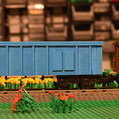 Dear LEGO® Train Fans, (You can found a german translation here.) We’re planning a new event for lego train fans, who want to be different then other lego train exhibitions and so we're proud to present the “Bauspielbahn 2019” in Schkeuditz, a town next to Leipzig, Germany. Schkeuditz is next to the Leipzig airport and it’s easily accessible via the Autobahn A9 and A14. "We" - these are a handful of lego train fans from leipzig. In last five years we were part of a lot of lego and model train exhibitions all over germany. But now it's time to cook our own soup and we want to make some different like other train shows. the 'Bauspielbahn 2019' will take place from 14th to 16th June and is primarily intended as a event for LEGO railway fans to get to know each other, assemble a huge common layout and to play together. The exhibition will be open for the public on 15th and 16th . Welcome is the entire range from 4.5V to the new Powered up, from the more classical station to the shrill fantasy landscape. As a single model or contribution to the common layout. For the joint layout, the assembly is planned for Thursday (13th), single layouts/mocs can be build up on Thu or Fri. Over the days, we’ll do sightseeing, have barbecue in the evening (depending on the weather) and introduce every tourist trap in Leipzig to you. You can camp on the enclosed grounds or park a caravan there (toilet on the premises available, shower unfortunately not); Hotels in different price categories are available in Schkeuditz, we are happy to help you with addresses. Please don’t hesitate to ask questions, should any occur. Invitation to a Train Enthusiasts Weekend From 14.06. to 16.06.2019 Goal We would like to use the weekend to assemble a common train layout, with LEGO fans from everywhere contributing their modules. Anyone can take part, as long as the segments meet the requirements listed below. A prior registration is necessary to enable us to plan the layout of the railway. Any kind of modules with e.g. train stations, connection tracks or just regular tracks, landscapes etc are welcome. (Maybe you know the modelrailroad - Meetings like FREMO - or others.) pictures are from our lastest exhibitions. but the layout of the get-together-weekend / Bauspielbahn 2019" will look some different, of course. Location We have gained the opportunity to use the Historic Tram Depot Schkeuditz as fitting venue to assemble our modules. It’s not just its history that makes the old depot a fitting location, but also its size. The available hall area is about 1000 m2 and well lit by skylights. Exhibition The event will be open to the public during the weekend. Aside from spectating the traffic on the main installation, visitors will also be able to see single exhibits with models or segments that couldn’t be integrated. Common layout We will be contributing multiple segments to combine with yours for a large installation with diverse train routes. Modules that fit our specifications would be appreciated, but are not necessary. The detailed methods of construction and basic requirements will be published during the next few weeks. However, segments with differing designs can still be utilized. The main routes of the common layout will consist of 9V tracks, operated with the classic speed regulators. Multiple electrically separated routes are planned, to allow for power supply for the individual modules and to enable the simultaneous operation of multiple trains. Non-electrified tracks can, depending on the available amount, be used for connection tracks or individual routes. The same applies to 12V tracks. Differing types of tracks could also be connected via train stations. Every module of the collaborative layout will require at least one track with possible connections to other modules, ideally on multiple sides. Exceptions are welcome, but need to be agreed upon on an individual basis. However, the final layout can only be determined after all participants have registered. Individual modules and installations. Any model related to trains is welcome and can be displayed on additional tables. Registration Participants can register with their name and a short model/modular description until Sunday, 31.03.2019 at eisenbahner@lbrick.de. We reserve the right of admission. To allow for the best possible planning we require specific information from you. After initial registration we will send you a form for the specifics of your modules. Please fill it with all the information about your contributions and send it back to us. I hope we will see us in June. Michael / MTM
 -
 How to: Fix frayed wire on Lego 9v track connector Materials: Frayed wire New wire Heat shrink crimp connectors Heat shrink tubing Wire strippers Razor blade Lighter or heat gun Step 1: Cut wire between track connector and ferrite core (black cylinder), cutting as close to the ferrite core as possible. Step 2: Cut wire at similar length on the controller end. Step 3: Strip back rubber insulation from controller end, track connector, and new wire. Step 4: Crimp wires together, sliding the heat shrink crimps as close to the connector as possible. DO NOT FORGET TO SLIDE HEAT SHRINK TUBING ON, IF YOU ARE USING IT. (I forgot for one half) Step 5: Use lighter or heat gun to melt shrink tubing, again sliding the heat shrink as close to the connector as possible. Step 6: Repeat for wire between track connectors if needed Step 7: Test *Disclaimer* There may be a better way to do this. I simply used what I had to fix the problem. No guarantees that this will work for you. Thanks for reading and hope this helps someone, Unfinished_Projects
 -
This is the latest contribution to my Lego train collection: another Trans Europ Express (TEE) VT 11.5, this one 7-wide and 2.5 m long. (Still remember when I visited the railway stations in Basel as a young guy and admired these legendary trains with their monstrous locomotives). This train with four 9V engines is a (slightly modified) copy of @HoMas original that was launched last fall. The length of locomotives and coaches is 52 resp. 48 studs. (The significant overhang of the noses resulted in extensive modifications of the 9V Extreme track, particularly w.r.t. polycarbonate railings). Even this train is equipped with PF LED (powered by two 9V batteries) for the front and end lights. Button cell powered mini LED string lights are used for interior lighting in each coach with the benefit of no cables between the coaches. The TEE VT 11.5 project has been my most challenging, complex (and most expensive …) Lego train project so far. The result however is simply breathtaking and magnificent! What a magic experience to watch this train in action! Extreme coping with extreme …. And what an exciting and instructive journey it has been to build this iconic train – the crown jewel of my train collection! A big thanks to Selander and HoMa for all advice and help! And a big praise to HoMa for his incredible MOC, one of the most beautiful and most spectacular trains ever built in Lego. Big Brother and Little Brother ... (Copyright Ulrich Budde) And this is how the train looks like in reality. (The VT 11.5 was actually awarded a gold medal at the Expo 58 in Brussels “for outstanding technology”!)
-
I have the pleasure to present a Rework of my first MOC After several years I had to redesign a locomotive with more bricks, more length and more realism and more functions Length: 58studs Wide: 7 studs Weight: 1050g Pieces: around 1200-1300 Motor: 9v motor + PF train motor linked with a PF extensión wire This Scheme is famous by the Big locomotive series and number painted on sides, I could put a vinyl sticker but I decided to go further and make all lettering with pieces with all limitations of this More details Grill effect using Dark gray and DBG This locomotive is not going to run in R40 as is ridiculous due the length, but is necessary to me to run trough Lego switches so, boguie has all front attached to pass without problems trough them. I used custom lightning using SMD leds and coil wire to include realist lights with no pieces modification. And also I included a LIPO battery with USB charging, all inside the locomotive MORE PICTURES IN FLICKR ALBUM
-
Hi, I have probably a 20-25 year old motor that only on the straights jitters/loses connections and looks to be slightly bouncing. The track is clean because other motors work flawlessly on it. I am wondering if I need to take it apart or if something could be warped. I'd rather not have to buy another $50-$80 motor for my metroliner if I don't have to. Thanks -RailCo
-
After last summer, I noticed deteriorations of current transfer from rails to 9V engines. This is due to coatings of rail plates, something that occurs over time. Normally, I clean rails/railplates manually. However, in the case of the 9V Extreme Track, this is hardly possible since many sections are difficult to access alt. out of reach. The only remaining expedient for cleaning is a highly efficient rail cleaning train! The latest version of my rail cleaning train consists of three different types of cleaning units: Cleaning unit type I: Total weight: 760 g Cleaning surface: wooden blocks covered with three layers of fabric Cleaning unit type II (4 units): Total weight: 250 g Cleaning surface: Masonite board Cleaning unit type III: Total weight: 380 g Cleaning surface: Cotton wool rolls (normally used by dentists ...) Because of the heavy weight in combination with considerable friction, I have to operate the rail cleaning train in two versions. (It feels like driving a car with applied handbrakes ...) Both versions include six locomotives 7939 with two 9V engines each: Rail Cleaning Train version Alfa: Rail Cleaning Train version Beta. Does it work? This is how the undersides look like after the first cleaning rounds: After several rounds through the entire layout, the current transfer between rail plates and 9V engines is back to normal again.