-
Posts
2,668 -
Joined
-
Last visited
Content Type
Profiles
Forums
Gallery
Everything posted by 2GodBDGlory
-
2GodBDGlory's old MOCs
2GodBDGlory replied to 2GodBDGlory's topic in LEGO Technic, Mindstorms, Model Team and Scale Modeling
Full RC mod 42043 Mercedes-Benz Arocs This was a bit of a casual project for me. I was rebuilding my first Technic set, the 42043 Arocs, for fun, and decided first to do the cab black, and then to do a fairly extensive RC mod. About this creation Aesthetics: I changed little but the color of the cab and arm. It looks fine this way, I think Mods: I motorized every function of the original set that used the gearbox, as well as drive and steering (Not only was there not really any space to motorize the pneumatic switches, but there were also not enough IR channels). I removed the gearbox and used its space for an M-motor for the outriggers, an L-motor for the crane rotation, and an M-motor for the compressor. The original L=motor was hooked up to the bed tipping. I replaced the I6 engine with another L-motor to allow it to drive, and put another L-motor where the original battery was, for steering. I stuffed a rechargeable battery under the seats in the cab, and put three IR receivers where the original battery was (over the steering L). It worked quite well, and was fun to play with. The only issue was that the many wires behind the cab made it hard to tilt the cab, an action that was necessary to turn the battery on and off. Overall, this was an easy, fun little mod to make. You can see my YouTube video at: IMAGES AT: https://bricksafe.com/pages/2GodBDGlory/rc-arocs 1970 Chevrolet Chevelle SS Wagon This is my first real model with my new quasi-hobby RC components I bought. These components are supposedly good for 50 km/hr in the original truck, so I hoped for good performance. About this creation Aesthetics: They are pretty crude, but maybe recognizable. It is an ol' black wagon, with a bumper sticker where the hooligan driver can tally the tires he has scorched (ten, so far). (I won't even go into the three or four meanings that the license plate was supposed to imply) Chassis Development: Nil. Thus, it was master of all maneuvers (shenanigans) involving loss of traction, but could never get close to its top speed without degenerating into glorious donuts. In fact, it was challenging to coax it to any speed without degenerating into said glorious donuts. In order to try to curtail these tendencies, I put a couple of weighted bricks in the front, but to little to no avail. Drive: The drive was simple, with my fancy new motor driving the rear wheels with a 12:28 ratio using a new 28T gear. It had lots of torque, and could have had a lot of speed if it had had any handling whatsoever. Steering: The Third-party servo (surprisingly large) sat behind the rear wheels and steered the fronts. It was proportional, and not really a bad system, so I can't blame it on the model's complete lack of handling. I will blame that on its not-too-sticky tires, low weight, and high power (perhaps the highest power-to-weight ratio of any Technic-bodied RC ever). Overall, the model was fun. I didn't have to put in too much effort, and I had fun. Still, though, the motors are worthy of a more refined model. If you like the idea of cheap power for your Lego models (The whole setup cost me about $60 CAD, less than even a single Lego RC Buggy Motor), you can ask me where to buy it in the comments. You can see my video at: IMAGES AT: https://bricksafe.com/pages/2GodBDGlory/1970-chevrolet-chevelle-ss-wagon Technic/RC Dodge Challenger This was my follow-up attempt to my Chevelle SS, with an aim to increased refinement. About this creation Aesthetics: I think it looked all right. It was a black box, mostly, but it looked properly aggressive. Drive: It had RWD using my quasi-hobby RC motor, at a 1:3 reduction, with an old style differential. Steering: It had a typical RC steering setup (at least, with a non-Lego Servo). Suspension: There was simple front suspension (I suppose it would be called a sliding-pillar design). I had originally built it with trailing-arm rear suspension, but I deleted it after I feared that it was accelerating wear on a drive axle. Overall, it looked fine and was fun, but it seems that a transverse mounting of this motor increased part wear greatly, so I didn't get to have much fun with it. Also, it was little more refined than my Chevelle, despite its greater size and grippier tires. It appears that I forgot to take video of this model. I could likely do a full presentation of it at some point, if there is interest. I have some other stuff to post that might get priority, though. 1999 Toyota Land Cruiser 70 Troop Carrier I did it. Again. They said it couldn't be done. I said, "There's no reason a man can't build himself five distinct Toyota Land Cruisers." So I did. This model distinguishes itself from my other Land Cruisers by being a first-gen Land Cruiser 70, and by being the long-wheelbase 2-door Troop Carrier model (Not that this is actually a military model). It was also a test model for my 2-speed automatic gearbox seen elsewhere. Aesthetics: I think it looked quite good. It had nice integration of the front fenders, and then a full slew of off-road/overland equipment, such as a front bar, a roof rack with ladder and stuff on top, two spare tires, and the somewhat less essential bumper stickers. There are also LED headlights and taillights. Interior: The interior was simple but complete. It is RHD, because that is sort of cool, and has an opening glove box. There are two front seats, and then eight more seats in the rear, divided into four benches oriented sideways along the walls. These rear seats can fold up against the walls to maximize storage space. Opening stuff: The hood opens and has a stalk, and the front doors open and have crude locks. The rear barn doors open and have a more sophisticated lock. Drive: Here is the basic way to put it. There are two XL motors that drive either the rear wheels or all four, depending on other things I will get to later. There is also a gearbox that I will get to later, and a micro I6 piston engine that I will not get to later. Steering: The front wheels are steered by an L-motor in the chassis, through some universal joints and CV joints, to a small linear actuator that does the real steering. It had some slack, but let me keep the axles fairly small, a major goal for this model. Transfer case: An M-motor shifted a heavy-duty sliding gear transfer case using a small linear actuator, to activate rear-wheel drive high range, four-wheel drive high range, and four-wheel drive low range. Locking differentials: As I said before, keeping the axles small, like the axles on real 4x4s, was a goal for this model. As such, I didn't want to put my differential locks in the axles, so I put them in the chassis, connected them to the axles using universal joints, and got them to the wheels using bevel gears. The inboard placement made locking them easy, which was done using another M-motor. Winch: The winch was powered by an L-motor through a worm gear. Suspension: There was coil-spring suspension for the front live axle (realistic, since this is a post-'97 Land Cruiser), and a "leaf spring" rear suspension. The front suspension's travel was not what it could have been, but the rear's was satisfactory. Gearbox: This model used my new 2-speed automatic gearbox. In order to increase friction, and hence decrease its propensity to shift into first, I used two gearboxes in parallel. It proved to be durable, but it wore down the tires being used for friction, and rarely was willing to shift up to second. It is a nice gearbox, but would probably be more at home in a lighter, more efficient vehicle. Overall, this was a model that was nicely refined and functional. I am pleased with it. You can watch my YouTube video at: https://www.youtube.com/watch?v=tt5SQ2gLv-U IMAGES AT: https://bricksafe.com/pages/2GodBDGlory/toyota-land-cruiser-70-troop-carrier 1970 Dodge Charger R/T This is an interesting model. It attempted to combine good looks from a System body with the overkill power of my quasi-hobby RC setup. About this creation Aesthetics: I am very pleased with how the model works. This is my first Technic/System model in years, but I think it turned out well. I was aided by the parts from the Speed Champions set of this car. Steering: Steering was a simple setup using my RC servo. Drive: There was RWD with the hobby motor at a 12:28 ratio with a differential. The model was powerful (its high weight didn't seem to hurt it much), but very hard to control, and giving it full throttle for much time at all would twist a 5L axle into oblivion. Still, though, I am satisfied with its appearance and performance. You can see my YouTube video at: https://youtu.be/qh7dD7yhKkE IMAGES AT: https://bricksafe.com/pages/2GodBDGlory/1970-dodge-charger-rt And with that, I wrap up posting my old MOCs. I have some other old stuff that hasn't been posted anywhere yet, which I will probably post in individual threads, and I may also give a few of the better MOCs on this page their own thread. About this creation -
2GodBDGlory's old MOCs
2GodBDGlory replied to 2GodBDGlory's topic in LEGO Technic, Mindstorms, Model Team and Scale Modeling
Full RC mod 42043 Mercedes-Benz Arocs This was a bit of a casual project for me. I was rebuilding my first Technic set, the 42043 Arocs, for fun, and decided first to do the cab black, and then to do a fairly extensive RC mod. About this creation Aesthetics: I changed little but the color of the cab and arm. It looks fine this way, I think Mods: I motorized every function of the original set that used the gearbox, as well as drive and steering (Not only was there not really any space to motorize the pneumatic switches, but there were also not enough IR channels). I removed the gearbox and used its space for an M-motor for the outriggers, an L-motor for the crane rotation, and an M-motor for the compressor. The original L=motor was hooked up to the bed tipping. I replaced the I6 engine with another L-motor to allow it to drive, and put another L-motor where the original battery was, for steering. I stuffed a rechargeable battery under the seats in the cab, and put three IR receivers where the original battery was (over the steering L). It worked quite well, and was fun to play with. The only issue was that the many wires behind the cab made it hard to tilt the cab, an action that was necessary to turn the battery on and off. Overall, this was an easy, fun little mod to make. You can see my YouTube video at: IMAGES AT: https://bricksafe.com/pages/2GodBDGlory/rc-arocs 1970 Chevrolet Chevelle SS Wagon This is my first real model with my new quasi-hobby RC components I bought. These components are supposedly good for 50 km/hr in the original truck, so I hoped for good performance. About this creation Aesthetics: They are pretty crude, but maybe recognizable. It is an ol' black wagon, with a bumper sticker where the hooligan driver can tally the tires he has scorched (ten, so far). (I won't even go into the three or four meanings that the license plate was supposed to imply) Chassis Development: Nil. Thus, it was master of all maneuvers (shenanigans) involving loss of traction, but could never get close to its top speed without degenerating into glorious donuts. In fact, it was challenging to coax it to any speed without degenerating into said glorious donuts. In order to try to curtail these tendencies, I put a couple of weighted bricks in the front, but to little to no avail. Drive: The drive was simple, with my fancy new motor driving the rear wheels with a 12:28 ratio using a new 28T gear. It had lots of torque, and could have had a lot of speed if it had had any handling whatsoever. Steering: The Third-party servo (surprisingly large) sat behind the rear wheels and steered the fronts. It was proportional, and not really a bad system, so I can't blame it on the model's complete lack of handling. I will blame that on its not-too-sticky tires, low weight, and high power (perhaps the highest power-to-weight ratio of any Technic-bodied RC ever). Overall, the model was fun. I didn't have to put in too much effort, and I had fun. Still, though, the motors are worthy of a more refined model. If you like the idea of cheap power for your Lego models (The whole setup cost me about $60 CAD, less than even a single Lego RC Buggy Motor), you can ask me where to buy it in the comments. You can see my video at: IMAGES AT: https://bricksafe.com/pages/2GodBDGlory/1970-chevrolet-chevelle-ss-wagon Technic/RC Dodge Challenger This was my follow-up attempt to my Chevelle SS, with an aim to increased refinement. About this creation Aesthetics: I think it looked all right. It was a black box, mostly, but it looked properly aggressive. Drive: It had RWD using my quasi-hobby RC motor, at a 1:3 reduction, with an old style differential. Steering: It had a typical RC steering setup (at least, with a non-Lego Servo). Suspension: There was simple front suspension (I suppose it would be called a sliding-pillar design). I had originally built it with trailing-arm rear suspension, but I deleted it after I feared that it was accelerating wear on a drive axle. Overall, it looked fine and was fun, but it seems that a transverse mounting of this motor increased part wear greatly, so I didn't get to have much fun with it. Also, it was little more refined than my Chevelle, despite its greater size and grippier tires. It appears that I forgot to take video of this model. -
Nice work! I like the use of the 11x19 "baseplates"; I think this may be my first time seeing them in a Lego model!
- 15 replies
-
2GodBDGlory's old MOCs
2GodBDGlory replied to 2GodBDGlory's topic in LEGO Technic, Mindstorms, Model Team and Scale Modeling
Quest Kodiak This model is my first attempt at building a Technic aircraft, and attempts to expand the functionality of Technic plane models. About this creation Aesthetics: This being my first plane, it is hard for me to judge its looks. It is quite boxy, but so is this plane, as planes go. The red parts make it look good, as well, I think. I made it a stylish sign, as well, to put at the base of the stand, and to hide the IR receivers. Most notably, though, it is really big! Opening Stuff: The front doors open, as does the rear side cargo door. See them open! See them close! Interior: I tried to do a bit of an interior, with two seats and a control panel. There is a crate inside the cargo compartment, but don't look too close, as it subtly hides an M-motor! Propeller: The propeller is driven by a couple M-motors geared up three times before the small turntable. More notably, though, a Servo motor tucked behind them pushes an axle through this turntable, to add variable pitch control, which is controlled along with the drive motors. They are linked on the controller, but they are still on different channels, so the propeller's pole reverser can be flipped to allow for a reversible propeller (like the real Kodiak) without messing with the Servo. Also, because of some petty foolishness (Involving one of my receivers breaking down, V2 receivers not working with M-motors, my V2 receiver's red channel only working with Servo motors, and my insistence on having the propeller and pitch motors on seperate channels) I had to use a servo motor controlling the speed dial on the battery box to run the propeller motors. It really shouldn't have to be that way, but said petty foolishness required it of me. Ailerons/Tilting: The plane has functioning RC ailerons using an M-motor (positioned on the base, and mechanically linked to them through the stand), but, in a first taste of the real highlights of this model, it is coupled with an L-motor that drives a rack via a worm gear to actually tilt the plane--as it should when the ailerons are activated! Elevator/Tilting: Like the ailerons, an M-motor also tilts the elevators (using some vintage flex system stuff), and another L+worm+rack tilts the plane forwards and backwards. Incidentally, I had to thread three independent axles through the stand--while allowing for the tilting in two ways, and rotation! In the end, I pretty much ignored the rotation, as the torsion of the long axles, unreinforced between their ends, caused little problem. I stuck three U-joints through the axes of tilting, but they would still slide up and down, so I had to add extending axles, made of springless shock absorbers, inside the stand. Despite all this fuss, it ended up working quite well. Rudder/Slewing: Another L-motor on the base turns the rudder, but rather than using two motors for this function, the same motor works the rudder and turns a 56T turntable through a worm gear to rotate the entire plane on its stand, with some dramatic twisting of support beams! It worked fine, though. Flaps: A M-motor inside the plane works the flaps (which can't move very far. This is a result of my foolishness in not determining certainly which way they should tilt before I built it. My flaps used to move up, and were changed at the last minute to go down. They can't go far, though, without hitting some U-joints for the ailerons.) There is no dynamic motion of the plane for this function, because I was unsure what it would be. Flaps are just supposed to increase lift of a plane, usually for takeoff and landing, but I wasn't sure how to express this. I suppose I could have moved the plane up and down vertically, but this would still be unrealistic, and VERY CHALLENGING. Anyways, the flaps just worked on their own, and were quite simple. Controller: I tried to make the controller fairly faithful to the controls of a real plane. Thus, the ailerons are controlled with "foot pedals," the throttle and flaps with levers, the rudder by turning a wheel, and the elevator by pushing or pulling said wheel. Overall, it was quite an interesting model to make, being my first plane and quite innovative and interesting. In addition, it was HUGE dimensionally, and very dramatic to operate. This model was a lot more interesting to my family and friends than some big 'ol supercar with highly complicated but pretty much invisible functions (Gearbox, brakes, etc.) You can see my Youtube video at: IMAGES AT: https://bricksafe.com/pages/2GodBDGlory/quest-kodiak Ford Mustang Shelby GT500 With this model I conclude my trilogy of 1:8 scale models of modern ultimate pony cars, with light grey and black bodywork. This one aims to sacrifice complexity for reliability, which worked fairly well. About this creation Aesthetics: The model looked very good, in my opinion, and is likely my best looking model yet, I think! Of course, most of my models don't look too good, so this isn't saying too much... There are LED headlights, and various details from the real car, like black stripes. Interior: The interior is done as usual in all black. I quite like how the front seats look, and they can be slid fore and aft with small linear actuators. The glove box opens, and there are many functional controls, as well as a tiny, hard-to-read speed indicator in the central console. This model does have a back seat--the reviews of this brand-new model came out partway through the build process, after seats were in. Sadly, this means that this GT500 is limited to the less hardcore version, as the top level one deletes those back seats. Happily, the seats cover up some of the structure of the chassis! Opening stuff: The hood can be opened by pushing a lever in the cabin, and two dampened shock absorbers raise it slowly and majestically, with the grace of a sleeping lion rolling over--or, something like that. The doors can also be opened, but with their woefully undampened shock absorbers, it is more comparable to, say, the crisp, quick, fluid motion of a venus fly trap snatching its prey. Those doors also have locks, which also keep the door shut with the irrevocable hold of said venus fly trap's jaws. It would be nice for me to be less poetic and actually tell you about the mechanics of this, but I WON'T! Not really. See, these locks are spring-loaded in a compact space using a rubber axle joiner, and work fairly well (Their reliability is improved by this model's impressive body stiffness--without having to jam everything full of mechanics, I had space to strengthen it). Less impressively, there was also a tiny hatch at the rear to allow a view of the gearbox to ensure that it was exactly in a gear. Suspension: There is full independent double wishbone suspension, with two hard shocks per wheel. In keeping with this car's refinement over functionality idea, it actually had travel! It worked! There was also negative camber angle on all wheels (If you know what the angle is called, you look kinda smart. If you know the positive/negative, you look really smart!). Drive: Two XL motors drove the rear wheels and a V8 piston engine. There is also a sort of limited-slip differential, made by using a normal differential and wrapping it with a couple of orthodontic elastics that create friction on the spider gears, making it more hesitant to differentialize. A Servo motor under the floor made a working gas pedal. P.S. When I was ripping of the body to take chassis images, I, er, destroyed it. Thus, there are few mechanical pictures. Steering: An L-motor in the front steers the front wheels, which have castor, kingpin, and Ackerrmann geometry. The steering wheel also worked. Way cooler than this, though, there was also working sequential turn signals! You see, the Mustang has these cool trademark turn signals with its three cells at the back. It looks kinda like this: [][][]. When the turn signals go, it looks more like this: [][][]-[0][][]-[][0][]-[][][0]-[][][] and then repeats. Mine used LEDs that lit up when the steering went. An M-motor in the rear with a direction-sensitive gearbox would then rotate beams that had those LEDs inserted into them to move the light past one cell at a time. In order to keep the LED wires from winding up, I used the new part that looks like a 1L beam with a 1L axle protruding from it, common in light grey, because it has unusually low friction in its pinhole, and then I also used rockers that pinched the LED while allowing it to slide up and down, while not rotating. It was too slow compared to the actual steering, and controlled along with it, but still looked cool. Brakes: There is an M-motor under the floor that pulls on the brakes, and is pulled back by rubber bands. There are four-wheel disc brakes, and they make a true difference. The brake pedal also works. Gearbox: There is a 7+R dual clutch sequential gearbox, now entirely gear-shifted for enhanced reliability. An M-motor in the central console shifts it, through a worm gear mechanism. Shifts worked well, and it "drove" in all gears. Overall, I liked the car. It basically did everything I wanted, though the shifting motor could slide off its supports, aggravatingly. It looked good, had decent functions, was reliable, and was refined. You can see my video at: IMAGES AT: https://bricksafe.com/pages/2GodBDGlory/ford-mustang-shelby-gt500 Super Crawler This was a fun, quick model built for fun. It is a very impressive off-roader! About this creation Aesthetics: It in general has a rather spare aesthetic, with an emphasis on the whole "Function over form" idea. What body it does have is all a blinding fluorescent black, that is black enough to start a black hole, just by looking at it. Fortunately, the amount of such bodywork it has is equal to zero. Drive: There are three XL motors to drive it, at fifteen times reduction, five of which are in my new ultra-heavy-duty portal axles, which combine O-frames and nonsteered hubs to create a super-tough gear reduction and wheel connection. It is fairly slow, but no faster than it needs to be--unless it wants to climb any slopes steeper than the 48 degree slope it managed to summit. Two of these XL motors are on the rear, and one on the front. One of my secret little tricks that isn't a secret is to stuff the tires with marbles. True, this requires more torque to move it, and also needs a heavier-duty drivetrain, but these difficulties can be surmounted to enjoy the traction-aiding weight, and the crawling-aiding lowered center of gravity. A lot of its wild crawling would turn into rollovers without this. Steering: Steering is often overlooked on serious Lego 4x4s, at least on mine, but it has a super serious role, which this system reflects. It uses a L-motor with twenty-four times worm gear reduction to give it all the torque it needs. Suspension: There is super-flexy live axle suspension on both axles, using four non-parallel links to stabilize them. Overall, this model was a lot of fun to crawl indoors. Sadly, here in Canada, we have snow now, so outdoor driving is pretty much shut down for the year. You can watch my video at: IMAGES AT: https://bricksafe.com/pages/2GodBDGlory/super-crawler -
I've just been messing around with Micro piston engines, and I agree that that particular solution. doesn't work that well. A better solution, in my opinion, would be to place the 5L half-beam at the end of the 2L axles, over the half-bushes, and then invert the half-pins, to allow the cams to mostly just touch the stud on the pin.
-
2GodBDGlory's old MOCs
2GodBDGlory replied to 2GodBDGlory's topic in LEGO Technic, Mindstorms, Model Team and Scale Modeling
Jeep Hurricane V2 This is a simpleish model of Jeep's off-road concept, and it includes the original's turn-on-the-spot abilities. About this creation Aesthetics: I like the way the model looks, and I think that it is quite a bit like the original concept. However, mine has a bit of a body lift over the original! There is also a full interior, though nothing in it is functional. Drive: Four XL motors propel this model, one per wheel, and each one has 5:1 gear reduction, including the portal axles. It is quite quick, but even with four motors, it lacked torque. (The fact that I had to run all four through one regular receiver probably added to this) However, if I stopped and waited a few seconds, I usually got some more power. Each motor is independent mechanically, allowing for the skid steering crucial to the model's on-the-spot steering. Because each motor steered along with its wheel, the steering angle was not limited by the working angle of universal or CV joints. Steering: Steering used four M-motors, one for each wheel. Each was geared down 40:1 with a worm gear. Because of the independent control for each wheel, all sorts of steering modes were available, such as FWS, RWS, 4WS, Crab Steering, and the trademark toe-in on-the-spot steering (As well as useless toe-out stall-everything steering, and plenty of other useless things.) [EDIT: I am sure the turn-on-the-spot steering worked in the dirt, but I am not certain whether it worked well on hard ground or not. Remote: Three IR remotes control the model. One is devoted to drive, with two levers to be pushed together for normal drive, and a lever thing for skid steering. The other two remotes control the steering, with individual levers for each wheel, and long bars that could be used to push all four levers at once for regular 4WS] Performance was hampered by the power cuts and fragile, hard to control steering. However, it could off-road far better than any other Hurricane model I have ever seen, which was pretty much the point of the model. You can see my YouTube video at: https://youtu.be/kCQwmg0wZTU IMAGES AT: https://bricksafe.com/pages/2GodBDGlory/jeep-hurrican-v2 Porsche 911 Manual This is my first attempt at the world of 1:10 manual supercars. I have depicted a 2020 Porsche 911 (992) Turbo S Cabriolet, with many manual functions. About this creation Aesthetics: The car is quite rounded (I am improving in this regard). The front still looks a bit awkward, though, as does the back of the roof when up. I think the rear looks realistic; unfortunately, I dislike the real car's rear, so I dislike mine, too. Still, though, I think it looks decent, which is enough for me. Interior: There is a full 2+2 interior with four seats, functional control elements, an opening glove box, and a detailed dashboard. Opening stuff: The hood opens manually to reveal the front trunk, and stays open with a stalk. The doors are spring-loaded and auto-locking, just like on my bigger cars. There is also a small access panel that opens to allow me to see the gearbox more easily. Steering: There is manual steering via a knob. The steering wheel turns, the front wheels are turned through an unusual linkage, and, after some gearing down, the rear wheels steer a bit, too. Drive: There is AWD with three differentials, which drive a rear-mounted H6 piston engine. RWD/AWD Switch: There is a lever in the center console that slides a transmission driving ring. In one mode, there is a sort of linear clutch thing made with a clear blue Technic circle, a transmission driving ring extender, and a few other pieces. It works quite well. In another mode, the central differential is locked, allowing for RWD without sending all the power through the differential into the middle of nowhere, which is what happens when the switch is in the middle. Clutch: If I depress the clutch pedal, a linkage activates that disconnects the wheels from the engine with a transmission driving ring. It even uses some old flex system components! Transmission: There is a rear-mounted 7+R manual gearbox. It is quite compact, and even uses some techniques that would never be used in a official set, all to keep it compact. There are long, long axle things that all come into the center console, where a single lever can select all of the gears, though some better than others. Suspension: There is full independent suspension, with all the fancy angles. There is one hard shock per wheel, and one rubber band in the front/two in the rear. There are also worm gears that allow for adjustable hardness/ride height for each wheel independently. Brakes: There are manual disc brakes for all wheels. A linkage connects the front and rear and controls the brake pedal. Towball links are used in the suspension, and are supposed to push rubber axle joiners against the inside of Chiron brake disks. However, in practice, it doesn't work. If I was really strong, maybe I could push the link hard enough to have some effect, but even then, I don't know. The brakes worked when all I had together was the axle, but it got lost in the complexity. Still, it is a very unusual feature at the 1:10 scale. Adjustable spoiler: One can manually push up the spoiler, and it will stay up. Ooh! Aah! Convertible Roof: One can also manually raise the roof (supposedly a soft top, and connect it to the windshield. Sadly, the rear supports are ugly (My Mom suggested an improvement, but I had already taken pictures, so it was too late!) Overall, I think that this was a very complicated and fairly refined 1:10 supercar, that is unlike anything else ever built. As I often do, it had so many functions, that it was hardly functional. All the weight and complexity prevented it from working well, but hey, I build my models for the building, not for the playing. Why, this model wasn't even together for 24 hours before I took it apart to start on the next! Anyways, I like this model, and it was an interesting foray into the world of manual models. You can see my video at: Ferrari LaFerrari This was an attempt to see if a car with 4L motors in a bigger car can beat two in a smaller one. P.S. It can't About this creation Aesthetics: It looks pretty ugly, but I put some effort into it, at least (My next small car that I will post, has no effort, pretty much). It looks a bit like the real car, I would say. Steering: There is steering with a Servo. Simple, simple, simple. Drive: The model has four L-motors driving the rear wheels, at a 5:1 ratio. Because I only have one Lego Rechargeable battery, I am using it and my little camera battery to power all of these motors. It was fast, but acceleration was bad, and it wasn't as fast as my smaller cars. I could have learned this from some simple math, had I done it, because I was counting on twice the power increasing speed, despite the added weight. This car was 50% bigger in each dimension, which doesn't sound like too much, but, when I do the math, I end up with about 3.4 times the volume and weight, which, with only 2x the power, will not help. Overall, I am dissapointed in this car, both in looks and performance. But, at least it taught me to do the math first! You can see my Youtube Video at: IMAGES AT: https://bricksafe.com/pages/2GodBDGlory/ferrari-laferrari MazdaSpeed3 After my high-powered 4L Ferrari Laferrari failed due to high weight, I went to the other extreme, and made a tiny, 1L powered car. I am pleased to say that it is the smallest RC Technic CAR that I have ever seen! About this creation Aesthetics: I am less happy to say that it looks downright ugly. Steering: Simple Servo and rack Drive: There was only room for a lone L-motor and camera battery. In order to get the perfect gear ratio, I did an unusual gearing: A 36T gear to an 8T gear. This required some illegal spacing, but it works well. It is also geared 3:5 at the axle. In the end, it was fairly fast, but was so ugly and felt so insubstantial that I think a slightly bigger, 2L powered car is the optimum size for a performance car. Still, though, I was glad to have contracted the scale limits for Technic cars. You can see my YouTube video at: IMAGES AT: https://bricksafe.com/pages/2GodBDGlory/mazdaspeed3 Toyota Blizzard Trial Truck This is my latest shot at Trial Truck Mastery. The car itself is the obscure (in North America) Toyota Blizzard, a small SUV (with a convertible option, as here), with serious 4x4 abilities, and a Daihatsu brother. You see, I have built so many Toyota 4x4s, I have to make ever more obscure ones (at least if I want to keep dual live axles) About this creation Aesthetics: I am pleased with how this rig looks. It is fairly simple, but I put some work into giving it character (unlike my old Land Rover Defender). To this end, I added the Canada flag on the back (My Dad's when he was a kid, but it doesn't seem to be listed on Bricklink!), as well as several original bumper stickers! The one rear wheel is grey rather than black, simply because, while testing an earlier version of this MOC, its wheel was hanging over the front of my bike basket on a forest trail, and it fell off, never to be seen again, despite hours of searching. [EDIT: It turns out that a friend of mine came across it in the woods, took a look at it, and then salvaged the marbles that were inside it, while leaving the tire behind. The next spring, he heard that I had lost such a tire, so he went and found it again for me! The tire itself smelled like a skunk, and showed plenty of signs of animals having chewed on it, but I am still glad to have it back] I bought a replacement tire, but no wheel yet. The body was also easily removable. Drive: Drive was fairly simple, with one XL motor per axle, geared down three times at the axle, and then five more in the portal axles (Yes, 8:40 gears!) It was slow, but had plenty of power. The homemade portal axle housings never skipped and were mud-proofed, but transferring such massive torque through a mere axle (especially an 8L with stop. These seem weaker than others) caused huge, huge axle twist, breaking bushes and sliding wheels further off. Steering: Steering was an L on the front axle geared down nine times, followed by a rack. It wasn't quite as strong or torquey as I would like, but it worked. Suspension: After trying many different suspension designs, I settled on brick-built leaf springs to suspend live axles. It was tough, but too hard and without much travel. In retrospect, old-school shocks and links would have worked much better. I also made a typical skidplate for the bottom. Overall performance was good, but I continue to learn lessons from my Trial Trucks. Next time, I will change some things. You can see my video at: https://youtu.be/hTKQAgWf42s IMAGES AT: https://bricksafe.com/pages/2GodBDGlory/toyota-blizzard Technic+Hobby RC buggy This is a super fast Technic buggy powered by two 9.6V RC batteries! About this creation Power: Each RC battery powered four motors, but, because although Lego MOTORS can take 9.6V, receivers can't, it seems, so I used switches to control them, and used a third camera battery to flip these switches with a Servo motor, and for Servo steering. The electronics were highly complicated, but it was fast! Unfortunately, the switches overheated quickly. [And have never been the same since] Drive: There were four XL motors on the rear axle, geared up four times, and four L motors on the front axle, geared up two times. It had plenty of speed, but could stall in grass easily. I never really off-roaded it other than that, because I took it apart early (more on that later). Steering: Servo on front axle. Suspension:There were live axles front and rear, with long shocks. It was a great suspension, worthy of a better off-road vehicle. Overall, it was a pretty fun model to drive, but afterwards the switches would be burning hot, so I took it apart earlier than planned. My conclusions are that yes, Lego motors can take up to 12V, but anything you would use to control them cannot (ie, switches and IR receivers.) My new plan for greater performance is to just get all the electronics from a higher-end RC vehicle and put them in a Lego car. I know it's been done before, but it should be pretty foolproof, and a ton of fun. You can watch my Youtube video at: IMAGES AT: https://bricksafe.com/pages/2GodBDGlory/technichobby-rc-buggy -
Purism
2GodBDGlory replied to Erik Leppen's topic in LEGO Technic, Mindstorms, Model Team and Scale Modeling
Here's an analogy: Technic is like chess (not just in planning several steps ahead). Some rules are required to have fun, but some rules may be more fun than others. For example, I believe that chess queens used to move just like kings, until someone decided that it would be more fun to play with fast-moving queens. Say my buddies and I like the old rules better, so we decide to play with wimpy queens. There's nothing wrong with that, but we'll never win at tournaments if we play by the wrong rules. Just like that, if I think it is fun, there is nothing wrong with my building with custom parts, but my work can't be compared fairly with that of purists, since we are playing by different rules. So, the bottom line is that each builder has to decide first what "rules" are the most fun, personally, and then whether it is worth it to play by different rules than everyone else. Because the questions listed above are subjective, not objective, there is no reason to judge builders who play by different rules, we just need to realize that their models cannot be equally compared.- 179 replies
-
- discussion
- purism
-
(and 3 more)
Tagged with:
-
Purism
2GodBDGlory replied to Erik Leppen's topic in LEGO Technic, Mindstorms, Model Team and Scale Modeling
Well, since this topic got bumped up again, I might as well give my personal opinion. To me, the primary goal of building Lego is to have fun, with a secondary goal being to impress/inspire people. Therefore, it really depends what I am building. If I want to build a small, fast, fun RC car, I have no problem using hobby RC components, because this particular project is biased toward goal #1, and more power is more fun! However, if I am building a big, complex supercar or truck, my priorities get swung more towards goal #2, so I keep it much more purist. That said, I am never totally purist. I often use a compact 7.4V camera battery for models, knock-off buggy motors, orthodontic/Rainbow Loom elastics, disassembled shock absorbers, and painted light-bluish-grey panels. In my complex models, I suppose my goal is to accomplish my functional goals within what is possible with Lego. Sure, you might not be able to make the same model in light-bluish grey without painting stuff, but you could probably do it in orange more or less, and I am just too cheap to buy several thousand orange pieces for something like that. The same goes for the buggy motors. Small rubber bands are very convenient and fairly well accepted, and disassembled shock absorbers are still, to me, Lego parts. Can't you even buy the individual parts on Bricklink? As for that camera battery, I usually try to keep it in my "fun" models, or ones where I need two batteries to make it work.- 179 replies
-
- discussion
- purism
-
(and 3 more)
Tagged with:
-
NXT Electric Guitar
2GodBDGlory replied to Capt. Kirk's topic in LEGO Technic, Mindstorms, Model Team and Scale Modeling
On the topic of guitars, I built a mechanism a while back that fit onto an acoustic guitar that would just strum for you while you did the chords, at variable speed. It wasn't useful (it wasn't intended to be), but it was fun. -
2GodBDGlory's old MOCs
2GodBDGlory replied to 2GodBDGlory's topic in LEGO Technic, Mindstorms, Model Team and Scale Modeling
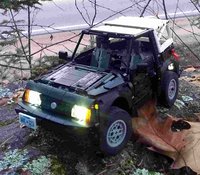
Jeep Wrangler TJ Trial Truck This is my latest attempt at 4x4 domination, with the body of a 97' Jeep Wrangler TJ on top. About this creation Aesthetics: It looks like a Jeep. There is no spare tire on the rear because of approach angle/weight distribution issues. The headlights work, and the tailgate opens. (I think it is my best-looking Trial Truck to date. The mud helps a lot too; the above picture is now my desktop background) Suspension: There is 4-link suspension front and rear, with large shocks. It isn't as long travel as I would hope, but there is still quite a bit of travel, and it is quite flexible. I put a full skidplate in, which was flexible in between the axles to let them rotate relative to each other. Steering: An L-motor with 9:1 reduction operates the front rack steering. It is powerful and tough. Drive: An XL motor is in each axle, and is reduced 36:12, and then 24:8 again, for a total reduction of 9:1. The tires were stuffed with marbles to lower the weight distribution. Perhaps because of this, it occasionally needed more torque (Though the friction of mud in the portal axle hubs also contributed to this!) Winch: An L-motor at 24:1 pulled a winch that was sufficient to lift the whole Jeep. You can see my video at: IMAGES AT: https://bricksafe.com/pages/2GodBDGlory/jeep-wrangler-tj Mini Toyota 4Runner The idea with this model was to make a 4x4 at similar scale to my tiny cars. It went pretty well! About this creation Aesthetics: It looks OK, though a bit more like a recent 4Runner than the 90's one I intended on. Drivetrain: There were two L-motors powering skid steering 4WD. Each motor was geared up 1:3. Suspension: Each wheel has Tatra-type suspension with a rubber band at the front and rubber axle joiners in the rear. Performance was good, though not superb off-road. It was fast and fun to drive, though the skid steering was odd. You can see a video at: IMAGES AT: https://bricksafe.com/pages/2GodBDGlory/mini-toyota-4runner '69 Dodge Charger R/T This is a very high performance small car, and a model of a classic muscle car. I will warn all you purists, though, that it does use a non-Lego motor and battery. About this creation Aesthetics: The looks are simple, but fairly realistic, and tough enough for the many crashes this thing has to endure. Electronics: There are non-Lego electronics ahead... The battery box is a small 7.4V camera battery I picked up for free at a garage sale. A wire from a dead M-motor is attached onto this (I can't solder it securely, though, because then the battery couldn't fit in its charger), which hooks up to a PF V2 Receiver. Steering is done with a PF Servo motor, while drive is seen to with an RC4WD 80T Crawler Motor. This motor offers similar performance to an official Lego RC Buggy motor, but I got it for only $15 CAD+ Shipping, while Lego ones cost about $85 CAD+ Shipping. Although the motor is non-Lego, it is easy to attach to it. I attached the wires to Lego by building a module that you can see in the pictures with old 9V plates (2x 2x4 and 2x 1x2, arranged with a 2x4 on the bottom, two 1x2s covering one half of it, and the other 2x4 over top of it all, with the leads in the area without 1x2s) ). The wires have bulky ends that fit well into this module, and stay together well when elastics are used to hold it together. This can then easily be attached to PF via the 9V/PF adapter wire. The motor itself was attached with some axle pins, that slotted nicely into the front four studs apart, and the shaft hooks up to Lego (Not in this model, but I improved it since) by stuffing a cut rubber tube that came shielding the motor's leads onto the motor's output, and then jamming an axle extender over it all (this is hard, but holds it very securely). I should mention, though, that the motor causes my Lego Rechargeable battery to shut off, for all practical purposes, when a load is applied. There is no problem with the camera battery I used, though it strangely performed far better at half battery charge. PERFORMANCE: The car is a barrel of fun, with huge power, light weight, and RWD. It can drift all over the place on a smooth floor, and is fairly fast (Though I think I should have kept the gearing faster). You might want to see my YouTube video at: IMAGES AT: https://bricksafe.com/pages/2GodBDGlory/69-dodge-charger-rt Toyota Land Cruiser J79 This is a somewhat complex, yet still tough model of what is likely my favorite vehicle worldwide (Emphasis on "worldwide," because this rig is and was not sold in North America). About this creation Aesthetics: I think that it looks pretty good, with some stickers and off-road add-ons. A rear panel is white because (A) I wanted it to look like an old, beat-up rig with replacement panels, and (B) I was out of light grey... Opening stuff: The hood opens and has a support, the doors open, and the tailgate lowers with a realistic linkage to prevent it from opening too far. Interior: The cabin is detailed, yet realistically simple. There is a working steering wheel, an opening glove box, little tires hanging from the rearview mirror, and folding rear seats, behind which an included mattress, sleeping bag, and pillow can fit, creating the budget camping setup! Suspension: Like the real Cruiser, my model has front and rear live axles, with coil springs up front and leaf springs, made of axles, in the rear. It works fairly well, but could use some more travel, or a lift (Why did I decide to keep this model's suspension and tires stock again?). Steering: An L-motor in the body runs a 24:1 worm setup, that pulls a linkage, which pulls the link connecting the wheels side-to-side to steer. There is lots of slack, and it is pretty terrible performing, but it is realistic (both in setup and in poor responsiveness (I think)). The steering wheel also works. Drive: Two XL motors under the hood drive a V6 engine and all four wheels (SLOWLY!) Gearbox: The gearbox uses a highly modified version of Sariel's heavy-duty 4-speed sliding gear gearbox (from his book), but with the gears rotated to make it more compact, and a very heavy duty shifting mechanism with stops to prevent the sliding gears from sliding ON rather than WITH their axles. It didn't skip once, but did jam sometimes when shifting. Transfer case: There is a two-speed transfer case shifted with an M-motor through a worm gear and a 6L link. It performs pretty well, but strangely seemed to make little difference, though the ratios were far apart. Maybe it's just that it's infinitely slow in all gears! RWD/4WD Switch: An M-motor slides some double-bevel gears either together or apart using a small linear actuator to engage or disengage the front wheels from the motors. Of course, you should leave it in 4x4 all the time! Locking Differentials: Another M-motor used a small linear actuator, a fancy group of connected axles, and some 6L links to lock the front and rear differentials simultaneously. Winch: Another L-motor uses a worm setup to pull the winch. However, more interestingly, I used the worm gear's sliding ability to create a directional gearbox, that allows the string to be pulled out four times faster than the motor reels it in! However, this complexity made the winch too weak to be practical. Overall, I like this interpretation of this great truck, and I appreciate how tough the drivetrain was. However, this complexity made the truck's speed "abyssal" or, slightly more kindly, "sluggish to a fault" In addition, like most Lego models, I didn't quite match the real Land Cruiser's sterling reputation for reliability. You can, as usual, see my video on YouTube, at: IMAGES AT: https://bricksafe.com/pages/2GodBDGlory/toyota-land-cruiser-j79 -
Interesting working principle! Are you planning on creating a tutorial video at some point demonstrating how you made it?
-
Another option for increased travel is to create custom shock absorbers by taking apart a few 6.5L shock absorbers, taking the springs, placing them on an axle, and building a shock out of it. I don't know what your feeling is about taking shocks apart, though. Otherwise, it looks like a fun, powerful model with a sophisticated suspension design!
-
Toyota Supra MK4 A80
2GodBDGlory replied to Matiss56's topic in LEGO Technic, Mindstorms, Model Team and Scale Modeling
Okay, thanks! -
Are the knock-off ones any good? I assumed they would be rubbish. Thanks again everybody. Great forum. I am not sure. I have a couple fake RC Buggy motors I got about five months ago, and both are working great despite some hard usage, including powering them from a hobby 9.6V battery. I have some other parts on the way that I have ordered; hopefully they will last for a while! Apparently fake Servos aren't much good, because they do not have any proportional control, and must rotate the full 90 degrees before coming back to center, even if the controller is only tapped. Nonetheless, I think a lot of the parts could be worth it, because (especially if found on sale) they can be between half to a fifth of the prices for Lego ones, so even if reliability is worse, at least replacements are dirt cheap.
-
I watched the video of this one, but, not understanding the language, I couldn't figure out how it worked. It appears that air is pushed down onto the cylinder head until the cylinder reaches the bottom, at which point it is sent out of the hole drilled down there. After that, though, I don't see how it could be pushed back up by the flywheel against the air. Besides, such a design would have no need for all the stuff on top of the block. Could you give me some more information please? Also, has anyone ever considered using a spray can of compressed air to run a pneumatic engine in a model?
-
Yep. Before long, the only tolerably cheap option for PF will likely be the knock-off ones. I believe Servos, IR receivers, and some other parts are out of stock (for me) at Lego Shop, and unlikely to be restocked. Once the rest are gone too, I imagine used prices will continue creeping up to the point where it doesn't make sense anymore to stick with the real stuff.
-
Toyota Supra MK4 A80
2GodBDGlory replied to Matiss56's topic in LEGO Technic, Mindstorms, Model Team and Scale Modeling
Very nice looking! Are there more images or a video somewhere? -
Powered Up motors: L vs. XL
2GodBDGlory replied to FoxOne's topic in LEGO Technic, Mindstorms, Model Team and Scale Modeling
Could it be designed as a performance motor to be used with a yet-to-be-released power supply? It's a long shot at best, though. Do any of you know if the electric hardware inside could take significantly more power? -
2GodBDGlory's old MOCs
2GodBDGlory replied to 2GodBDGlory's topic in LEGO Technic, Mindstorms, Model Team and Scale Modeling
RC Snowmobile This is a remote-controlled Technic Snowmobile! About this creation I don't really like how the model looks, but then I have little experience in snowmobiles. There is double-wishbone independent suspension on the front, and a swing-arm suspension on the back. Both the track and the skis can also tilt. A Servo Motor steers the front skis using towball links and a small rack. An L-motor drives the rear sprocket at a 5:3 ratio. Performance indoors was bad, because the skis couldn't steer. It was better in the snow, but still not as good as a simple wheeled vehicle would have been. You can see my video at: IMAGES AT: https://bricksafe.com/pages/2GodBDGlory/snowmobile 1:12 Jaguar F-Type This car is meant to have a lot of the sophistication and functions of my 1:8 cars, but in a much smaller package! About this creation Aesthetics: I think it looks pretty good, with LED headlights and a sweeping rear. It seems quite British from the back, but it reminds me more of Lego's Aston Martin DB5 than a Jaguar! Interior: It has a full interior, just like my big cars. The steering wheel works, and the seats can slide forward and backwards. Opening stuff: The doors open and have auto-locks, and the hood opens as well. Suspension: There is full independent double-wishbone suspension with one hard shock per wheel. Drive: There are two L-motors to power the AWD with a central differential and a micro V8 piston engine. It drove quite well! Gearbox: I used my new 8-speed gearbox (Type 1), posted elsewhere. It was shifted by an M-motor through a worm gear, and had a speed indicator. It worked quite well! Adjustable suspension: This was the hardest function to fit, and was powered by an M-motor through a worm gear, a whole slew of bevel gears, and four small linear actuators connected to the shocks. It lowered well, but was too weak to lift itself. Overall, I am quite pleased at this 1:12 car. I used to build almost only these cars, since they were the biggest wheels I had! It was fun to return to this size with my current skills, and I am pleased with the result. You can see my video at: IMAGES AT: https://bricksafe.com/pages/2GodBDGlory/jaguar-f-type Ichthia Epitome: Ultimate Supercar This is a car I have been working towards for a long time. I have tried almost all of its functions on simpler cars, so it was time to put it all together. This is [EDIT: Was. My 1:7 Chiron surpassed it, and a Ram Rebel TRX I just finished probably will too.] my ultimate complexity supercar, with just about every function used in Technic supercars. Because no real car has all the functions I wanted to include, I made up my own car, the Ichthia Epitome. About this creation Aesthetics: This car looks fine, I think, but the front doesn't quite have the feel of a high-end hypercar, with a bit more Nissan GT-R than there ought to be. Still, I like it. There are LED headlights and taillights, and actual mirrored mirrors, using a cut Lego sticker. Opening stuff: The hood opens manually and is nicely spring-loaded. There is a tiny amount of cargo space under it, which holds a spare shirt for the driver. The doors open with springs as well, and has the usual auto-locking locks. More unusually, though, I managed to hook up the internal and external door handles, so that when the outside handle is turned to unlock the door, the internal handle also moves. Because in a car like this there is very little luggage space (And I couldn't bear to waste ANY space!), there is an auxiliary luggage compartment on the one side. Inside is a Lego shopping bag. The rear engine cover also opens, but doesn't do anything fancy, because it has to open easily when the convertible roof operates. Interior: The interior is fully black, with dark grey seats. These seats can be adjusted forward and backward using small linear actuators, and can be tilted using worm gears. The gas and brake pedals work, as does the steering wheel. The glove box opens and holds a thermos bottle, which also fits into the cupholder in the center console. A very unique function of this car is the CD player. A disc can be inserted manually, and then ejected with a button. (The CD is supposed to be TobyMac's This Is Not a Test) There is also the switch for the pneumatic compressor, the pneumatic valve, the on/off button, and the center differential lock/parking brake lever. One way of this lever locks the center differential, and the other works as a parking brake by locking the drivetrain. Suspension: There is full independent double wishbone suspension, with four hard shocks and a rubber band per axle. Because of how low the car is, it is hard to see its affect, but I think that there is one. There is negative camber. Pneumatics: There is an M-motor running a compressor, which powers a single small cylinder that controls the rear differential lock. Drive: Two XL motors drive the car through three differentials. There is a flat 8 piston engine, and a Servo motor controls the gas pedal. This particular Servo motor's wire is wearing out, and I had no spares, so it only rotates one direction. This wasn't so bad, however, because it let me build more compact. Driving performance was decent for such a heavy, complicated car. (It was 7-8 pounds). Steering: The steering on this car was far from simple, and my favorite function of all! First of all, it has all wheel steering. In addition, there is castor, kingpin, ackermann, and toe. Also, the steering wheel works. The front and rear are driven by separate motors, and the one in the rear is dependent on what gear the car is in. The shifting motor flips a switch controlling the rear Servo, so that it has regular four wheel steering in low gears, front wheel steering in medium gears, and crab steering in high gears, just like real AWS cars. Finally, there are aero flaps in the front and rear, which work with the motors to "slow down" the correct side. Brakes: There are all wheel disc brakes using an M-motor, a large linear actuator, and a large sliding thing of beams. This pulls strings, which pull a rubber axle joiner onto the inside side of the Chiron brake discs. The brakes are very weak, but the brake pedal works, and strings are pulled to activate the front aero flaps and to tilt the spoiler. Gearbox: This gearbox was basically just my latest-design 7+R dual clutch gearbox, shifted by an L-motor at a 20:1 ratio. Sadly, I discovered that all of the odd gears wouldn't work, because the bracing for the two meshing 8T gears wasn't strong enough. There was a speed indicator in the interior. I really don't have pictures of just the gearbox, so you might want to check out its separate post (Coming soon to Eurobricks). I also put a monkey under the rear spoiler with a bunch of levers and stuff. No existing computers can give the Epitome the gear-shifting precision it requires, so a highly-trained monkey is provided. Adjustable suspension: There is a simple adjustable-hardness suspension using an M-motor in the front and an L-motor in the rear, that basically just winds up the rubber band to tighten the suspension. Windshield Wipers: The wipers were similar to the ones I have used previously, but geared to allow for a longer sweep. They use an M-motor. Spoiler Raising: An M-motor and two small linear actuators raise and tilt the spoiler. The tilt occurs when a string becomes taut. Convertible Roof: An L-motor, through a 24:1 worm reduction, lifts the convertible roof, stabilized with a 4-bar linkage. The cover is pushed up and down by the roof, and typically snaps shut dramatically! I am very glad to be just about done posting this! I am tired of typing! Anyway, I am very happy with this car's complexity and refinement, and it is going to be hard enough to top that I doubt that I will try anytime soon. [EDIT: And yet I did.] The biggest disappointment, though, was that half of the gears didn't work. I don't plan to build many supercars soon, because the disappearance of the snow lends itself well to outdoor 4x4s... You can watch my Youtube video at: IMAGES AT: https://bricksafe.com/pages/2GodBDGlory/ichthia-epitome -
General Part Discussion
2GodBDGlory replied to Polo-Freak's topic in LEGO Technic, Mindstorms, Model Team and Scale Modeling
Cool!- 5,465 replies
-
- rant!
- Bionicle Technic
-
(and 1 more)
Tagged with:
-
42123 McLaren Senna GTR
2GodBDGlory replied to Ngoc Nguyen's topic in LEGO Technic, Mindstorms, Model Team and Scale Modeling
I wonder how much work it would be to modify this into a street version. I'm not much into race cars.