Jump to content

2GodBDGlory

Eurobricks Dukes
  • Posts

    2,668
  • Joined

  • Last visited

Everything posted by 2GodBDGlory

  1. I think that there are capacitors (If I remember correctly from grade 10 science, they are the cylindrical components with two leads on the one end?), and I could possibly replace those with ones from a broken V1 receiver I have. They have a different appearance, though, so they may be different between the two versions.
  2. Okay, that makes sense I may have to, thankfully, prices have dropped since I last checked a year or two ago. I think it does this with all batteries, but I am not sure. I can check Thanks for the advice!
  3. I was wondering if I could get any advice on ways I could fix a V2 receiver of mine. I got it from a used 9398 Crawler a few years ago, and ever since I got it, it has had a couple of serious "quirks." The first, and most obvious, one is that the red output only runs Servo motors and LEDs, but no other motors. This is annoying, but since my MOCs usually have at least one Servo, I can work around it. The second problem is that if the drive motor is put under too much stress, the motor slows down as if it had a brake being applied to it, and the receiver starts to emit a squealing sound. If I stop sending IR signals and wait a second or two, the system resets, and I can drive again until the receiver gives up again. Right now I have it in a Quad Bike model with a single Buggy motor for drive, powered from a PF rechargeable box, and it will drive mostly fine on a hard floor, but only for a few seconds on carpet. I have taken the receiver apart and had a look inside, and tried to clean a few things up, but there is no improvement. If anyone has any advice about the cause of this problem, I would appreciate it. I have a soldering iron, and I'm not afraid to use it.
  4. Yep, the Jeep Wrangler absolutely still has two live axles. In North America, at least, the light-duty vehicle world has only four dual-live axle vehicles left: the Ford Super Duty trucks, the Ram heavy duty trucks, the Jeep Wrangler, and the Wrangler's pickup variant, the Jeep Gladiator. It is certainly possible for Lego to fit in the suspension at this scale. See this model of the same car at similar, if not smaller, scale. I certainly hope they include it, since it is a very characteristic feature of the Wrangler. It would be all too easy for them to simplify to a rear-wheel drive car with independent front suspension and a trailing arm rear, as in many other small off-roaders.
  5. I quite like this! Great looks are joined with (presumably) solid performance. My favorite detail is the use of the radar dish on the rear axle to simulate the differential cover! I have often been annoyed that Lego solid axles rarely look like real ones, but that one detail does lots towards improving this!
  6. I did a similar thing a while back, where I just took an old transformer (originally used for charging something or other), cut off the end, and attached the positive and negative ends to the positive and negative plates of a spare AA battery box. I now have it screwed onto the bottom of my desk, as a constant, switchable PF power supply!
  7. Is what you're saying that Servos are drawing power while they are in the extreme positions? If so, it would not be a problem for this gearbox, because the way it works is that it rotates 90 degrees, pushes the gearbox into the next gear, and then returns to center without shifting anything, because it simply ratchets over the gears. By the way, I have since taken inspiration from other builders and made a far more compact and reliable gearbox with the same mechanism that can be used with those Chiron selectors--this old design is a little primitive, I think. Thanks for commenting!
  8. Fascinating video! I am glad I found the patience to watch it. Like you said, the coolest thing is finding the maximum possible power output for a Lego motor. Right now I am working on building a massive pickup truck with an 8-speed automatic gearbox. It has fully electronic control, with a Powered Up hub controlling both drive and shifting, and so I essentially have full control over when the shift points will be. Knowing this, I can fine-tune it to offer me the peak power! Sadly, I don't know if there are any spec charts for PU XL motors yet... Anyways, if nothing else, I discovered the real reason I need to study Calculus: To improve my Technic models! One less sophisticated, but very tough (suitable for a tractor, I suppose) 2-speed automatic can be found here:
  9. Ford GT This is my best 1:8 supercar to date, in my opinion. It has eight independently controlled RC functions, including another 7+R dual clutch sequential gearbox. About this creation Aesthetics: The car looks pretty good I think, though not perfect. There are some gaps in the back; those are just there because they are there on the real car. There are LED headlights, and the engine cover opens. Interior: The interior has three-way adjustable seats, which can slide forward and backwards and tilt the bottom and top parts independently. The steering wheel works, and the dashboard and central console are recreated from the real car. There is a speed indicator hidden inside the small black tire on the central console. Suspension: There is full independent suspension using two hard shocks per wheel (The hard shocks have grey tops) It is a little saggy. There is camber angle on all four wheels, and kingpin, castor, toe-in, and ackermann geometry on the front axle. Drive: The car is driven by two XL motors, through the rear wheels and the gearbox. It also drives a rear V6 piston engine. Steering: There is steering with a Servo motor. There are fancy angles mentioned in the suspension section, and a working steering wheel. Doors: Both butterfly doors can be opened using their own PF M-motor. There are manual locks to keep it in place when shut. Brakes: The disc brakes are powered by two small pneumatic cylinders, one on each axle.The discs are made from wedge belt wheels with small rubber track inserts in them, and the calipers employ two rubber axle joiners per wheel. The pneumatics are powered by a PF L-motor through an Autovalve, where it pumps and switches simultaneously, and the switching is controlled by the motor's direction. Gearbox: There is another 7+R dual clutch sequential gearbox in this car. It is totally updated and now uses Chiron shifters. The gearboxes are now set on the sides, with the clutches in the middle, allowing for an efficient use of space. Formerly, both gearboxes were always running, as even when gearbox A's clutch was disengaged, it was still driven from it's output. Now, there are not only clutches on each gearboxes input, but also on the output, so as to maximize efficiency. There was a speed indicator hidden in the black tire in the central console, and the gearbox was driven by an L-motor. Track/Street modes: Just like the real car, my model can be switched from Street mode to Track mode. In street mode, the suspension is raised and the spoiler is down. In Track mode, the car is lowered and the spoiler is raised. Also like the real car, lowering the suspension hardens it up a lot (Mostly because it is only bending pieces at that point) This system is driven using another L-motor and pneumatic autovalve. The front axle uses a new really big cylinder, and the rear axle and spoiler each use an old large cylinder. Spoiler tilt: The spoiler can be tilted using a M-motor. It drives a worm gear which drives a 20T gear. This gear is the one in my collection that is the loosest on axles, which is important, since an axle connected to the spoiler must slide through it. Overall, I am very pleased with this model. It looked pretty good (For one of my cars!), functioned pretty well, and actually drove happily sometimes in most gears! As far as I know, it is also the first Technic supercar to use all eight RC channels! I think it is my personal best model! Please ask in the comments if you have any questions about how it works. You can see my (amateurish) video at this link: IMAGES AT: https://bricksafe.com/pages/2GodBDGlory/ford-gt Hummer H2 This is a very large Off-Roader, with the emphasis on functions, not performance. About this creation This is my first big, functional Off-Roader in ages, it seems, so I am glad to make this model. It isn't my most refined model, but it looks OK, and has interesting functions, and drives! Aesthetics: The model has a blocky body, like the real one does. There are opening doors, a swing-out spare tire, the rear liftgate, and a hood that I am ashamed to say opens the wrong way. (I discovered this late in the build process, and I was so short on grey (And just wanted to be done) that I left it that way) There is a simple interior, but with FIVE seats! Drive: There is 4WD with two XL motors. It could drive well in at least some gears. Steering: A Servo motor steers the front wheels. That's as fancy as it is. Winch: There is a winch driven by a PF L motor through a 24:1 worm ratio. I used a little trick to be able to manually slide an axle through the 24T gear and out of the winch piece (Which allows axles to slide through it). This allowed me to pop the hood, slide the thingie, quickly extend the winch, then reconnect it and power it back in. Adjustable suspension On Wikipedia I learned that the H2 has an "Adjustable rear suspension". I didn't know whether that meant height-adjustable or hardness-adjustable. I went with height, using a PF M-motor, a worm drive, and small levers connected to the rear shocks. The height difference was minimal. Suspension: There was front independent suspension, sprung using torsion bars (Like the real H2), and also rubber bands for extra stiffness. There was a rear live axle with two hard shocks. The front was longer travel than the rear. Wow. The pictures of the suspension are pitiful. Gearbox: There was a simple 4-speed sequential gearbox using the new Chiron shifters. It was shifted by an M-motor tucked in the front, driving some U-joints, which drove a stepper (Yes, that is a modified white knob wheel in the picture. In my defense, one of the knobs broke off naturally in the line of duty, so it isn't like I savagely mutilated a flawless element) There was a simple speed indicator. (Again, I gotta take more pictures. It also might not hurt to let the model survive at least 24 hours before I rip it to shreds and start on the next project. That way I could actually take MORE!) Drive Mode Selector: There is a fancy dancy drive mode selector that allows you to choose among 2WD High, 4WD High, 4WD Low, and 4WD Low all differentials Locked. This is controlled using a PF L-motor with a stepper. This stepper turns a longitudinal axle that controls the five variables. In each position it pushes an exact combination of variables, while the others are kept in their default position by rubber bands. I hope this makes sense. Overall, I think this was a cool model. I liked the drive mode thing, and the winch disconnect. It looked fine, drove decently, and was fun to make. The weight really hurt the performance. There is a video at: IMAGES AT: https://bricksafe.com/pages/2GodBDGlory/hummer-h2 Hennessey Velociraptor / Ford Raptor This is a model of the Ford Raptor and the Hennessey-modded version of it, the Velociraptor, which has an extra axle. About this creation This model is meant to be small, and a good Off-Roader. Hennessey Velociraptor This six-wheeled truck had lots of torque and good floatation for off-roading. It really could have used more ground clearance, though. Aesthetics: The model looks decent, and I think the FORD grill looks OK. It is pretty simple, but everything opens that should. The interior is very basic, lacking even a steering wheel. Suspension: There is front independent suspension with two hard shocks per wheel. The rear suspension is a live axle suspended with flex axles-- it was surprisingly responsive! There were also pendular bogies on the back, using small turntables Steering: There is a basic Servo front steering affair. Drive: Two XL motors drive all six wheels at a 9:1 ratio. There is a heavy duty universal joint in the back, and there are no differentials involved. Ford Raptor This was a modified one with a different rear suspension, which drove at a 1:1 ratio. It was a much worse off-roader, but was still [EDIT: The end of this sentence has been lost to history.] I have a YouTube video at IMAGES AT: https://bricksafe.com/pages/2GodBDGlory/hennessey-velociraptor--ford-raptor 1:8 Honda Civic Type R This is my latest 1:8 supercar. It has a couple functions that are new to me. About this creation Aesthetics: I think the car looks pretty good, which is probably because it is a simpler looking car than, say, a Ford GT. [EDIT: Really? It may be simpler than a Ford GT, but I would go so far as to say that the CTR is notoriously hard to build, with all its random angles.] The windshield isn't raked enough, though. Opening stuff: The hood, doors, hatchback, fuel cap, glove box, and center console open, and there is a 60/40 folding rear seat. The front doors have a fancy auto-locking-when-you-shut-it lock, but the rear ones are simpler. Suspension: There is front independent suspension with four hard shocks and a torsion bar. This axle has castor, camber, and kingpin angles. There is rear multilink suspension with camber angle. (Dear me. I forgot to take bodyless pictures!) Drive: There is a transverse motor/engine/gearbox/differential setup for this front-drive car. It drives well in the lower five gears, and [EDIT: The end of this sentence is gone, too!] Steering: There is servo steering with Ackermann geometry and a working wheel. It cannot steer far, though. Brakes: There are four wheel disc brakes, as usual, powered by an L motor. There are also fake brakes that stay level when the wheels turn, like the ones in my Bugatti Chiron. Noisemaker: There is a M-motor geared 1:9 running an inline 2 piston engine to get some growls, like the rear one's louder exhaust setting. Adjustable hardness suspension: There is a long, skinny pneumatic cylinder on the rear axle and two small cylinders on the front axle, that harden the suspension when extended, and soften it when detracted. An M-motor powered an auto-compressor, like Sariel's design, to pump whenever the air pressure got too low, and another M-motor flipped a pneumatic valve. Gearbox: There was a six-speed sequential gearbox controlled using three Chiron shifters carefully synchronized, and a six-speed Overall, it looked good, had fun opening stuff, and drove well. I am happy with the gearbox, but the steering and adjustable suspension weren't the best. Sadly, I forgot to take some pictures I really should have. There is a Youtube video at: IMAGES AT: https://bricksafe.com/pages/2GodBDGlory/honda-civic-type-r
  10. Do you think my RC setup would modulate speed by varying the voltage? If so, I could block the trigger to prevent it from exceeding 9V.
  11. I have tried that, but it is mostly just a very bulky solution, that couldn't really fit in the light, compact models I wanted to use it in.
  12. Cool! I see that you used the steering module from the old RC sets, along with a PF Servo! That is a very unusual part usage these days, but it appears effective! As for the radio-control, I have a little experience with that sort of thing. My brother got a Foxx S911 RC truck a while back, and, despite a relatively low cost, it can allegedly hit 50 km/h! I was looking for some higher performance Lego stuff, so I spent about $50 CAD (more like $35 USD) to buy the complete electrical system from that truck from some replacement part outlet, and then modded the stuff to put it in Lego models. The main problem is that the original motor has way too high RPMs, so it will always destroy the first axle I attach to it, before I have a change to gear it down. Because of this, I am thinking of running my two Chinese Buggy motors off of that RC system (at 9.6V), with the original Servo, sometime.
  13. Speaking of tires, from what I hear (I haven't seen the images), the small tractor tires could be absolutely perfect for the Monster Jam trucks. Could they find their way onto them in the end?
  14. Interesting axle design, with almost double portal axles!
  15. Where are you guys seeing these images? I have taken a short look, but I can't find them. Perhaps we aren't allowed to post the links on here, but I would appreciate it if someone could private message me it. Thanks
  16. Thanks! I am new to using apps in general, so maybe that was an obvious question.
  17. That is great news! I just checked my app, though, and I am still on 3.4.0. Is there any procedure to do to update it?
  18. Buggy This is a very simple, fun little buggy. About this creatio Drive: It could barely be simpler. Two L-motors are directly connected to the rear wheels. It is fast and fun! Steering: There is steering using a Servo motor, a few gears, a rack, and towball links. Suspension: There is an independent soft long travel suspension on the front and a soft long travel live axle on the rear. It used custom shocks using the springs from soft shocks. This thing was super fun to drive. I really better post my video for this one... IMAGES AT: https://bricksafe.com/pages/2GodBDGlory/buggy 1:8 Dodge Viper This car has six RC functions, three working pedals, and some other refinements. Aesthetics: The car has decent looks, largely due to the simplicity of the real Viper's body. There are LED headlights, opening doors which are spring loaded, an opening hood, and an opening trunk. The windshield is made from part of a report cover. The doors can be locked using a Keyfob hidden under the hood with a magnet on the end, which would lock the door when swiped on a certain part of the car. Interior: The car has adjustable seats with seatbelts made from PF wires, an opening glovebox (With a monkey inside-- I wanted to put in a snake, but I couldn't find one!) a working steering wheel, speed indicator, brake pedal, gas pedal, and clutch pedal. There is a detailed dashboard and a fake gearshift and handbrake. Suspension: The car has double wishbone independent suspension on all four wheels, with 3 hard shocks (The grey ones still have hard springs) and rubber bands on the front, and 2 hard shocks on the rear wheels. The suspension sags from the great weight of the car. I might go to torsion bars in the future. Drive: There are 2 XL motors driving the rear wheels of this car, and a coupled PF Servo motor controls the gas pedal, which has speed control ability, as well. It couldn't drive well, though, as the clutch kept coming out. Steering: The car has steering using a PF L-motor through a worm drive. There is Ackermann geometry and a working steering wheel. Clutch: There is a simple clutch using a M-motor. It also has a working pedal. It uses one of the new 20T clutch gears. Unfortunately, it proved to be the (Sadly inevitable for me) weak link in the drivetrain, keeping it from driving happily. Gearbox: There is a six-speed sequential gearbox, using a similar shifter to the one found in MrSmith's 6-speed flat gearbox on Rebrickable. Mine was taller, skinnier, and was more reinforced. It worked pretty well, I must say, and it had a speed indicator, too. Brakes: There were four-wheel disc brakes using a M-motor and a worm drive. It moved a long lever to connect the front and rear brakes. Sadly, the brakes had a negligible effect. Roof: There was a soft top convertible roof (It may be the first soft top in a Technic model!) The frame of the roof consists of a scissorwork of 5L beams, like in some of those old racers sets with slammers. This whole thing is on some long vertical axles, and slides up and folds out the scissorwork using a section of large track that is flexible enough to push both up and out in the space I had. It was driven by an L motor. The soft part was from the other part of my report folder. The roof went up nicely, but the soft part would sadly bunch up on descent. Overall, I think that this car upped my refinement levels, and though it wasn't my most functional car, I am quite pleased with it, especially the roof! There is a YouTube video of it at this link: IMAGES AT: https://bricksafe.com/pages/2GodBDGlory/18-dodge-viper
  19. Well, I am not nearly deep enough into programmable Lego to answer all of those questions, but I am guessing that you will need to ditch the Control+ app, because it allows for essentially no modification. You will likely need to use the Lego Powered Up app, write your own program in the "create" tab, and see about writing code for the readouts as well as the original stuff. With the current setup, the only real feedback I know of is to the controller profile on the remote, but I am far from being an expert.
  20. In the English-speaking world, it is generally associated with the Mercedes-Benz G-Class (Maybe other SUVs as well), but I think that it is a general German word for something along the lines of "off-road vehicle," that Mercedes just decided to apply to its off-roaders.
  21. Nice work! I was once considering building the Supervan 2, because I wanted to pack as many drive motors as possible into a model as small as possible, and the Supervan has plenty of internal space. Your rendition looks far better than mine ever would have!
  22. Well, it is true that I am posting these MOCs fairly quickly, but, as I mentioned at the very top, these are old models of mine, which were previously posted at the now-defunct MocPages. I am really only posting them here so that I can refer to my old stuff, and have it somewhere on the web, and much of the older stuff is not representative of my current skill. I should post some of my more recent models here, though...
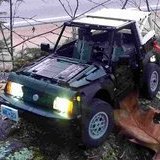
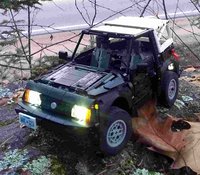
  23. Toyota Land Cruiser FJ40 Trial Truck It is a bit more complex than my recent trial trucks, as it has a gearbox and a winch, as well as suspension, drive, and steering. Aesthetics: The vehicle looked little like a stock FJ40, but that was fine, as I was copying from a Hot Wheels car I have, which portrayed a modified one. It had LED headlights which could be turned off with a switch to avoid power cut from the battery, an opening hood with a inline 6 piston engine underneath. This engine was originally driven by an extra M-motor, but when I added the L-motor and winch, there wasn't enough room, so the engine sadly isn't driven at all. I had fun making the custom license plate, too. It looked cool and rugged, so I liked it! Winch: The vehicle has a simple winch, driven by a PF L-motor with a 20:1 gear reduction. I never actually used it outside, but it was plenty powerful, and gave me peace of mind, knowing that I could pull the winch whenever traction ran out. Gearbox: The model had a simple 2-speed gearbox. It had 1:2 and 5:4 ratios, and was shifted by a medium motor and a small linear actuator. It had a sliding axle coming from the drive motors, but rather than make the motors slide with it like Sariel has done, I used a CV joint simple for the extendable part. It worked perfectly! The gearbox itself worked quite well, I would say! Drive: The vehicle was driven by 2 XL motors, coupled using knob wheels, through the gearbox, geared down 3:1 in the axles, and then a further 3:1 in the portal axles. It worked well until the knob wheels started wearing down from the strain. I actually went home discouraged when it stopped driving after a while, and attributed the main problem to the knob wheels. However, I think that it might have just been that a front portal axle was falling off (Though that could have just been from the walk home in my backpack) The knob wheels also made an annoying squeaking sound. Steering: Steering was very simple, with just a PF Servo motor on the front axle, driving a rack. Suspension: The suspension was long travel floating axles all around, using long shocks and ball joints, which worked quite well! I was pretty happy with this model, but I think the performance could be a bit better, and the squeaking knob wheels were annoying. IMAGES AT: https://bricksafe.com/pages/2GodBDGlory/toyota-fj40-land-cruiser-trial-truck Neon Buggy This is a simple MOC built in less than a day as a break from my supercar-in-progress. It is fast and fun! About this creation This model is driven by two hard-coupled L-motors built into the rear axle geared 3:5, and is steered by a PF Servo motor, which is geared down 3:1 before rotating a 2L beam connected to a 3L beam connected to the steering towball joints. There is simple front independent suspension, and a rear live axle. The suspension was meant to be soft and long travel. The model was a blast to drive outdoors and inside, and totally worth the <2 hours it took me to build it! Images at: https://bricksafe.com/pages/2GodBDGlory/neon-buggy 1:8 Bugatti Chiron [EDIT: I actually originally planned on posting this model the same day that the Lego 1:8 Chiron was released, but technical difficulties defeated me!] This is a MOC not at all related to the official Lego set. I had hoped to post it before the set came out, but Sunday Mocpages was down, I was gone Monday to Wednesday, and the site was also down Thursday. Anyways, here it is, by far my most advanced supercar yet, with 6 RC functions, 3 manual functions, and 4 Aesthetic functions. About this creation Aesthetics: The model I think had pretty good bodywork, and I think it is among my best yet, though I am no master of aesthetics. The hood could open, and the on-off switch was underneath it, so you could just tap the hood to turn it on or off. The doors opened, and there were automatic locks connected to the handles. The bodywork could also be easily removed by disconnecting about 16 pins, but it was still pretty well connected. The LEDs were built into the chassis so they would not have to be disconnected. The wheels were also pretty cool, as they had custom paper rims, as well as a new brake caliper idea I had. The caliper always stays in the right position due to gravity. The calipers were made from printer labels, which I use for stickers. Interior: This car had a pretty nice interior, with adjustable seats, a working glovebox, a working steering wheel, and a working brake pedal. Suspension: Naturally, the model had 4-wheel independent suspension. It is height adjustable, which I will get to later, and the front axle has 4 hard shocks + rubber bands, and the rear axle has 8 hard shocks + rubber bands, simply because the axle design kept me from putting the shocks anywhere that they would give much hardness. There was camber angle on all four wheels, and castor angle and kingpin inclination on the front axle. Differential lock: The car has a manual rear differential lock, just like the real car [EDIT: I doubt it is actually manual in the real car]. It is controlled by the front lever in the center console, and turns some U-joints which lock the diff. Handbrake: The rear lever on the center console controls a parking brake, or handbrake. It just flips a transmission driving ring on the driveshaft to lock into a 16T gear, which is connected to an 8T gear which is locked, thus locking the drivetrain. Drive: Now into the meaty motorized functions: The car is driven by two XL motors, through the gearbox, through a central differential, to all four wheels. It was also connected to a mini W16 piston engine using some rubber bands, but the rubber bands usually just slipped.Unfortunately, the gearbox was forced to use a chain, which usually broke, preventing the car from really driving. (As usual :( ) Steering: The car was steered by an L motor and a worm reduction. There was Ackermann steering geometry and a working steering wheel. Gearbox: There was a new generation of my 7+R dual clutch sequential gearboxes in this car, now without friction clutches, which slip too easily. It was driven by an L-motor, and had a crude little speed indicator. Brakes: There were functional disk brakes in all wheels. This was powered by an M-motor, and was connected to a brake pedal in the cockpit. Height-adjustable suspension: 2 M-motors (One in each end of the car) geared 24:1 rotated 2L beams to raise and lower the suspension. It was a little weak to raise the car, but was still pretty good. Spoiler: A L-motor could raise the spoiler using a weird mechanism of worm gears and U-joints, but it worked pretty well. The brakes could also pull a string to tilt the spoiler down a bit, but sadly, not very far at all. Speed edition: I made use of the removable bodywork and built a faster chassis, with 2 6XAA battery boxes and 4 XL motors geared 1:3. I think I was too ambitious with this ratio, as it struggled to drive. Overall, I think I succeeded with this model, and I like it a lot. It was a lot of work, and a few functions don't work perfectly, but I think it looks fair and has very good functions. IMAGES AT: https://bricksafe.com/pages/2GodBDGlory/18-bugatti-chiron Toyota Supra This is my first 1:10 supercar, with all of my other ones being 1:8, 1:12, or less. It has only three motorized functions, as a result of the decreased size. About this creation This model has working suspension, a piston engine, motorized steering , motorized drive, and a smooth-shifting gearbox. Aesthetics: I think that the car looked cool with the one-piece headlights, but not actually that much like a Supra. I am surprised at how long the car is, but it is scaled correctly! The hood and doors opened, and there is a 2+2 interior. There is a working steering wheel and a gearbox speed indicator, plus a pretend stick shifter. There were also LED headlights. Suspension: It has simple independent double wishbone suspension with 2 hard shocks + rubber band on the rear wheels and one hard shock on the front wheels. Drive: The vehicle used 2 L-motors to drive the rear wheels, which are coupled with a mini inline 6 piston engine. : The vehicle uses an L-motor to steer the front wheels and a steering wheel. Gearbox: There is a 4-speed sequential gearbox of the "One Touch" variety, meaning that one push and release of the gearbox lever will shift exactly one speed up or down. It was inspired by a design by ibessonov on Rebrickable. However, it used an XL motor instead of a Servo motor, but it still tended to return to centre. The car has a big enough trunk that I could fit the whole gearbox into it! The long spring loaded axles coming from the gearbox work the speed indicator in the cabin. Overall, I am pretty happy with this model. It drove quickly and happily, with gear 2 being the best overall, as the motors were a bit strained in gears 3 and 4, though it still drove. The aesthetics, as I said earlier, looked cool but un-Supra-like. Still, for a simple supercar I am happy with this, and I am glad to have learned how to do "One Touch" gearboxes. IMAGES AT: https://bricksafe.com/pages/2GodBDGlory/toyota-supra Jeep Wrangler Rubicon Trial Truck Here is my latest Trial Truck-- intended to be simple and tough, and also to have low power consumption for long battery life. About this creation Aesthetics: The model was actually too skinny because of a scaling mistake, but at least it gives me an excuse to build another Jeep in the future-- they are very fun and easy to make! Otherwise, I liked it enough. The doors were removable, as was the hardtop roof. The hood opened, as did the tailgate, which had a lock. The spare tire was located in the back not on the tailgate partly to aid in weight distribution and approach angles (?), and also because of said scaling errors, it was wider than the tailgate. The interior was crude and basic with only some super-simple seats. Drive: The vehicle was driven by an XL motor at a 15:1 ratio. There were no differentials and there were portal axles. It was slow and strong Steering: There was simple steering using a PF M-motor on the axle at a 48:1 ratio. It was not Rack and Pinion Steering, instead using a simple lever Suspension: There was full live-axle suspension using ball joints and long shocks. I cannot figure out how to post the video on here directly, as it will either say "Don't use Applets" or "Don't use frames or iframes", and the HTML thing isn't working, but I can put in the link to be copied and pasted. IMAGES AT: https://bricksafe.com/pages/2GodBDGlory/jeep-wrangler-rubicon-trial-truck
  24. Yep, I ordered some from Lego a few weeks back, and they are definitely glossy! Also, notice that the mold is definitely new; if you look at the bottoms of the axle holes, the new ones allow you to see the cross profile, while the old ones only had a semicircular hole.
×
×
  • Create New...