Search the Community
Showing results for tags 'tractor'.
-
Lego Tehnincs for me started with 42000 set. First step to own creations was small B-model modification Then I started to create my own creations. At that time I didn't even knew about other "sick" peaople and forums like this. So, as a first post, littlebit about what I have created until now. First creations was only from parts of 42000. First creation was some trike (or something like this) with font wheel drive Then there was (street)quad
-
Hello! Let me introduce to your attention the model of mini-tractor Staub RT4 in Lego-City format. In the model 32 parts. For an assembly description, see https://www.youtube.com/watch?v=DaamMEnPRY4 Best regards, Andrew :)
-
 Hi! That is my entry for the new contest: a tractor mixed with a dragster with a cartoon style! I amplified the shapes of a real tractor: I put huge rear wheels compared to the frond ones, there are 2 big headlights on the front of the hood... The only fonction of this MOC is that it is powered by a pull back motor. (Also, you can move the spoiler because it is fixed with a pin with friction, but that doesn't upgrade the playability) The anti-roll bar has a real utility. Without, the tractor finishes on its roof. The shock absorber is really useful: without, at the acceleration, the drive wheels "jump", they are not in contact with the floor anymore, so the motor is not used at 100%. So actually, the tractor does wheelies smoothly. That's all!
 -
 Hi everyone, finally took some pics of my Xerion. Its kind-of finished, but could do with some cleaning up here and there. Anyway, here's what i have so far..! 4 Wheel drive (Motorised RC) 3 Diff locks, all using the orange wave selector and all manual. Track width is about 1L to wide, but to get the drive, steering and diff lock in, plus have the tyres not foul the chassis when turning, its the best compromise. 2 steering modes - both the steering and the mode selector are motorised and RC. Rear axle has two steering racks, small LA slide the pinion axle to engage the 'other' rack to give standard 4 wheel steering and crab. Rotating cab using a modified version of 42054 - was motorised, but changed the layout of a few bits, not yet reconnected it. Bonnet is a lengthened 42054 but mounted at a different angle. Rear 3 point linkage, motorised and RC. Very similar to the one i had on the Axion. Dimensions are: 130mm tyres, Overall length 46cm, height 24cm and wheelbase is 22cm Not sure if i'm going develop it much further... i get kinda bored after a while and take things apart to start something new. (case IH Stieger or Magnum Row trac maybe...) I'm always poor and embedding and sharing pics, so at some point in the next 10 mins i'll get the flickr album link added plus a couple of pics. Hopefully. https://flic.kr/s/aHskPKa6M1 20190101_131359 by Team Thrifty, on Flickr 20190101_131337 by Team Thrifty, on Flickr 20190101_131638 by Team Thrifty, on Flickr Here's one next to 42082 for scale.. (and also some of my building environment) 20190101_134917 by Team Thrifty, on Flickr
 -
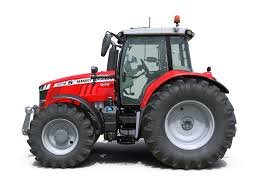
Good evening cognoscenti I am working on a (roughly) 1:12 MOC of a Massey Ferguson 6716S tractor, and need a bit of help with getting some custom / 3d printed rear wheels. For the front wheels I'm using the Claas / 6x6 tow truck tyres 23798 with light grey six spoke 15038 56mm D x 34mm wheels (although loader style solid wheels would be better if i can find some). For the rear i have bought some RC4WD ZT0129 2.2" mud basher tyres (https://www.modelsport.co.uk/index.php?product_id=401784), which fit pretty neatly (with a bit of fiddling) onto the Porsche rims 23800 62.3mm D x 42mm. However, I would really like to get some custom or 3d printed wheel loader style (ie solid dish) rims with an axle connection, six pin holes and a more neutral offset to match the real tractor for the reat tyres. Any recommendations on whether anyone has already made such a wheel, or who could make one? I have already had a look at the third party tyres for technic rims thread, but not found quite what i am after yet. It would be even better if i could also get solid dish loader style wheels in 56mm D x 34mm to go on the front. I think the simplest fix would be a combination of the Porsche rim and a solid dish. However, a neater solution would be to mimic the 'beadlock' arrangement that the RC models use, but make in lego technic - ie a main dish & rim, a slide on collar, and a locking rim (which pins the tyre in place against the slide on collar and the main rim) held in place with eg 6no 3/4 pins (RC beadlock uses tiny screws here). beadlok by hpil 102, on Flickr# Creating a beadlock type technic wheel would then open up a whole range of RC wheels fitting better onto lego (or lego compatible) rims... So, any suggestions of offers to create some 3d printed rims for me? hpil
-
 Ever since Lego released the 42054 set, I've been waiting for a smaller size agricultural tire to be able to build a medium-sized tractor. Unfortunately, there are no smaller agriculture tires, but I decided to build a medium size tractor :) New Holland TM 140: The model was built to create instructions. Knowing this, I've created a compact chassis that I can use in the future. The tractor has a drive with a Large motor with gear ratio 1:7 and steering using a servomotor. Three-point hitch systems are raising by the medium's engine . The front one can be detached. In addition, the power shaft drives the medium motor (gear ratio 1:3). The model has 4 functions so it is controlled by sbrick I had to limit the amount of details so that everyone can easily build such a model after buying the instructions. The original fits very well with building from bricks. I am very happy with how it looks because it's hard to know that it's a LEGO model. The instructions have been created for me by M_Longer Creations. Thanks Marek! Parts list in Rebrickable, Bricklink XML, Brickstore and png versions can be found here: https://bricksafe.com/pages/M_longer/misc/nh140 Instructions can be bought at Sellfy and Rebrickable: https://sellfy.com/m1longer https://rebrickable.com/users/M_longer/mocs/ Claas Quadrant 2200RC I did not want to build only a tractor. I decided that I would build a straw baler. I chose the Claas Quadrant 2200 RC. It seemed to me that it would be possible to copy it very well in bricks. The original machine has very many curves. In the end, I managed to build everything and put a lot of details. An additional function is moving the straw bales and the next ones can be put on the top of the machine. More photos: Video: Thank you for reading and all the comments! :)
 -
 Good Day. 8281 is a $10 set released in 2006 which had a simple harvester(?) attachment that could be lifted up using a lever to disconnect it from the driveshaft. Even being so simple it's a neat set nonetheless and it was my first ever Lego set (was 5 y/o). This would be an homage to my grandmother as well, who gifted me this set, making a perfect introduction for me to Technic. The goals of this build are: PF remote control Green color + yellow wheels rear PTO Some sort of harvester attachment, red-colored Front pendular suspension Cabin with shock absorbers Rear axle with locking differential 13x24 front wheels (rear ones on 8281) 62.4x20S rear wheels Progress so far: This is the approximate wheelbase I planeed initially, however, as I won't be using a buwizz, it can be shortened by1-2 studs. The front axle is pretty much solved, it has even got ackermann geometry (not accurate one though). The pivot point is the steering shaft, and the axle will be held onto the chassi using the 90° connectors on front&rear. Rear axle hasn't had the same luck. The current encarnation has a locking diff and is powered by a XL motor. However, the 16z between the 24z crown and diff slips even under the speeded-up motor. Also, the motor is positioned way too high, so most of this will have to be rebuilt. EDIT: will use a worm gear As the motor will be moved to the front, a 9v battery will be used to allow space for PTO, suspension & proper cabin. Hopefully this won't be another failure as it is pretty much out of my comfort zone
 -
After some inspiration and ideas from the likes of @TeamThrifty, @I_Igor, @nerdsforprez, @kennywest and many others, and several hundred hours sat on the living room floor, i have functioning skid unit for my 1:12 MF 6716S tractor. The real thing: http://www.masseyferguson.co.uk/mf6700s.aspx#360 Disclaimers: it uses third party tyres - 2.2" RC4WD mud basher tractor tyres - and there's still a way to go on sorting cables, pipes, detailing etc but the functions i wanted to replicate are all... functioning DSC_1185 Functions: Full 4wd - no diff locks (no space!) from an XL motor which also drives the fake engine. From the rear diff the drive is split to two half-shafts on each side, driving z18s that engage inside the power miners wheels. This keeps the speed up and so torque down, and shares the torque going to the big rear wheels, as well as making a strong & balanced structure that (hopefully) can't pull itself apart under the torque. Steering via an M motor & z24 friction clutch "Quadlink" suspended front axle using 4 rubber figure of 8 donuts as the front mounts and two small pneumatic pistons as the springs Working rear linkage & pto, plus working front linkage and pto Working UK style automatic pick-up hitch - for those not 'in the know' this is standard fitment on most UK tractors and is basically a towbar that can be lowered and lifted with the rear link arms to attach trailers, and then locked into the raised position for safe towing or when not in use. The safety latch is operated from the cab. Mounting position behind the fake engine for (future!) fitting a loader. Driven axles provide rotation to drive large LAs for the lift/lower and small LAs for the tip/crowd functions Pneumatic system (incl tank) to provide pressure for the suspended front linkage, driving pneumatics on attachments (rear and hopefully on the loader) and for 'in-cab' operation of one of the changeover catches. An L motor drives either the rear linkage or the loader lift/lower via a changeover catch (catch 1). The front linkage can be latched either to the rear linkage or to the loader drive via a second changeover (catch 2). This means the front linkage can either work simultaneously with the rear or, if there is no loader fitted, on its own. Putting catch 2 in neutral means the front linkage doesn't operate at all - for loader work. An M motor drives either the rear PTO or the loader tip/crowd via changeover catch 3. The front pto can be connected, via changeover catch 4, either to the rear pto or to the loader tip/crowd. This means the front PTO can work simultaneously with the rear or on its own if no loader is fitted. Putting catch 4 in neutral means the front pto will not work at all - for loader work. The changeover movements for catches 1 and 3 will be slaved and (hopefully) driven by a small pneumatic piston with valve lever in the cab - so this lever will control switching drive from the L & M motors between the rear linkage / pto and the loader. Movements for 2 and 4 will be manual. The M motor also drives the pnuematic pump via a z24 friction clutch and changeover catch 5. The combination of on/off via the catch 5, friction clutch and air tank should hopefully give a full range of flexibility for keeping the air tank topped up without wearing out the friction clutch. The plan is to use an SBrick to control everything, probably with two profiles - a 'loader' profile with joysticks to control drive & steering and the loader, and a 'field work' profile with joystick for drive & steering, sprung slider for linkage operation and latched slider for pto operation (if indeed such arrangement of sliders is possible - a future problem!) It could also be done with 2nr IR receivers and maybe a bit of mechanical jiggery-pokery to latch the PTO control on when required. Some more pictures: DSC_1188 DSC_1190 DSC_1202 DSC_1203 DSC_1191 DSC_1192 DSC_1193 DSC_1194 DSC_1196 Oh, and this is the first time i've tried anything on this scale and complexity - my only previous moc experience of any note was a power harrow for the 8284 tractor... this Massey has made my head hurt!
-
UPS Truck & Semitrailer built in Old Brown color, Classic Town/Legoland 4-studs wide theme-ish 01 by George Legoman, on Flickr 02 by George Legoman, on Flickr 03 by George Legoman, on Flickr 04 by George Legoman, on Flickr 05 by George Legoman, on Flickr 06 by George Legoman, on Flickr 07 by George Legoman, on Flickr
-
 Good news, everyone! From the second attempt, but I finally managed to create this monster from the past. So, T-1000, also known as TET - Turbo-Electric Tractor, was originally created in Soviet Union in the 70s. It has manually operated hood and simple door lock. And the most important and gorgeous function - Transformation! Yes, this unique tractor can be both wheeled and tracked! When tracks are unfolded, driver's chair turns aside to provide comfortable working conditions. All fuctions that are RC: -wheeled driving - L -tracked driving - 2XL -transformation - 3L -fake engine - M -steering - M -foldable plow - L Just for demonstration I've made a simple plow, which can be attached to the rear hook for transportation or to the side hook for working position. Plow's L-motor connects to the tractor's IR reciever and then it's folding can be RC operated as well. Video as always is here: Thanks for watching. I hope, you liked it. P.S. What do you think, what was the purpose for which this tractor was created by soviet engineers?
 -
 Hey fans! Today I'm gonna to share with your my latest project. This is middle or even small scale American Truck. It's all RC. Also I/m planning to make a white cab for it from suitable parts. HD photos: http://bricksafe.com.../american-truck It has the next functions: XL- motor for driving M - motor for steering M - motor for gear shifting. It has 4 speed Sariel's sequental gearbox M - motor for the pump A Pair of front and a pair of rare lights. Openable doors and hood Pneumatic PTO for the trailer. PLease enjoy the photos, click to enlarge. Video coming soon... Openable hood PTO for pneumatic, Fake Manometer (Air pressure meter), fake lights to light connecting trailer in the dark Now here are some photos with trailer. Loaded and not. As you can see, all wheels in the trailer are simply but suspended. Very expensive loading, though)) - Brothers? - Definitely not
 -
Greetings, friends! :) The little tracked "workaholic" of the American company Cleveland Tractors hails from the 1930s. The model has 114 parts, 40 of which are links of caterpillars (20 each). Description of the assembly scheme can be found here: https://www.youtube.com/watch?v=jPAlMnIZcso Best regards, AMV
-
 Hi, I decided to continue building of MOCs inspired by vehicles available in Spintires. Here is my first clash with rather big scale model - scale 1:15. It is russian tractor Kirovets K700A. For purists, only LEGO parts. Some details: - weight: 1,92kg - dimensions LxWxH: 40x18x22 cm - switchable 2x4/4x4 drive (XL motor) - articulated steering (M motor) - 2 speed gearbox with neutral - working steering wheel - working fake V8 engine - suspension via articulated frame - easy battery case change - openable hood and doors - 2 available channels ready for additions More photos: https://bricksafe.com/pages/keymaker/5.-kirovets-k700a Video:
 -
 Hello everybody. Here's my WIP moc of Case IH Magnum 340 CVX. Controlled by Control+ More photos soon, currently testing.
 -
Now 99% happy with this, my interpretation of a backhoe excavator, based originally on the red farm tractor by TLG and evolved from there, enjoy, hope you like it like me, comments feedback welcome.
-
Soooo, before i take it to pieces i thought i'd share a mostly finished moc of the Claas Axion 960. First thing to mention is the use of 3rd party rear tyres. These allow the scale to be 1:16.5 which means squeezing in features is much easier! Also mean the Xerion wheels are the correct size to be used as front wheels. Here is a link to a flickr album.. if i work out how to embed sensibly sized images i will also - https://www.flickr.com/gp/152155419@N02/229t54 Features: Full RC drive, steering, Pneumatic pump and 3 point linkage - 4 motors. 4 wheel drive, engaged via driving ring clutch Rear Diff-Lock engaged via driving ring clutch Realistic 3 point linkage... 42054 had a very none-real arrangement. Rear PTO engaged via driving ring clutch Narrow (3L) waist to allow 45 degrees of steering lock while retaining a to-scale track width - just realised there's no pic of this, i'll add one. Rear wheels will not be to everyone's taste! But to get a decent scale, i think its needed.. all the supercars are around 1:8 or 1:10 scale which gives you room to fit things. even with these 130mm tyres, its still only 1:16.5. One of the biggest squeezes is getting the track width narrow enough with 4wd and steering.. its actually about 0.5L to wide, the axle will allow a narrower track but then the lock will be 30 degrees or something equally poor. Its 39cm long and 23cm wide, not weighed it yet. Piece count is totally unknown. I'll take a vid of all the function and add it to youtube in the next day or so before i dismantle.... I've got plans to build a proper Xerion with 3 difflocks. Axle is already built so i'm itching to start! I know tractors are a fairly niche category, but i love building them.. all comments welcome! 20180908_181504 by Team Thrifty, on Flickr
-
A Reform Metrac is a two-axle mower. In real life : And my MOC : I chose to make the version H7X because of the disponobility of the DBG parts. This version has been more practical to do the color sheme. Only the Hood is black. (Not possible to be DBG) I also done stickers for more realism. I didn’t find patterns, so I sent an e-mail to the company, and someone sent to me that I needed. Thanks! The main objective was to do the best design. The exhaust is very descreet, so here is a picture just for it ! The headlights are different than the H7X version. They match to the G5 version, because they were more easy and nicer to do. Steering is like on the #42054. There are 3 modes: Only front wheels 4 wheel steer Crab The difference is that there is a 4x4 transmission to activate the 2 PTO, and the front axle is pendular. Frond pendular axle: By opening the hood, you can see the 4 cylinders fake engine: The PTO can be activated using the blue levers, near the hood. There are lifts to attach the lawn mower. The front has been very difficult to make because of the pendular axle and the compactness of it. Rear lift : http://youtu.be/alPyCaJytAw
-
 Hi! Finally, I present to you my dump trailer for Claas Xerion 5000 Trac VC, which I've built quite a long time ago and teased you with in this topic. My intention was to model a really cool looking trailer Krampe HP30 - a 3 axle offroad heavy haul trailer, which goes perfectly to Claas Xerion 5000 set. I didn't actually scale it, but scetches/blueprints on the official site were of good use. As you can see on the photo below, I made a fake front cylinder, which unfortunately doesn't exist in LEGO Technic, so I had to cheat and used a pulley system to lift this huge red bathtub. String drum located on the front of the trailer is rotated by rear PTO of the tractor. I used the fantastic Efferman's motorized remake, but an OOB 42054 model could run it too. The trailer is steered as well - BUT! - Shamefully, I've realized 1st and 3rd axle should be steered and not 2nd and 3rd like I built it. And that happened just an hour ago while editing the video! Oh well, I will have to put more effort in research next time Somehow, I missed the video explaining the steering part on YT. Steering is modelled by levers and works according to the angle between the tractor and the trailer. The 3rd axle has larger steering angle than the 2nd. As you can imagine, it has some play in it... All three axles are suspended (normal springs for 1st and 2nd axle, hard springs for the 3rd.) - I borrowed and altered axle designs from MB Arocs set. Tailgate raises automatically and is locked when the dumper is lowered. Here are some details, to make the trailer more juicy . ...and the underbelly - for those eager Technic fans, who can't do without . For the end, here's one with a little breeze and a video of course. I hope you enjoy it! You can find more photos here. Partlist and instructions here. Thank you for your attention and constructive criticism! Best regards, Miha
 -
 Hi, this is my C Model for the 42043 - MB Arocs, It's an articulated tractor with a tipping trailer! Tech specs: 1x L Motor 3x Pneumatic cylinders, 2x 11x2 to lift & lower the trailer bed, and a 1x5 cylinder to open & close the trailer flap. 10x Wheels, 8 on the tractor in a dually configuration, & 4 on the trailer. Well, now on to pictures! All pictures & more are available at my BrickLink http://bricksafe.com/pages/XtremeBuilder/c-model-42043---mb-arocs---articulated-tractor--trailer
 -
This is a promo video for the agricultural Agricultural Power and Equipment Technician program at WITC (Wisconsin Indianhead Technical College). This was made as a college assignment, but I ran short on time so it is not quite as complete as I had wanted it. So I already am aware of the lack of actual animation and the lengthy still shots. This was the first time we had touched LEGO stopmotion in almost two years, it was fun to have a reason to do something again.
-
My husband got the idea to build a studless version of 8859 made in 1981. We made it together and here it is with youtubevideo and instructions and photos. Free nstructions here: http://rebrickable.com/mocs/MOC-8462/Helgejohan3/technic-8859-revival-4wd/
-
Hello, I present here a small agricultural tractor. The origin of this model is simple. It has an educational value. I used the subject to begin explaining to my son the basic principles to achieve his own models. The purpose was therefore to explain to him the following principles: - Steering rack, steering wheel. - How does a pendular axle work? - The U-joint how does it work? - Differential utility, - Realization of a simple transmission, - How to properly cross a transmission axle and a steering shaft, - What is a gearbox? ; simplified application in on / off mode for a function. There were finaly lots off things to explain. And the result is a nice tractor, playable simple to build. Here it is : About the design, we are on a MF235 base or something like that, (it's not really important;) Some other views: The rear linkage is three-point type, the PTO is in the central position, offset from the wheel axle for realizing a transmission axle with the gearbox wich is located under the steering wheel and allows to put the PTO on/off. Closer: The lifting is carried out by means of a simple mini-cylinder controlled by a crank located on the left side of the tractor: The hood is openable, of course, and we have a small engine L3 in direct drive on the differential of the rear wheels: We added some details, such as a pseudo oil gauge: Small zoom on the PTO control, under the steering wheel: The front axle is pendular (thank you to the neighbor who showed it in real life to my son), a view of the driving position, with the high exhaust pipe , in order to not 'Gaz' the farmer :) And finally the traditional view from below or we somewhat sacrificed the possibilities of crossing by installing the mini-actuator, but ...Who cares? In the end this Moc comes back to me rather well, it fulfilled its first role;) What else? Steph.
-

[MOC] Claas Atos
Thirdwigg posted a topic in LEGO Technic, Mindstorms, Model Team and Scale Modeling
I'm getting a little behind on posting some of the projects I have finished. Either way, here is a mid sized manual tractor, based (can't we get some red medium sized wheels) of the Claas Atos. A full gallery may be found on Flickr, and much more at thirdwigg.com. Features: Rear wheel drive Steering 3 cylinder engine Front PTO Front Drawbar Rear PTO with on/off Rear Drawbar a couple of implements, more coming (probably) -
 Ladies and Gentlemen, Boys and Girls, BEHOLD: The Mighty MAZ 7310 Uragan Cargo Truck, in LEGO! This massive set, which I have designed over the course of two years, stands almost ten inches tall, two feet long, and is comprised of almost 7,000 pieces. I sat at my computer for hours a day, sometimes, surfing the web, looking at blueprints, building, deleting, building some more, etc. And now, finally, I can reveal my masterpiece to the world! Bwa-ha-ha! Okay, anyway, I have designed my set for maximum playability, stuffing it full of all sorts of awesome goodies, like opening hood, doors, tailgate, and utility boxes. A removable roof, folding rear seats, free-spinning wheels (including the steering wheel), two Diesel engine options, a generator, compressor, radiator, Master Mechanic's Toolkit, fuel and water drums, 12v batteries, large cargo container, winch, wide-load flags, roof racks, warning beacon, fog lights, two sets of mirrors, lightbars, and more! (Whew! I'm out of breath!) Now, for the real machine: The MAZ 7310 (Minsk Automobile Plant, in Russian), was a large 8-wheeled Missile Transport truck built in the 1950s and 60s. Soon after, people started using them as cargo trucks, tankers, tow trucks, and airport fire trucks. Alright, that's it! Thank you all for looking at my LEGO creation! If you have any questions, comment, I'll do my best to respond ASAP. Happy building and have a great day! Update: Also, some of you may have noticed that the cab of the real vehicle is slightly longer. This is true, I had to shorten the LEGO version out of necessity, as the extra length could’ve affected my MOC’s stability and structural integrity. I suppose I could probably figure it out eventually, but I like it how it is. Thanks for understanding!
 -
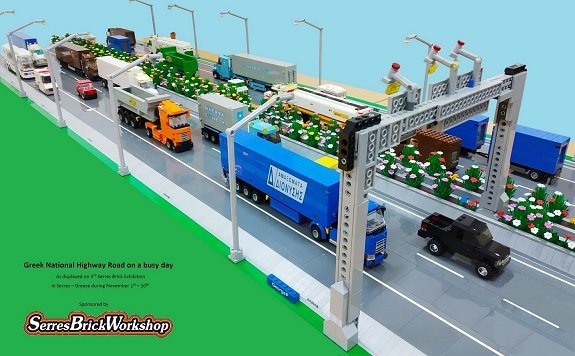
This is a prior version of the Greek National Highway Road with a single middle partition