

gyenesvi
-
Posts
2,396 -
Joined
-
Last visited
Content Type
Profiles
Forums
Gallery
Everything posted by gyenesvi
-
 Oh nice, I saw it in dark blue in that truck, but I did not know it also exists in black! That's useful :) Cool, and this one also comes in a few colors!
 -
I saw this in a recent video, and wanted to ask about this model, because I really liked the very polished looks! So smooth blend of great looks and fun playable functionality. Nice packing of electronics too! I was surprised to see the front fender part, which fits really well, is that from the Icons Defender but in white? I really wish Lego would make more such sideways snap-on fenders in technic as well, like the Technic Defender one but smaller. Could achieve much smoother looks than the current fender parts. What's the part used for A pillar?
-
Thanks! :) Yes, the main reason is the additional mounting points, that's why I'd say it's optional. But also, it kind of feels better for protection as well, so that maybe wires don't get tangled up in the running motor (since it's an outrunner), in case I'd want to run wires around the motor. No, I did not need to cut it, because I made the wall thick enough (4mm) so that the remaining shaft is not too long. But also, I checked that inside the planetary gearbox, the first stage carrier has a hole in the middle, and the 2mm motor shaft just fits in there, so even if it would be too long, it can protrude in there! Really useful, so that no cutting is required, which would be really difficult, and might damage the motor bearings I guess.. And the 2435 motor has the same shaft width/length! That's reassuring to know! Thanks, I'll look around. Indeed, I want to buy conical ones, and also I noticed that feature in the cad designer program (I am using OnShape, and free online editor). Also, canonical screw holes have the advantage that they can be printed without support even if they are at the bottom. In fact, that's how I printed the pinholes on the front face, as that was at the bottom :) Yes, it shuts down kind of abruptly. It would be nice to configure it a bit, I have the configurator board, but can only run on Windows, and I use Mac, so I need to borrow a laptop for that.. Yes, and the profiles also match kind of perfectly as I put them side by side, was sooo happy about that, otherwise swapping the gear could have been a difficult step in the assembly. No, all the pinholes on the front face and side are full stud pinholes, with proper recesses at the two ends, and pins go in quite nicely, even snap in a bit (I experimented a lot with printing pinholes from both orientations). As I say above, when printing holes at the bottom, I use a 45 degree conic section inside after the initial 0.8mm recess. When printing holes on the side, I don't use support because it did not really change anything, but a trick that worked for me to get the top of a hole right is variable layer height, optimized automatically by the slicer. This way, I don't need to do any post processing of the printed parts, they just kind of good enough. All parts were printed without any support. The holes on the back end are not half stud either, they are just inverse stud holes, so only 2 mm deep, and no recesses around the rim. This way they hold half pins quite well. Will post as soon as I have something! :)
-
Thanks, well that is also a concern of mine, yet to see when I build something with it.. but I have hopes. For one, I have been using modified PF L motors with buggy motor inside, that has the same planetary gears and there was no problem there so far (that has almost this high RPM range). Also, I have a feeling that I am not going to drive this at full throttle all the time.. but it would definitely be good to know how they hold up, so I might do an endurance test at some point.
-
[MOC] SB Offroader
gyenesvi replied to N1K0L4's topic in LEGO Technic, Mindstorms, Model Team and Scale Modeling
Yeah, that's what I'd be worried about. They also add friction if they touch :) That's interesting to know, makes sense, thanks! That's a nice fix, I'll try that! I meant the seats, now they are kind of pushed onto the steering wheel :) You know, the general rules state "realistic spacing between seat and steering wheel" :D -
Looks beautiful, great use of the new fender parts! Let's hope for more to come in the same style!
-
[MOC] SB Offroader
gyenesvi replied to N1K0L4's topic in LEGO Technic, Mindstorms, Model Team and Scale Modeling
I have to say that yours was my favorite model in that race exactly due to its simplicity and compactness, and because you made an effort to make it look good too. Well deserved win! I actually got inspired for next year and decided to make something of a similar spirit for next year, although not this compact. A few questions / comments: Mounting the steering linkage to the planetary hubs could be done simpler and with more clearance the same way as done in 42099, no? Did you try that? Are the 4 motors connected to the same axle? If you use 2 to drive the rear wheels and 2 for the front wheels without connecting them, there's less chance for melting I think. Did the knob gears get a lot of wear? Or is the reason why people don't like to use them for fast models because they are a bit noisy? Are those tires 95mm ones? Aren't those the ones that slip on the rim very easily? How did you solve that problem? Did you try pushing the Buwizz units a bit further to the back to have more space for the internals? -
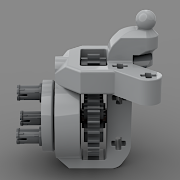
I decided it's time for me to enter the game :) So here it comes, my first brushless motor! A small one to start with. A few days ago I bought myself a Bambu A1 Mini 3d printer, and started experimenting with making a housing for brushless motors. Features Dimensions: 3x3x6 studs Weight: 34 gr Reduction: 24x down-gearing with 2-stage planetary gearbox of PF M motor Speed: around 1100-1200 measured RPM, but around 1500 on paper Design I decided I wanted to base my design on SurpassHobby 24xx motors, based on the ideas of @HorcikDesigns presented in this thread. For me, the ideal form factor is the 3x3 one, which those motors fit perfectly, and because with a planetary reduction, we can keep that form and get good amount of reduction. So my key idea was to take apart a (3rd party) PF M motor, and take out the planetary reduction for my purposes. The PF L motors also has essentially the same reduction, but its internal housing has a bigger shape due to the L motors bulge, and so I could not use that. I went on and bought a SurpassHobby 2435 3300 kv motor. When I started looking for an ESC, I came across this super small Injora one, and since I used its brushed counterpart already, and I was satisfied with it, I decided to order one (it can handle 25 A continuous and 60 A peak current, 2-3s LiPo, has adjustable BEC output up to 3A, and is waterproof). I realized that there's an accompanying mini outrunner motor as well, they come in a combo, so I bought that as well (17x21 mm only, 2800 kv). The wiring is really plug and play, you just need a battery with an XT30 connector, and a receiver. To my surprise, the motor comes with a 11T gear that's a perfect match to the gear inside the PF M motor, so it meshes perfectly with the planetary reduction. Furthermore, it also comes with a couple of 2M screws that I needed for the assembly, so I set out to print a housing for this one first. The housing consists of 3 parts. First is the front face together with the planetary housing. Second is the mounting wall. And the third one is the back cover (it's optional, but good to have). The rear holes serve as ventilation openings, as well as they are inverse studs for mounting. The assembly sequence is as follows. First, the wall is screwed to the motor from the inside with M2 screws that comes with the motor. Second, the planetary reduction slides into the two horizontal slots of the wall (the planetary housing has two horizontal tabs on the back to fix it against rotation). Third, the front face can be screwed on at the corners from the back using M2 screws. And last, the back cover can be pushed into the slots on the wall mount from the back. It's a really tight fit, so it does not come off. Optionally, the inverse studs on the back can be used to fix the motor or add further mounting points. More pictures are available on my Bricksafe. I haven't yet built it into any model, only tested the bare motor. The control is insane, it has super slow startup, it can go as slow as about 1 revolution per 25 seconds, but with enough power that I could not stop it with my hand.. And then it can go up to 1200 RPM. I'm really curious how it will perform in a model :) I am planning to make a similar motor using the SurpassHobby 2435, but of course without the back cover, but first I need to buy some M3 screws for that one. Any ideas where to get them in various sizes?
-
Now this is interesting! First of all, I'm both really happy and surprised at the same time that they redo it with such a short time gap, and very probably at the same scale. Wonder why they redo it? Did 42122 receive so much criticism in terms of looks / poor functions that they feel the need? And why didn't they go for a bigger scale this time? Probably they would like to make a complete lineup of off-roaders at this scale, the same way as the small scale supercars lineup? That is quite positive actually. As for the suspension, I actually agree that we might see some interesting development here. Agree that Jeeps are known for keeping both live axles, so I'd expect that this would not be a reskin of the Bronco, but rather have a live axle at the front. Though I'd agree that driven front axle would be too much, even though it is not impossible, but not with a proper differential/frame. But I'd like to see at least a more proper rear live axle as well, maybe a non-driven front live axle. Also, what I think would be really timely for Lego, and what really shows to be a bottleneck in the suspension of these models are the springs. Somehow, these springs are just too bulky for these models, hard to place in such small vertical space. Some alternative mounting technique would be useful.
-
The steering angle is not limited by the steering links, but by the planetary hub hitting the vertical thin liftarms connecting the upper and lower A-arms. But it's not a problem, still, the steering angle is quite good. In fact, the model easily oversteers in fast turns, so I actually had to limit the steering angle programmatically for more stable control.
-
I don't see how that part could be used to build an A-arm that's not super big (should be 9L and this part is already 8L), and that's not wobbly (this part only has axle holes), and doesn't have all kinds of unnecessary parts in the way. Thanks! About the levers, I actually took the idea from the Ariel Nomad, this model is loosely inspired by that one. I think the 3rd long lever is a hand operated brake (not the parking brake). The double steering rack actually makes the steering system have less slack because it is more constrained from both sides. Also, this way it is possible to tighten the links as it is in this model (they are not parallel), without introducing toe issues (because the wheel hubs are pulled in both direction). For solid axle, sure, the beam based connection works better, but that's not applicable here.. The point was to make it independent suspension, which works much better for fast models. I actually bought those parts in bulk from AliExpress, so no idea which period it is from, probably older. But the truth is I put in the Cada liftarms after I broke the first original lego part, so that can also break..
-
That's exactly the idea! @tseary this just came into my mind again and thought I'd check in if there's any progress on this? Sorry to bug you, I know if a guy promises he'll do something, then he'll do it, there's no need to ask every 6 months..
-
Thanks for the info, he shared this video with me as well, now I understand how it works!
-
Thanks, @Krxlion that looks good indeed! One question: where do you connect the configurator on the ESC? And what kind of configurator software is required on the PC for it to be accessed? Do you have experience with that?
-
What's happening with Technic?
gyenesvi replied to Amt0571's topic in LEGO Technic, Mindstorms, Model Team and Scale Modeling
That's a lot of megablocks in that video.. -
Really cool stuff again! What's that AM32 ESC that you guys are using? Do you have a link to that? Does it also contain contain a BEC that can power the receiver? I saw some small AM32s don't contain BEC..
-
Oh, I see, I didn't look there. But I agree, this seems like a quite unstable way of making it adjustable. And even the outer mounting of the steering linkage is not a very stable one (okay for a manual model, but would slide apart under pressure).
-
Great model! I like all the detailed internals, especially the suspension geometry. One question: how did you make the toe adjustable? The bodyworks looks interesting, on one hand it has nice shaping, and I love the color combination, but on the other hand the hood part does not work so well for me. I really like the use of the micro panels in general, but here it becomes too fragmented for my eye, all the small parts don't add up to continuous surfaces unfortunately. I think it is kind of a flaw of the technic panelling system, Lego designed them to be multi-purpose, but as a result you just can't use them for an important purpose: building (continuous) larger surfaces from smaller parts..
-
Mini AWD Trophy Truck
gyenesvi replied to Zerobricks's topic in LEGO Technic, Mindstorms, Model Team and Scale Modeling
Really nice build, I love the small scale, the electronics is powerful enough for this scale, and it's not too much for the plastic either. The suspension setup is very clever at the front, you are too fast testing out these new parts, but that was expected :) And the overall looks is also really nice, flows well with the available parts! -
Well, there may be nice functions, but their implementation quality seems questionable. That suspension looks awfully weak and bendy in the review video.. The adjustable springs (not the ride height) looks interesting though. I really like the fender parts on this one, this is nice way of making them! The bodywork around them can be built much nicer than on Lego models. Not sure why Lego has not yet arrived to this simple design for technic, when they are doing similarly for Icons.
-
I think that this B model looks really good. Good idea for the available parts and nice execution! But I agree that $10 is a bit much for this size. Can you tell/show more about the inside? Is the drivetrain/suspension setup different in some way from the A model?
-
I like the suspension on this thing, it's nothing new, but a nice space efficient implementation of the classic pendular axle tilt averaging linkage. Here's what this reviewer says about it: "instead of the usual spring shock absorbers, it uses custom technic parts". He means beams and links. Really custom technic parts..
-
42213 Ford Bronco SUV
gyenesvi replied to Ngoc Nguyen's topic in LEGO Technic, Mindstorms, Model Team and Scale Modeling
@Jundis I agree with you on the above. I also built mine over the weekend (I think this was my first ever day 1 purchase and build). Overall a really nice set, and great parts pack, I even thought about getting another one.. However, I also want to talk about some shortcomings. The front end of the chassis is really interesting, with a tight build for the front axle. The middle is pretty empty, just a frame and two beams basically, and the rear end is kind of messy, and I also wondered if it would be better with soft springs. There's a lot of space in the back, and I think a ball-joint based rear suspension could have been made, even leaving the rear seat area clean; but the problem is the steering shaft. Not only that it would have to be routed to the spare wheel (though I guess a HoG would also be okay), but rather that the front axle is so tight with the engine sitting on top, that the steering must really be done from the bottom. This makes the routing/crossing of steering/drivetrain difficult.. Another area where I was somewhat dissatisfied is the paneling. Not because it looks bad, it's quite okay, just because I'm a maximalist :) Let me explain. My biggest pain point is the design of the new flat fender panel; they chipped off the top corner of it, just like all other fenders, and I'm inclined to think that in this case (flat part), this might hurt more than it helps. I understand that the goal is to allow some other part to protrude in there when really needed, but as a disadvantage, that space needs to be filled in all other cases, which for example means all cases on this model, and that makes it unnecessarily cluttered. Just imagine how nice it would be if those corners just continued straight to meet the adjacent part. Even structurally it would make it more useful. I check the new small Ferrari as well, that model uses one of those corners for a panel, but it could be built differently as well without using the corner. So my opinion is that that might have been a bad compromise, I wonder how many future models will use that corner for good. The only good use I can imagine is to put lights in there, but that's something done with stickers nowadays anyway.. The other area of improvement is the door. It's a bit more cluttered than necessary, simply putting a 5L red beam vertically next to the hinge could have smoothed it out. Not to mention that yet another example where a 5x7 flat panel could have been perfect if existed! Last area is the roof paneling. I know it's mostly invisible due to the roof rack, but not sure whey they could not make it just more uniform looking, it's pretty cluttered and could have been made smoother easily just by rearranging some parts. And one more thing. The seats are shifted half stud to the center and don't line up with the steering wheel. This is done so that the door handle can be attached to the door; it needs some extra structure from the inside of the door. I hate when one detail has such a long reaching effect, and when fixing one screws another one. I also agree with others that the one stud wide shoulder line might be too much and it could have just been better without one. The width is especially missing for me from the hood; this way it does not have that iconic bronco ridge along the two side edges of the hood, rather it has the inverse. That black claw-like part, which is a really neat solution in itself, feels like hanging in the air with no surroundings. But still, one of the best sets of the year, and I'm really happy that Technic is moving more towards smaller scale off-roaders. Maybe I'll try to pimp this one up if I have time.. -
Of course adding more pins could make it a bit stronger, though the problem is not stiffness, but that the liftarms can detach from the pins towards the wheel end. And mostly the top one.
-
Thanks! I agree that it's not soo necessary. However, I was afraid that when doing jumps and driving fast on rocks, it could just fall apart by the vibration if it's not form locked. I remember someone built a model without those cross connections, was it yours? Physically broke.. though I have to admit I was using cada parts there, just in case it breaks :D And those may be weaker moulds. The gearing was 20:12 up-gearing from fast output of motors, then 12:12 at the differential, and then to the planetary hubs.