Search the Community
Showing results for tags 'steam'.
-
 The Frisco 1522 loco is a 1926 oil burning 4-8-2 "Mountain" type, (4 leading, 8 drivers, 2 trailing) that was made surplus in 1951, donated to the Museum of Transportation (in St. Louis, Missouri) in 1959, and restored to working order in 1988 by the St. Louis Steam Train Association (SLSTA) for it's excursion career. It's new lease on life lasted until 2002 when rising insurance costs made the engine enter it's second retirement, which will be probably be forever. When the engine was running in it's second career, the SLSTA had four train cars (one of these MOC's is a fictional fifth car to beef up the train's length) in it's excursion support role. They carried parts, tools, merchandise to sell, and crew members not on duty. After re-retirement of the 1522, most of the cars were eventually sold to Milwaukee Road 261 organization and were renamed and repainted into a different paint scheme more suited to that group. This may not be the best interpretation of the Frisco 1522, but it seems to be the one of the few I've seen built out of Lego. The model you see here has been my dream ever since I was 5 or six years old and rode behind the steamer on one of it's last public trips. (I don't remember much of the trip, but I do remember the sense of awe and respect for the power of steam after seeing the loco pull past us on it's journey back to the museum and into what looks to be permanent retirement.) The rear of the (newly remade in 7 wide) locomotive. The cab walls on both model and real engine have the name of the railroad (Frisco) on it's side, while the number of the loco (1522) is on the tender sides. Inside the cab. I chose the classic printed slope with the knobs and gauges seen here a throwback to my first train MOC from the early 2000's. One half of this baggage car (named 'Black Gold' after a train the 1522 used to pull) housed tools, spare parts, lubricants and a fire hose or getting water for the loco, among many other things. The other half (usually closest to the engine) had the souvenir shop with shelves and tables for fundraising merchandise selling. The car is now repainted and named 'Golden Valley'. It has been used with Milwaukee Road 261. The 'Firefly' was the crew car. It was also named after a train the 1522 used to pull. The car has been sold to be used with Milwaukee Road 261. It sits in storage currently. This coach is NOT based on any SLSTA car. It was added to the train to beef it up to normal amount of five passenger cars. It is named 'Meteor' after an actual Frisco train like the others just to look accurate. The diner-lounge 'Chouteau Club' wasn't owned by the St. Louis Steam Train Association (SLSTA), but by a private individual who was a member of the club. It now is stored / owned by Illinois Transit Assembly in Madison, Illinois, sidelined by side sill rust. The 'Bluebonnet' was a business car and brought up the rear of the train. It was also named after a train the 1522 used to pull. The car has been sold to be used with Milwaukee Road 261. It has been renamed back to it's first name of 'Milwaukee' and repainted into the proper colors for that railroad. The real engine is publicly displayed at the Museum of Transportation in St. Louis, Missouri. The Lego model of the loco is sitting on the front of the loco, just above the cowcatcher. This official Frisco 1522 website gave me invaluable info and pictures of the excursion cars and the loco itself. This page in particular was very helpful in getting the window amount / spacing / 'look' of the excursion cars right. NOTE: Yes, I had a thread made in 2016 for the loco only. That thread was last updated in 2017, and I didn't want to mess with the moderators by bumping it. Thus, this new thread was created. I hope that was ok! EDIT: 11/26/25: Revised real world photos added with fifth passenger car and remade 7-wide steam loco + tender.
 -
Both of the models featured in this thread together. This 2-10-0 'Decapod'-type freight locomotive was built by Baldwin Locomotive Works in 1918 under contract with Imperial Russia as part of an 1,200 strong order. Needleless to say, after the Communist Revolution the last 200 or so locos were not deliverable. Twenty of these orphaned engines were subsequently purchased by the St. Louis - San Francisco Railway (also known as the 'Frisco') - including this loco, 1621 - and modified from Russian 5 foot gauge to the standard 4 foot, 8 1/2 inch gauge, among other changes. After working on the Frisco for many years it was purchased by Eagle-Picher Industries to haul lead ore to it's smelting plant in Oklahoma, before eventually being donated to the Museum of transportation in St. Louis, Missouri as a static display in 1961, where it still resides today. The 1621 also has a operational sibling (1630) you can see / ride behind at the Illinois Railway Museum in Union, Illinois. My LEGO model of the 2-10-0 is 7 studs wide, and is not lettered for Eagle-Picher like the real engine is currently. I have instead chosen to label it how it was before the recent remodel, with the only road name visible being Frisco. Truth be told, I borrowed a lot of the design for the 1621 from an earlier loco of mine from this same museum, a 2-8-2 lettered for the Chicago & Illinois Midland. I stretched out the engine's frame, added two more drivers, removed the rear pony truck, and revised the tender and cab quite a bit. (The boiler is brand new however!) The rear of the engine. Sadly, this will most likely be my last loco using small drivers, since Big Ben Bricks is closing / going away at the end of this month... and before anyone asks, I refuse to use 3D printed parts! A view inside the cab. This is a LEGO model of an St. Louis - San Francisco Railway (also known as the 'Frisco') wood-sheathed caboose from 1942 that used to be at the Museum of Transportation in St. Louis, MO. Not much about this rolling stock is known (or at least I can't find any info!), as it was scrapped in place in 2012 due to being totally beyond saving. This model is an approximation of the former caboose based on pictures from when it was scrapped and pictures of other Frisco cabooses from the 1940s, as I've been unable to find pictures of this specific car in it's glory days. NOTES: The 1621 steam loco MOC has spurred the re-model of it's stablemate, 4-8-2 'Mountain' type Frisco 1522, into 7 wide with some accompanying upgrades. Keep an eye out for this revised model, coming soon! Thoughts?
-
This VIP / railroad executives' train consists of several different late 1800s / early 1900s vehicles in a variety of color combos. I did the because I got tired of making a few passenger cars for one train all in one or two colors, so i decided to go with every color scheme I could think of that would work on a train from this era. Because of the multiple color schemes used, I dub this 'the amazing Technicolor train'. From front to back, right to left: - dark blue 4-6-0 steam locomotive + tender - tan / brown baggage coach - dark tan / tan sleeper - dark red / dark brown dining car - sand green / dark tan observation car This early 1900s / late 1890s-era dark blue 4-6-0 steam loco is modeled after the bones of the engine in set 7597 (Western Train Chase) from the Toy Story 3 line. I stretched out the frame slightly to include a third driving axle, added a loco tender of my own design, along with new pistons and new studs-up boiler. Rear view of the engine, which is numbered '9'. (To be honest, this tender design I made has been used quite a bit for my early steam locos... but if it ain't broke - don't fix it!) Inside the cab. The tan / brown combination baggage / coach is for my railway executive's train. This car's purpose and paint scheme is actually inspired by a car owned by the (fictional) Wasatch and Nevada Railroad in the 1975 Western / thriller 'Breakheart Pass', based off the novel of the same name by Alistair MacLean. This dark tan / tan sleeper car was great fun to design. Figuring out a good color scheme while playing off the other three cars in the train and deciding on the fancy woodwork near the base of the car were the highlights! The dining car. I already had the dark red in my collection, but the trouble was deciding on a good secondary color. Eventually (after much thought) I realized dark brown looked best for this car, and thus this model was finalized. This sand green / dark tan observation car was based off the same source material as the baggage car, which is the film Breakheart Pass. In the film, the car was named 'Fairchild', after the fictional Nevada Governor played by Richard Crenna in the film. As to why Abraham Lincoln is standing at the back of the car even though he is actually long dead by the early 1900's, I have but one answer: because I forgot to take him off the model before taking pictures! Thoughts?
-
steam locomotive coal and water towers - real world MOCs
Murdoch17 posted a topic in LEGO Train Tech
My father built his original old grey water tower in this style way back in the late 1990's / early 2000's. When he built my first LEGO train (it was a set 7722 inspired steamer, which gave me the idea for my original red & black color scheme) in 2006, he built me a matching water tower to go with it, but it wasn't until 2014 when I built myself a long-awaited coaling tower using inspiration found on the internet. The two refueling towers were taken apart around 2017, and were subsequently replaced with much bigger versions in a grayscale color scheme. Several years later in 2024, I rebuilt the water tower digitally, but in the original color scheme my Father built his (not the black and red of my original copy), with the addition of a bather up on top, Petticoat Junction style. And finally, in 2025, I've got the design finalized for the reworked coal tower in a matching color scheme. In addition, my brother designed the coal chute as I couldn't get it to look good on my own. The front of the coal tower, with the chute lowered and ready to fill a waiting steam loco with fuel. The rear of the coal tower. The front of the water tower, with the bather up on top in the tank. The rear of the water tower. "Honey I shrunk the steam loco refueling towers!" Size comparison between my nearly a decade old XL fuel towers (in back), and my new smaller ones (in front). Thoughts? -
Belgium Franco Crosti’s Absolute unit Belgium Franco Crosti’s Absolute unit from BrickLink Studio [BrickLink] and a set of steam turbine locomotives with an "industrial look" Behemoth based on the Norfolk and Western 2300, "the Jawn Henry" Behemoth from BrickLink Studio [BrickLink] Leviathan based on the Chesapeake and Ohio class M-1 Leviathan from BrickLink Studio [BrickLink]
-
Fifteen years ago, I bought instructions for @SavaTheAggie's '2-8-0 Consolidation' six-wide steam locomotive. I never really used them beyond learning techniques for useful building steam engines that could actually take curves - unlike my own late 2009 4-4-0 MOC that worked well only on straight track! You can see Sava's original 2-8-0 model here (in red / yellow with oil tender) at his new online home for his awesome instructions at Brick Train Depot. This older model got an additional axle on the new front bogie, making it a 4-8-0. The loco features a non-Sava tender, pistons, and cab. The only things that survived from Sava's instructions are some portions of the boiler. As for the coaches, they are inspired by 24-year old set 10015 (passenger wagon) from the 'My Own Train' series. I made a baggage car and three passenger cars for this train using as many new parts as possible - except for the doors, as I had no good alternatives for that part. The front of the steam engine, which was a 2-8-0 until a few weeks ago. The rear of the loco. Inside the cab. The baggage car which is half my own design and half inspired by 2001 set 10015. Two of the three mostly-identical coaches. The third coach carries the red marker lights for the rear of the train. Thoughts?
-
This 2-10-4 'Texas' type steam locomotive MOC I have made has two older ancestor LEGO models that were both 2-8-4 'Berkshire' types by other builders. Parts / techniques / ideas from these two models were mashed together to design my own loco. For the first ancestor loco, we have to go back to 2012, when I bought @SavaTheAggie's 8-stud wide 2-8-4 Polar Express loco instructions. I then spent the next three years heavily modifying the model I made from them, eventually ending up enlarged into a 2-10-4 'Texas' type. This revised loco also had a very similar color scheme to my new loco, with an all-black look with red box on the tender. This original 'Texas' type loco was destroyed long ago for parts. You can buy the original loco instructions by Sava here. For the second engine, we move forward to 2021, when I bought some Rebrickable instructions by @Plastic_Goth for a 7-stud wide 'Berkshire', from which I took the boiler and cab areas and made the rest of the loco myself using principles and ideas gleamed from the first loco 9 years prior. this design was modified and used several times in 4-8-2, 4-8-4, 2-8-4, and more wheel arrangements over the years. You can buy the instructions by Plastic_Goth here. Now in 2025, I have designed a 2-10-4 based on a stretched Plastic_Goth boiler with the paint scheme of my modified 8-wide version of the Sava Railways engine and my own loco running gear + tender. I think I did a really good job mashing these ideas together and making it into my own MOC. The engine rolls beautifully without any major issues except one: when being pushed backwards the engine can collide with the tender. Grabbing the loco itself and pushing the tender back (instead of dragging the loco behind the tender by holding that) bangs the cab roof into the top of the tender. It's my design's fault, and I can't seem to sort the issue out, unless If making the cab roof shorter in length. (which I don't think looks good and won't be doing.) The rear of the loco. Apologies for the one tile not being pushed down all the way - it has since been fixed. The cab of the loco, with firebox and gauges. The engine is 7 studs wide from this point back through the tender, while the boiler is 6 wide, not including the overhang for the walkways. Thoughts?
-
 Hello everybody, I am glad to introduce you my last big project : a pneumatic steam locomotive ! I think it's one of the firsts pneumatic locomotives, using only Lego parts. First of all, the YouTube video and some photos: The idea with this model is to replace the steam of a real Locomotive by compressed air, and this for as much functions as possible. Here are the main functions : Movement of the train : Using 4 pistons, 2 on the sides, and 2 inside, the train can move forward. It works like a classic LPE, with 2 pistons shifted 90° from the others. 4 pistons consume a lot of air, but they guarantee enough power to move the whole train. To make the rotation smooth, a free wheel is hidden inside the boiler part of the locomotive. Its rotation is 25 times faster than the wheels of the train (40t/8t x2). The train isn't moving very fast because the pneumatic elements aren't modified. However, it's fast enough to make it interesting to look at the connecting rods and wheels moving. The breaks : On a real locomotive, compressed air is produced by a compressor (powered by steam) and is used to press some brake shoes against the wheels. Here, the same technique is used : a small piston is filled with compressed air, and thanks to some rods, brakes shoes are pressed against the wheels. It's cool but...it's not enough. Plastic against plastic isn't very efficient to stop the train's movement. Therefore, another rod is connected to the brake system and press another brake shoe against the free wheel. Because its rotation is faster (and therefore, with a low torque), it's is way easier to stop it. The Whistle : A system that I love in this locomotive is the whistle. Currently there isn't any whistle produced by Lego that could be used in the locomotive, so I had to think a little for finding something working. This whistle is activated by a switch in the cabin. The Cabin : Nothing much to say except that in contains 3 switches for the 3 main functions (whistle, wheel movement and brakes). There is also a pressure gauge showing the pressure coming from pumps. The train moves with a minimum of 1 bar. A 2-2.5 bars, the movement is faster. The air supply : There are several possibilities for the train : we can directly pump with Lego pumps, or store the air into 6 to 8 airtanks or produce the air with Lego motors and small pumps. For instance I use 4 pumps side by side, linked to some air tanks, but I don't what the final model should work. Maybe some motors and pumps could be cool ? The design : The hard part was to make the boiler of the locomotive. It's a little hard to make cylinders with Lego technic parts but, with flex axles passing through Technic beams, I managed to make something satisfying. Some details are visible on the locomotive, I tried to make it look a little crowded like a real locomotive with fake air/sand tanks, fake compressors and mechanical elements. It's probably possible to make it look better, but for instance I am happy with it. The rails are "homemade" with Lego bricks. The locomotive is too big of course to work on Lego railtracks. The wheels aren't perfectly flat so the train is "blocked" in position inside the rails. Therefore, the train can move foward cur cannot go out of the railtracks (which is great for a train). Finally, as a bonus functions, there are some bumpers at the front and back of the locomotive to imitate the real bumpers used to absorb small chocs on a Locomotive. That's it for now, I hope the model is interesting to you and if that's the case, don't hesitate to support it on Lego Ideas ! Click Here to support :) If you have any question or comment, please reply to the post, I'll be glad to discuss with you !
 -
Like many people, I regarded steam locomotives as rather dark and monstrouos machines untill I first saw their early iterations. It was a novel technology at the time, so embelishing them for the amazed crowds and potential contractors should have been appropiate. The mechanical detail is more aesthetic than plausible. Yet, there are elements taken from what an early steam walker should have looked like, besides the vibrant colours. Most of its inhards are shown, there are very few largue pieces of metal, structural elements take over shape design. It is somewhat outlandish, taking a mechanical shape similar to that of many tin toys. Even if it seems to be something rather decorative, there are a few tricks to make it more resistant than it seems. Legs rest directly over the axle pillar and the superstructure it hides. Feet are also anchored to the base to avoid deformation.
-
The whole Merrimac River Runner passenger train, headed up by Baldwin RF-16 "shark-nose" A +B diesels number 3701 with assistance provided by 4-8-4 "Northern" steam engine number 2980. The name of this train is a play off the Missouri River Runner, a real train that Amtrak runs from Kansas City to St. Louis. The Meramec River is a body of water that runs next to the real world 12-inch gauge Wabash Frisco & Pacific, so I switched the name to the Meramec River Runner. Never mind the fact the Missouri Pacific used to run on the roadbed the WFP now uses up from the 1850's until about the 1940's, when it was rerouted to it's current alignment and abandoned the old one to the eventual WFP use from the late '50's to today. These Baldwin diesel RF-16-like locos were inspired by set 10020, (Santa Fe Super Chief) for most of the basic body work and and fellow Eurobricks user @Legownz for the knife-like Sharknose front end. (Thank you for that ingenious design!) The cab and booster units feature no interior details because I have no need for such items on my layout.. that and retrofitting all my trains with inside details would be quite costly. The rear of each of the locos feature doorways to the next engine compartment, and / or the passenger train itself. This 7-wide steam loco began life as a 2-8-4 Berkshire type built by @Plastic_Goth and purchased from Rebrickable a seen here. I upped the wheel count by another leading axle, making it into a 4-8-4 Northern-type from the original 2-8-4 Berkshire. The pistons are entirely my own work, as is the complete tender. The coal tender will have the letters WFP on the side, standing for Wabash Frisco & Pacific, while the cab will feature the number 2980 on both sides. This is a scrambled homage to real world WFP 4-8-2 engine 928, which is so strong, it's pulled every piece of rolling stock the railroad owns -at one time- with ease! The inside of the cab features two gauges and the firebox door. This is all the interior the whole train features. Combination baggage and passenger car three identical passenger coaches for the train The observation car of the Meramec River Runner. (This car is to become fully enclosed soon, with a wraparound rear window provided by two of this piece.) Any thoughts, comments, or complaints? EDIT 5/11/21: Added 4-8-4 steam loco to this post. Real life pictures coming soon.
-
Hello, all! Today I bring you my latest creation, a 4-8-2 mountain type based off of Frisco's 1500 class. I have been able to fall more in love with Frisco locomotives as I've been helping take part in cosmetically restore the Frisco 1501 located in Rolla, Missouri. Not only that, but my great grandfather was one of the engineers of the 1501 before it was retired. Some history of the locomotive: “Steam locomotive 1501 was once part of a proud stable of thirty such engines on the Frisco Railway system. Built in 1923, the handsome modern machine was the pride of the fleet until dieselization of the system in the late 1940s. The 1501 was part of an initial order for fifteen locomotives placed with the Baldwin Locomotive Works in Eddystone, Pennsylvania in 1923. The order was the Frisco's response to delays in passenger service due to the tortuous Ozark territory west of St. Louis. The oil-buring locomotives were a type nicknamed "Mountain", which has a wheel arrangement of four lead or pilot wheels, eight driving wheels, and two trailing wheels under the cab (4-8-2).” Down below you can see the progress of the locomotive from the very beginning. I decided to update this as to help show the final product.
-
The prime method of transportation to and from the North Pole for children is now arriving at your front door! So, grab your robe (but don't rip the pocket in your haste to get outside!) and head on the adventure of your life... "Well, aren't you coming!? This here is the Polar Express!" What happens to the steam-hauled Polar Express when the steam-era parts suppliers eventually go out of business in the mid-to-late 1960's? Elves know toys inside and out, but steam locomotives are a bit out of their wheelhouse. Enter 1231, the newest locomotive-set in the Polar Railway's repertoire of railroad vehicles / rolling stock, used as a eventual replacement for 1225, and current freight loco. Built by EMD in December 1959 as a FP9 for the cab unit and a regular F9 for the B unit, these engines use small steam boilers to heat the heavyweight passenger cars, just like the 1225 before them with it's (obviously much larger) boiler. 1231 is currently assigned to freight duties at the North Pole awaiting it's turn at the head of the Polar Express. (eventually) The whole Express train, headed by steam locomotive 1225. This steam engine began life based on my design of the Frisco 1522, a 4-8-2 Mountain type, which I had built into a 2-8-4 Berkshire for my Polar Express. I then saw a far superior model by @Plastic_Goth over on Rebrickable, as seen here. It was then purchased, and I added my own wheelbase to it from the pervious Frisco 1522-derived version as I try not to use those small friction wheels for the front pony truck, as it squeals too much. (as used by Lemon_Boy in his version) Then, I took the open bottom cab and added mine back in, albeit in 7 wide. I redid the tender to be seven wide as well, while shortening my passenger coaches by four studs. (I will put them on a 24 stud train-plate instead of 28 for each car.) this will give me nearly enough parts to add a firth car as a third identical coach. I kinda took inspiration for the Emerald Night for the firebox. Simple and elegantly held on by technic pins, it makes a good converter from the seven wide cab to six wide boiler. The tender retained its ladder to the deck, albeit on a smaller scale - about what I did for my Emerald Night tender MOD. This is the saddest car in the film: the recycled toys baggage car, which thankfully is empty here, but in the movie was full of tangled marionettes and broken toys galore. This car features a sliding baggage door in addition to the usual opening regular doors. (which in turn were styled after the Emerald Night's coach's doors) These two coaches feature opening doors on each end. The color scheme chosen for the cars was inspired by @SavaTheAggie's Polar Express, and not the movie. (Dark red windows and medium blue train cars are accurate, but way too expensive!) This is the observation lounge car, and features a viewing balcony on the end of the car. From left to right these people are: - Narrator child - Engineer (I'm calling him Max) - Fireman (now named Joe) - Conductor (named Charlie, as far as I'm concerned) - The mysterious ghost hobo (who I'm trying to write a story linking him between the movies Emperor of the North and Polar Express. It will explain how he got onto the Express, and how he died at Flattop Tunnel. Based on a deleted scene from the Polar Express.) Everyone knows about the Polar Express passenger train, but what about the other half of the railroad business: FREIGHT! Well, this problem is now solved with the "1231" Electro-Motive FP9 diesel cab + booster locomotives, along with boxcars for toy materials, hot cocoa tankers, coal cars (for naughty children and the hungry 2-8-4 steam loco 1225), and flat cars with varying loads, this one being Santa's backup sleigh w/ reindeer! This model originally was inspired by the EMD FL9 in the "Lego Train Projects" book from No Starch Press. I made it shorter and added a B unit, while changing up the color. I also make them into a regular diesel powered F-units instead of the dual electric / diesel powered FL9. The chosen color scheme is of my Polar Express train which, as you most likely know, is usually headed up by 2-8-4 steam loco 1225. Well, here is the backup / freight loco number 1231. NOTE: This idea of a later-day diesel hauled-Express is actually not new, as I've seen it in blue-and-dark red Lionel models for a while now in several Hobby shops... they even have a Polar Railroad GP-7 as a model too, according to my Google search! The engine will feature (once built) feature printed letters on the A-unit's sidewalls saying "Polar Railway", and closer to the nose, will have the "1231" as the loco number. The rear has a doorway to the first passenger car. The boxcar seen above is for for carrying toy-making materials, such as wood, and barrels of plastic pellets. This flat car is supposed to have three hay bales in front of Olive (the other reindeer, who is usually omitted from the regular team pulling the A-Sleigh because of his bad habit of calling team leader Rudolph names and being generally unpleasant while playing reindeer games.) Olive pulls the backup sleigh instead. This hopper car is for carrying naughty children's coal, which also happens to fuel the 2-8-4 steam loco 1225. A simple Hot Cocoa tanker car.. be careful, it really is hot! The last car in the freight train is a caboose. The letters "PR" (standing for Polar Railway) go on the side wall studs. As usual, any comments, questions or complaints are welcome. There is only so many days until Christmas, and then this train becomes relevant again, so I'm building this REALLY soon! EDIT 4/22/21: Added freight cars to the post.
-
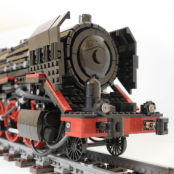
Good evening, everyone, Today I would like to present you our model of the German "war locomotive DR BR 52" of the "Deutsche Reichsbahn". This is a tender locomotive, of which more than 7000 units have been built since 1942. It is often called a war locomotive, because it was designed and built especially for war conditions and the resulting shortage of raw materials. Even after the war, these locomotives were still in use for a long time, distributed throughout Europe. The retirement of the Deutsche Bahn took place in 1962. The model can be powered by two Power-Functions L-motors. Both engines and the infrared receiver are installed in the boiler. The battery box finds place in the tub tender. The locomotive consists of approx. 1218 components and is approx. 64 studs long. The model has some details, such as the undercarriage, the superstructure on the boiler or the striking tub tender. Various SNOT techniques were used during construction. Have fun watching and many greetings Comments and criticism welcome These and other pictures can be found in our Flickr folder and on our homepage.
-
I hope this is the right forum to post this :) Recently I got challenged by my friend Felix to build a micro-scale steam locomotive. I have never tried building anything like this but I gotta say I was surprised how much fun it can be. The new pieces definitely open the whole another world of possibilities when it comes to tiny builds like this. And I am really quite pleased with the result :) If you want to build your own, I put together building instructions which you can get for free on Rebrickable!
-
The War Department "Austerity" 2-10-0 is a type of steam heavy freight locomotive that was introduced in WWII in 1943. It was designed by R.A. Riddles, the same man who latter went on to design the British Railways 9F 2-10-0 type. I've backdated my 1950's 9F type into this 1940's Austerity class by removing the side smoke deflectors and changing around some small features here and there. As most of this engine still existed as-built from my previous 9F build from 2014 (that itself was inspired by @ScotNick's model of Thomas and Friends' 9F-type engine Murdoch) or so, I just needed to get wheels, a tender draw-bar connector, pistons / side-rods, and the little bit of parts to convert it to a Austerity type. The tender has "BR" printed on it in 1 x 1 tiles, standing for British Railways, as this engine was placed into service with the newly nationalized rail network after service with the War Department during WWII (around early 1948). However, it still is carrying it's War-time grayscale color scheme at this point in the early 1950's, lending to it's nickname the "Gray Ghost". The cab of the engine, with firebox in the middle. In the real world, the Austerity 2-10-0 class engine was designed and built during the Second World War as an British export locomotive, with some going as far away as Greece, the Netherlands, or Syria, while a few stayed in the UK to be worked by the War Department, and later, British Railways. All but three of the ones from the UK (of which one was owned by the Longmoor Military Railway) survived mass scrapping in 1962 and were preserved, while a fourth was brought back from the Netherlands and also survives. (There are also a few derelict versions in Greece, while a museum in the Netherlands has an engine as well, albeit in much better condition than the Greek locos.) All credit for the BR plank wagon model seen in the picture above goes to @Pdaitabird, who designed them. See here for an awesome step-by-step tutorial by the original builder of the BR plank wagon. Original design by Flickr user Fireglo450 in 2013, revised by me in 2020. See here for the original inspirational model. Here we see the whole gravel train at an "on-it's-side" view for maximum viewing. This train is destined for the Gravel loading facility where it will be loaded with crushed stone for either rail ballast or concrete works projects elsewhere in the country. As usual, comments, questions, and complaints are always welcome!
-
Here are all the pictures of my (and a few other members of Gateway Lego User Group) Wild West era-stuff on display at Our Lady of the Snows' Way of Lights display, in Belleville, Illinois until December 31st. (excluding Christmas and New-Years eve, they are closed those nights.) These only are some of models I have been making since 2014, more can be found in this thread here. There are a ton more tables (and themes!) at the show, so come on down to view them all, this is only a small inkling of what's there! (sorry mod's, had to do that last bit.) US army Fort Legoredo, circa mid-1885. The town of Legoredo, part 1: general store (in front, next to fort) Doc Brown's saloon, (corner lot) train station (obviously placed) The town of Legoredo, part 2. post office (in white with red flags) Sheriff Woody's lockup (next to the water tower) barber shop (with the deck on the second floor) Bank (the big impressive building) blacksmith's shop (small shack across from the bank) rear-wheel steamboat Proud Mary and the Boulder Cliff Canyon through-truss bridge. Also, Stinky Pete's house nearby. Rapid River Village, part 1. The posse is chasing down the escaping convicts on the handcar, while the train is making up for lost time and might beat both of them! (I was inspired by the 1990's LEGO Loco video game opening cinematic with the handcar being chased by the train, if you couldn't tell.) Rapid River Village - part 2, with skull butte and the village elder's tepee's on top. Also, see if you can spot the tail end of the Delorean time machine in the tunnel! NOTE: This is not all my stuff - the Indian village on the tan base-plates was designed by Gateway LUG member Chris Curtis, and the red stagecoach was brought in by a third member. My father designed the three elevated wooden box-risers next to the skull mountain, under the cubed tan felt. Any thoughts, comments, or suggestions? Please leave them below!
-
This train is named the 909 National Limited, a (fictional) early 1930's steam-powered train run by Brick Railway Systems. This transcontinental train has it's respective east or west bound sections leave New York (or Los Angeles) on Monday at 9-AM sharp for the 3-day "Day" trip to the final destination, 72 hours distant, at 9:00 AM on Thursday. Then, after that train is cleaned and restocked in less than 12 hours, than it, or the standby train if their is delays, can be sent back as the "Night" section on-wards at 9-PM Thursday to 9-PM Sunday night. At 9-AM Monday morning, the whole cycle repeats anew for the next week. Their are five complete train-sets, two being used at any one time, two being cleaned and restocked on a bi-weekly basis, and one for standby in case of breakdowns. Also, coaches are in ready to use condition in several yards in large cities, just waiting to be dropped into place if a car needs to be worked on en-route. There are seven of the streamlined 4-8-2 "Mountain" type engines (numbers 4307 to 4314) assigned to the 909 National Limited, with a rotating pool of rolling repair and preventative maintenance schedules vigorously followed. Here we see engine 4312, it was built in the late 1920's by Lima locomotive Works. It was one of the lucky few of the 50 engines bought by Brick Railway Systems to receive a complete streamlined casing shortly after being assigned to 909 National Limited in 1931, along with six other's of it's type. It is painted in reddish brown with a fluted black side stripe on the engine and black box stripe on the tender to keep it in line with the passenger cars of the 909 National Limited, it's assignment for the foreseeable future. In reality, this locomotive was inspired by the South Australian Railways 520 class 4-8-4 and the hover mono-rail engine from the Legend of Korra TV Show, while the train coaches were inspired by a vintage 2009 LEGO model of "Galaxy Express 999". (Link to Brickshelf here ) The real story behind the of the name 909 Limited is a combination of this fantasy train and the Beatles song "One after 909", which is sort-of about a train. This is where the food is cooked and baggage is stored on the transcontinental journey. I don't know if such a car type really exists, but if not, I'm not sure what to call it... any suggestions? One of these cars is a sleeper, one a dining car, and one is a coach. But YOU get to guess which one is which! (Answer: They are exactly the same externally and there is no inside details. Only my imagination provides the difference!) The observation car at the end of the train has a viewing platform for looking at all the wonders this country has to offer as they go by. Builders Notes: So I looked back through the forum archive, and didn't see a topic posted for this train by itself. I saw one with other trains with it, but not one by itself, and it wasn't even in real bricks... so here is my updated for 2019 pictures and detailed description for this revised model. Also, the three day journey each way is plausible, as I asked Google, and it spit out a map from 1930 that said it took a train three days (72 hours) to get from Los Angeles to New York City. Now, I know that most trains headed to LA started in Chicago, but I'm ignoring that fact in my alternate reality LEGO-world here steam never died off completely, Amtrak doesn't exist in the semi-corporate mess it does today, and the electrification of the Milwaukee Road reached from the Twin Cities region to the Pacific ocean and are still there today. On that note, the North East Corridor wires stretch all the way to Chicago. ...anyway, kinda got off topic there. As usual, if you have any questions, comments, or complaints, please post them below!
-
First off: I did not design this steam engine! I modified it heavily to suit my tastes from this Eurobricks post (link here) from user @damangos. I did, however, rework my original 7 wide Emerald Night tender from 2014 instead of the 6 wide tender used by damangos in the original model, and I also reworked his model to suit my tastes and be cheaper on BrickLink. The engine in question is modeled in LNER dark green, and is numbered one higher than the A3 engine series ever went, though it is still called the the Emerald Knight. (just the set 10194's name with an added K, as you may have noticed.).... and yes, it's a bit dusty. I just noticed, and it's too late to retake the pictures now. (It's been sitting in a open-top bin waiting for the coaches to be built for a while, and I thought I dusted it thoroughly.) LNER is the name of the railroad that built the locomotive (like it's real-world inspiration, the Flying Scotsman, 4472), and it stands for London North Eastern Railway. The number 2509 was chosen because the A3 class of engines never went that high in numbering. (2508 was the highest, and was the last one built in the mid-1930's.) These four regular coaches, (and one guard's coach, seen below) are inspired by the recent Hogwarts Express cars, to save money on wheels and train car bodies / frames. They don't have any of the interior details the Hogwarts Express has, though. I based the colors of the coaches on a inverted set 10194 (Emerald Night) coach color scheme. I always thought the colors looked better like this, and it avoids the problems of the tan 1 x 4 x 3 train windows used in the original set. (which are very expensive!!) Fictional locomotive backstory: Fictional locomotive backstory: This is loco 2509, built January 1936 as the very last A3 to roll out of the factory for London North Eastern Railways (LNER). It was given the name Emerald Knight, a name which, while being the name of a wining racehorse from the mid-1800's also matched it's dark green paint job. The engine was usually assigned the the Kings Cross to Scarborough line, hauling the Scarborough Flyer until being withdrawn in 1965. The engine survived WWII in remarkable shape of maintenance during those hard years due to the heroic actions of it's engine and shed crews who were said to have taken a shine to "well-riding" and "good tempered" engine. Steaming never was an issue, and the fire was always roaring right when you wanted it according to a fair amount of it's crews from 1940 to 1947. British Railways (BR) took over in 1948 and the engine was painted "Express dark blue". Loco 2509 soldiered on for 17 more years until 1965 when it was deemed unnecessary for future use and sold for scrapping. Thankfully, unlike 99% of the rest of it's class (except for the Flying Scotsman, which was also saved), it was not condemned to the scrap line for very long, as it was saved in 1966 by the Lego Rail Transportation Society (LRTS), a preservation group with aims to restore the trusty engine to it's former glory. LRTS backdated the loco to it's original 1936 exterior specifications, while keeping abreast of any interior improvements made to it's sister loco "the Flying Scotsman" (loco number 4472) over the next forty years. In early 2018, the engine was rolled into the shop for it's new boiler ticket tear-down, when it was announced it would wear LNER dark green again instead of the BR dark blue. The engine rolled out of the LRTS shops on December 26th, 2019, just in time for the engine's 84th birthday celebration in January 2020. Well, that's all I got for now... just need to get my layout up and running again! Comments, questions, and complaints are welcome as usual!
-
 Good evening everyone, Today I would like to present another "international" model. This is the "NSB Type 49 - Dovregubben" of the Norwegian State Railway. It was built between 1935 and 1941 and was mainly used on the "Dovre-Railway", that´s the reason why the locomotive is also called "Dovregubben". The model consists of approx. 1020 individual parts, is 58 studs long and approx. 10 studs wide. It can be driven by two M-engines, one above the other in the boiler. The IR receiver is located in the cab and the battery box in the Vanderbilt tender. This model was developed from a former customer request and was a special challenge, since there are unfortunately only very few meaningful photographs or pictures in the Internet to find. Usually only black and white. Therefore we mainly used photos of a H0 model. Praise and criticism are very welcome. Kind regards Martin Further pictures in the flickr-folder or on our homepage
 -
Hello everybody, my last construction project took me to Scotland. The Jacobite Steam Train still operates between Fort Willam and Maillag. Various steam locomotives are used for this train, e.g. the LNER class B1 No. 61264, the LNER class K1 No. 62005 (when I visited in 2005) or the LMS Class 5 "Black Five" No. 45231. They all serve as wagons of British Railroads Mk. I coaches. The classic British steam train passenger car par excellence. As a locomotive I chose the LMS Class 5 "45231". This promised a challenge as a Lego model: a conical boiler and angled cylinders. Exciting. The locomotive has 2 Lego PU motors as a drive. 1x in the locomotive on 2 of the 3 large main axles (BigBen XL wheels), 1x in the tender on 2 of the 3 tender axles (BigBen M wheels). Each engine has its own HUB. The locomotive is controlled via the Lego PU remote control. However, since the motors have to be operated with different power due to the different wheel diameters, a tablet / mobile phone with the Lego PowerUp APP is interposed between the remote control and the locomotive. The APP accepts the travel commands from the remote control and forwards them to the two HUBs in the locomotive. The lighting of the locomotive consists of self-soldered LEDs, connected to the Power UP HUB in the locomotive. A normal Lego Led for PowerUP is installed in the tender. The entire lighting is controlled via the handheld remote control and the APP. Forward travel: steady light at the front, optionally flashing light or off at the rear Reverse: front flashing light or off, rear continuous light The flashing is realized via the APP. Built from Lego parts with the following third-party parts: - BigBen wheels S, M, XL in new dark red - Linkage from the 3D printer - Lighting partly self-made - Self-made lettering / decoration But only a locomotive is no train.... The classic: British Railroads Mk. I passenger car. Built in the 50s in very large numbers and in many variants, these cars are still in use today on tourist trains and in collections / museums. The color "new dark red" was attractive and difficult at the same time. There aren't many windows and if you do you can't pay for them ... So I first looked for a solution for the windows: buildable, affordable and based on the model. In particular, the 4 small windows above are the mark I also found the variety of variants impressive and couldn't really decide which one to build. So I build all ;-) The cars are all built according to the same basic scheme and yet completely different. There are some with an open compartment (e.g. FO - First open) and some with individual compartments (e.g. SK - Second Corridor). I have 1st and 2nd class. 1st class has dark blue upholstery and a side table with a lamp. The 2nd class is more simply equipped. It was very interesting during the construction: the left / right sides of the car are often very different. E.g. In the case of the corridor cars, the doors are on the corridor side in line with a compartment door. In this way, in the event of war, the wounded could be pushed into the compartment on couches through the outer door. The bogies were of course important to me again: Model type Commonwealth: All cars are again equipped with ball bearings. The reason is simple: the cars are long and heavy, and weigh around 900-950 grams. Most cars can drive Lego R40 curves, only the two very long ones cannot. Since my locomotive also needs R104, I prefer to use the cars on large radii. The roof of all cars can be partially removed to insert figures. With the corridor car you need little fingers ^^ BR Mk. I 3093 Florence FO (First Open): An open 1st class car. 1st class cars typically had maiden names as proper names: BR Mk. I 4951 SO (Standard Open): An open 2nd class car with an open-plan compartment. In terms of construction, this car is longer for me than most of the others, this has to do with the spaces between the windows. All of the cars have the correct number of windows, but the wall between windows in 2nd class cars was smaller than in 1st class cars. It's hard to do with Lego. So I decided to use the length differences. BR Mk. I 1840 RMB (Restaurant Mini Buffet): A restaurant car with a small bar / kitchen for coffee / tea / snacks. In the fan area is the bar. To the left of the middle door is a small storage room. BR Mk. I 13320 FK (First Corridor) Anna: A 1st class carriage with a corridor and 7 individual compartments with 6 seats each. Ok, only 2 Lego figures per compartment because of excess width ... BR Mk. I 99035 BSK (Brake Second Corridor): A 2nd class carriage with a corridor and a brake / attendant compartment. It also serves as a luggage cart. This car belongs at the end of the train. In the case of "runaway" wagons (the wagons were torn off from the locomotive), the train attendant was able to recognize the situation via periscopes (the angles on the roof) and brake the wagons. This is why this car has the rear end for me. This is implemented as a flashing light and can be switched on inside. BR Mk. I 21266 CK (Composite Corridor): A corridor car with 1st and 2nd class. The car transitions are designed the same for all cars: The aim was: the smallest possible gaps when cornering: This is what the car transition looks like in an R104 curve: Enjoy: Thomas
-
Hey guys! I have a new MOC to share. This was a commissioned build that will be turned into a full kit for bricktraindepot.com. Will be doing additional full kits for Nickel Plate #765 and Pere Marquette #1225 as well. Pre-orders for all three kits will open on September 1st! If you purchase the C&O kit, $100 will be donated to Kentucky Steam to help with the restoration of #2716. Anyways, about the engine. The Chesapeake and Ohio Railway's K-4 class were a group of ninety 2-8-4 steam locomotives purchased during and shortly after World War II. Unlike many other railroads in the United States, the C&O chose to nickname this class "Kanawha", after the river in West Virginia, rather than "Berkshire", after the region in New England. During the 1940s, the C&O K-4's were being built to haul heavy freight services and were used mostly for high speed freight and passenger services throughout the north-eastern regions of the United States and part of Ontario, Canada by the Pere Marquette Railway. C&O Class K-4s were one of the few recognizable 2-8-4 (Berkshires) classes in North America along with the Pere Marquette Class N (road numbers 1201-1239), and Nickel Plate Road Class S (road numbers 715-779). Both the PM Class N and NKP Class S were manufactured by the Lima Locomotive Works in Lima, Ohio. NKP 779 was the last standard-gauge Berkshire to be built in the world, and the last steam locomotive built by Lima Locomotive Works. My model features 2x L motors in the boiler with custom battery box in the tender and all specialty wire custom finished, 3D printed XL drivers, BrickTracks wheel in roller bearings, custom side rods by TrainedBricks, and decals by OkBrickWorks. I've finished the physical build and have been doing testing while waiting for OKBrickWorks to print my decals and wheels. Hope you enjoy the renders for now. More pictures will be coming soon! Left Front by Jeffinslaw, on Flickr Right Front by Jeffinslaw, on Flickr Getting close! by Jeffinslaw, on Flickr Additionally, be on the lookout for other train cars from BTD such as the AAR 50 ton hopper in C&O livery as well as an update to our TOFC to include a C&O flat car and some Railway Express Agency trailers. Let me know that you guys think! -Jeffinslaw
-
At long last I present to you all my second steam engine: The Canadian Pacific G2 Pacific I was pleased with how this one turned out especially the smokebox on the locomotive. It took longer than I wanted and that is because I had other things around me to consider. But I would see to it that it would get through for you guys. Runs of 2 L motors housed in the boiler with the IR receiver and battery box in the tender. I know it is rather bulky for a small steam engine. But I wanted to make sure that I could get in as much details as possible.
-
A 4-6-6-4 type steam locomotive. First conceived by the Northern Pacific in the 1930s, they were among the steam locomotives that represented "super-power" where engine builders learned to create locomotives that combined both power and speed. The first batch of 12 of these engines were first delivered in 1936 to replace double-heading methods. The locomotives please Northern Pacific so much in fact that 9 more were ordered in 1937. They could be found all over the NP's divisions hauling fast freight trains and reefer trains. Their 69 inch drivers allowed them not only strong pulling power but also the ability to go 60 miles per hour. I thought it could bring a real "challenge" to those who want to build it. It has OVER 2000 parts total. It has a side rod system that needed to be reversed engineered a few times to perfect it to where no 3rd party elements are required. Unlike most other articulated steam engines I have seen on YouTube and other places, mine has a FIXED rear engine unit and a front free swinging engine unit just like Union Pacific 4014 that was restored in 2019 if I am correct. Description: Locomotive is powered by 4 LARGE motors, these sit inside the boiler and provide the means of going forwards and backwards. Both the IR receiver and battery box sit inside the tender. I would recommend some extension cables given the fact that the locomotive itself is very long. The IR receiver also plays a part in the tender for the locomotive is designed to look like an oil burner. The bogies on the tender are specially designed to not only to look realistic but also to take turns at the same time. And the same can be said on the lead truck in front of the first engine unit. The cab will actually let you house an engineer and fireman to simulated them driving the locomotive. To look at my other creations go to BrickLink and search under Strader987 https://www.bricklink.com/v3/studio/design.page?idModel=160723 This locomotive is also on The Lego Ideas website, here is where to find it: https://ideas.lego.com/projects/7a2adb34-7fc5-401a-aa28-c8eddd37480c Please help me get 10,000 supporters please.
-
Dear community, Today I would like to advertise a campaign and present a MOC to you, which basically does not belong to my core competence, but which I nevertheless enjoyed developing very much. But now lets start at the beginning... In the middle of June one of my customers from Dresden wrote me a kind e-mail. He informed me that the Saxon paddle steamer fleet, which is the oldest and largest paddle steamer fleet in the world, is currently in economic troubles. Not only because of Covid-19, but also because of the increased low water in the past years. Locals, fans and friends want to support the association "Weiße Flotte Dresden (white fleet dresden)" with various activities. The idea of my customer was to create a construction instruction for a steamship model and to sell it. A major part of the proceeds were to go to the campaign. I wanted to help. I wouldn't call myself a real fan of steam ships, but after some research I was fascinated by these old heavy machinery, like the steamers on the rails. The problem, clearly, I had never built such a model before, but once my interest was caught and after choosing a suitable original, I started working on it. It gave me great pleasure to see the model grow, also the acquisition of new building techniques from the sector ships was exciting. But soon it became clear that a scale model would be about 1.5m long. This is of course way too big to make a instruction for private customers. So I designed a model in reduced size. I paid special attention to the recognition value by the colouring and the proportions. Various details were reproduced in the exterior and on the decks, but also in the interior. For example the steam engine, which can be driven together with the two paddle wheels by a Power-Functions or Powered Up motor. The model is built in minifig size. The individual decks can be removed individually and the interior can be played on. The instructions are available directly on our homepage or in our Ebay-Shop for 14,99€ / $17.99. From each sold steamship instruction, we pass on 11€ / $13. We support the crowdfunding initiative "Preservation of the Dresden Steamship Fleet", which was founded by Michael Hillmann. Further information about the initiative can be found here. Many thanks and best wishes Martin | www.bricks-on-rails.de Inspired by the steamship "Dresden" The lifeboat is also present The roofs can be removed, the bridge offers space for the captain There are several seats at the rear, the lower deck is not equipped. The view of the "steam engine" In the front saloon there is, besides some seating, also a small galley The ship is divided into individual modules The dimensions of the finished model
-