Search the Community
Showing results for tags 'medieval'.
-
Hello, and welcome to the Royal Nest! The updated Griffin Castle is back for the BrickLink Designer Program Series 11, you can find my submissions here: https://www.bricklink.com/v3/designer-program/series-11/main.page?page=1&s=tlg The round bastions, the decorated main gate, Gothic windows, the yellow half-timbered house, the plants, and many other details make this castle a worthy home for the king of the griffin faction. It can be displayed either closed or in multiple open formats, and in the open configurations, the interior becomes accessible. It includes a throne room, the king's bedroom, an attic with a treasure chest, a dining hall, a kitchen with a masonry oven, a blacksmith's forge with an anvil, a prison in the basement, and servants' quarters. All the doors are functional (though the one at the top of the staircase is blind). The set includes 9 minifigures (8 characters and 1 skeleton) and some animals, including a horse, offering plenty of play opportunities. Notable changes from Series 10: Much more detailed Gothic window and additional greenery on the main tower The color scheme and flags have been adjusted to better represent the Griffin faction The King now carries a faction flag Dimensions of the castle (closed): Width: 51.2 studs / 16.1 in / 40.9 cm Length: 51.9 studs / 16.4 in / 41.5 cm Height: 55.2 studs / 17.4 in / 44.1 cm The set is not actually based on a real building, but was inspired by some famous castles. I prefer the brick-built solutions to keep the flexibility of the used parts in further builds, so only one coat of arms sticker is used. Thanks for visiting, _TLG_
-
Hello, and welcome to the Royal Nest! For Bricklink Designer Program Series 10, I’ve reworked the interior to be more spacious and logical, added an extra cave, more windows, and fresh renders to show it all off. You can support it by voting and commenting: https://www.bricklink.com/v3/designer-program/series-10/4126/Royal-Nest The round bastions, the decorated main gate, Gothic windows, the yellow half-timbered house, the plants, and many other details make this castle a worthy home for the king of the griffin faction. It can be displayed either closed or in multiple open formats, and in the open configurations, the interior becomes accessible. It includes a throne room, the king's bedroom, an attic with a treasure chest, a dining hall, a kitchen with a masonry oven, a blacksmith's forge with an anvil, a prison in the basement, and servants' quarters. All the doors are functional (though the one at the top of the staircase is blind). The set includes 9 minifigures (8 characters and 1 skeleton) and some animals, including a horse, offering plenty of play opportunities. Notable changes from Series 9: A more spacious interior at the main door Additional cave under the dining hall More logical staircase arrangement Cleaner and more detailed main entrance under the half-timbered house Additional skeleton and dog for more playability options Dimensions of the castle (closed): Width: 51.2 studs / 16.1 in / 40.9 cm Length: 51.9 studs / 16.4 in / 41.5 cm Height: 55.2 studs / 17.4 in / 44.1 cm The set is not actually based on a real building, but was inspired by some famous castles. I prefer the brick-built solutions to keep the flexibility of the used parts in further builds, so no stickers are used. Thanks for visiting, _TLG_
-
Hello everyone! This is Samurai Castle my new project for LEGO Ideas! A modular Japanese castle with a full interior and 8 minifigures. The build is a tribute to Ninja, the classic Castle sub-theme for 1998 and 1999. One of my favorite themes from when I was a kid. The build takes a lot of inspiration from set 6093 Flying Ninja Fortress and features multiple references to the set. I would love to see a more '"realistic" samurai/ninja set from LEGO, similar to LEGO Ideas Viking Village. Let me know what you think! If you like the model, you can support it on LEGO Ideas: LEGO IDEAS - Samurai Castle Thank you!
-
Hello everyone! After a long pause due to lack of free time, lack of inspiration, and too much work... at the beginning of the year, I found the desire to build again, and after six months of work, here I am with module 5 of the Medieval Village! The fifth module of the medieval village is the classic market square where you can find food, tools, trade, and entertainment. It consists of three 48x48 bases and integrates with the previous four village modules. The buildings present are (from left to right): 1) The Lord Merchant's residence 2) The Bakery 3) The castle's entrance portico with two watchtowers 4) The Tavern 5) The Painter's House 6) The Fruit and Vegetable Seller 7) The Blacksmith 8) The Sundial Tower In the square, we can also find additional accessories: A cart with wood and spices, the baker's stall, the tavern table, the village well, a raised stage with minstrels and jugglers, the fishmonger's stall, and five knights (on horseback). On the left side of the first house, we also find a tree and a small bridge crossing the stream that connects to the watermill (from the previous module). The tavern is also a clear remake of set #6067, a tribute to this glorious Castle set. The tavern also features interior furnishings. For the other buildings, I am considering recreating the interior details in the future. This new MOC is made up of 32 minifigures and an approximate total of 14,500 pieces. You can view all the detailed photos of the MOC in this Flickr Gallery: https://www.flickr.com/photos/sdrnet/albums/72177720327772401 I hope you enjoy my latest work, and stay tuned for the next module #6! Comments are welcome! Sandro, SDRnet
-
Hey all, it's been quite awhile since I was last able to build, but I just couldn't miss the Colossal Castle Contest - especially with a warship category this year. So, Instead of building a handful of rushed entries, I decided instead to pour my heart and soul into a single entry. (Pictures link to Flickr) I decided to revisit an idea I had when I built my first ship a couple years ago. I hadn't managed to make it work then, but I have come a long way as a builder since then. The technique ended up working even better than I had hoped, allowing me to build a sturdy, frustration-free hull with multidirectional curvature and minimal attachment points. This enabled me to make the sides of the hull removable, and to add an interior. The walls you see belowdecks are actually attached to the backside of the ship's frame, meaning that no matter which side is removed, the cabin will always appear as a complete cross-section. In addition, the entire ship is modular, allowing for the removal of the mast and rigging, forecastle, stern decks, hull, and even the main deck, which slides up over the mast. I really wanted to go all-out this year, and, inspired by JKBrickworks' working torsion-spring ballista, I decided to add a functional artillery piece to the deck. This was very challenging, as JKBrickworks' model is over 16 studs wide (much too big for mounting on the ship). Effective torsion springs took up too much space, so I instead lashed together flex tubes and built a scaled-down winding/ratcheting system that is similar to JKBrickworks' original design. It worked, and the ballista you see will wind, hold, and launch multiple projectiles across a desk. Finally, the ship features a working rudder and tiller, all-LEGO rigging (including the rat-lines, which are cut and sewn-together nets), deployable anchors, three projectile types for the ballista (bolt, harpoon, and ball-and-chain), crow's nest mounted crossbow, working doors and hatch, and a full crew including the VIP passengers, captain, navigator, sailors, cook, naval warfare officer, ballista crewmen, marine detachment commander, marine boarder, "Leatherhead" marine sharpshooter, and expeditionary marine. I hope you enjoy this build as much as I enjoyed building it! As always, comments and criticism are welcome and appreciated, and there are (and will be) more pictures on Flickr. Happy New Year!
-
Hi guys, I would like to present my latest creation - Guarded Inn - based on the classic LEGO Set #6067 Guarded Inn which is one of my favourite sets ever :) Here's the link for the complete album on flickr including a comparison picture of my MOC and the classic set I own. Unfortunately I lost the knight minifg but beside that I think the set it's complete! yay! Comments and other kind of feedback are welcome :D Cheers!
-
Hi, I'd like to present my latest MOC - Eastern European Castle based a bit on concepts from upcoming game "Kingdoms Come: Deliverance". It is also my entry to XIV CCC in Miscellaneous - Large Creation Full gallery is in my album on flickr.https://flic.kr/s/aHskPcg1NX
-
“Weary from the long journey, our heroes find the toppled great tower looming before them. An unspoken question haunted them: had the daughter of the Duchess been in her quarters? Should she no longer breathe, the mission would be for nought. Once a floor hatch, now a door. Once a door, now a floor. Her room was on the 4th level. They entered the 9th.” -------------------------------------------------------------------------------- My initial attempt at bringing the resting tower to life ended in ruins. I made it too large, and I began running low on the necessary parts. About a month ago I made the decision to tear it all apart and start afresh. It was a hard decision after all the hours spent on construction, but it was worth it! I had just received a much needed bricklink order, so the timing was good. The smaller size was much easier to manage, and I had enough parts to spare for the large chunk of wall the tower fell through. I would have loved to spend more time on it, but I knew I could go on endlessly, so I made the call after about two months of part time building. The big challenge on the second go at building this MOC was fusing the odd sections together so it wouldn't fall apart every time I touched it. Watch this short video to get a behind the scenes glance at how I build and document my MOCs: https://youtu.be/edeZsEzeXBA - Loreman RestingTower_02 by The Loreman, on Flickr RestingTower_03 by The Loreman, on Flickr RestingTower_05 by The Loreman, on Flickr RestingTower_06 by The Loreman, on Flickr RestingTower_07 by The Loreman, on Flickr RestingTower_09 by The Loreman, on Flickr RestingTower_10 by The Loreman, on Flickr RestingTower_11 by The Loreman, on Flickr
-
Underground mine entrance in the mountains of Erilea. Selecting the mineral from the gangue outside the entrance of the underground mine. A messager coming... = = = = = = = = = Here we are with a medieval MOC I created for a little event there in my places. Had fun working on it, hope you like it guys! Enjoy!
-
”And then from the rampart came a guffaw, he he he… because one or another attacker got inpaled…” with these words the late professor Władysław Filipowiak of ancient Slavic history, took up the story of first settlers on Polish soil. The lecture was about one of the first settlement from the Iron Age – Biskupin. The Biskupin settlement has been discovered by accident while draining marches in mid. 1930s. The age of this particular settlement was estimated as old as VIII century b.c.. The settlement was established on a slightly wet island of over 2 hectares and consisted of ca. 106 oak and pine log-houses, of similar layout and measurement (appox. 8 x 10 m each), built in 13 straight rows. Each house accommodated one family of 10–12 persons (in total over 1000 people). An open hearth was located in the centre of the house. Because of the damp, boggy ground the streets were covered with wooden planks. The settlement was surrounded by a tall wooden palisade, set on a rampart made up of both wood boxes filled up with earth. The rampart surrounding this grid town was more than 450 m long. The settlement was most probably consumed by the lake when the climate change, and thanks to that fact was well preserved to our times. For that, it is called the "Polish Pompeii". Nowadays, a full-scale entrance gate, part of the rampart and two house rows were erected on the site. Such settlements were called "grody" ("gród" in singular). They were build (in this or similar forms) on Slavic areas of nowadays Poland till the early medieval times, when location of dwelling shifted in favour of towns around or close to castles (first wooden, later on stone / masonry). It took almost half a year for this Lego model to become reality. First works began in late December 2015 with initial drawings and virtual construction in LDD. As it was my first virtual project, it took some time to complete. Each hut is, despite same frame construction, slightly different (wall arrangement, thatched roof). Here and there some details like dried herbs, woven cloth or tools mark the hut’s wall. One of the huts is open, and with a bit of luck (the aisles are – as in original settlement – very narrow), one can see the interior and hearth. The MOC took over 36000 elements to complete. It measures 5x4 baseboards, divided into two modules (3x4 and 2x4) – otherwise due to size and weight it could not be moved out of my flat :). The not-planned in LDD technic boundary runs alongside one the aisles, so fortunately for whole process, I encountered no construction drawbacks. The settlement is accurate build from historic point of view. Of course there is a limitation towards the number of aisles (9 instead of 13) and houses (the longest rows had 10 huts, mine are 5-4 huts long). The one visible exception is the statue of Światowid (Svetovit, the pagan Slavic god of 4 faces), which stands on the main square of the village, while it would be better of in a chram (a temple) outside the settlement or amid a sacred grove. As our historic settlers took up hunting, fishing, root and berry gathering, perhaps some early farming on the mainland, and crafts such as weaving, pottery, fur tanning – we have all those on the Lego counterpart. The minifigs sport custom made decals. Many thanks for Jetboy for his extensive support with the photo shoot.
-
Who does not know Leonardo da Vinci? Probably the greatest genius of all time. Passionate about everything from astrology to painting, writing to weapons, invented and built the most diverse machines. He was responsible for the most incredible inventions and genius of history. I present these are the summary of the passions that characterized Leonardo: the technological innovations in the military and civilian spheres The Hammer, the Tank and the Ornithopter The hammer was created as an aid to the blacksmiths of the time, thanks to a rotating mechanism, he was able to deliver powerful blows with the hammer that rose and fell on the workpiece The tank is on top of my preferences regarding Leonardo's machines... together the helicopter ... Pushed (manually) from 4 independent wheels positioned inside that allowed to rotate on its axis, was equipped with cannons on 360 °, was equipped also have an observation tower and accessible by stairs. As regards the model the wheels are functioning and are equipped with handles for easy rotation. Protection is totally removable to find out what is hidden inside. In the Ornithoper model you can move the wings up and down as you want. Here you can find the complete album: https://flic.kr/s/aHskAzngrZ
-
Hi I have designed a couple of medieval-style cottages, but I think this is my favourite scale. It's similar to the little buildings in the Ninjago Temple of Airjitzu, and the Medieval Market Village, which i think works really well. I am planning a medieval mountain village, inspired from the clean lines of Howls Moving Castle and the cartoonish architecture and machinery of Final Fantasy/Zelda RPGs. I'm most proud of the windows, which I think really characterise that robust, animated style. Anyway, I'm hoping to construct a few more buildings in this style, and place them in a mountain top village. Although this plan is still pretty fluid at this stage. I've also experimented with a topo map for a background, from somewhere in regional Victoria... Thanks for looking : ) Crystal Mine Cottage by simon crocker, on Flickr Crystal Mine Cottage by simon crocker, on Flickr Crystal Mine Cottage by simon crocker, on Flickr
-
For those unfamiliar with the game, Age of Empires is a real-time strategy game that requires players to build up an economy, train units, and conquer other players. A few of the guys from InnovaLUG, including myself, have really enjoyed playing the game ever since Mark (Mark of Falworth) introduced the game to us when it was on sale. We play Age of Empires II HD edition on Steam. If any of you play the game, add us! Maybe we'll get a game together sometime! Anyway, enough with the background. Several members from InnovaLUG decided to do a Flash-MOC by recreating some of the buildings from the game. We hope you enjoy! Visit the article on InnovaLUG's website to see each building separately with links to the posts on Flickr.
-
Hello everyone . A week ago I made a new castle wolfpack and I've added things lately . I hope you like it.
-
Here's a day's build, first complete model in a while from me. The experiment here was using old, yellowed 'white' bricks alongside modern tan ones for a more aged texture. The mirror is a badly-applied sticker on a Friends set found in a charity shop, so I had to build a chunky frame to hide the edges. The baseplate here was an old, broken one too, which prompted me to try to build this glorified shield display stand from parts in my collection that would never otherwise be appreciated. Comments welcomed, enjoy!
-
Hi all, this is my new creation, Medieval Square. It contains of a blacksmith, a bakery, an old tavern and a little market with street entertainers. Medieval Square by Nikola Đurić, on Flickr Medieval Square by Nikola Đurić, on Flickr Medieval Square by Nikola Đurić, on Flickr Medieval Square by Nikola Đurić, on Flickr Medieval Square by Nikola Đurić, on Flickr Medieval Square by Nikola Đurić, on Flickr Medieval Square by Nikola Đurić, on Flickr
-
 This is the newest addition to our LEGO Medieval Layout - a mansion for the masters as well as an integrated smaller building for the servants. The main colours of the building are Cool Yellow, Dark Red, Dark Brown and Reddish Brown. After having been stored in boxes for almost a year, our medieval buildings, towers and trees have finally seen the "light of day".
 -
Hello everyone! After a constructive stop of a couple of months at the beginning of the year I decided to try my hand at building a medieval mill. I like to think of this mill set in the Middle Ages, inhabited by a simple family that lived in an era where today's technology did not exist yet, without cell phones, computers and the Internet. Only a stone and wood house built with the toil of the hands and a life led to produce flour for bread and to grow vegetables and products of the earth. All surrounded by a luxuriant nature without the traffic and the polluted air of today. A life that is certainly very difficult but much simpler and built on basic concepts like family, land and food. The construction of this moc took a couple of months and made up of about 5,200 pieces and it took two months of construction. The blades of the mill are powered by a Medium Lego motor and can be turned over with a button on the back of the house. Moc presented for the first time at the MEI in Verona 2018 (Italy). View the complete gallery on Flickr: https://www.flickr.com/photos/sdrnet/albums/72157690184763535 Comments very welcome. Good vision! Sandro
-
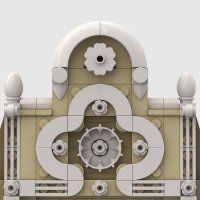 Hello everyone, it's finally time to reveal my latest modular building to you! This building is inspired by the leaning, half-timbered houses you can still find in the old, medieval town centres of many cities across central Europe. Being from the town of Esslingen in southern Germany, I've loved these old buildings since I was a young kid, and am in the very lucky position to now actually live in one of them. The building was inspired by buildings from around my hometown aswell as buildings in other cities, but it is not modeled after a specific building. Instead; I tried to capture the main defining features of this kind of building - namely jettying of the upper floors, a steep, gabled roof, a big window beneath the gable which was used to haul in goods (the uppermost floors were used for storage) and a stone-built ground-floor. The somewhat rich facade decorations are a figment of my imagination, inspired by buildings built or renovated much later. Some stats: Piece count: ~3750 Height: 35cm Features an asian restaurant, a veterinarian and two apartments Design first started in July 2017, but then I paused for almost three months. After another pause during much of November and December, design was finished at the start of February 2018. And the best thing: I put a three storey version of it on Lego Ideas: Please vote for it if you like it! https://ideas.lego.com/projects/033f7603-82f3-4447-8a4c-64bc92e7ed1f But enough talk, let's get on to the pictures! The asian restaurant is nicely decorated with dragon murals, an old Samurai sword, themed images on the smoked-glass windows, and old disks inscribed with sacred inscriptions...or so. The couple enjoys a nice evening here, accompanied by a good wine. The kitchen is a little bit cramped, retrofitted into an old cellar. Still, enough room to cook delicious meals! On warmer days, the beautiful, shaded outside seating area is a nice way to escape from the stress of modern times. The first floor houses the veterinarian's office. First thing up the stairs is the reception counter. The house may be very old, but the furniture and IT equipment here is very modern! Who would've thought that the dog's skull looked like that under all that fur? The overhead cabinet contains everything that might be needed. The second floor houses the first of two apartments. There's a nice, old armchair with a beautiful old lamp, mainly used for reading. There's a disused room on this floor, unconnected to the apartment... luckily, the apartments occupant loves all living things, regardless of the number of their legs! Beneath the steep roof, there is yet another apartment. Deviating from classic modular fashion, the entire facade lifts off together with the roof! The young man living here loves to play the guitar. As usual, more pictures are available in the flickr album: https://www.flickr.com/photos/131278188@N08/albums/72157666886273808 And again: If you like my MOC; please support the accompanying project on Lego Ideas: https://ideas.lego.com/projects/033f7603-82f3-4447-8a4c-64bc92e7ed1f Hope you enjoyed this, Tobias
 -
Hi, this is my first post here, so enjoy it!! Excalibur 1 by ✠ Corvus Auriac MOCs ✠, en Flickr Excalibur 4 by ✠ Corvus Auriac MOCs ✠, en Flickr Excalibur 1 by ✠ Corvus Auriac MOCs ✠, en Flickr All the sword is metallic and there are precious stones in the guard. Around 580 pieces.
-
Hi guys! I'm planning on making a huge castle with my wife that'll be constructed on top of a table. Currently i have already designed a functional machicolation on top of my castle walls. Currently i'm trying to figure out a good gatehouse. I'll probably make two towers and have the gatehouse in between them. Any tips for a mechanism for a iron gate that'll go up and down? Behind that, i'll add two wooden doors. The castle will be in normal minfig scale. So it'll end up being quite large. I already made a sketch on LDD but the gatehouse was too tall. And the mechanism to lift the iron gate using chains needed a different mechanism so the crank would be behind the gatehouse instead of in the side. I need the crank to be built so it'll be unnoticeable. I'm trying to aim towards historical accuracy. I'll update this thread as our project goes. PS: The prototype of the wall is finished and i'll probably add pictures soon.
-
The Summer Joust is back for 2018! With 6 new categories and 17 prizes, there is something for everyone. Check out all the details in the dedicated flickr group.
-
So! This is my first MOC in Guilds of Historica as a Nocturnian and I hope to build many more GoH related builds! I hope my English is not too cringey, although I don't mind feedback on it. Argatz seeks the help of Hanrik the bone lord. Summoning was not one of Argatz's special talents. Yet, he wants to summon one day a one hundred and thousand troops to take over Nocturnus and eventually conquer the whole vast continent of Historica. Of course, this evil ambition was not shared with Hanrik, as we will soon read how he will lie to him for his own spiteful good. “So, you want to summon demons, yet you are inexperienced in doing so?” questioned Hanrik the bone lord with a curious cackling voice. “But for what purpose?” And Argatz answered as honestly as he can: “For keeping my house clean, my bone lord!” “Very well! You have to realize I don't teach my superior summoning skills to someone who might want to conquer me or this land.” said the bonelord without any suspicion in his voice. But his last words give Argatz an unsetteling feeling, as if he was caught on his dreadful lie. Hanrik the bone lord took his place before the black pedestal and began chanting before it in rhyme. “Oh, ghost of a thousand dreams, enter your portal of green beams. As I, the bone lord, command thee to come forward!” And there it was. The ghost arose from the glowing green stones of the black pedestal. “Huh? Where am I?” asked the ghost in a unintelligent mumbling manner. “I summoned thee!” answered Hanrik prideful. “You are standing in one of the many rooms of my castle! As a guest, of course!” “Oh, thanks... I was sleeping. Now, if you excuse me, I'd like to go back to sleep.” The tired ghost went through the window above the bone lord's head. The bright green glow of the stones fade away as well. Argatz scratched his chin as he was pondering what he should summon for this lesson. It did not took him that long and he stepped a bit to his left so he was standing exactly in front of the pedestal. “Now, remember!” said Hanrik with his cackling voice in high volume. “Just summon a ghost and nothing else!!” Argatz rolled with his eyes, which should tell anyone, especially the bone lord himself, as a warning for what is to come next: “Oh, in the land of the north, Where Mitgardia lies, come forth. I want you, you heinous troll, appear before me as a whole!!” And before Hanrik tries to cancel Argatz summon, after hearing the word 'troll', it was far too late. The aforementioned troll stands there on the glowing pedastal, squatting and grunted: “Gotta go dookee nookee!” And Argatz, who stands behind the troll, feels much regret.
-
I already had the concept of "little castles from different subthemes" last year, but I didn't have the time to build it. Not long ago, I realised that the Yellow Castle will be 40 years old in 2018. I've put the two things together, and created a Lego Ideas project to commemorate this anniversary of the Castle theme. The concept of this MOC is similar to the 4002016 set: recreate some of the iconic castles of the Lego Castle history in smaller size. I've chosen a castle set from each decade from the 1970s to the 2010s and created a little tower that resembles that set. It was built in LDD and rendered in Bluerender. It was the first time I tried Bluerender, and I'm quite satisfied with it, but the texturing of the missing minifig and shield decals was pretty time consuming. You can see more pictures here: https://www.flickr.com/photos/149157518@N03/albums/72157680073276641 If you like my MOC, please support it on Lego Ideas: https://ideas.lego.com/projects/171709
-
This MOC is a rebuild of the Ninja’s Hide-out set, 6045, from the Ninja theme of 1998. I’ve added some details and made the MOC more look like a cave. Original set: Picturs of my rebuilded version: 01_Ninjas_Hide-out by Mathijs Bongers, on Flickr 02_Ninjas_Hide-out by Mathijs Bongers, on Flickr I’ve added the same playability of the original set, a working trap. 06_Trap by Mathijs Bongers, on Flickr I’ve redesigned the hangglider. 05_Hangglider by Mathijs Bongers, on Flickr More pictures at Flickr: https://www.flickr.com/photos/mathijslegofan/albums/72157679041850800 Hope you like it :)