Jump to content

2GodBDGlory

Eurobricks Dukes
  • Posts

    2,670
  • Joined

  • Last visited

Everything posted by 2GodBDGlory

  1. Yep, that's an efficient way to make use of that deal!
  2. That's not a bad idea at all! For more information:
  3. Yeah, I guess it depends how continuously he wants it running, but if he's hoping to use wall power, you're probably right to assume that it'll be pretty continuous, so it might not be a good idea to use such an expensive, potentially fragile, motor anyways. Sariel often used 71427 motors in applications where he wanted to keep sound down, so you could try them, but it looks like it would require rebuilding your base to fit it. M-motors are the obvious choice, but they're not the quietest, so I guess it depends how important that is to you. Running at lower voltage could help with that, though
  4. Perhaps an old Lego micromotor could work well here? You probably don't need something that small, but it has the low speed/low torque/small size characteristics you're looking for
  5. Yeah, the gear's reasonable, just not the gearbox parts. Do you remember how long it took for those 2018 parts to drop in price? I remember buying some when they were new, but just buying the minimum I wanted because they were expensive. I think I picked up more later when I saw them at cheaper prices.
  6. Yeah, according to that review the winches are disconnected using driving rings, so they would be free-falling.
  7. Yeah, it definitely is helpful to have PAB, which is why even if the prices are high I can't be too cranky I know, it's really strange! According to the Bricklink price guide (at least when I checked yesterday), six Yamaha's had been parted out, and all the gearbox parts had been sold. On a set that's been out for months, why so few? I really don't get it
  8. Yeah, I'm kind of annoyed by that! $5 CAD for one driving ring? I'm looking at about $60 just to buy 14 gearbox pieces, which compares rather (really) poorly to what I could get in a set of that price. Lego is supposed to inspire creativity, but I guess in my case they're just inspiring me to creative ways to avoid paying prices like that! I had figured buying those Yamaha parts would be a no-brainer, but I'm definitely having to think harder about it now. Anyways, I don't want to complain too much, since I'm at least thankful that Lego offers parts individually like that--they don't have any obligation to provide that service!
  9. Yes! This is the day I've been waiting for! [EDIT] Ouch they're expensive!
  10. Wow, it's amazing you managed to fit that much functionality into such a small, detailed body! Too bad there's no boom extension, but I can't imagine how you would add that without making it a very different model--I guess it would have to be much larger to fit an extra control channel plus the extension itself, so it's perfectly reasonable to exclude it. Again, I'm very impressed by the Technic functionality you got into such a tiny model, without making it ugly!
  11. Welcome to Eurobricks! I really like the idea for that sequential bed operation, but it's hard to know how it'll work in practice. I'm pretty sure that at minimum you're going to have issues with the worm gear interfering with the LBG connector at the end of the axle next to it, though you can probably redesign it to avoid that problem relatively easily. Is the idea with that long axle next to it with bushes on it to have the worm gear engage with the bushes? I also think it might be quite a challenge to prevent the force of that shock absorber from making the worm gear skip over whatever it's engaged with (I'm not sure if it's the 8T gear on the bed or that axle, or both)--you might want to look into a more robust way of bracing the worm gear, or a weaker shock absorber maybe.
  12. I've made a fair bit of progress since last time! Mainly I've just built the main bodywork, which is simple, but I think makes effective use of my available white parts. (The LBG 3x11 panels on the bed and the DBG one on the roof will be replaced by white ones that are currently in my Geo Tracker MOC). It's got some LED lights, a roof rack, seats, and a bed area in the rear. I've also got the rechargeable PF battery installed along with two PF IR receivers. The only functionality added this time is an I-3 piston engine mounted just behind the cab and driven by the XL motor for drive (It was challenging to route drive to it, but I made it work!), and torsion-bar suspension added to the tracks. Next I'll have to work on the front blade and the crane arm!
  13. Thanks! Yeah, those wheel covers are exact copies of the Ford GT ones (Just exported directly from Stud.io Part Designer). I do like those little Suzuki off-roaders a lot, so it'll be nice to see your Jimny! Yeah, I was pretty pleased with the rear springs! I actually did a much more minimal interior than I typically do, after noticing that the main models I was inspired by (stuff by RM8 and Madoca) kept it a lot simpler, and I think it was the right call.
  14. That is a shame! He's been my go-to for video reviews for a long time, because I appreciate the orderly layout where I can quickly find the information I'm looking for, and the subtitles that don't require me to have audio on.
  15. Just looked at that now. That is a cool design! I remember seeing someone use it in a bulldozer(?) MOC one time using turntables, and I thought it was very interesting. It's definitely not common in Lego, though!
  16. That does look like a lot of fun! I really am starting to like builds at that scale--those small wheel covers are kind of a game changer in allowing good looks at that scale!
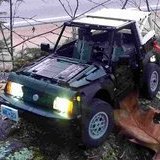
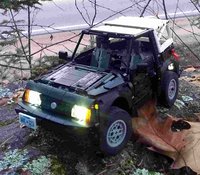
  17. Well, I've always thought there should be some unwritten rule among Technic builders that we would always build models of our real-life cars. However, it seems that this laudable piece of mental legislation has never been widely adopted. In an attempt to reverse this trend, I am pleased to present a Technic MOC of my real-life car, a 1995 Geo Tracker! So, for some context on the real-world car: In Canada, this car was sold under a dizzying number of nameplates, with Geo Tracker and Suzuki Sidekick being the most common, but Chevrolet Tracker, GMC Tracker, Asuna Sunrunner, and Pontiac Sunrunner were also used. Much of the world received it as the Suzuki Vitara, a name that didn't come to North America until the second generation. As a fun fact, the legendary Technic builder @Sheepo mentions on his blog that he does/did own a 1992 Suzuki Vitara, which would be essentially the same as this! Anyways, the real car (in the North American market) came with a 1.6L 4-cylinder engine, 3/4 speed automatic transmissions and 5 speed manuals, body-on-frame design, MacPherson strut front suspension, a coil-sprung 3-link rear axle, a 2H/4H/4L transfer case, and typically a removable canvas roof (on the 2-door models). Mine's a 2-door convertible, 16-valve, 4x4, 5-speed model, which is to me the most desirable configuration--I was very pleased to find it for sale near me at a reasonable price, because these things have almost rusted out of existence here in snowy/road salted Ontario, Canada! Anyways, on to the Technic model: The essential idea here was to build the kind of model that I could conceivably leave built indefinitely, which means a priority on appearance, reliability, and driveablity. I'm not planning on keeping it together, but I'm at least considering building it in Stud.io in order to have a record of it, so that should I ever gain enough adult responsibilities that I don't have time for regular building, I could rebuild it to leave it built. Aesthetics were a big focus for me in this model, and I'm very pleased with what I came up with! Perhaps unsurprisingly, I found that I actually enjoyed building bodywork when I took the time to do it well--inferior, rushed, work simply doesn't bring the same satisfaction. Anyways, I'm sure it's not up to the level of what some builders could do, but I'm prepared to say that this is my best-looking model ever! Also, note the 3D-printed wheel covers. I really wanted to use some kind of panel part for this, and the rear ones from the Ford GT fit nicely, but are only available in Dark Blue, so I printed a set in black, which I think really helped the appearance of the model. A little side-project that got added to it was the custom license plates. When I'm on the road, I always enjoy looking for license plates from different locations, taking advantage of the way that Canadian and American provinces/territories/states create creative, distinctive plate designs, in a way that I don't think is really replicated anywhere else in the world. As an offshoot of this, I decided to try custom 3D-printing license plates from a few different places in a 2x4 tile format, with the design being offset and printed in a different color. The three plates I chose to make were Ontario, the province I'm from, and the states of Oregon and Colorado, which I think have the most attractive designs out there: (There's no significance to the numbers and letters--these were simply what was on the cleanest pictures I could find online for converting to SVG for 3D modeling) Functionality includes: 4WD with two PF L-motors Steering with a PF Servo motor 2-speed transmission with PF M-motor and moving cabin lever Front independent double-wishbone suspension Rear three-link live axle LED headlights/taillights Opening doors, hood, and tailgate Removable roof Most of the functionality was relatively standard, though there were a few noteworthy techniques used. 4WD: The drive was pretty normal, with two PF L-motors running the gearbox at a 20:24 ratio (with 12T idlers in between), and then running the two axles at 1:1 without differentials, with 12T bevel gears in the front and knob wheels in the rear. The front gearing was rather weak, as I anticipated, but it was necessary to keep my desired suspension design in the front, and it didn't prove crippling to the model. There were also metal U-joints going to the rear axle, which could maybe have been avoided, but when I found plastic ones breaking and had metal ones on hand, it was a very simple fix to just stick them in. Steering: Nothing interesting here, just a Servo, a couple 16T gears, a rack, and some links. Transmission: I was quite pleased with how the transmission worked! It was a basic two-speed design with 1:1 and 1:3 ratios, the latter of which was using a cut-down (fake) 24T differential because I haven't been able to get my hands on the official 24T clutch gear from the Yamaha yet. Shifting was done by a PF M-motor which ran a small linear actuator, which rotated a lever with a "toilet-paper" panel on it, which engaged with the driving ring. It was a very robust system, and fit the space well! The linear actuator ensured that I had zero problems with it jumping out of gear. Suspension: The front suspension uses one of the new CV joint shafts from the Ford GT to create what I believe is the skinniest odd-width, fixed differential, three-pin hub-using, independent suspension possible, and one that is notably skinnier than anything possible before the Ford GT's release: It's also using disassembled shock absorbers to provide long travel in a small space: The rear suspension was a three-link design, and also had unusual shock absorbers, in this case made from towball pins, bars, and springs from Lego shocks: Both suspensions were quite responsive, with less friction than normal shocks create. The rear axle did have some rubbing on the plugs on the battery mounted behind it, which was unfortunate but not too bad. Opening stuff: The hood, doors, and tailgate opened. The doors had latches built into their handles, and the tailgate could be latched by rotating the spare tire (which had some friction on the "handle" above the license plate to keep it from moving) Removable Roof: The roof could be removed in three pieces: one above the seats, one large piece above the cargo area (or rear seat, but I didn't build one), and one small strip that runs along the top of the tailgate. The aftermarket hardtops for the vehicle typically come in two pieces like this, but with the part I had on the tailgate as part of a hatch coming down from the roof. The factory soft tops, like mine has, come in one main piece, but with a zipper for the rear window, which then stays connected to the tailgate during everyday use, like the beam I have on the tailgate in this model. I wasn't happy with the segmented look of the white roof, because it doesn't match the way my soft top stretches over the structural beam behind the doors, though it is realistic compared to a hard top. For fun, I also built a black roof, which doesn't match my car, but does blend in with that structural beam better. Anyways, I was very pleased with this model! I think it looked really good, it had some interesting techniques, and its performance was quite satisfactory, with good speed in high gear and good torque in low gear, and off-road abilities mainly limited by its stock-size tires and lack of lift. You can see more pictures here: https://bricksafe.com/pages/2GodBDGlory/1995-geo-tracker I made a special effort to get pictures in scenic locations this time, which isn't too hard when you're living right on the edge of the wilderness of Northern Ontario!
  18. I'm fairly ignorant about how real-world track systems work--do you think the subtractor is actually more realistic? I would think that a typical system would be a single engine running a hydraulic pump, and then hydraulic motors running the tracks individually, which makes a two-motor system more realistic in that they'd imitate those hydraulic motors, but a subtractor system more realistic in that it'd simulate the single engine running the pump. Either way, this is more interesting, and allows for convenient control! As for making sure I get 90 degree rotations, I had thought about using PU electronics so I could program it, but while it seemed like it would have a good end result, I wasn't looking forward to the prospect of pairing a phone every time I wanted to testsomething in the build process! (I guess I could have used RemoteBlaBla for that, come to think of it). Because of that, I'm just going to be relying on precise control through a worm gear and watching the selector while controlling it to make sure I end up in the right gear.
  19. Very impressive looking! I like the adjustable suspension concept, and performance is quite impressive for the size! I'd also be interested in learning more about those custom wheel hubs you mention.
  20. I've got a lot of progress done on this model! The main frame is pretty much done functionally--I just need to add some suspension for the tracks and install a battery and IR receivers. After that I'll have to work on the crane arm and front blade and the bodywork. Anyways, I finished the gearbox, which is now a rather complex system. A PF M-motor first runs a direction-sensitive worm gear gearbox, so that when it drives clockwise it runs one output, and when it drives counterclockwise it runs a different output. These two outputs are two different distribution gearboxes, both of which are driven by a PF L-motor. First the L-motor runs through a normal 4-output distribution gearbox controlled by a wave selector. The four outputs of this gearbox include lifting and rotating the front blade (not implemented yet), and rotating the crane arm's turntable. The fourth of these outputs simply runs into the second distribution gearbox, the three-output unit built around the turntable that I showed in my first update. So in summary: The M-motor shifts the wave-selector gearbox when rotating forwards The M-motor shifts the turntable gearbox when rotating backwards The first three outputs of the wave-selector gearbox run functions normally The fourth output of the wave-selector gearbox runs into the turntable gearbox, which then controls three additional functions This makes for a total of six RC functions controlled through the gearboxes Also, the turntable gearbox is no longer shifted via the 4-bar linkage seen in the original video, but now by this eccentric mechanism: The other functionality is the driving and steering, which is done through a subtractor, with a PF XL motor being used for driving forwards and backwards, and a PF M motor being used for steering. Because this is a subtractor system, we've got different drive modes: 1. XL only, drive forwards 2. XL and M, drive forwards and steer 3. M only, steer on the spot It would probably perform better and be simpler with a basic two-motor drive system with one XL motor on each sprocket, but I've always wanted to build something with a subtractor, and I hardly ever build tracked vehicles, so this was a good opportunity to build one. I'm also using planetary hubs to drive the front sprockets, which provides a nice bit of torque. Anyways, I think things are going well, and the complicated gearbox has been made reasonably compact, so as long as it proves durable enough to run its outputs, I should be in good shape!
  21. Wow, that is very tiny! Nice work, it reminds me of the Mitsubishi Delicas you see around here sometimes, though of course that's a bigger van
×
×
  • Create New...