


janssnet
-
Posts
75 -
Joined
-
Last visited
Content Type
Profiles
Forums
Gallery
Everything posted by janssnet
-

wheel lock for RIM 55982
janssnet replied to janssnet's topic in LEGO Technic, Mindstorms, Model Team and Scale Modeling
That's great, thanks for sharing. That could indeed be the reason for this notch. Thanks. -
Hi there, While building a small rc car using a RIM 55982 (18 x 14) I needed a way to lock the wheels to be able to drive it with a motor. Almost started drilling holes ..... and then, after removing the tire, it turned out there is a little notch inside the wheel. Looks like it is a space for a tiny piece of plastic to slide in, to lock the axle to the wheel. Exactly what I'm looking for! Have I missed something? Is there a LEGO part that fits this notch and locks the wheel? Or should I make it myself. https://drive.google.com/file/d/1UgLxSAbwba1zWIg1YRPNkqPdqAq3pMu7/view?usp=sharing
-
Custom springs
janssnet replied to Zerobricks's topic in LEGO Technic, Mindstorms, Model Team and Scale Modeling
In case you're (still) looking for additional ideas regarding these custom springs. I found some additional springs on AliExpress that fit the LEGO standards perfectly. It enabled me to created a super-soft and a stiff absorption spring. Hope it is still of interest (after 9 years ;) ) -
I'm trying to build a waterproof LEGO (power-) boat using a 54779 Hull. Have already attached the hull to the deck using silicone but haven't found a way to build a hatch on top of the deck in order to: 1. Protect the electronics inside and 2. be able to easily remove the deck to switch the battery inside the boat on and off. Just covering the deck with base-plates is (unfortunately) not enough. Water is still finding a way inside. Putting plastic foil under the base-plates is a mess. The remaining option (so far) is to make a silicone mold which then works as a rubber strip between the deck and the baseplates to stop the water from going under the baseplates. Definitely not a method with guaranteed success. Anybody any tips? https://drive.google.com/file/d/168JsCBVT6ALASfuV-NYymiWoyGaMogaN/view?usp=sharing
-
Is this thread still open? Still interested in some ideas aol000xw?
-
Thanks Matt, appreciate your comments. I'm in doubt if I will do a next version: back to the old 3 stud-high wishbones for stronger steering and lower placement of motor and accu for better balance. If I do a next version, I will do a GPS measurement. Problem is though, that there is no space for the steering servo if the chassis base is lowered, unless the base is made wider (like normal RC cars). Any ideas? Additional problem, with a wider base, I can't use the LEGO hull any longer as a body :(( And I still like the LBOW idea .... a LEGO Boat On Wheels (the body is made of an 54779 LEGO hull).
-
Project is ready. If you're interested to see the results, please have a look at some of the pictures here. (Warning, contains modified and non-LEGO parts). https://www.flickr.com/photos/153697698@N03/albums/72157702072230814 Album also includes a short video of the car on an RC race-track. And guess what .... the weakest link turns out to be construction of the wishbone arm :( Thanks for warning Sariel! Steering axle did a fine job BTW. Speed test showed 84.5 km/h, without hardly any wear out on the axles. Thanks to the silicon spray. Will do a video soon.
-
Thank you Attika. I did the math and you guys are 100% right. When in neutral position, the driveshaft is 15.94mm under the upper wishbone. When suspension is active, putting the arms under (for instance) 10 degrees, the driveshaft is 15.70mm under the wishbone. 0.24mm difference :(( It's just that I don't like the wheels to toe-in when putting torque on differential. The longer the arms of the wishbone get, the more this seems to be the case. Do you have another solution for this? You may have seen my previous remark regarding the cross-block. You are 100% right. There is friction when the wishbones go up and down. Regarding the 'steering connectors'. I couldn't resist doing a short test. Please have a look . (Did add 2 extra bushes for extra safety). https://www.flickr.com/photos/153697698@N03/44893400601/in/album-72157695812709340/
-
Thanks for your remarks Sariel. I will surely have a serious look at the 'steering connectors'. Regarding the cross-block. I can assure that it works perfectly, no friction is introduced when suspension is active. The reason for this is, that the pivot points of the driveshaft are 100% equal to the pivot points of the 'wishbone' arms. Therefore the cross block continues to stay completely in parallel with the driveshaft. The drive-axle does move left and right through the cross block when suspending, but there is enough space left to do this (hence this cross block 32557 and not the regular cross block 42003). Hope this helps. Happy to show if there is wear-out on the axle after a serious test-drive.
-
Totally see your point and thanks for responding. I was in doubt myself while building, if this would hold. Turns out it does. Even at high speed. My (highly speculative) assumption: When driving, the wheel puts pressure on the steering arm, which then puts pressure on the connector holding the steering bar. Since the angle between the steering arm and the steering bar is not 180 degrees there is also a force pushing the connector 90 degrees backwards. The result is enough friction not to start sliding. Let's see if I can put a camera on this thing while doing a next test drive. May take a few weeks though. Hope you appreciate, if this construction holds, that it enables toe-in and toe-out and it protects parts when crashing.
-
Give it a try, you'll be surprised! I will post a video when the rest of the car is ready. For now, you may want to check this out, an earlier version using the same steering-bar.
-
Dear folks, Don't know if this forum is in need of 'yet another AWD front steering', but decided to post it anyway since it may have some interesting features to share: - Compact 5 stud high modular design - Strong, double suspension per arm - Embedded cross block, to prevent bending axles - Adjustable steering arms to enable toe-in and toe-out (and as a side effect, prevents damage when crashing) - Ready for (2.4 GHz RC) servo steering ;) I needed a flat front module to fit my chassis, but didn't want to use the 'old' 3 stud high Wheel Hub (50301). It simply has too much friction in the turns and breaks too easily. Furthermore I wanted to use the universal joint (61903) in stead of the cardan cup (92906). Since I'm putting significant torque on these joints, and it turns out the universal joint is much stronger. However, this does requires the wheel arms to pivot 1 stud wider than using the standard config. Using the 5 stud high 11949 front wheel bearing and bound to a maximum height, I needed a way to fit suspension within this height. Very happy with the result. Anyway, have a look if you're interested. Happy to hear if anything can be improved. https://www.flickr.com/photos/153697698@N03/sets/72157695812709340
-
No battery indicator, trial and error :)) There has been some swimming involved! Yeah, I know, I know ... However, having used a LEGO hull and having gone through the hassle of fitting everything into, what on the outside looks like, a LEGO boat, gave me some justification to claim this. Thanks for noticing. It is indeed an improved version. The previous one continued to lean to one side at higher speed as a result of torque roll. Hence the idea to try and build a version with counter-clockwise turning dual props. There was only limited space left in the hull, but it worked out well. With ultimately much more control, which then created the opportunity to put in a brushless motor for even more speed. The battery can resist some water, no explosions (so far). And the great thing is that the (even upside down), the boat turns out to be fairly waterproof.
-
Not for LEGO purists, contains modified LEGO parts. It has been a wonderful struggle, but it paid off: a super fast, relatively stable LEGO RC Boat, driven by a brushless elektromotor and two, counterclockwise turning propellors! No torque-roll anymore, almost no porposing (thanks to the trim tabs), direct steering and great fun! To get the balance right and to get the boat planning at higher speed was a challenge. But it works! The wet area can be reduced to a minimum, at high speed the boat is almost complete on top of the water (downside: hardly any control left :(( ). Based on a 54799 LEGO Hull with a few additions: - 3D printed stuffing tube to cater for an in-board, brushless motor (10 mm tube stuffed with LEGO parts to make it waterproof) - A gearbox to convert the motor output into two counterclockwise turning axles - A 2x2 3D printed LEGO brick to make the steering arm waterproof - And al the 2.4GHz RC parts: ESC, servo, battery pack, receiver Please have a look at the video and let me know your comments.
-
Hi folks, This is not for purists. Contains modified and non-LEGO parts. My urge to build a super fast LEGO RC Car often stopped at the stage where the body needed to be build. Seeing all the great designs on forums like this, it somewhat discouraged me building my own. Besides the fact that these bodies come with some weight and will not hold a crash a higher speeds, I had to come up with something else. As a result of an earlier project (building a fast LEGO boat) a had some damaged LEGO Hulls (54779). Since a car body works basically the same as boat hull (but 180 degrees rotated), I thought I'd give it a try. Have a look at the result in the YT video. It works fine. Gives strength to the car, the aerodynamics work well for good driving stability and it is not that ugly :) Called it The LBOW (Lego Boat On Wheels). Included standard RC components: ESC, brushless motor, 3s Lipo battery, digital steering servo and .... a Gyro. Resulted in a very fast RC Car. Theoretically this should be able to reach 100 km/h. Speed test will follow (need to find a good track first). For those trying to do similar things, I'd strongly recommend to add the Gyroscope to your car. It prevents the car from breaking out at higher speeds. Very useful.
-
The final version! Torque roll is under control, thanks to the trim tabs. Perfect planing and no porpoising at higher speed. No leakage, boat returns safe and dry. Resistance is minimised using an optimised version of the propellor steering. The LEGO components stay in perfect conditions, no wear-out. And this is all achieved using a brushed elektromotor. Imagine what happens when including a brushless motor ....
-
Hi folks, Just launched 2.0 of this RC LEGO boat. The result is far better than expected. Spectacular speed, stable steering. Great fun! Have a look at the youtube video. Main improvements compared to previous version: - Propellor steering instead of rudder steering (works surprisingly well) - Prop behind the boat (not under the boat) - Better stuffing tube (reduced angle of 10 degrees, less resistance, better torque)) - Adjustable trim tabs (to lower the bow and to compensatie torque roll) The main challenge that is left is to handle the torque roll. Have not yet reached full throttle since it results in starboard going into the water. Any suggestions?
-
With only a little effort you can create a far more efficient, LEGO compatible, propellor. Happy to explain in some detail if there is a need.
-
It's hard to tell if it warps. Should put a camera under water to be able to view what's happening. But the weight is reaching its max already. However, without under-water-shots it's half the fun. Will give it a try soon. Would love to have two motors and two props, but there is too limited space left in the hull and the weight is becoming an issue. Any ideas?
-
The propellor is a Grauphner standard prop : EAN 4013389487511 It turns out an M4 screw fits pretty well into a Cross Axle Extension (59443). This holds the prop and Extension together. Going backwards is not advised though :) The brushed elektromotor runs (unloaded) max. 20.000 RPM. During the first test (the video) the boat didn't reach full throttle yet. Wanted to get a feel for speed and steering-control first.
-
Hi folks, Most LEGO boats have out-board motors. Not very elegant, not very fast. I felt a strong urge to find out if in-board was possible. And, if the LEGO hulls could handle some speed. Although it did require a 3D-printed part (a so called stuffing tube), it worked out well. Built in some 2.4GHz RC components to make sure the boat could be controlled from a distance. And included a modest brushed elektromotor. Please have a look at the result hereunder. Leave a comment if you wish to see more details. Happy to share. Currently working on a optimized version: The prop behind the boat, not under the boat. Less resistance, more speed, more control.
-
For some time I'm working on a 2.4GHz RC controlled LEGO car. Trying to create maximum speed with a LEGO-based car using standard RC-components (sorry, not for purists). To make this work, I introduced some rules. The car must be build using LEGO parts, except for the battery, motor, speed control, steering-servo, remote-control and receiver (and optionally a car-body). Fully agree with comments regarding LEGO not being able to match RC-performance. But, nevertheless, I enjoy pushing the limits to see what speed can be achieved using (mainly) LEGO. It has been a great journey. Lots interesting problems to solve: reducing wear-out, maximizing traction, optimize direct steering, increasing control with suspension, etc. Happy to share the results so far. Haven't done a proper speed check, but some rough calculations show a speed above 50+ km/h. Please check the video: LEGO RC Car video. LDD available on request. Open for comments, suggestions, improvements.
-
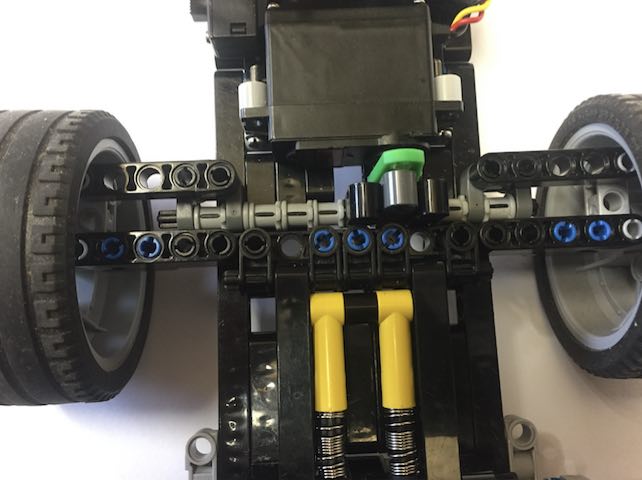
Hi there, just ran into your Le Mans Car on Youtube. Great stuff!! (Also) Posted a question regarding the ball bearing. If you can share any details, much appreciated (can't find it on Shapeways ....) Noticed the car steers slightly nervous. Had the same problem. Resolved it using attached mechanism. Just for inspiration. Please notice the modified bush (1/4), gives a tiny bit of toe-in, works well.
-
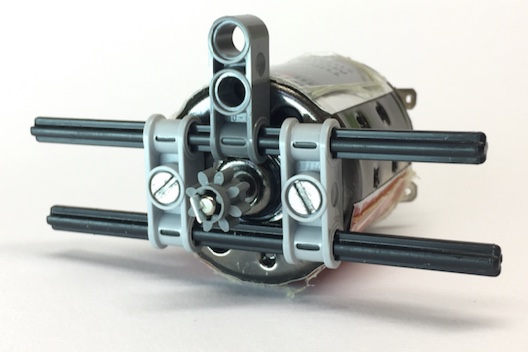
In case you're looking for more inspiration mounting a standard RC-motor to LEGO, please have a look at this video. I'm using some of these constructions in an attempt to build a fast Hybrid LEGO car (combining standard RC-parts with LEGO). Things look very promising. Lots of speed, hardly wear-out of LEGO parts, great project. Aiming for 50+ km/h. The RC-motor I'm using can be found here (21 turns, 20,000 RPM, 7.4V) https://www.conrad.nl/nl/absima-thrust-b-spec-brushed-elektromotor-voor-autos-20000-omwmin-aantal-windingen-turns-21-239458.html
-
Allow me to jump in. Being new to this forum, please guide me if this should be posted somewhere else. For some time I'm working on a 2.4GHz RC controlled LEGO car. Trying to create maximum speed with a LEGO-based car using standard RC-components. To make this work, I introduced some rules. The car must be build using LEGO parts, except for the battery, motor, speed control, steering-servo, remote-control and receiver (and optionally a car-body). Fully agree with previous comments regarding LEGO not being able to match RC-performance. But, nevertheless, I enjoy pushing the limits to see what speed can be achieved using (mainly) LEGO. It has been a great journey so far. Lots interesting problems to solve. I can't share any achievements yet. Version 1.2 is waiting for the weather to improve. There is a guy on Youtube reaching 57 km/h which is the first target I'm aiming for .... Anybody else interested in this challenge? Building the fastest possible RC controlled LEGO car. Happy to share high and lowlights and images soon.