

Samolot
-
Posts
249 -
Joined
-
Last visited
Content Type
Profiles
Forums
Gallery
Everything posted by Samolot
-
 Thanks for the positive feedback. I must say that the construction of this model gives me a lot of fun. A few more pictures of the cabin, I think I'll be able to make it tilted.
 -
Ok You're right. I moved the engine forward. Now the whole engine is inside the cab. By the way, it's a good question whether there should be a piston engine in such a futuristic vehicle. Due to the number of panels available, I decided to build a cabin in dark azurre color.
-
The original, however, is a fairly large model and nowadays it would probably have more features. So I decided to add some features to my model. Working steering wheel, suspension rear outriggers and fake engine,
-
Instruction LEGO MOC Tow Truck 8462 Reincarnation by Samolot77 | Rebrickable - Build with LEGO I'll try my hand at the competition again. A few years ago we had an identical competition on the Polish forum Lugpol. But I did not give advice in it to start. But that's when I caught my eye with the 8462 set. It came from a time when Lego technic models didn't really like it, but today I see a lot of potential in it. This futuristic vehicle is still controversial today, but I think the panels available today will give it a cool form. I'll try to add some features to it.
-
(MOC) Bigfoot
Samolot replied to Oliver 79's topic in LEGO Technic, Mindstorms, Model Team and Scale Modeling
Great model, compact and clean -
Zil 130 mmz Zetros Camper Arocs Flight Simulator BWSM 80 Zil 130 Terminator Ural 5920 Gaz 53 All videos at my Youtube Samolot Lego Creations https://www.youtube.com/channel/UCg80sdmEPxsax_Zq466dMlg
-
Thanks guys for the positive response.
-
7:10 14: 6 19: 4 4: 3 11: 2 20: 1
-
[MOC] Nissan skyline R34
Samolot replied to LoMaC's topic in LEGO Technic, Mindstorms, Model Team and Scale Modeling
Amazing. Ready to box -
This is standart lego rims. https://rebrickable.com/parts/22969/wheel-62-x-46-technic-racing-large/
-
The movie was made on Blackmagic DaVinci resolve 17 program.
-
Front and rear https://rebrickable.com/parts/48912c01/technic-shock-absorber-115l-complete-assembly/ middle https://rebrickable.com/parts/76320c01/technic-shock-absorber-10l-damped-normal-spring/
-
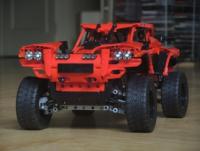
This time something completely different. Let it not be that I build only Russian ironwork. This time, my own design, inspired by the American Crusher combat drone. When I saw it for the first time, I immediately liked the design of the suspension. Soon I started figuring out how to do it with Lego. The problem was that no Lego tires fit the scale, but luckily I had MilSpec at home which I used in my AJBAN. The construction of the suspension went quickly, the problems started during the tests. I dreamed that the vehicle was dynamic, but here the obstacles stood in the way: the weakness of Lego motors and the soft rubber compound from which the tires are made. The Crusher does not have a classic steering system, it changes direction by varying the speed on the wheels on both sides just like a tank. So you can imagine the friction the motors have to overcome to flip a model weighing more than 3 kg on 13 cm diameter tires. In the first variant, I developed a special gearbox for it, in fact, six synchronized gearboxes tied to six PF L engines. I naively thought that I would be able to get excellent off-road capabilities in one gear and dynamic flat driving in the other. In practice, the speeds in both gears, despite the large difference in gear ratios, hardly differed and the complex gear shifting system could not be synchronized. So I simplified the design and used more powerful PF XL motors, I also reduced the gear ratio and used planetary hubs. It was a bit better, but only on a suitable surface, such as fine gravel or pebbles. On the asphalt, the rubbers put up a huge resistance and on the slippery surface, the wheels spun in place. The use of Xerion tires helped, and in this variant, I adapted the chassis to my Zil Peacemaker. However, the use of these tires changed the proportions of the model completely and was not suitable for the Crusher. It was necessary to further work and to use rollers limiting the work of the wheels to the sides, stiffening the frame of the vehicle and making it slimmer, and using three Buwizzes, one for each pair of wheels, to drive. 6x PF XL and 3x Buwizz and planetary hubs are a satanic combination and give the model incredible power in the field like a beast, but it maneuvers well only on loose surfaces or on the wooden floor. I was a bit ashamed that such a large model has so few functions, so at some stage, I developed a gripper on a boom that could pick up "valuable remains, e.g. radioactive" from the battlefield, load them into a special chamber, and then by opening the hatch in the chassis to drop the load for underground silos. But the whole thing was weighty and the smooth maneuvering of the vehicle had to be forgotten, so I dismantled it. Interestingly enough, for the first time, I was able to use the 19086 element in a meaningful way. On the visual side, I wanted to stick to the original for a while, but quickly found it simply ugly and decided to give it a bit more aggressive form. I am already working on another version of this vehicle, this time with a more classic steering system. The movie is not mine, for the first time, made by a friend from DR Ebike, I am curious how you like it. Gallery https://bricksafe.com/pages/samolot/crusher https://www.facebook.com/PawelStefaniukSAMOLOT
-
I'm afraid I know the result of this match. The Zi 4906 doesn't stand a chance. For a simple reason. It uses 2x Control + XL and the Ural 5920 uses the good old PF XL x2 and is powered by 2x Buwizz. But I'm working on another 6x6 Zil on the PF XL and this one will be able to beat URAL.
-
Thanks. video is mostly done in speed x1 so it goes that fast. Original Ural 5920 max speed is less then 30 kmph
-
In the 1960s, Russians intensively searched for oil in large areas of northern Siberia. They begin to see the urgent need to have a vehicle capable of running through snow and mud. That can transport equipment and materials needed to extract and transmit oil. To accelerate the implementation of the vehicle, they decide to use the experience of foreign constructors. To this end, they send a special delegation to Canada which buys a batch of Bruce Nodwell machines. On their basis, in 1972, the NOMI 0157 vehicle with the Urala 375 cabin is created. Research and launching the production, however, takes years. It was only in 1984 that the small-series production of the first 150 machines was started. Production takes only 5 years, but the original plans for 8,000 units are not met. Several hundred copies are made and with the collapse of the USSR, production stops. Only in 2003, production of the modernized version marked ST-1 was resumed. I built the model relatively quickly, in about two weeks. Then, of course, it took a couple of weeks to collect a few missing bricks and footage, but finally, it is. I had been dreaming about it for several years, but I had no idea for wide tracks until finally, the day came when I had the idea to connect them with this funny 4x1 plate with two studs. Of course, I was almost sure that they would fall apart and nothing will come of it, but the patent works surprisingly and it's pretty good. The track carriages went quite fast, the torsion bar suspension, the new differentials, nothing too complicated. I knew that I had to put the motors within the tracks because the LEGO cardans would not manage to transfer the drive from the frame as it is in the original. But I wanted to reproduce the original drive system, so it happened that it works in a way the other way around. Two PF XLs drive the tracks and from the diffs, the drive goes to the shafts leading to the central differential and then to the fake V8 engine under the hood. The most difficult part in the construction was achieving a sufficiently stiff frame. The model is 80 cm long and almost 4 kg weight, most of the weight falls on the track carriages. The Pf XL wheels and the mass of the links did their job. I have already built rigid frames on 3 x11 panels, but recently new 7x11 frames are available that fit perfectly with them. This structure can also be very easily stiffened depending on the needs by adding eleven liftarms. [/URL] The vehicle's functions are therefore limited to a spinning steering wheel and winch. Two buwizzas are used for power supply, but they are built in the cab under the seats so they can be replaced with two PF batteries and the vehicle also runs a little slower. Interesting movie about URAL 5920 tutaj [/youtube] Gallery https://bricksafe.com/pages/samolot/ural-5920
-
Thanks. I am thinking about instruction.
-
This is my first approach to the B model. So a tracked dumper inspired by Komatsu models. The model is quite simple. The drive consists of two control + XL engines, for lifting the tipper and turning the body, two control + L engines, all connected to one hub. He drives efficiently and is able to throw off quite a lot of weight. I had problems with the turntable drive with the taper z12 at an angle, this setting requires really good reinforcement. In the end, I made two versions of the cabin, but I was not satisfied with either.
-
I built one Zetros a few years ago, so I'm curious how they will make a cabin. Will it be similar?
-
In Poland, we have the same color scheme for sea rescue helicopters.
-
47: 10 35: 6 51: 4 29: 3 24: 2 57: 1
-
Thanks for feedback. And some more pictures
-
Very nice model. I once built similar vehicles but on a larger scale.
-
Ził 4906 Blue Bird Since the Soviet Union began intensive flights into orbit using Soyuz-type ships, there has been a need to develop a special system for recovering landers. Capsules with astronauts often fell in hard to reach areas of the Soviets. To this end, the amphibious PEU-1 was developed in the 1960s into a special vehicle, but it had many shortcomings, and the need for a more perfect design soon emerged. In the early 70s, the construction of a suitable machine began in the Moscow Zil plant (factory of Lichachiv), thus Zil 4906 was created. The new vehicle was intended to function as part of the Blue Bird PEK 409 system, which included two amphibious vehicles, one equipped with a crane to take the lander and the other with a cabin for transporting astronauts. The idea was that the vehicles should not be too big and they could be transported by air to the vicinity of the action. The vehicles were built on a lightweight aluminum frame and the fuselage was made of fiberglass, a standard 150 HP v8 engine with Zil 130 was used for the drive. The whole was made in a three-axle system, the first and third of which were steered and the drive was transferred to all 6 wheels. The suspension was independent with a small stroke based on torsion bars. In addition, at the rear there were two propellers and rudders providing water-based propulsion. The drive train was very interesting. Behind the engine was a 5-speed gearbox, then a special gearbox that transferred power to the shafts located on the sides of the fuselage driving individual wheels and the propeller shaft. When building my model, I set myself the goal of not only looking and working similar to the original but above all mapping this complicated drive and suspension system. That is why the drive from two Control plus XL engines placed under the V-8 is transferred to the gearbox which drives two shafts on the sides of the hull. These shafts drive all wheels, suspension is independent on torsion bars. The model is equipped with a remote-controlled differential lock. So in difficult terrain, you can fasten the drive of the right and left side of the vehicle. An additional shaft drives the propellers. The steering system moves the first and third axles and rudders behind the bolts. The amphibia is equipped with a remotely started compressor with two pumps and a pressure tank for moving four actuators that raise and extend the crane's arms. The crane roller can also be operated remotely. Pneumatics and outriggers are manually operated. The whole model has a chassis and body that can be easily separated by pulling out the safety axles, pneumatic hose and plug with powered up cubes at the back In total, it has 6 engines 2x C + XL for drive 1x C + L control 1x C + L differential lock 1x C + L Compressor 1x WEDO Medium crane winder it is powered by one C + hub located at the front and One Powered UP at the rear of the vehicle The model weighs about 3 Kg and is 72 cm long, it is on a scale of 1: 12.5 and is quite nicely planned with one exception. Due to the size of the technic panels, I had to slightly increase the wheelbase from 18.5 cm to 19.5 cm, but fortunately, this compromise did not damage the proportions of the model. As for the white strip between navy blue and blue, it appeared at different heights in the original vehicles, so I accepted it. I hope you like it. gallery https://bricksafe.com/pages/samolot/zil-4906