

gyenesvi
-
Posts
2,396 -
Joined
-
Last visited
Content Type
Profiles
Forums
Gallery
Everything posted by gyenesvi
-
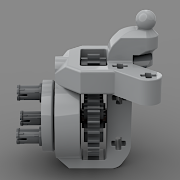 This would be a useful part as well, both for connecting adjacent layers of beams, and for half stud offsetting in two directions. For sure it's doable, because the 24T gear has this pattern in the middle, but that's too big for such purposes.
 -
I think in this case, it would be simpler to use the motors as structural elements, and connect the tracks to their sides (start with a 2L beam on the motors to create mounting points in the middle). Then cross brace the whole structure above/below. Flip flop beams can be helpful for that indeed. It's actually ridiculous how hard it is to build such simple structures out of technic parts. The system is clearly missing many connector types.
-
Transport truck or transporter truck sounds better to me. Otherwise it sounds like you plan to use a crane to transport a truck.
-
42172 - McLaren P1
gyenesvi replied to Ngoc Nguyen's topic in LEGO Technic, Mindstorms, Model Team and Scale Modeling
I think in the world of off-roaders, there would be many possibilities for building interesting stuff, like suspensions. For example leaf springs, proper live axles, portals, linkage based steering, etc. Pity that Technic focuses on new models instead of classic cars that had those types of suspensions. Even in case of regular/sports cars, suspension geometries could be improved (like MacPherson). Also, don't forget that we are probably getting a new gearbox construction with this supercar, at least. And hopefully the G-wagon will focus on diff locks. Not that new conceptually, I know, but maybe better constructions.. -
Interesting findings about the Mk servo. I have always wondered what is so hard about copying the PF servo when everything else is easily copied. So you suggest that the core problem could be the lack of fixed positions and the fluttering of the servo? Maybe the use of a different signal is intentional to dumb the servo down to 3 positions instead of letting it flutter which would be even worse? By seeing you experiment with Arduino, I guess you might be okay with RC electronics and 3rd party components? Have you heard of GeekServos? Small, fast, precise, cheap. Only catch is that it requires a proper RC transmitter/receiver to control, and an ESC to control the drive motor. Plus a LiPo battery.. But those can be small, so might fit your scale needs..
-
42172 - McLaren P1
gyenesvi replied to Ngoc Nguyen's topic in LEGO Technic, Mindstorms, Model Team and Scale Modeling
I wonder if there's any actual new info behind this or is it just based on the GWP that we saw already? The brick clicker video seems to be showing only that as well. -
True, I have realized that after I made the sketch. The studs just go under the protruding cable holder. I see. However, I think it would not be a problem if the switch sticks out a bit upwards, but two studs sounds too big indeed. Maybe sticking out 1 or 2 plates is okay, and would help accessibility among the cables actually. But in general I think this problem should be fairly easy to solve, RC models seem to have switches as well, no? And Buwizz / other batteries solve it too, though they may not need to handle so much current? Thanks, interesting! Although I guess we can't just take it out of the casing and reuse it somehow. It has too many pins in the way (for the lights I guess). What do you mean handmade? Do you mean custom made by some PCB manufacturer? I guess these are also manufactured, not hand soldered :)
-
In what timeframe did that happen? I have a model built now with an ESC that has an on-off switch, and it's constantly plugged into the battery for a couple weeks now, and it's working fine, not even draining the battery that much. But I think it strongly depends on the ESC construction, if I remember well mine specifically states somewhere that it does not really drain the battery when off. I just had an idea. I think the area for the reversible PF port could be reduced to 2x3 studs instead of 2x4. How about a port like this? The plug would attach to it the other way around, like this, leaving space for the cable in both directions: That could leave a 1x4 surface on a total 4x4 surface, used for the built in cables and a switch :) (that could break the circuit) It would also need less wire connection points than your current one (2 (middle) pins instead of 4). That's what I thought too, but I could not find such a product (only an old one not in production). Do you have any links to such? Not sure that that's too useful. It does not reduce wiring, only it would provide attachment points, but that can be solved easily / flexibly with some plasticine tacks. I agree. I guess the main variation is in the details (number and arrangement of ports, switches, LEDs).
-
Sounds good! Can you show that ESC and the PCB? Those would be interesting components. Do you know if a PCB also exists for servo pins with some casing like the one you use in your first RCDeck? I'd be interested in experimenting with my own layout too.. I get that, and I think there's nothing wrong with that. This looks like the most space efficient thing. You can always add parts with pinholes at the bottom if you need. I see, true that it would be better if it was breaking the circuit too.. But many ESCs include one, so do you say those are not the best to use? Yeah, that's a hard one, maybe on the side. An alternative would be adding one more stud of surface area in one direction, and also routing the cables upwards to make it possible to build it around on all sides. Because this way it effectively requires 5 studs of space in one direction due to the cables.
-
Nice looking model, and I like the cleanliness and simplicity of the electronics layout / drivetrain! Only thing that messes it up a bit is that half stud offsetting required at the front axle.. Have you checked the model file he provided?
-
[MOC] Monster Truck MK4
gyenesvi replied to paave's topic in LEGO Technic, Mindstorms, Model Team and Scale Modeling
Cool little model, clean and simple construction, I like the chassis and the body as well, nice styling even without stickers. -
Exactly, hence one of the most useful possible products to start with :) I'd get one for sure! So is this just a mock case, or is there already an ESC in there? Things that seem missing for me is the on-off button, and a status LED. I know you could just disconnect the battery, but that's cumbersome. And the next logical step could be including a receiver and 4 servo ports in there too :) That would be my ideal product. But that may be rushing too much ahead..
-
No, not really, they feel the same, though I haven't driven the PF version that much. Not that much different, and even though RB has the part list for the PU version, the PF instructions have the correct part list in the end for that version only, so you can look it up.
-
Maybe the platform is meant to be motorized to make the logo spin? Hand cranking seems like a pointless thing, no? About the color, if there are new parts in bright light orange in the GWP then we can expect the actual car to have that color as well. And I think the 3L pin with axle-hole end seems like bright light orange (if not pearl gold) and that would be new, right? I'd actually welcome more pieces in that color as it is a nice one but the current lineup of parts is not really useful.
-
Initiated by a fan, a PF version has been made for this MOC. The drive motors are easy to swap, and the servo for steering can also be replaced relatively easily by lowering the steering linkage at the front (the servo just passes under the hood, with a little hole necessary near the windshield to allow it to open). The gearbox motor was more problematic; in the PF version it is controlled by an M motor with clutch protection. Still, the switching sounds a bit more violent (clutch cracking) than it would ideally be, but it works fine (built and tested). Furthermore, the PF version is powered by a Buwizz 2.0, but alternative hubs could also be used. I have adapted the instructions for the PF version as well, can be downloaded free.
-
I actually noticed that too on my model, and I was getting worried if my servo is getting worn out or something. Another strange thing I noticed today, is that in Ludicrous mode, the Buwizz 2 was unable to move a PF M motor under small load (gearbox) at 50% power, but is easily able to move it in Fast / Normal mode (at 50% power). At the same time, I heard a similar squeaking sound, as if it was struggling. That must be some glitch in PWM control I guess, I've read that that can produce motor sounds in various pitches.
-
Yes, in general it should be legal, only thing that can prevent you as others said is if a part that has axle hole longer than 1 unit, than those may have a stopper in the middle.
-
Thanks a lot guys, glad you like it! I'm really happy that people are pleased with the looks, truth is that often it is easier to build something polished on a smaller scale, as it's easier to get good curves and less holes. Also glad that people appreciate the technical side if it as well :) Thank you, yeah, the new 24T clutch gear is really useful in this respect, and since the model has good power to weight ratio, the speed difference really comes out. Thanks, that kind of became my specialty, and there's a lot more to do in this area :) Hope TLG will pick up some bits sooner or later.. Unfortunately, I share most of your frustration with Buwizz. Maybe it's not so bad in a small model like this, as there are no power outage issues or short battery life in this case, as the motors are smaller. But year, steering needs a lot of fiddling to get smooth (while Control+ or Pybricks is quite okay out of the box), and for the gearbox, I haven't experimented too much yet, this was my first model with that, but I quickly gave up and resorted to just using it as a fixed 90 degree stepper motor as I recall, that works okay for my use case (that's why in the video you can see that I can also set it to neutral). Even though I often mix up the buttons and try to rotate it in the wrong direction.. so I should give this more testing. It's a frictionless axle-pin in the recently released pearl dark gray color. That's why the instructions say the color is important, because this color (probably due to different material / surface / tolerances) holds the bar really strong according to my tests with many pin and bar combinations. By the way, the regular blue axle-pin with friction also holds the bar strong, that combo is used for the lower suspension links.
-
I understand, thanks!
-
Huh, this took me to a deep rabbit hole.. So now that you mention this detail, I remember seeing this as a drawback of this construction before, and I think the 3rd link (or any method except using joints) cannot completely solve it. Without joints, I think it's impossible to completely avoid situations where one of the shafts enters the axle not completely perpendicular. This is because as the axle articulates (tilts sideways), it cannot articulate around all the 3 shafts as axes at the same time, only around one shaft (mostly the middle shaft). So the side shafts will necessarily have some contact with the frame. I understand that the third link helps to reduce the problem; without the third link, the axle can move in two ways that would result in some of the shafts contacting the frame: the whole axle could rotate forwards / backwards as the motors spin the wheels, and the axle can move sideways. In general, a third link can prevent both, but only because it has a single degree of freedom (limited sideways, kind of a simulation of a triangulated 4-link in lego form). However, this third link solution also has a problem in your case; depending on the relative arrangement of the links, as the axle moves up/down, its caster either stays constant or may change differently as the angle of the driveshafts would require. It could in principle change together with the driveshafts if the 3 links would rotate around the same axis at the chassis end, but that's not the case in your build. But having a third link may still be better in your case than not having it, I think in that case the wear at the contact points without 3rd link came from rotational motion and maybe also from sideways motion. However, if the range of articulation was bigger (longer springs) then it would not work so well, as the angle discrepancy of the driveshafts would necessarily have to become more. The reason I said it's not necessary to have the 3rd link is because there are other ways to prevent sideways / rotational motion, without loosing ground clearance and without the problem I detailed above. The sideways motion of the axle can simply be avoided using a panhard rod (cross link). But, the really interesting part is avoiding the rotational motion of the whole axle. My first axle I built without double CV joints in an older model was similar to yours in one aspect; I put the springs to the same position in the middle (longitudinally), right above the driveshaft to the wheel and I also got some lego axles that did not look good at the friction points, and in some high torque situations the driveshaft got torn apart :) Later, in another model, I learned that it is much better to put the springs behind the whole axle, for multiple reasons. First, they can be lowered, leaving more free space above the axle, and it also looks more realistic. Second, and most importantly, in lego form, it is enough to prevent the axle from rotating, so you don't need to use a third link for that. Btw, in my model I did not solve the problem this way back then, but rather by limiting the degrees of freedom of the link at the axle end, only allowing the axle to tilt, but not rotate forward/backward (and using a panhard rod). Since then I learned that that's actually a solution used in reality, even on front axles. So in the end, you do need a third link, a panhard rod, but that's easier as it's not in the way under/above the axle, but can be placed behind it and is more realistic. And all this can only provide a really solid solution that would work for high articulation angles as well when there is only one driveshaft, and it has to be in the middle (symmetric for axle tilt). In reality it's called torque tube suspension btw. As for the wheel hubs, the ones I linked are not rare or expensive, they are in production, used in many models. Can make things a bit more stable, especially if you run the lego axle all the way through them to the wheels.
-
Thanks all for the feedback, this little fellow is getting more positive vibes than I expected :) Thanks a lot! Yeah, indeed, one of the parts I miss the most. I haven't tried that, but in this case it might not matter much, because it is kind of overpowered already with two L motors. It rather spins the wheels under itself than gets stuck, and in that case the extra weight actually helps. Thanks a lot, agree that Lego should focus more on small RC models (and not like in the upcoming Porsche with not really reusable electronics). The small black panels at the base of the windshield are not my invention, I took that from Anton Kablash's design, exactly because they are spot on :) Indeed, it's like that. I have been experimenting with something in this scale for years, and now finally it came together. Thanks, sometimes, it's easier to get the right look in a smaller scale :) Enjoy, curious how many different variations people come up with!
-
It's an interesting concept for the rear axle / drivetrain. But the middle link one at the bottom looses ground clearance, and it's not really necessary to have a third link if the axle has positive caster and doesn't have CV joints at the axis end. Is there any reason why you don't use proper wheel hubs on the rear?
-
Sounds good! What does that mean? What would that do? Just to be able to have a center diff, or something more? That's huge, and that small motor rips with all that to carry! Serious power!
-
That's great to hear! Curious what you manage to bring out of it! Is the idea similar to what I proposed above? Oh, I see. Indeed, that seems a bit too powerful :) Could try with 2s LiPo only.. What scale / wheel size is that? About 80mm?
-
Hi Folks! Here's my latest build, this time an RC model on the scale of 56mm wheels, the smallest scale I have built so far. My goal with this build was to see whether I can build a 4x4 RC chassis with complete and realistic, properly articulating 4-link live axles and linkage based steering, while keeping the cab area free for a complete and relatively clean interior. As you guessed, it worked out, and in the end as a bonus, I managed to squeeze in a 3:1 ratio 2-speed RC gearbox as well. For the form factor, I choose a pickup, as those have a better fitting shape for this chassis. To show the result and how it performs on some challenging terrain, here's an action video: Features Powerful 4x4 drivetrain using 2x PU L motors Steering by PU L motor via linkage Powered by Buwizz 3 battery Realistic 5-link live axle setup both front and rear 2-speed RC gearbox with 3:1 ratio, operated by PU L motor Complete interior with seats, dashboard and a gearstick Openable doors, hood and tailgate Chassis design As usual, it all started out with the most complex part; the front axle. For a while, I have been experimenting with a small axle design with good ground clearance, without differential and just brick built wheel hubs held from the top. I tried to keep it slim, and finally, I came up with this solution, which uses a couple towballs on bars put inside axle-pins to achieve the required density. The blue axle-pin with friction holds the towball very well, but the tan one without friction does not. However, I discovered, that the new pearl dark grey frictionless axle-pin does hold the bar very well, and that's what made the steering linkage possible. The steering arms are also connected at the bottom by a 9L link. Another tricky part was the mounting of the springs low but stable enough so that it does not go way too high in the chassis, all while leaving space for the steering servo in the middle (the flatter PU L motor can just fit). Furthermore, the driveshaft enters at a variable angle, making the use of a second joint unnecessary. In front of the axle, there's mounting point for a Panhard rod as well. The rear axle was derived from the front one, simplifying it by fixing the wheel hubs. Given the two axles, I started designing the chassis with the fact that the position of the steering servo was given, just reaching up to the height of the springs, giving enough space for the axle to articulate. That meant that the drive motors needed to go on the floor if I wanted to keep the cabin space free. This setup has a disadvantage; the motors can be in the way for the mounting of the suspension links on the chassis end. Luckily, in this case the links connect very deep to the axles, so that meant enough space left for the motors in the middle. I went with my usual setup that leaves space in the middle between the two motors, and checked out whether a gearbox could fit. And the new shorter driving ring from the Yamaha set was just perfect for the job, it resulted in just the right amount of spacing. I had to make some significant down-gearing before the gearbox though to make it practically useful with a 3:1 gearing ratio, using the new 24T clutch gear, and to make the model strong in low gear and fast in high gear. Also, I needed to use the long CV joints to allow the driveshaft length to be uneven / vary, resulting from the angle. Here's the X-ray view of all the functional parts. Finally, the seat and the dashboard have just enough space to fit in, along with the Buwizz 3 unit in the back of the cab. I could even add a gearstick that actually moves with the gearbox, albeit tilting sideways. Bodywork The bodywork started with the idea of using the small fender parts (roughly matching the 56mm wheels) that are available in blue but with a print, so I had to remove all the print with an eraser, which took quite some time, but worked out fine in the end, the result is a nice clean blue fender (I also considered building it in orange, but some key panels were missing in orange), and I have added some brick built fender extensions on the back, and some shorter ones on the front as well, that still allows the wheel to steer and articulate without getting caught in it. Furthermore, I needed to select a real model that has a hood shape that's big enough to hide the front axle / servo. A pickup was ideal for that, so I started experimenting in that direction. Also, I have done a bit of search on Ford F150, and came across this nice model of Anton Kablash, using the same fenders in blue. I really liked the construction of the hood and the windshield, so I borrowed that, but designed the rest to my liking. Namely, I wanted to replicate the front grille in some simple way, for which I managed to use a combination of bricks and technic beams, and also cut out the Ford sticker from the Raptor set (just good size). Also, the headlights; it struck me that a rotated sideways transparent brick build could work out, and in the end I managed to squeeze it in, and add a simple bumper below it. Connecting the bumper to the fender was a bit tricky though :) Not perfect, but does the job. Another area I wanted to focus on were the doors; I wanted to make them openable and have a clean door line. The new small panels work nice here to prevent too much beam stacking. The brick built rear taillight idea is also taken from Anton's build, adopted to my needs. Finally, I could make the tailgate also openable, while still keeping things solid. The bed area is just deep enough to look like a bed, and I intended to integrate the L motor and the springs into it as much as possible. I had to leave some holes for the cable routing though, and I wasn't able to hide them even more, but they look a bit like some cargo :) The roof is fixed in a solid way by the center column and the B pillar, the model can be lifted by the roof. Here are some photos of the real life build as well. More pictures are available on my Bricksafe. Free building instructions are on my Rebrickable page. Let me know how you like it! Cheers, Viktor