

gyenesvi
-
Posts
2,396 -
Joined
-
Last visited
Content Type
Profiles
Forums
Gallery
Everything posted by gyenesvi
-
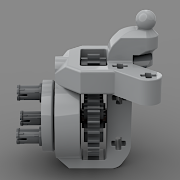 That's a neat one for the front suspension, though took me some time to figure out how it works :)
 -
That looks pretty agile on the video, nice work!
-
Thank @ZENE for the answers! I see, that's just a bit longer than 9 studs, so would be hard to work with, but sounds good that you are considering an upgrade! I understand it would be a bit weaker, but the idea is that for smaller models, that could still be by far enough. I guess the question was if it is possible to encapsulate a different ratio? Or how about double-stage reduction, like in the Lego motors? More reduction could be advantageous in two ways. The output would spin slower, so would be less of a problem for plastic parts, and the torque would become bigger, so the smaller motor could also be enough for more applications. For example, if I take a 3300 Kv motor, then it has 24420 RPM at 7.4V (2s LiPo), and 36630 RPM at 11.1V (3s LiPo). With double stage planetary reduction (1:16 for example), the output speeds would be 1526 and 2290 RMP respectively, which is roughly as fast or 50% faster than a Buggy motor's fast output. So even that speed would be very good for many applications, if it was in a small form factor. Sure, that's why I like the custom planetary reduction solution of Zene, because it solves that problem :) Yeah, I don't quite like that, not only because you'll need bearings everywhere, but also because you'll need a lot of space for all that reduction (and all that needs bearings/metal gears). I think the built-in planetary is the easy and space efficient way of avoiding the need for plastic gears/axle holes to handle high RPMs.
-
Exactly my point; the current motor seems like a bit of an overkill for many purposes, and the smallest possible one (2435, 3300 Kv) should also be enough, would spin slightly (10%) slower and would draw much less amps (50%) according to the below specs, while the whole motor could be at least one stud shorter. On the other hand, I think this is one of the best possible form factors for an RC motor to be used in Lego, because the radius is exactly 3 studs, it fits nicely to the system, it does not require extra housing, and it allows an axle to run right underneath or next to it. Together with the planetary reduction on it, it might be an ideal solution, maybe even without other metal parts. I'm thinking something like if a motor like this could be a replacement for 2 coupled buggy motors in a small form factor, that would be great. With some improvements, it could be doable I think: - the output could be slower (at least 2x slower, even then it would be about 2x faster than buggy motors), so bigger planetary reduction would be needed - better mounting points would be needed, like on an L motor, at least on the front (probably the back is not easily doable) - the total length should be at most 9 studs, but maybe 8 would be doable as well: the 2435 is 35mm long, that is 4.5 studs. The planetary reduction on a lego L motor is 1.5 studs, and the mounting points on the front is 1 stud long. In total that would be 7 studs, but maybe it needs one extra stud for firmly attaching the planetary/front part to the motor, that's how I got 8 studs. 9 studs would in principle allow for mounting points on the back, but the cabling may be in the way for that.. What do you think @ZENE?
-
BuWizz Motor [Video Test]
gyenesvi replied to Sariel's topic in LEGO Technic, Mindstorms, Model Team and Scale Modeling
That's the ratio between the fast and the slow outputs, as far as I know. But I meant the total down-gearing starting from the motor itself (until the fast output). -
BuWizz Motor [Video Test]
gyenesvi replied to Sariel's topic in LEGO Technic, Mindstorms, Model Team and Scale Modeling
Does anyone know what's the gearing ratio inside the Buwizz motor (from the motor to the fast output)? -
It would be easier to get feedback if we'd also get answers to our questions :) There was a question above about the availability and price of the motors alone that went unanswered. I'm curious too, as the form factor of the motor looks quite good, though the mounting points could use some improvements, something like on the Lego L motor. What are your thought on that? BTW, what's the total length of the motor? And one more thing: I see that you are using a 2445 motor in your product (meaning 24mm diameter, 45mm length), and the same motor also exists in a smaller 2435 variant. Would it be possible to use that motor as well? Could it be (somewhat) easily swapped out? A smaller but bit less powerful motor would also be more useful for my purposes.
-
Thanks for all the nice words and the frontpaging! And I have more ideas for trailing arm suspensions to come :)
-
Hi Folks! I'm back with another alternate build this time. I've had the Ford GT for a while, and had this idea quite soon, but could only get around to actually build it recently. As usual, I wanted to build something of an off-roader, as I'm more into them than sports cars. Also, I wanted to see if some alternative suspension is buildable from these parts. A buggy seemed a good material for that, as they usually have independent front and triangulated trailing arm rear suspension, something I rarely see in lego form. And the color scheme and fender parts made this set perfect for the Red Bull SMG buggy. Carlos Sainz used to race this buggy in the Dakar Rally. He just recently won the 2024 Dakar Rally at the age of 61 (with and Audi E-tron :D). So this can also be considered kind of a tribute to his older car :) Features: Bouncy, high travel suspension, double wishbone independent front, independent triangulated trailing arm rear Mid-rear mounted V6 fake engine driven from rear wheels HoG steering on the roof, easily detachable for display Doors openable upwards Here is a video to showcase it all: Some more details on the design. Chassis and suspension The design started with the rear suspension. I have only recently seen such a trailing arm suspension in real life, and made me interested how to make it in lego form. Mounting the wheel hub on a triangular arm in a stable way was actually easier than I thought. The tricky part is the drivetrain, as it is perpendicular to the swinging direction of the trailing arm, and hence the length of the driveshaft needs to change a bit during travel to follow the movement of the trailing arm. That all could have been replicated nicely if TLG didn't make the driveshaft a single piece in the Ford GT, but instead two parts that could slide in and out, but well, they don't seem to think about reusability in different contexts (it is still a mystery to me why they made it a single piece). But anyway, the change in angle is small enough here to allow it to work for a manual model even with the single part in the set. Anyways, after the rear suspension seemed doable, I tried to build a chassis to connect it to the front axle, and this is where I got slowed down. The main structural part in this set is the 3x19 frame, but that was impossible to use here on the sides as in the A model, because it was too long to fit in, as the rear suspension protrudes to the front quite a bit. At the same time, I needed it to connect the front suspension in a stable way. Also, this model being an off-roader should sit quite a bit higher than a sports car to have ground clearance, but should not be too high either. So I had little space left for framing. Furthermore, the engine placement is also difficult, because the set does not contain enough gears to route it elsewhere (higher) but to a low mid-rear position as in the A model. After a lot of juggling, I managed to use two large frames in a flat position that results in a stable connection to the front and sides of the car. It helped a lot when I realized that the H frame around the differential does not need a super solid connection to the middle chassis, because the rear suspension is not connected to the center, so it does not bear any load :) Also, I had to leave a big hole on the floor to be able to place the seats low enough, and in the end the 15x11 frame turned out to be quite useful, going around the seats. The next difficult area was the front suspension, because due to the larger ground clearance required, I had very limited space to work with, into which I also had to fit some down-gearing to make the HoG easier to use (same way as on A model). But luckily, the range of travel turned out to be good, though it was hard to place it all under the hood. Here is the complete chassis: Bodywork and interior The interior contains sporty seats placed as low as possible, along with a simple dashboard. Fun fact: TLG made the steering wheel in this model just a tiny bit wider than 4 units (whose idea was that?), so it does not fit exactly in front of the 4 wide seats (I had to offset it half a stud in order not to collide with the door panel, which is right next to the seat). On the exterior, the most challenging part was the hood and the front fenders, both because of the shaping of all the curved surfaces, and because the very front is just hanging in the air, so I had to make the connection from the center firm enough to hold it, while avoiding it to collide with the front suspension. It went through about five iterations until I arrived to this one. The hood is unfortunately sitting a bit too high, I could not lower it any more, but it's not too bad. One thing I wanted to emphasize is the air vents? on the sides. Also, I managed to make something of an openable door (rather window), not sure how the original opens, but I have seen something similar on buggies like this, and this was doable from the available parts. The stickers were made by Forwart Sticker. The model originally got finished for a car exhibition in Hungary, so I decided to have them made because it does elevate the looks quite a bit I think. Here are some photos of the finished model. More images are available on my Bricksafe. Building instructions are available on Rebrickable. Let me know how you like it! Cheers, Viktor
-
I like this, all the micro panels work quite well for this model, nice shrinkage!
-
Actually, it can make sense. An ICE is used to generate electricity, and the car can have a fully electric drivetrain, which has advantages; less mechanical complexity, motors can be placed near the wheels, precise wheel speed control, better acceleration, etc. At the same time, the ICE can be smaller, can run with a steady RPM in a range at which it is most efficient, instead of running in bursts. May even result in less consumption altogether, if there's not much loss of efficiency in the transformation to electricity. I guess it's the same story with electric machinery and diesel generators and power plants generating electricity from fossil fuels. It can matter how/where you burn that fossil fuel. And later, when we have cleaner power plants, the transition will become easier.
-
That would be a cool function indeed! I must say I do start to like these smaller sets, even if cars, because they seem to push the boundaries, in terms of paneling and even in mechanics, which means need for newer parts :) If this set contains new pistons and new 3x13 frame, on top of all the DBG panels, then it starts to be quite a good parts pack.
-
Thirdwigg's MOCs
gyenesvi replied to Thirdwigg's topic in LEGO Technic, Mindstorms, Model Team and Scale Modeling
That's very cute, I like the shaping and the playability, especially the working PTO / attachment in such a small scale :) -
[WIP] Race Buggy
gyenesvi replied to JLiu15's topic in LEGO Technic, Mindstorms, Model Team and Scale Modeling
Grey looks best to me, then black. Maybe red? Goes with the springs, especially if you add more red accents.. -
[WIP] Race Buggy
gyenesvi replied to JLiu15's topic in LEGO Technic, Mindstorms, Model Team and Scale Modeling
I like the dark blue color scheme, looks nice so far. One thing about connecting the piston engine to the fast output of two coupled buggy motors; I've tried something like that, and found quite a bit of plastic powder in the pistons afterwards.. So I won't do that again :) Lubricating pistons isn't a way to go either. -
General Part Discussion
gyenesvi replied to Polo-Freak's topic in LEGO Technic, Mindstorms, Model Team and Scale Modeling
I'd almost believe that, if it weren't so that at the same time they do seem to have the capacity to re-release strange (non-generic) parts in exotic colors (like some posted a few pages before in this thread) for the sake of certain themes. -
General Part Discussion
gyenesvi replied to Polo-Freak's topic in LEGO Technic, Mindstorms, Model Team and Scale Modeling
I love how those small scale sets are using more and more technic parts for some posable 'functions'. Hopefully this kind of technic part reuse also results in more diverse technic parts, especially basic structural ones. That's a shame. Not sure I understand how much re-releasing such parts would cost (I guess mostly a bit of storage cost, apart from switching molds/colors one more time). But my guess is that it could probably used in other sets too in the future, as it's a basic color.. Maybe cheaper than all the work they need to do to avoid it in the next set as well.. -
42177 Mercedes G500 4X4
gyenesvi replied to SNIPE's topic in LEGO Technic, Mindstorms, Model Team and Scale Modeling
100% agreed :) -
That leaked confidential preliminary image by TLG itself is a nice glitch :) Agree that the preliminary model looked more finished.
-
With only 1 buggy motor on each Buwizz 2.0, that's strange, should be able to drive it without problem I think. Do you mean it's shutting down, or just slowing down? What software are you using? If Buwizz App, did you try setting the max amps? I think for builds with at most 2 buggy motors, a single 3.0 could have been more economic (and requires less space as well), though you'd have to buy at least a PU L motor for the steering, but still seems cheaper than 2x 2.0 units. But the 2x 2.0 can be used in two smaller models, so it's up to your needs.
-
Where exactly do you see that?
-
General Part Discussion
gyenesvi replied to Polo-Freak's topic in LEGO Technic, Mindstorms, Model Team and Scale Modeling
For a second I thought we are getting 5L flip-flop beam.. That seems like it, great stuff! I think it must be 6L to match the A-arms, and the new color is to differentiate from the regular ones. -
This looks interesting, both mechanically, and the looks definitely have the old car chassis vibe, which is cool. Wonder how the steering works through the folding mechanism, I only see steering links when folded (they look like LBG to me, which would be a new color), and I don't quite see the steering wheel, is it a yoke in the middle? Upon more observation, I think there is a double-folding mechanism; the wheels fold under, then the whole front/rear sections fold up. That's how the steering links get to the outside when folded, while they are on the inside in the unfolded state. Those wheels also look interesting, wonder what else that's gonna be useful for, maybe motorbikes and large scale buggies? The fender looks really specialized for me, looks like a single piece.
-
That looks like a nice DBG parts pack! It does not even look bad for the scale (in itself, don't know how it compares to the real one), the panels cover nicely without holes, and it's a good mix of studless/studful parts.
-
Thanks a lot, glad to hear you see it that way!