

gyenesvi
-
Posts
2,396 -
Joined
-
Last visited
Content Type
Profiles
Forums
Gallery
Everything posted by gyenesvi
-
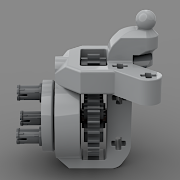 This seems like an ideal speed range for Lego, and fits single-stage planetary reduction better, so the mechanics is simpler. Also, the casing is simple, as it does not require a back side! Unfortunately the 5x5 form factor is less great, but for large models it is still quite okay. Also, it is easy to swap out the motor for 1400 KV or 2200 KV, which could still work fine for faster models! I think this is also a direction worth pursuing, I was already trying to get my hands on one of those motors developed by the Russin guy but could not contact him. Great that others are also working on the same concept! Great to know that with a good ESC it works fine, sounds promising!
 -
Yeah, that sounds a bit too powerful/fast. A better ESC can improve low speed control, but I guess using a fast motor and not using the higher RPM range is kind of a waste. So yeah, motors with lower Kv rating would be better (I believe lego can safely take about 2000 RPM strong motor outputs, like two coupled Buggy motors, so given that and the 1:6 downgearing, about 1500 Kv would be ideal, assuming 2s LiPo at 7.4 - 8.4V), but I haven't really seen such Kv rating in this form factor.. Does anybody know something like that?
-
I see. But I believe the reason that two Buwizz units are used in Greyhound is not just to have enough ports for all the motors (you could simply stack two motors on one port since the 4 drive motors are controlled simultaneously, and then one Buwizz unit without Sbrick would be enough), but rather because one battery may not be powerful enough to drive them all. Too many motors might overpower and shut down the battery, though L motors may not draw that much power, depends on many factors like weight and gearing. So not sure about that, but you could give it a try, as I said, you can do it without Sbrick as well, and if not enough buy another Buwizz. Another option could be to use a Buwizz 3, the 4L motors connected to the 2 PF ports, and replace the steering servo with PU L motor driven from a PU port. What is the 6th port needed for? Lights? You could use PU lights as well, you'd have 3 more PU ports available.
-
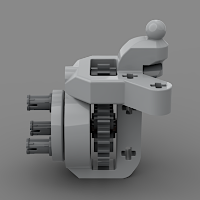
That is a really neat construction, exactly what I was wishing for (except maybe having a two-stage planetary reduction instead of a single one). The 3x3 form factor is ideal for the Lego system, and it seems that fairly powerful motors already exist in this size. A few questions: - What is the total length, 8 studs, or just 7? I guess depends on the exact motor used? - Are the wholes on the rear section inverse studs to accept half pins for support? - Doesn't the single stage planetary reduction result in an output that's too fast? Did you need to apply significant reduction afterwards? (besides the planetary wheel hubs). I guess two stage reduction is out of the question with printed parts.. - How much torque does the motor have with this reduction? Maybe in comparison with an L / XL motor? I have been looking around in your Makerworld profile, man, those live axle components look gorgeous, especially the diff lockable version. Wish lego made such things instead of all the non-reusable bionicle body parts.. there's sooo much room for improvement in this area.
-
You're talking about the Buwizz unit, right, not the Buwizz motor? Because the servo has nothing to do with the cables on the Buwizz motor I guess? The Buwizz motor has still 4 wires, but I guess it also only uses 2 of them, so same as all other drive motors.
-
General Part Discussion
gyenesvi replied to Polo-Freak's topic in LEGO Technic, Mindstorms, Model Team and Scale Modeling
I think some alternative brands have that part (towball socket with pin), I did buy some of those a while ago. -
I tend to agree with this. So if you don't agree, what is your counter argument? Because this one is not a counter argument, it just says why not? It does not tell what your benefit is from all this. Apart from making a video with a big wow factor that attracts a lot of views.. Which can be legitimate, but is different from something useful in the technical sense.
-
I guess the pin voltages on the Buwizz must be the same as on a Lego reciver, otherwise servo control would not work. Btw, how are you planning to use a Buwizz to power an Sbrick, and why? The only use case I could imagine is to multiply the number of ports, is that your goal? Otherwise you can just use the Buwizz app to do roughly the same stuff as the SBrick app does. But in case of multiplying ports, an app then would have to connect to both the Buwizz to turn one of its ports on, and then connect to the SBrick to do the actual control. Can BC2 app or something else do that? (I guess neither Buwizz app not Sbrick app can do that). Nice, but how does that relate to the question of the thread? :)
-
Well, I think we have seen in many cases that once a part is made, it is quickly used in other sets as well, and sometimes the first set that uses the part is not the one for which the part was designed, but they are trying to use it in more and more places to amortize the cost of the new mould. For example, the yellow differential was introduced in the Ferrari Daytona, but it was most probably made for the motorized Audi, which came one year later. So I agree that there might be other sets coming in the future where it is required. Another example is the new suspension arm introduced for the P1 supercar, and the same part being used in the Mercedes G-class, even though it would have been quite easy to replace (even would have been better if a proper rear suspension system was designed).
-
[MOC] Yellow Hot Rod
gyenesvi replied to Corrado's topic in LEGO Technic, Mindstorms, Model Team and Scale Modeling
That low profile adjustable front suspension is interesting, and looks cool, nice work! -
General Part Discussion
gyenesvi replied to Polo-Freak's topic in LEGO Technic, Mindstorms, Model Team and Scale Modeling
I was just wondering where it could be used, and that does make sense! -
General Part Discussion
gyenesvi replied to Polo-Freak's topic in LEGO Technic, Mindstorms, Model Team and Scale Modeling
That's what I thought too, couldn't even easily see the green connectors in the botanical set.. At the same time 42157 was missing that pin connector in green, it wasn't recolored for that one.. -
General Part Discussion
gyenesvi replied to Polo-Freak's topic in LEGO Technic, Mindstorms, Model Team and Scale Modeling
Some interesting part recolors coming in October in non-technic sets (according to newelementary.com): 13 x 2 x 5 fender flare in dark blue pin connector in green (in a botanical set) links in orange, yellow and green (in a Supermario set). 3x3 T-beam in bright light orange (hidden inside the oldschool batmobile, probably coming from that huge 1:1 P1 promo build). The sheer number of recolors of plates, tiles, wedges, etc in a single month (listed in newelementary.com) is just amazing. It seems that recoloring is not really an issue for TLG. Yet, some basic connectors are rarely recolored for a new technic set, like the above pin connector in reddish orange for the Mercedes G-class.. -
Well, I think that's not that hard :) I routinely bump into such situations. For one, if you try to build mechanisms that are not the typical, already solved problems, even in case of cars/vehicles, like various types of suspension. Another good exercise is to try building compact, small scale stuff. You'll quickly run into cases where you see there could be a possible solution if a given connector existed, or an existing part in the correct size was available. Technic models are often oversized just for the sake of being impressive, and fairly empty inside; that does not put much pressure on parts, as it gives enough space to hack things around with existing parts. Also, as things evolve, the expectations for looks is going up too. More and more parts will be required for bodyworks. So you guessed by now that I disagree with this. I actually even think that a good system should be overcomplete, meaning that there should be multiple ways to build the same structure, because depending on the context, some solutions can become unavailable (for example due to space availability due to surrounding parts), or unstable in certain directions (lack of form locking). I have been in situations where in principle I could have come up with 3 different ways to build something, but none of them was available because all solutions were missing a (non-existent) part. As far as I have heard from a former lego designer on this forum, TLG did already think about them about 20 years ago, and had prototypes of them way before Cada came out with them. One thing I suspect that has stopped them from bringing them out could be strength, maybe older manufacturing technology was not deemed good enough to manufacture them to the required strength.. I don't think those are mutually exclusive. New parts could result in better products that sell more. I think this is the problem here, that they are being too cautious now. All those one-off special moulds were clearly a big mistake, as they were not contributing to a good building system. But now they are sabotaging the system by erring on the other side, by not introducing parts that would make a good system. This page has a fairly nice summary of new parts every month: https://www.newelementary.com
-
This is a really nice solution and good to see it being polished and improved step by step! The only thing I'm curious about is the improvement over the original solution. I only have the Mustang, and in those rims, the wheel hub fits inside a bit, so the steering pivot point is quite okay to start with. Do you have some comparison shots with how the original one pivots? Also, can you tell where the pivot point falls more or less? It seems to me that it is quite a bit on the outer edge of the wheel (is that realistic?), and so the inner edge gets really close to the fenders.
-
I totally get that it may work like this, but isn't that totally insane and short sighted? It literally goes against the very idea of Lego in terms of systematicity. And when they finally introduce those parts, they are used in dozens of sets and the cost of the molds get amortized quite fast I guess. Also, I think many people are pretty fine with having to pay extra for the new parts. I bet much of the cost of molds for interesting new basic parts could be recuperated just by individual B&P sales, not to mention the sets they are included in, especially if those models end up being clearly superior due to new building techniques / visual elements. So I just don't get the short sightedness around this. I understand that they don't want to introduce a bunch of new parts at the same time. But they could at least group them conceptually. When they decide to go out with a game changing concept like flip-flop beams, go out with them in all sizes in the span of a few years, not 20! Those pinhole/axle-hole lattice parts would be really useful indeed! And that is what I call systematic approach..
-
Not Lego, just made virtually in Studio part designer, but they do exist in Cada.
-
[MOC] LiuGong 856HE MAX
gyenesvi replied to Bricksley's topic in LEGO Technic, Mindstorms, Model Team and Scale Modeling
Well, if you program in Python, it is free. Actually that is the primary language, and the code blocks are only a visual mapping to that :) But yeah, the blocks coding isn't too expensive either. -
The core topic of separating or mixing studful and studless technic and system parts is an old one I guess, but there are some interesting considerations in this thread. So here's my experience and what I think would be the way forward for Technic. Just like others, when I was a child I also used to build a lot with studful technic bricks, so I was used to that system. When I came back to Lego as an adult (and with an engineering mind), it was already the studless era, so I had to learn a new system, and I found that it has advantages and disadvantages as well. As others have noted, on one hand, in principle the studless system allows true 3-dimensional building, as it is symmetric in all dimensions, while in the studful system one dimension (up) is special and has a different size (I like to call such a system 2.5 dimensional). That symmetry is a plus for me, and also the increased density that comes with it. I think that's essential for modern technic building. On the other hand, it felt considerably more difficult to connect parts and build solid structures, even the simplest ones like a flat frame, not to mention a 3d frame (like a cube). And that somehow felt like a big flaw in the system, when such simple things are quite hard to build, not to mention in a solid way, as they require a bunch of connectors that take up quite a bit of space. This is because the a beam has connections in 1 dimension (pinholes), while a brick has connections in 2 dimensions (pinholes and studs), which is quite a difference. Of course, over time I learned to use the new beams and connectors, and I can build okay structures with it, but I still feel that many simple things are more complicated to build than would be necessary. Much of the above problem is addressed by flip-flop beams (and frames), as they restore the property of having connections in 2 dimensions. However, even though they are essential parts and true game changers for building, their complete rollout is taking ages (just can't believe how TLG can be so short-sighted). At the same time, I guess entire families of parts are still missing for efficient building, such as these: The beams have another key feature compared to bricks: their edge is round. This is also an advantage and a disadvantage at the same time. An advantage because they can be rotated to any angle at the end point without interfering with things next to them (an important property). But it is also a disadvantage when for example used on the outside of a model; it is not possible to build a flat surface out of them if two or more need to be put next to each other, which happens more often than necessary do to beams being only available in even sizes. This is another big flaw of the system; even the most fundamental piece (beams) is not available in all sizes. Again, requires a lot of workarounds and messy structures that are less rigid and look suboptimal. So I do think technic could be great for building dense internals, but it is still lacking some core structural part families. And then we get to building externals. Over time, TLG realized that they need to put emphasis on that, and they started to invent new systems (panels) for that. I think this is a good direction, because I think bodyworks require entirely different parts than beams, due to the above mentioned inherent property of beams not even being good for building connected flat surfaces. Also, I think for smaller models, using a brick built body on a technic frame can work, but only up to a certain size, and only when not too high density of internals is required, because the connection between the technic frame and the brick built body requires considerable amount of connecting space due to some mis-alignments in the two system (odd vs even counts, half beams vs plate sizes). For these reasons, I think inventing a new system of panels for bodyworks does make sense. The problem is again that this system is half baked and un-systematic. Even flat panels only exist in a handful of sizes, and many curved panels (wing shaped ones) cannot generate a continuous surface even when just placed next to each other. Even connecting flat panels leaves a bunch of gaps that clutter looks. Part of the problem I see is that many parts are designed to fulfill multiple different purposes or used in too many different scenarios, and in the end they are not great for any purpose. I think it would be great to differentiate structural and aesthetic parts and let both of them be the best they can be for their purpose. I think that groups of panels, like the recently extended group of 1x2xN mini wing panels, that don't try to be too many things at once but solve one problem properly and in a systematic way, are much more useable and are the way forward for other sizes/shapes as well. By the way, I think using system parts such as plates, tiles, (curved) slopes attached to technic parts through half pins can be a great way to complement technic panels and finish off surfaces in certain situations, and I welcome that such techniques are used more and more in official sets as well. So all in all, I think these are the things that Technic could improve. A good foundation of basic structural parts (beams, flip-flop beams, frames and connectors in many sizes), and a more systematic selection of panels that are better at creating good looking surfaces. Start with the basics such as flat surfaces, and surfaces that curve in one direction, and make it possible to build arbitrary sizes of those in a visually pleasing way. Then go for more complex shapes. Unfortunately I see that TLG is doing exactly the opposite, come out with complex shaped panels in a few sizes that are meant to be used in complex overall surfaces, while leaving simple things unsolved (well solved in a cluttered/clumsy way). So yeah, in a way it could be beneficial if Technic went back to its own foundations, but not to studful building, but rather to revise the studless foundations.
-
[MOC] LiuGong 856HE MAX
gyenesvi replied to Bricksley's topic in LEGO Technic, Mindstorms, Model Team and Scale Modeling
Very nice build, great mix of technic and system building, and nicely hidden electronics inside. Wish Lego would provide a proper hub for things like this; 6 ports in the size of the technic hub, and a proper rechargeable battery that provides 9V.. To improve the play experience a bit, you might want to try PyBricks, that allows you to connect the Xbox controller to the hub directly, without the intermediary phone, and to program it really flexibly in Python. The program will be stored on the Mindstorms hub, so as long as the hub stays inside this build it should keep working without worrying about software updates on the phone; it is worth exploring. -
I can confirm that because I also got a like from him for my Jeep Wrangler alternate of the Zetros, was pretty surprised that he looks at them and even interacts, pretty cool!
-
Thanks, that's really useful info to know, I always assumed those Cada ones are soft..
-
Really good looking alternate build, you made good use of the available parts, I especially like the brick built front face, captures the Bronco features really well. And I like that you managed to put 3 diff locks in!
-
42172 - McLaren P1
gyenesvi replied to Ngoc Nguyen's topic in LEGO Technic, Mindstorms, Model Team and Scale Modeling
This all sounds quite controversial with those motors and the speed, but my biggest gripe is not that (I could understand that the drivetrain would not work out of lego parts), but rather all the money they are spending on this, while they spare new parts out of actual sets. I read that they made 7 new parts just for this, and even supposing that they are only recolors, that's a lot when actual sets don't get some smaller connector parts recolored, and I could easily imagine that we'll never see those recolors in actual sets, which just feels like a waste. I'd rather would like to see TLG brag about how realistic lego car set they actually made with innovative/realistic parts. They could have just started by making a 7L link for the steering that goes with the new 7L suspension arm without resulting in toe in/out.. I feel this is so hypocritical. And I wonder if marketing-wise the cost of this will ever be returned in actual sales.. Though even wonder which party covers the cost.. -
Thanks, nice little joint, though it looks a bit fragile, even for a manual model. Couldn't it have been built symmetric, by using two of the blue 2L thin liftarms on both ends?