

Jundis
-
Posts
1,951 -
Joined
-
Last visited
Content Type
Profiles
Forums
Gallery
Everything posted by Jundis
-
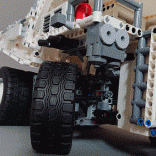 Normally I really don't care about cars, but this is such a giant beast! Even technic are double-stacked and reinforced where I see, just whoa. Will the steering be geared up somehow or did you already try it under weight and decided against? :D
 -
Kind of cool that Lego holds on to the Monster Truck theme, can we maybe hope for a bit of suspension for the 30€? Curious about the other models for 2026, we should get some more info soon :-)
-
[TC29] Hornsby Tractor from 1904
Jundis replied to Jundis's topic in LEGO Technic, Mindstorms, Model Team and Scale Modeling
Tinkered all the weekend to run this thing, but the sprockets sometimes just seem to stuck on the tracks... Even with a wormgear final drive, it just wasn't going to work as intended. As it deeply saddens me, but I gotta abandon this model When the primary drive feature doesn't work properly, it just isn't satisfying to present it here. Sry guys... :-/ -
[TC29] Mudrunner Knight
Jundis replied to Samolot's topic in LEGO Technic, Mindstorms, Model Team and Scale Modeling
Love the look of the whole cabin section, you captured that perfectly! -
General Part Discussion
Jundis replied to Polo-Freak's topic in LEGO Technic, Mindstorms, Model Team and Scale Modeling
As it will be in the smaller scale, do you really need a rolling ball or is a normal (bigger) ball joint sufficient? -
[TC29] Hornsby Tractor from 1904
Jundis replied to Jundis's topic in LEGO Technic, Mindstorms, Model Team and Scale Modeling
Turned out this is more complex than I first thought, but very fun to build :-) The gearbox is finished and just has to be implemented in a stable manner, but drives my moc-up very well. The red gears and the flywheel attached is driven with the motors rpm and then geared down to get enough torque. Can't really settle on a good suspension setup. The original one is kind of strange and would require special parts without beeing too bulky and still rigid enough :-/ -
Carbon fiber wheel
Jundis replied to PlasticGear's topic in LEGO Technic, Mindstorms, Model Team and Scale Modeling
Geez man, is it really that hard to buy a little braiding machine like this and just braid em like a pro? Kidding aside, CFK is really hard to work with when aiming for a specific and more complex shaped geometry. Hats of for trying that in such a small scale! -
This turned out to my favorite model so far in the contest, what a brilliant job! Just to get this right: You ditched the servo and just use 2 motors (one for each track) and when one motor drives slower it engages the steering via the diff and clutch gear, right?
-
What's happening with Technic?
Jundis replied to Amt0571's topic in LEGO Technic, Mindstorms, Model Team and Scale Modeling
On the last of the seven pages, I like that they at least included some scenery. Why not also a building site for page 6? Why not a sandpit for G500, Audi RQ, Ford Bronco and the 2 pullback Monster Trucks? Why not a racetrack for the race and formula cars? I know there are not all in the same scale, but still some are and can be placed next to each otther. -
Another very tiny tweak: Flip the 90° axle connector on the backend of the model and use a black 2L pin instead of 2L axle pin. I wonder why they didn't to this in the first place... as designer nowadays try to hide the blue pins as much as possible.
-
[MOC] Claas Cougar 1400
Jundis replied to Jundis's topic in LEGO Technic, Mindstorms, Model Team and Scale Modeling
Thanks, guys :-) Nah there is some room for improvement. When this panel is out in lime, I will add fenders. Also I would need to make a PF an PU version. Don't know if the switch on the PF will have enough space in the front... -
[MOC] Claas Cougar 1400
Jundis replied to Jundis's topic in LEGO Technic, Mindstorms, Model Team and Scale Modeling
Finally I managed to make a video with the usual poor video quality of my phone... Still it should capture the features of the model and the highlight the main function: -
Both versions are superb! As @Teo LEGO Technic already said, the movement is soo fluently and fits so well in this scale. Outstanding job @Appie! And actually I love the simple fact that Lego gives us a model to mod and to improve on. Hopefully we will get more heavy machinery in the years to come :-)
-
4 a.m. ... can't sleep ... reads thread about steerable and liftable third truck axle ... remembering a model I built but never published ... built a mock up with sleepy eyes .... make a pic ... trying to go to bed again ... https://i.ibb.co/r2h2TLzT/DSC-0264.jpg
-
Lego Technic RC Buggy Version 2
Jundis replied to MAP Tec's topic in LEGO Technic, Mindstorms, Model Team and Scale Modeling
Nice model! And I like the whole setup of functions, speed and looks. But do we really need 2 thread for nearly the same MOC...? -
45 Degrees in technic
Jundis replied to Alien's topic in LEGO Technic, Mindstorms, Model Team and Scale Modeling
This thread might help you :-) -
Actually really strange... the 42210 introduced wheel covers again, so wouldn't it be way easier to use the normal 30.4 mm wheel and just put a cover inside? There is plenty of room for both the rim spokes and the 3-star nut...?
-
Nice effort :-) What I think is way out of scale are the orange steps on the undercarriage. Even the original model has only small bars. Sadly, no telephone handle is available in orange...
-
Kinematics of wheel loaders
Jundis replied to Jundis's topic in LEGO Technic, Mindstorms, Model Team and Scale Modeling
Link -
Kinematics of wheel loaders
Jundis replied to Jundis's topic in LEGO Technic, Mindstorms, Model Team and Scale Modeling
Thanks, guys. Looks like the L120 has both systems: Z and PT -
Hi guys&gals, while discussing the 42209 in the corresponding thread, we stumbled upon the kinematics behind the arm and bucket movement. As this theme applies to all wheel loaders, I'd like to follow the idea of @jorgeopesi and create a seperat thread to discuss this in more detail. The basics so far: There are different kinematics, the main ones are Z-kinematics (Z represents the appearance of the linkage) , P-kinematics (parallel) and TP-kinematics (torque-parallel, so far Volvo exclusive). Z-Kinematics With Z-kinematics, the tipping movement of the bucket is actuated when pressure is applied to the push-side of the cylinder. The piston rod extends and pushes the reversing lever forwards. This lever is rotatably mounted on the lifting arm and so the movement is transferred to the mounted coupling rod which causes the bucket to start tipping in. This kinematic system has a very high break-out force due to the pressurization of the push-side (we come to that later in the pic with the cylinder). When tipping out, very short tipping times are possible. P-Kinematics The parallel kinematics enable goods to be lifted and lowered in parallel according to their layered design. This is particularly advantageous when operating with a loading fork, as the driver does not have to manually adjust the cylinders during the lifting process. The connecting linkages, the cylinders and the lift arms together form a parallelogram. They are controlled in the opposite direction to the Z-kinematics. The system is primarily used in wheel loaders for the agricultural sector and construction. This results in lower break-out forces and longer tipping times but higher linear stability. Here is a short video which compares the Z and P-kinematics on a Liebherr Wheel Loader and a picture (P-kinematic on left, Z-kinematic on right side) TP-Kinematics The torque-parallel-kinematics combine the advantages of Z-kinematics and P-kinematics. Its like an inverted Z-kinematics. The design results in a high break-out force with parallel guidance during the lifting process as well as controlled tipping in the upper lifting position. As far as I know, only Volvo uses this system. The main purpose of using a Z-kinematic instead of a P-kinematic is the difference in the force of a hydraulic or pneumatic cylinder for push and pull. The piston rod reduces the surface area of the pull side (orange) by the cross-sectional area of itself (green). Therefor, the cylinder has a higher push-force (yellow area) and a lower pull-force (orange = yellow minus green). Coming back to Lego: At least from my understanding, there shouldn't be any difference in force when using a linear actuator --> can someone confirm or disprove this assumption? Linkage System The linkage system itself is way more complicated and so far I found this source from Stefan Segla from 2018 published in the Journal of Manufacturing Technology called: "Kinematic Analysis and Optimization of a Wheel Loader Mechanism" It is only for Z-kinematics, but should also be adaptable to PT kinematics. It describes the optimization by seperating the differen linkages and given movement and geometrical constraints. He then optimized them via an analysis of the desired and the actual value of the bucket angular position. I put together the initial picture and included the virtual point J he introduces in the abstract view of the mechanism and also coloured the lines in the image below. Depending on the scale of the Lego model, an initial value should be used instead of meters. I would suggest using the yellow line BG, which for example is 2 studs for the new bucket of the 42209. By replacing the line BG of 0.35 m with 2 stud we get the measurement of 1 stud equals 0.175 m. We then can calculate back the other values, which are the following: BG = 2 studs GD = 4.68 studs DC = 3.84 studs CE = 1.92 studs JC = 5.06 studs AJ = 5.53 studs While some value may be round up well to suitable numbers for available bricks, others are kind of hard to achieve... To be continued...
-
Not the visually pleasing one but an easy fix for the bucket with just 2 x 3749, 2 x 32054 and one 4519. Give a little better angle for bucket tilt in lower arm position:
-
Finished mine just now and have to agree. The linkage is good (height when raised, bucket tilt downwards), but far from perfect. Will work on a mod for that.
-
Exactly my thoughts.... if the set designer at Lego are reading our forum and gathering input, ideas and suggestions, they really will bump their head at the wall. Model with many motors: "Gnaaaa... we need more gearboxes, this is no true technic!" Model with one motor and gearbox: "Gnaaaa.. lame, why didn't they use single motors for movement?" There are two main flaws for me: The obvious one is the price, which is just ludicrous in contrast to the 41000 or older sets. The other thing is, that for the functions provided, this set is too big. A good comparison would be the 42082: All the space was used in this set and the driving section was actually more interesting with outriggers, motor and steering. In contrast, on the 42215 I glance at an empty undercarriage, which is a shame at that scale. In conlcusion, if this set goes sub 240€, I might get it, just to support the effort of bringing out heavy machinery and not cars as flagship models. *Edit: Is this set in scale with the 42114?
-
My god, what a mod! You can hardly recognize the motors at all!