

Elostirion
-
Posts
1,569 -
Joined
-
Last visited
Content Type
Profiles
Forums
Gallery
Everything posted by Elostirion
-
[COR FB] Deep in the jungles of Celestia
Elostirion replied to Darnok's topic in Brethren of the Brick Seas
Excellent write-up for a neat little jungle scene. I'd suggest some more elevation of the ground and even denser jungle at the edges of the MOC, and maybe a tan tile 1x6 on to of the altar to cover the studs, but that's about all I can suggest. Great work, keep it up please. -
Jameis Farstrider's Guide to Halos
Elostirion replied to Elostirion's topic in Brethren of the Brick Seas
Terraversa or the Gateway to the New World People The original inhabitants of Terraversa are the Atwi tribe. In the more than a hundred years after Basker's discovery of Terraversa, the Atwi have mingled with the Mardierians and other Halosian inhabitants of the newly founded settlements, with some children already being in their fourth or even fifth generation of mixed races. Terraversans have grown to be a self-aware people with a strong national pride, which some may even consider arrogant. They open their doors to foreigners, yet hold their possessions dearly and don't make any donations. History In 508 AE Mardierian explorer Ardmond Basker discovered the island of Terraversa, almost a thousand miles further east than any other island that had previously been discovered in the Sea of Storms. Since then Terraversa has been the most crucial gateway to the new world and Mardier used control of Terraversa to prevent other Mardician nations from accessing the new world. This changed with the death of King Harln of Mardier, and the ensuing civil war that began in 595AE. Eslandola approached Carlo Oldis, the Viceroy of Terraversa and paid him handsomely for permission to access King’s Port for trade and exploration. The Viscount agreed and eventually allowed all nations to pay for the privilege to visit the island. As the civil war raged on in Mardier, Terraversa; led mostly Carlo Oldis and his son Miro after him, struggled to loosen Mardierian control over the island. After more than twenty years of fighting, the civil war finally ended in early March 617 AE and as part of the resulting peace, Terraversa gained independence. Independence was short lived. Excessive taxation of foreign shipping led to a fall in revenue and resentment from the merchant classes. Meanwhile, political rivalry between Archduke Oldis and Admiral L’Olius led many of the aristocracy to wish for a return to imperial order. The major powers in the New World competed for influence and access to Terraversa’s vital ports with Oleon backing the ‘Loyalist’ movement who wanted a return to Imperial times, Eslandola seeking favourable trading conditions from Oldis and the merchants of King’s Port and Corrington supporting L’Olius from his stronghold in Westface. The uneasy peace was shattered in August 620 when Oleon; supported by the Terraversan ‘Loyalists’ in Nola Mar, commenced a full on invasion of the island. After heavy fighting and a long siege, King’s Port fell to Oleon in January 621 with Oldis fleeing to nearby Pamu where a strong force of Eslandolan mercenaries had recently disembarked. Meanwhile Corrington had declared war on Oleon in September 620 and sent a large expeditionary force to L’Olius in Westface. The Treaty of Pamu officially ended the Second War of Terraversan Independence as well as the independent nation of Terraversa. The island was partitioned into four zones, two independent Terraversas led by Oldis and L’Olius respectively, a central portion of Oleon controlled territory and the interior classified as Atwi tribal lands and creating a buffer between the other three zones. Having only recently split, the two ‘independent’ Terraversan States; the Grand Duchy of Terraversa (commonly referred to West Terraversa) and the Commonwealth of Terraversa (commonly referred to as East Terraversa) share many characteristics. Grand Duchy of Terraversa (West Terraversa) Flag: Primary Colours: Yellow and Gold Secondary Colours: Blue and White Demonym: Terraversan Nickname: ‘West Terraversa’. The Island itself is sometimes referred to as 'The Gateway to the New World' or 'The Line', Primary Real World Influences: Mardier, which had colonized and owned Terraversa until recently, still hast the most significant influence on the island. In the real world the Spanish Caribbean Colonies, colonial Cuba, Dominican Republic/Haiti and Puerto Rico, all fit the young nation very well. For landscape Madeira is a great inspiration. Ruler: Miro Oldis, Archduke of Terraversa (formerly Viscount of Mardier) Capital: Kings Port West Terraversan Cities and Towns of note Kings Port, on the island of Terraversa Minor settlements: Pamu, Tanari, Diplomatic Relations: Diplomatic relations are rated on a scale of 1-5 (1=Very Friendly, 2=Friendly, 3=Indifferent, 4=Unfriendly, 5=Very Unfriendly/Hostile. A rating of 5 doesn't necessarily mean the nations are at war and conversely a rating of 1 doesn't mean the nations have an alliance.) Corrington: Indifferent Eslandola: Very Friendly Oleon: Very Unfriendly/Hostile Sea Rats: Indifferent Commonwealth of Terraversa: Unfriendly Garvey: Friendly Mardier: Unfriendly Prio: Very Friendly War: None, a fragile peace exists with both the East Terraversa and Oleon. Alliances or pacts: Brothers in Arms with Prio, supporting them in their struggle against Mardier (link). Free trade agreement with Eslandola. Defining Characteristics Each NPC nation has values for eight primary characteristics set by leadership for the purposes understanding the powers of NPC nations. These values are dynamic and may change periodically in response to events in the Brick Seas. Naval power: • • • • • • • • • • With almost the entire Terraversan war fleet remaining in Westface after the second Terraversan war of independence, King’s Port does not currently field a dedicated navy. However the large trade fleet based in King’s Port is well armed and trained and are capable of defending themselves. It remains to be seen if Oldis will attempt to create a separate war fleet, perhaps with support from Eslandola or Prio. Military power: • • • • • • • • • • Two lengthy wars of independence and the resulting partitioning of Terraversa have created many experienced soldiers and militias; however have left the standing army in disorganised ruin. A significant portion of the officer corps defected to Oleon during the second war and many others were lost during the battle of King’s Port. The army requires significant investment and re-building. Whether this will occur, or whether Oldis will adapt a policy of relying on mercenaries and private armies similar to his new Eslandolan allies, remains to be seen. Scientific advancement: • • • • • • • • • • Mardier has never been a nation of scientists, and it never had to. Useful new technologies have always been brought to the island, both from east and west - and the Terraversans took them, adapted and used. With their past focus on being Mardier's gateway to the New World and then switching focus to the war of independence, they still massively lack in any kind of educational system. So while their general technological standard is rather high, they are far from achieving any progress themselves. Political/diplomatic influence: • • • • • • • • • • The partitioning of Terraversa has cast an impression of weakness over the shrunken nation. Oldis’ defeat in the battle of King’s Port has reduced his status and many openly whisper he is a puppet of the great Eslandolan Trade Companies. King’s Port; as damaged as it is, still commands a strategic position in the New World and it’s merchants will likely rebuild swiftly. Whether this will be enough to regain influence, or if Oldis can hold onto power, remains to be seen. Inner stability: • • • • • • • • • • Miro Oldis, succeeding his father as Terraversan governor, has led the troops to their final victory over King Alphonse of Mardier's Death Guard, declaring independence on the battlefield himself! His legendary status as leader of the first war of independence is dampened; however, by his loss in the second. Negotiating the return of King’s Port from Oleon saved some face, but his grip on power is still somewhat precarious. Treasury/coffers: • • • • • • • • • • More than twenty years of constant fighting for independence emptied the governmental coffers and the nation had not fully recovered before the outbreak of the second war of independence. Now King’s Port is in ruins after a lengthy siege and requires re-building. Infrastructure is also in tatters. The location of King’s Port, however, still bears great potential and the loss of territory to Oleon and East Terraversa has the unexpected effect of reducing the area needed to expend funds on. Whether the new Government can recover will strongly depend on the adequate use of trade and tax politics. On top much of the newly gained money will have to be re-invested immediately, to setup the infrastructure Terraversa needs to prevail as a nation of its own. Exploration: • • • • • • • • • • The legacy of Mardier means that potentially some Terraversans may know places in the east that no other nation knows about and some merchants may be taking advantage of this knowledge. Despite this, exploration is of very little priority to the fledging nation and maritime focus remains firmly on trade. Cultural advancement: • • • • • • • • • • The Mardierian cultural influence in Terraversa is still strong, and the Atwi tribe has enriched traditions even further. With sailors from all nations halting on the island, Terraversa has long been a melting pot of all variations of the most different cultures. The nation will have to pick the best aspects to form a cultural identity of its own, which is currently little less than the pride of being "The Gateway" between the worlds. Known Terraversan Personalities and Organisations Miro Oldis, current ruler of the Grand Duchy of Terraversa, former Mardierian Viscount and hero of the first War of Terraversan Independence. Oldis now has to recover his reputation as a ruler and lay the foundations to rebuild King’s Port into the gateway to the New World. Cristóbal Diego L'Olius, descendant of the Atwi tribe and Terraversan maritime hero. Once one of the Mardierian Royal Family's favourite captains, he sided with his homeland Terraversa in the Civil War. He fought glorious battles at Sea, raided the Eslandolan Town of Fuerte Unido and by many is said to have invoked the Eslando-Mardierian war. (For more see The L'Olius Case: 1 - 2 - 3 - 4 - 5 - 6; also see revenge on L'Olius). Ardmond Basker (Mardierian), discovered Terraversa in 508 AE, died in 533 AE in Kings Port. The Terraversa Rebels, a soccer team, reached the quarter finals in the Trador Soccer Cup of 617 AE (see here). Examples of West Terraversan builds MOCs in Terraversa: 1 - 2 - 3 - 4 - 5 - 6 - 7 - 8 - 9 - 10 - 11 - 12 - 13 - 14 - 15 - 16 - 17 - 18 - 19 Examples of West Terraversan troops Prima Compañía, the first official Terraversan miltary unit. Commonwealth of Terraversa (East Terraversa) Flag: Primary Colours: Yellow and red, most often in combination. Secondary Colours: Brown, Gold Demonym: Terraversan Nickname: 'East Terraversa’, Primary Real World Influences: Mardier, which had colonized and owned Terraversa until recently, still hast the most significant influence on the island. In the real world the Spanish Caribbean Colonies, colonial Cuba, Dominican Republic/Haiti and Puerto Rico, all fit the young nation very well. For landscape Madeira is a great inspiration. Ruler: Cristóbal Diego L'Olius, Grand Admiral (for more see The L'Olius Case: 1 - 2 - 3 - 4 - 5 - 6; also see revenge on L'Olius). Capital: Westface East Terraversan Cities and Towns of note: Tarlor South Sillitholina Diplomatic Relations: Diplomatic relations are rated on a scale of 1-5 (1=Very Friendly, 2=Friendly, 3=Indifferent, 4=Unfriendly, 5=Very Unfriendly/Hostile. A rating of 5 doesn't necessarily mean the nations are at war and conversely a rating of 1 doesn't mean the nations have an alliance.) Corrington: Very Friendly Eslandola: Indifferent Oleon: Very Unfriendly/Hostile Sea Rats: Indifferent Grand Duchy of Terraversa: Unfriendly Garvey: Indifferent Mardier: Unfriendly Prio: Friendly War: None, a fragile peace exists with both the East Terraversa and Oleon. Alliances or pacts: Brothers in Arms with Prio, supporting them in their struggle against Mardier (link). Free trade agreement with Corrington. Defining Characteristics Each NPC nation has values for eight primary characteristics set by leadership for the purposes understanding the powers of NPC nations. These values are dynamic and may change periodically in response to events in the Brick Seas. Naval power: • • • • • • • • • • L'Olius is one of the most famous captains alive in the Brick Seas, and a hero of the first Terraversan war of independence. The Terraversan war fleet was loyal to him personally and remained with him in Westface on the partitioning of Terraversa after the second war of independence. The fleet is small but well trained and experienced. Military power: • • • • • • • • • • Two lengthy wars of independence and the resulting partitioning of Terraversa have created many experienced soldiers and militias; however have left the standing army in disorganised ruin. A significant portion of the officer corps defected to Oleon during the second war, many others were lost during the battle of King’s Port and fewer still chose to remain in East Terraversa after the partitioning. Scientific advancement: • • • • • • • • • • Mardier has never been a nation of scientists, and it never had to. Useful new technologies have always been brought to the island, both from east and west - and the Terraversans took them, adapted and used. With their past focus on being Mardier's gateway to the New World and then switching focus to the war of independence, they still massively lack in any kind of educational system. So while their general technological standard is rather high, they are far from achieving any progress themselves. Whether Corrington will influence the young nation in this area remains to be seen. Political/diplomatic influence: • • • • • • • • • • The partitioning of Terraversa has cast an impression of weakness over the shrunken nation and L’Olius’ failure to support Oldis during the siege of King’s Port has reduced his status and many openly whisper he is a puppet of the Corrington. Westface; although undamaged by the war, does not command as strategic position as King’s Port and it is unclear if L’Olius will seek to improve facilities there. Inner stability: • • • • • • • • • • L’Olius has been building a loyal following in Westface for some years and is overwhelmingly popular among the mixed race Terraversans who make up a large portion of the community in Westface. He is; however, inexperienced in government and more suited to commanding a ship of the line. Whether he will listen to advice and mange to hold the new nation together remains to be seen. Treasury/coffers: • • • • • • • • • • The new nation is effectively starting from scratch, as most of the former government coffers were located in King’s Port and Oldis certainly won’t be sharing them. The new nation does have some economic advantages; until King’s Port is rebuilt or Nola Mar developed, Westface is the largest port on Terraversa and the nation inherited the vast plantations in the ‘Great Plantation’ region that generated a significant portion of the raw materials produced in old Terraversa. These advantages must be immediately exploited for the new nation to succeed. Exploration: • • • • • • • • • • The legacy of Mardier means that potentially some Terraversans may know places in the east that no other nation knows about and some merchants may be taking advantage of this knowledge. Despite this, exploration is of very little priority to the fledging nation and maritime focus remains firmly on trade. Cultural advancement: • • • • • • • • • • The Mardierian cultural influence in Terraversa is still strong, and the Atwi tribe has enriched traditions even further. With sailors from all nations halting on the island, Terraversa has long been a melting pot of all variations of the most different cultures. The nation will have to pick the best aspects to form a cultural identity of its own, which is currently little less than the pride of being "The Gateway" between the worlds. Examples of East Terraversan troops
-
Shipwrights Guild Hall (WIPs, feedback, and advice)
Elostirion replied to Bregir's topic in Brethren of the Brick Seas
Thanks for the input, I will definitely give this some thought. It would reduce the amount of cannons from 24 (12 per side) to 20 (10 per side). Bricks are not an issue (will just need dark green 1x2 instead of 1x1), nor is the effort of rebuilding the thing. The result is what matters to me, and I am here to learn, so yeah. :-) I will definitely stick with one gundeck. Looking at some Indiaman-pictures again I guess you are quite right about the distance between the gunports. Stay tuned for an update. Hehe. And the more I look at the current version of my ship, the more I feel it should be a tiny bit higher from the water surface... And Maxim, I am definitely looking forward to a rebuilt Margot! -
Shipwrights Guild Hall (WIPs, feedback, and advice)
Elostirion replied to Bregir's topic in Brethren of the Brick Seas
It really does look cool and fast. Those coats of arms on the sails look especially amazing. I continued a bit with some of your feedback in mind and redesigned the side. I like it a lot more now. (I feel it does look a lot better in reality than on those pictures.. -
Marvellous wall texturing and the addition of the plants makes it look even more beautiful. Great work on the cobbled street and the roof with the small oriels. The dirty small windows work amazingly. Fantastic work all around!
-
Shipwrights Guild Hall (WIPs, feedback, and advice)
Elostirion replied to Bregir's topic in Brethren of the Brick Seas
Your challenge has been accepted. :-) I decided to go for the Indiaman (we might want to call it Terraman over her? Or Fontonajoman?) However I will need some assistance, as I am still brutally new to shipbuilding - and horrible at it. I chose the Indiaman. The large ones I Wikipedia'ed (is this even a thing?) were usually 60m long (50m keel length), 10-12m wide and had roundabout 20-30 cannons. My current version has 22 cannons and is roundabout 30m long (the hull) (with a minifig at 1.80 metres height), and 7-8 metres wide. I consider making it 2 studs wider (or maybe even 4 studs), as currently it seems a bit slim, and one section (8 studs?) longer as it's still a bit too small... Also I am not sure whether it should be higher (as the railing should be 3-8 plates higher from the water surface to give more room for cargo)? Regarding the sails I guess I will have to find some yellow sails, the dark red ones from the QAR would be too much dark for an Eslandolan ship. If there is anything else that is just bad / wrong etc. please let me know. Some more pictures from slightly different angles: -
[COR - ML] Mesabi Landing Rock Quarry
Elostirion replied to Darnok's topic in Brethren of the Brick Seas
The one with "quite" -> better. The others: Maybe in some aspects, but not in the total appearance of the MOC as a whole, where I think the quarry is definitely better. Just my very personal opinion. .:-) -
Sailing Panther [SR-FB] [KPA reaction]
Elostirion replied to Roadmonkeytj's topic in Brethren of the Brick Seas
Perfect. Glad you picked this one up. -
Wonderful writeup Capt Wolf, loved reading it. Thanks for all the work you put into it! Makes me want to participate again in future MRCAs. :-)
-
[COR - ML] Mesabi Landing Rock Quarry
Elostirion replied to Darnok's topic in Brethren of the Brick Seas
One of the best MOCs I have seen from you here. Great work, love it! -
Dee Wheelworks of King's Harbour
Elostirion replied to Captain Dee's topic in Brethren of the Brick Seas
Marvellous new world, what a grand factory. Loving it! And as I said before: Amazing to see you stick with your unique personal style. -
[COR - FB] Quinnsville Shipyard
Elostirion replied to LM71Blackbird's topic in Brethren of the Brick Seas
Really nice work over here! Looking forward to see more from you. :-) -
[SR - MRCA Result] Fuerte Unido Grog Shop
Elostirion replied to Professor Thaum's topic in Brethren of the Brick Seas
Very nice MOC. Great placement of all items and the plants especially, and the irregular base adds a lot. Well done! -
I hope so as well. The ingot-pavement was actually how the whole MOC started. (initially had planned this for cat C but wasn't happy with it so I decided to postpone it for after the challenge. Glad I did) Thank you! And actually quite a cool idea. Will give this some more thought. I am not sure if it's physically possible for the jaguar to reach the goat, perspective might confuse here. Thank you! :-) Wow thank you - glad it comes over so well and you even like the camera. I put quite a lot of effort into it but wasn't really sure about the results... Thank you - impressive is always good. :-))
-
Román Fontonajo and his wife Clarissa are dressing up:
-
Román Esteban Fontonajo and his wife Clarissa Raltessa are dressing up for the Great Ball of King's Harbour. They went to one of Román's own smaller businesses in Nova Terreli to buy some new clothes. Much to the dislike of the grand landlord and entrepreneur and former Admius Legistrad. But she was right: They couldn't keep wearing the same boring clothes everytime yet expect people to buy their latest fashion all the time.
-
[COR-FB Feb] Somewhere to live
Elostirion replied to Lord Buckethead's topic in Brethren of the Brick Seas
Neat scene, great work all around. The minifig in the first picture is superb. -
A nice ship. I like the thickness and strength of the hull shown by the brown bricks at the side of it (don't know how to describe this better). I like the increased contrast of the pictures, I think 2-3% darker and it's quite perfect already.
-
Monezterrell shipyards & Fuerte Unido
Elostirion replied to Legostone's topic in Brethren of the Brick Seas
The first picture is especially beautiful - very cool micro scene! -
Amazing scene! The curtains are marvellous. Great work.
-
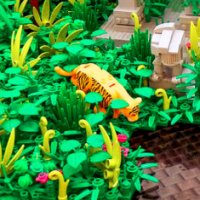
While adventurers have set out to find the most beautiful orchid in ancient temple ruins, very little is known about the origins of those ruins yet, et alone about the Celestian natives in general. Juan Alfonso Fontonajo and his companion have discovered a hill somewhere in the highlands of Celestia - and on top of that hill stands an ancient statue of a winged man riding a tiger. What is the history of this statue? Who have the natives of Celestia prayed to in former times? On the neighbouring island of Cascadia temples to the feline gods have already been discovered, deep in the jungles. But what is the connection between the cults and history that have been unveiled on Cascadia to that of Celestia? On Cascadia the Myzectlan still uphold their city as a refuge deep within a mountain vale, protected from the once (and potentially still today) maneating large carnivorous cats. But scientists like Montoya have set up a relationship to the natives of Cascadia, and researched their culture, their history and their doom. This has yet to happen on Celestia. And as the curious eye may or may not see, a native scout is closely watching Fontonajo's expedition already. Will he approve of Fontonajo approaching the strange altar on the hilltop? For now one difference seems to be obvious: While in Cascadia most shrines were hidden deep in the jungles - because of the secret and forbidden nature of the cult especially in its early days - this statue stands highly exposed on top of a hill for everyone to see. So how are the natives of Celestia? Are they like those on Cascadia? Do they emerge from the same ancient civilization, share the same blood and the same culture? Have all of them become primitive huntsmen? Or have they always been? Have they once lived on Cascadia, or vice versa? Or maybe those two peoples are not connected in any way, after all? Only time will tell, and only when scientists and adventurers have made their discoveries, written them down, made the connections between the puzzle pieces - only then will we finally know who and how the natives of Celestia really are - and why. For now it is most obvious that there must have been a religious cult involving large felines, at some point in the past at least. The altar is still in decent but not perfect shape, which may also be a result from the sun shining relentlessly at the rather dry hilltop. But who is the winged rider on the tiger's back? Is the tiger the worshipped one, or is it the humanoid with wings? Does the statue display a real hero, or rather a fictional divine being? What is the relationship between the two? And is it pure coincidence that a jaguar is drinking at the small pond at the foot of the hill? Surely other feline cats have recently been spotted on Celestia. But what is the releation between them and the inhabitants of the islands? An incident happened with a white tiger which was recently discovered and then killed shortly after. But are there also deep hostilities between the natives and the felines? Would the felines even attack wandering Halosians? Not even that is known yet. Only one thing seems certain for now: That Juan Alfonso Fontonajo and his company will continue their exploration of Celestia. -------------------------------------------------------------------------------------------------------------------------------- Thanks a lot to @Ayrlego, @Lord Buckethead and @Bregir for your support and feedback during the construction of this MOC. I am happy to have the chance of exploring Celestia with you - and hopefully soon some others as well. The island and its natives bear some great potential which we have the great chance to develop together. The general colourscheme with lots of olive green, mixed with some dark green, has been inspired by @Gideon's fantastic entry to category C of the most recent challenge. The orchid is a copy of that from @Kai NRG's delayed yet wonderful entry to the challenge. Looking forward to all other MOCs for the Celestian Natives. :-) --------------------------------------------------------------------------------------------------------------------------------
-
https://www169.lunapic.com/editor/ Upload your image (or copy-paste the URL). In the navigation under "Adjust" select "Color Saturation", "Brightness" and "Contrast". Whoever is able to MOC in LDD will be able to use this for sure. :-)
-
Corrington: Sign-up and Discussion, Era II
Elostirion replied to Bregir's topic in Brethren of the Brick Seas
Climbing those stairs will not be an easy task... -
Corrington: Sign-up and Discussion, Era II
Elostirion replied to Bregir's topic in Brethren of the Brick Seas
Juan Alfonso Fontonajo seems to have found some stairs on Celestia. Stay tuned to find out more. Celestia has some of the clearest water in its mountainous jungles. The heat makes forces even the largest cats to take a drink from time to time... -
Great ship. That high priest is magnificent! Really, really cool work here.