

Anders T
-
Posts
111 -
Joined
-
Last visited
Content Type
Profiles
Forums
Gallery
Everything posted by Anders T
-
Yes and with some explanation as well. On a Dromon the ram found on earlier galleys was replaced by a ”spear”. On the bow, there was an elevated platform with the weapon known as “greek fire”. Behind the platform is a windlass, which has similar purposes as the (later) capstan. The deckspace below and above the upper and lower rowers respectively, is a grid/lattice. This is makes it possible for the rowing soldiers to coordinate the rowing action. On a sidenote: Galley slaves was a rarity. Not even the Romans used them and not at all on a war galley. Professional rowers or soldiers operated the oars and participated in fighting the enemy when boarding. ...But -Ben Hur-. Yep that is Hollywood for ya. I "knew" about galley slaves before researching the ships as well. Aft. The Dromon looked similar to older galleys. On later Italian style galleys, a rudder would replace the steering oars. The elevated platforms on the side are a distinct dromon feature. Other versions usually have higher platforms or even an elaborate castle centered in the middle. I found that this made the ship potentially very heavy and/or compromising the use of sails. Not really fitting a shiptype named “runner”.
-
Still not pirate ships, as such, but some of them could be handy for a bit of raiding. The models resemble five ships from just after 1000 A. D. Viking-age in Scandinavia. They are minifig-scale or 1:40’ish. The largest model, Skuldelev 2, will have the dimensions Length: 80 cm, Height: 40 cm (with stand), Width: 10,5 cm The smallest model, Skuldelev 6, will have the dimensions Length: 29 cm, Height: 21,5 cm (with stand), Width: 7 cm There is approx. 4900 bricks in the models combined. With 2100 going to Skuldelev 2, 1100 to skuldelev 1 and 450-700 bricks for each of the other ships. The main source of reference is the The viking Ship Museum: Vikingeskibsmuseet i Roskilde The focus of the museum is a permanent exhibition of the five original Viking ships excavated nearby in 1962. The line drawings and data found at the museum is the basis for the models and the replicas Ottar, The Sea Stallion from Glendalough, Roar Ege, Helge Ask and Kraka Fyr are invaluable source material for the colors and final look. Information about the ships can be found here and at the links found above https://en.wikipedia.org/wiki/Skuldelev_ships Skuldelev 1 A “large”cargo vessel (Knarr), 1030 A. D. Skuldelev 2 (and 4, see information) A Warship (Skeid), 1042 A. D. Skuldelev 3 A cargo vessel (Byrding), 1040 A. D. Skuldelev 5 A small warship (Snekkja), 1030 A. D. Skuldelev 6 A fishing boat or small cargo vessel (Ferje), 1030 A. D.
-
Not really a pirate ship, but a ship nonetheless. From Wiki A dromon (from Greek δρόμων, dromōn, "runner") was a type of galley and the most important warship of the Byzantine navy from the 5th to 12th centuries AD, when they were succeeded by Italian-style galleys. It was developed from the ancient liburnian, which was the mainstay of the Roman navy during the Empire.
-
Glad to be an inspiration. Makes me feel old in a good way. I actually thought of making the upper part of a ship in the fashion you are doing. Looking forward to see how it works. This could end my reply, but you ask for tips, so here it goes: I will not refer to any LEGO, but there is one real revelation in regards to naval design that cannot be overstated. Architectura Navalis Mercatoria by Fredrik Henrik af Chapman, 1768 https://www.finemodelships.com/ship-plans/Chapman_Architectura_eng.htm I agree with ROBIN IV, there is some planning that could come handy at a later stage. With great risk of going overboard, any full hull ship is quite a task and I think there is something gained in thinking through a process. I usually go about it much like drawing, painting or sculpting. Broken down in themes a work process could be like this: Sketching -The guiding lines that makes the overall design harmonic- This means deciding the size and overall shape of the model. If there are, some major structures that define the overall shape consider them as well. Do this with LEGO, drawing or digitally. Technique -The level of precision vs elegance/panache- In all expressions, there is some level of compromise when realizing an idea. Here, always bear in mind that “Beauty is in the eye of the beholder”. The human eye is a forgiving instrument; this means that you can get away with some imperfections if you stay true to a style. On a ship-model, there is a clear distinction between the lower hull, the upper hull, the masts and the further details. Surface direction - The direction of the structure- Finding out what shape is the dominant. This more or less follows from “sketching” and “technique” You can find LEGO with a great variation of sloping, but usually you are stuck with a straight side. On a ship this changes throughout the structure, sometimes there are more than one and then you have to decide. Color -Natural, impressionistic and so on- Here there is the compromise between what you want and what you have. Orange lower hull?!? -Yep, it should be a metallic copper, but this is not available. Is the contrast between the wood on the deck that big? -No, but there is a difference and this looks quite nice. Details -Where the Devil is- You can get lost here, and when you get it right, it almost feels unreal. Steal …ahem… borrow. Usually this is where builders have fun coming up with one or two original ideas and then grab everything from somewhere else. This is just how it is. Sorry about the wall of text, but it just happened.
-
Oh the joy of building an island. It is a never ending story my friend. When seeing it irl. I noticed details like the giraffes, the ships and so on. I do not know if I said it at LW, but what really gets me in the builds are those understated details and decisions that rarely gets noticed. For instance the variation of terrain, the details on the buildings, the layout in the town and how you have made all it work. These things are impressive, and it is a welcome challenge to spot the advanced techniques used to achieve it. Only thing that is not up there is the water, it is the economic aspect, I know. BTW nice to finally meet you in person at LW, Copenhagen.
-
General MOC-Discussion, WIP-Help, and Teaser Thread
Anders T replied to Kolonialbeamter's topic in LEGO Pirates
Kurigan, you are a fast devil. Of course it is the HMS Surprise! https://www.flickr.com/photos/131641614@N06/21277038536/in/datetaken-public/ -
General MOC-Discussion, WIP-Help, and Teaser Thread
Anders T replied to Kolonialbeamter's topic in LEGO Pirates
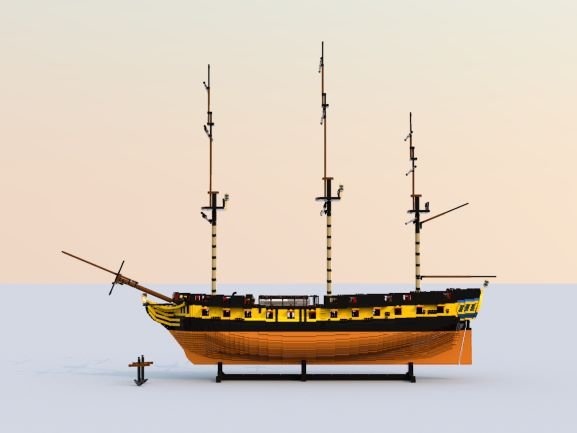
Never really used these three reasons for this thread: · Ever thought about posting a WIP but didn't think it would deserve its own thread? · Ever wanted to announce a huge, mind boggling, or simply your next project and ask your fellow EB members what they think about that idea? · Or have you ever just felt the urge to tease everyone with a blurred picture of your creation or some facts about it before releasing it for good? Here it goes… Just placed the brick-link orders for this baby. My goal is to have her finished during October. She is a redesign of an older LDD-MOC of mine. Kudos to whoever can guess which. To all you nerds: some boring details… She will be approx. 1.5 m long and 1.1 m tall (with masts). The model contains about 20.000 bricks.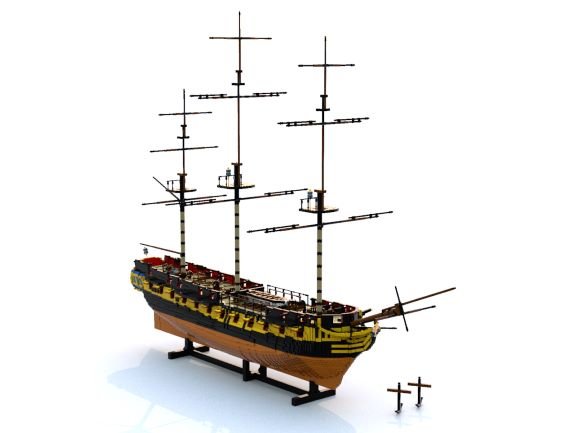
-
From keel to top
-
Magnificent. There is a lot of effort in making something like this. The amount of hours you have put in to this must be mindboggling. Details, details, overall curve, shape, color and yet more details… Thanks for the credit. Always fun to see the tweaks put on my creations. I see that the overall shape is indeed that of a deadly 18th century frigate. Wonderful post from 24th of july. The detailed description really tells how much you have done. I do feel your pain about the hull shape. This is has to be a compromise, one can always improve but will never be spot on like on a wooden model. However, it is so pleasing to the eye when the square bricks behave and make a curvy, almost organic shape. The stern is always a mindbender. I find that you also made some good decisions here. Moreover, I am a nitpicker: In my opinion, the masts are a bit too tall for a ship from this period. Other ships could have masts this tall, but 18th century frigates the main mast height tended to be about the same as the length from stern to firgurehead.
-
The features you describe places your ship before 1750’ish. Before that, there was even two deck frigates (rare) and sometimes 4th rate frigates (even more rare).The frigate design was (more or less) set after that, and a frigate would rarely have a poop deck later than that. In the age of sail, the helmsman would usually be placed on the quarterdeck. Some ships even had him below on the main deck. On smaller vessels, like a sloop (much favored by Pirates), the quarterdeck could be the only elevated deck on the ship. This is probably why fiction places the rudder-wheel on the poop deck. The fantasy bit gives you freedom to do anything, and you should go for it. Some fantasy designs I have made, would sink the moment they hit water. (With the helmsman firmly placed on the poop deck)
-
And here is another wall of text. The count of ½ gun is not official, but the only way I could make sense of the source material, I have researched so far. On the design of gun-deck: Gun-decks tended to close off as better gunpowder was developed. Early small frigates could have an almost open gun-deck. Like seen on a sloop or brig. On later frigates the gun-deck could be almost closed off just like on the HMS Lively or HMS Macedonian. http://todd.mainecav.org/model/macedonian/notes.html More on rating: On your color-scheme, I see that yours is a post-Napoleonic ship. On late large- frigates, the upper gun-deck could go all the way through. http://forum.game-labs.net/topic/3624-la-fregate-la-zenobie-4th-rate-52-gun/ These frigates were from a period where the frigate took over from the ship of the line as the main battle ship of a fleet. These frigates could be so large that the rating system I mentioned earlier did not apply. Some of them were even classified as 1st raters. If your intension was to build one of these behemoths. Your ship could indeed be a 4th rater. Secondary positions: There was always a balancing act of having maximum firepower and smallest weight. The guns were some of the heaviest equipment on the deck. The main gun-deck(s), held the largest cannons on the ship. On ships of the Line, there was a real threat of being outmaneuvered by a smaller opponent. Therefore, there were gun ports aft. However, these gun-ports were not permanent gun emplacements. Instead guns from elsewhere on the ship were placed here. On a frigate, the name of the game was speed. Therefore, there were gun ports fore. In the same manner as on the ship of the line, but in this case as an offensive option. The guns on the forecastle and quarterdeck were placed as the captain wished. Usually the alternative gun emplacement rule applied here as well. Sometimes there would be dedicated chase-guns. Especially if the ships main armament was not long-guns. However, these chase-guns usually had two gun-ports. This meant that they could be added to the ever-important broadside.
-
This moc blows me away. It is over the top entertaining. Cannons blazing, city in turmoil, wonderful build all over. Sure, there are details that could be different… This is the case for me to (every time). Thanks for the reference. I may steal something back.
-
Looking good. Custom made cannons is the way to go, and I really like your lantern. My experience is that the lower hull is more than half the work on a model like this. You already have this down, so just have fun with the rest of it. On facts. -Sorry this is geeky and lengthy-. Ignore if you want to. The HMS Surprise portrayed the HMS Providence from PotC. HMS Surprise is a replica of a 6th rate post-ship. (small 20- gun frigate) The number of guns is a tricky one. Guns on main gun-deck(s) count 1 each. For some reason guns on secondary positions: quarterdeck, forecastle… count as a ½ gun each. Swivel-guns and such does not count. The reason could be these guns: · Were usually lighter than the guns on the main gun-deck. · Were subject to weather conditions. Another tricky thing about guns. The main gun deck(s) usually have secondary positions for guns fore and aft. Rating-system at a glance. Ships of the line 1st rate three deck ships approx. 100 guns 2nd rate three deck ships approx. 90 guns 3rd rate two deck ships approx. 70 guns 4th rate the smallest ship of the line. Two decks with approx. 50 guns. Frigates 5th rate heavier frigates 30-40 guns. 6th rate lighter frigates 20-30 guns. Smaller vessels were unrated. The rating system was a guide to assess the relative strength of a ship in battle. However, it could be misleading and was in many cases. Just like any other assessment-guide.
-
And all that jazz. Just the right balance of lumpiness and elegance in the whale. Oh and the whole layout. Splashing over the top and all.
-
The barracuda is one of my favorite sets. So many details in this version. Tilted angles, great use of parts, kosher rigging and so on. And it is minifig scale!
-
General MOC-Discussion, WIP-Help, and Teaser Thread
Anders T replied to Kolonialbeamter's topic in LEGO Pirates
And I'm looking up at you doc. First of all make up your mind on how purist you are. More or less: What is the role of LEGO® in your creation? Are you building minifig illusion scale or scale model? I build in minifig scale 1:38ish’ (not to be confused with minifig illusion scale) I see the brick as an all-purpose substitute for anything that would be made of hard material in any other model: Plaster, plastic, wood, metal… Whether it is LEGO® depends on the hard material for me. This gives the freedom to choose what works best in terms of rope. Size: On my last models I used string in sizes 0,5mm - 2mm. Material: So far I have tried cotton and nylon. -Could be bought in most hobby-shops. …Next up is hemp. -Only found that in special ship-model-shops. -
Thanks man She is currently on display at a museum. I made that a separate topic above. I have built the oars, but for now, mainly due to size issues, she has no oars.
-
From 24. June to 20. August three of my ships will be on display. HMS Ontario Golden Hind A Penteconter Other LEGO ships on display will be Fregatten Jylland by Morthen Falk Poulsen And Jubilee Seaways by the employees of DFDS seaways There is also a smaller version the Jubilee on display. The seafloor below the Golden Hind was kindly built by Morthen Falk Poulsen.
-
I find that on early or ships such as a carrack or a galleon 2x2 stud gunports work fine. On later models like brigs, frigates and ships of the line 3x3 stud gunports seem more appropriate to me. In any case you should measure on the drawings. Work on one problem at a time. Either make a decision on your design of a possible opening of the hull and then go to the shaping. Or do it the other way around. -Do measure in LDD. If this is done right it makes the next stages of designing are so much easier. No matter what technique you are going for. On shaping: Here you should decide up front if you are going for something that relies on bending and twisting. - Can work very well: Or drawing with the bricks. Usually none of the standard LEGO® bricks (like guns, hullparts, masts, minifigs) work well on a scale model. This is where the challenge is.
-
Rating a snow I think Legostone has it right, and furthermore. Snow referrers to the arrangement of masts, but arranging the masts in a snow fashion was usually because the ship was too small for three masts to be practical. Whether a snow would be unrated or considered a 6th rater would be determined by her potential armament. I consider HMS Ontario an unrated vessel. Design Designing something like this with bricks is always a question of experience. I’ll probably look at her again a couple of years from now and decide to do a 3rd version. The sweeps are sticking straight out. Thanks for noticing, I think about making gravity (my archenemy) an ally in this case. Let them rest in a loose fit. Sweeps Thanks man, that was exactly what I needed to see. Pumps Nothing fancy. They are similar to the ones on my HDMS Lougen design. LDD file found here:http://www.moc-pages.com/moc.php/356786 Thanks. My aim is to make a brick model similar to a wooden model. My process is quite similar to what 3D artists do: Planning-measuring-perseverance. You know it Every flake is unique
-
The first MOC I uploaded was a model of the British snow (snau) HMS Ontario. Recently I decided to do a second version of the same ship. During this process I noticed some small square holes between the gunports. Researching this, I found out they were called “sweep ports”, and supposedly allowed the ship to be rowed. So I decided to experiment with oars. HMS Ontario version2 med årer .lxf by Anders Thuesen, on Flickr HMS Ontario version2 med årer bagfra.lxf by Anders Thuesen, on Flickr However I have never seen a model of a similar ship (sloop, brig, snow or frigate) with oars mounted. Why is that? A model of the HMS Ontario without oars would look something like this. HMS Ontario version2 uden årer.lxf by Anders Thuesen, on Flickr HMS Ontario version2 uden årer styrbord.lxf by Anders Thuesen, on Flickr Oars/No oars… What is the best choice?
-
There is a lot of measuring and calculation in the initial stages of such a build. Feel free to share and ask.
-
I recommend that you look here. And another Dutch ship from the same time period.
-
I do understand your wife, but Kurigan is right: Start small. To give you a specific idea on the size of what you are planning. Look at this Minifig- scale LDD version of a ship close to the size of HMS Roebuck. http://www.moc-pages.com/moc.php/298034 I designed it quite some time ago and would never attempt to build it as it is.
-
[MOC] Ship ''Halve Maen'' 1606 in minifig scale
Anders T replied to Captain Green Hair's topic in Pirate MOCs
Very cool indeed. I like your choice of techniques. Fx: A more or less consistant use of 15573/3794 to shape the hull Your use of tubes to shape the Crows nests Plates and hinges to shape the stern A thing it took a while for me to notice, was the fact that not only did you replicate the ship on the cut trhough, but also all the little guys.