aeh5040
-
Posts
790 -
Joined
-
Last visited
Content Type
Profiles
Forums
Gallery
Everything posted by aeh5040
-
 This is a truly epic build - congratulations! I too am a big fan of non-vehicle technic MOCs and unusual mechanisms. (Nothing wrong with vehicles of course, but it is harder to be original.) I spend a lot of time on youtube looking for non-Lego inspiration - search for things like "kinetic sculpture", "mechanism", etc. One thing I would like to see is a very large scale walker that can actually walk efficiently...
 -
So - the laws of geometry live to fight another day... Incidentally, there are numerous examples of Pythagorean triangles in official models. E.g. a yellow 6-8-10 triangle features prominently on the side of the 42009: And 3-4-5's form a vital part of the 9398 chassis: I'm not aware of any 5-12-13 triangles in official sets, but I'd be happy to be proved wrong on that... Blakbird???
-
Giant geared sphere
aeh5040 replied to aeh5040's topic in LEGO Technic, Mindstorms, Model Team and Scale Modeling
Yup, your calculations look spot on to me! The yellow version was mine as well. That was much easier because it doesn't need internal support. The yellow gears are not too hard to get hold of, but finding 50 red ones was a challenge! With just 8 of either type you can make an octahedron... -
Another kinetic sculpture for your enjoyment! Not much subtlety here - 50 Samsonite gears, 2 hailfire wheels, 60 #3 connectors, lots of 5x7 frames and 15L liftarms, 1 M-motor...
-
Technic Parts You Never Use
aeh5040 replied to DrJB's topic in LEGO Technic, Mindstorms, Model Team and Scale Modeling
-
Enjoy...
-
Here is my (WIP) entry. Not much subtlety here - one very simple function! Basically it is a pull-back motor and two "devastator" wheels, with three boat weights for balance. Plus I decided to blow about two-thirds of the parts on some rather unusual styling. Just under 200 parts at the moment - details of styling might change slightly. Video coming soon...
-
[MOC] Galloping Horse
aeh5040 replied to touthomme's topic in LEGO Technic, Mindstorms, Model Team and Scale Modeling
Wow, that's nothing short of astonishing! Very very well done. Any chance you could make instructions? -
Nope. "Hi" is a 2:1 ratio (geared up), "Lo" is 1:1, as Bzroom says. Just try it :) Differentials can be tricky ...
-
Well, of course it could be made more compact in various ways...
-
Here you go:
-
2.28 m tall Crawler Crane
aeh5040 replied to Sariel's topic in LEGO Technic, Mindstorms, Model Team and Scale Modeling
Wow, this is outstanding! A great example of what can be one by building smart and light rather than massive over-engineering (of course, that can be fun too!). Perhaps it would it be more manouverable and stable if the tracks were geared down more? -
Awesome work! I'm guessing quite alot more speed would be possible indoors on a smooth floor (maybe a gym or convention center). Those bumps really don't help...
-
[HELP] Pneumatic Walker
aeh5040 replied to Zerobricks's topic in LEGO Technic, Mindstorms, Model Team and Scale Modeling
I would definitely check out the brickshelf folders of Mark Bellis and Kevin Clague. There is also a list of old LUGNET posts that may be helpful. Since you only have 4 legs, you might need something like Kevin Clague's "one leg at a time" hexapod in order to keep balance: -
Impossible LEGO
aeh5040 replied to Boxerlego's topic in LEGO Technic, Mindstorms, Model Team and Scale Modeling
There is another pure lego solution to this one. First put a half-thickness liftarm onto the pin, then insert any minifig-tool type piece into the pin through the liftarm, and pull them off both together. I know it sounds unlikely but it works every time. (The tool enlarges the pin slightly making the liftarm grip it very tightly).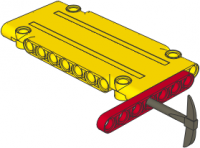
-
Nico71's Creations
aeh5040 replied to nico71's topic in LEGO Technic, Mindstorms, Model Team and Scale Modeling
Nice! Very original idea. The mechanism looks very different from what I was expecting... -
And a couple more
-
Thanks for the link! The mechanics are pretty straightforward - the hardest part was fitting motor, battery box and gearing inside,and then getting the center of mass exactly in the center (otherwise there would be a lot of wobble). I am indeed working on a rolling version! Here are some other variations on the theme using other gears:
-
If you want to do it without mindstorms then this is a solution (skip to 0:53 to see the control, and 2:14 for the internal mechanism - sorry for awful video quality). I think I may still have instructions for this...
-
Thank you very much for all the nice comments! Here are a few answers to questions. JGW3000: I will indeed try to produce instructions at some point soon. The paper is actually an annoying issue. In the video I am using two rolls of width 3ft taped together. This is not really big enough to complete the entire 256-step curve, and it is already a nuisance to handle and to get flat enough. Really I should perhaps redesign it to make the drawing smaller, although that would require putting the wheels "inside", near the middle of the vehicle. Gilbert Despathens, captainmib: The basic idea of a mechanical fractal-drawing machine definitely came first, and a dragon curve seemed a particularly natural choice because of the simple description, and because it looks interesting even without too many iterations. The lego implementation was by far the hardest and most time-consuming part. The Geneva mechanisms came first. There are several designs out there, but none of them quite worked well enough here - they need to be very precise and reliable, and yet have little enough friction to be able to have 6 turn each other in sequence and still have power to lift the side-arm. I'm happy with the final design for these. The motion is silky-smooth, and the 45-degree offset was achieved in a neat way. The other very hard part was the mechanism for turning a wheel by precisely one turn when triggered. I tried many many things here, including many which looked good in theory but simply didn't work, and others which worked fine "on the bench" but not under load. One just has to keep on trying different approaches. The "Armatron" design does work, and is just about reliable enough, but this in one area that could probably be improved further. legolijnte, Mestari: As will be apparent from my youtube channel, I have a strange obsession with doing mechanically what other more more sane individuals would do with Mindstorms.... Philo: Yes, Wikipedia is your friend here - I have now added some links. You are right about the way it works: when the k-th bit of Gray code changes, exactly the first k Geneva wheels make a turn, and only the k-th one triggers the arm mechanism. Since each axle has two cams at opposite ends pointing in opposite directions, at the times when this happens it is alternately the left and right sides that get triggered. So we get a left turn or a right turn according to whether the Gray code bit is changing to a 0 or a 1, exactly as in the wikipedia description. The last axle is different - it has 3 cams on one end (at 90 degree offsets) and 1 on the other, in order to get the "twin dragon". TinkerBrick: Yes, I think a few other curves might be possible with minimal changes - haven't thought about this properly yet. Definitely with some more extensive redesigns... D3K: the motor is indeed working hard. It is better than the many previous designs where it would stall completely! Victor Kojenov: it was definitely BrickCon 2012 (I didn't make it to 2013)
-
Here is by far my most ambitious project. It is a purely mechanical device which draws a fractal curve, driven by only one motor. So far as I know, this is the first time such a thing has ever been done in any medium, Lego or otherwise! Specifically, it draws a Heighway Dragon Curve, a space-filling curve that never crosses itself. It in fact draws a "twin dragon" which would in principle join up to form a loop, given enough time, floor space, and paper. (In practice, slight inaccuracies mean that it would not quite join up). I actually made this over a year ago (and it was the result of about a year of hard work), and showed it at BrickCon 2012. The long delay is partly due to the difficulty of filming it! The "brain" on the top layer consists of a series of Geneva mechanisms. These required many designs to get the motion smooth and precise enough - they also require a 45 degree offset. Each Geneva wheel is connected to two cams, one on the left side, and one on the right. The cams lift the two levers running along the sides in a particular sequence, related to Gray code (a variant of binary counting). When translated to left and right turns, this gives the Dragon Curve. The bottom layer contains two identical mechanisms controlling the two wheels, to enable precise turns. When one side is triggered by a cam, the wheel on that side needs to make exactly one turn. After many failed attempts, I was able to do achieve this using a variant of the "Tomy Armatron" mechanism (which was discussed here before), combined with a Scotch Yoke linkage. A worm drive ensures that the wheels are locked and cannot turn when not triggered. Enjoy! Here is what it would theoretically draw, after 256 turns, given enough space:
-
Genius! I love it. Reminds me a lot of some of the creations of the legendary akiyuky, especially these:
-
Thanks for the (re-)post! This is by far my most popular MOC on youtube. It worked nicely at Brickcon - sometimes people don't see what it is at first, and then they suddenly realise! Of course, making it into a multi-digit counter would be nice, but requires some kind of of powered carry mechanism, which I don't really know how to do. (Or NXT, but that would be cheating in my view).
-
Mecanum Wheels
aeh5040 replied to Zerobricks's topic in LEGO Technic, Mindstorms, Model Team and Scale Modeling
That's a great idea, and nicely executed. However, I suspect this construction would not be strong enough. The axles running through the special tires would have alot of bending force on them. And I suspect the radial axles might have a tendency to pop out as well. Can you find a way (within the demanding constraints that you point out) to support the tires at both ends? -
Short Axle Connection
aeh5040 replied to Boxerlego's topic in LEGO Technic, Mindstorms, Model Team and Scale Modeling
I would just move the top connection point one hole to the right and the bottom one hole to the left. Then two 4L axles will exactly fit!