

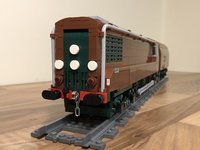
Hod Carrier
-
Posts
1,007 -
Joined
-
Last visited
Content Type
Profiles
Forums
Gallery
Everything posted by Hod Carrier
-
Vehicle Dynamics Laboratory investigates the Castering Effect
Hod Carrier replied to Hod Carrier's topic in LEGO Train Tech
Thanks for the input. I value your criticisms because it helps to refine the designs and move towards a better understanding of the mechanics of the problem. You're absolutely right to highlight the weakness of the passive steering design. Although it works quite well in some situations it works less well in others. For example, it is the cause of derailments on points/switches because the leading axle is being incorrectly steered through the gap in the frog when it should really be centred. I would have preferred to allow all axles to move independently of each other, but I was experiencing issues with the last axle derailing when the cars were being pushed through bends. This is where I have found passive steering to work particularly well because it steers this last axle into the bends and prevents such derailments. The self-centring issue with the last vehicle seems to be caused by friction in the pivot because physics dictates that the trail in the axle pivot should be sufficient to cause it to centre. However, until this can be overcome (I'm currently considering adding roller bearings) the only way to centre these axles is by applying some force to them. I resisted the temptation to add elastic bands because I didn't want to restrict the freedom of the axles to pivot. I was hoping that the force exerted through the couplers would be enough, although it appears not to be sufficient. I would be interested to see how the last axle behaves under the influence of the elastic bands because it is not obvious to me what force would be acting upon it to induce it to steer. I'm going to modify the VGA vans to use your idea and see how things go. If it proves more reliable than the solutions I have come up with so far then I shall be happy. At the end of the day, my aim was to discover whether or not it would be possible to make long wheelbase vehicles that can operate successfully on standard LEGO track. So far it seems that there are a range of solutions. I hope that others may be spurred on to possibly discovering further solutions to this problem. -
Thanks everyone for the kind words. I’m glad to have brought smiles to so many faces.
-
I would say that lighter trains aren’t necessarily a bad thing. Lighter cars with heavier locos (PF helps with this) means longer trains.
-
[MOC] Dual-voltage (9V-12V) GySEV Vectron locomotive
Hod Carrier replied to Ashi Valkoinen's topic in LEGO Train Tech
Blimey!! You've been busy. That's some very clever engineering packaged in a fantastic bundle and wrapped up with a bow. Very very nice indeed. -
@LEGO Train 12 Volts Wow!! That's a beautiful wagon. I estimate it's about the same length as the VGA but a much more challenging (and rewarding) shape. Whoever produced that must be proud to have that running before an appreciative audience. @zephyr1934 It would be remiss of me not to.
-
Thanks everyone for the kind words. @ColletArrow I guess a Cl58 might be an option. We shall see. @MAB You're right, it's not ideal to have the stickers breaking across more than one part, but I didn't have many alternatives. As you say there is no 2x6 tile so there were always going to be joins where I didn't want them, so I had to decide how many I was willing to put up with and in which direction they would run. In the end I opted for the results you see here which, for the sake of consistency, I have continued onto the panels that are just 2x4. If TLG ever bring out a 2x6 tile I shall swap the body panels over in a heartbeat. @baard Having shared the videos of the prototypes undergoing testing, I suppose I should also make a video of the finished models going for a spin. I'll try and get something done before the end of this week, but time is tight at the present moment. @Paddi I wanted the ribs to be only 1 plate thick, but they had to be 1.5 plates thick for mathematical reasons. It was the only way I could get the right number of panels and ribs in the length of the vehicle. Ha ha!! They look good but they're really only cosmetic and not actually part of the structure of the car.
-
European freight cars: gondola and detailed tank car
Hod Carrier replied to Brickwolf's topic in LEGO Train Tech
I stand corrected. -
Noted. It is quite a dark model and I make no claims about being a photographer. These are just snaps.
-
Thanks for the wonderful feedback. I'm glad you're liking them too. @ColletArrow I suppose I really should think about some motive power for these, and maybe a few more wagons to join them, but it might be a long-term project. Because Class 20s usually went around in pairs I was thinking I should probably opt for something double-ended so that I would only need to build one. Regional bias dictates a Class 31 but I suppose a Class 25 or even a Class 33 would do. Watch this space, as they say. @FLBRICKS The stickers are perhaps easier to make than it appears. I do the layout on my netbook using MS Word. I prefer to set out a table so that I can control the size of the final print by changing the cell sizes and I find it's the easiest and most predictable way of getting the results I want. Then I add text or images and tweak the sizes, fonts and colours until everything looks right. Once I'm happy I turn the print quality up to maximum and run off the required number of copies. The fact that the graphics have remained legible is just down to good luck and good materials, I guess. I have a normal desktop inkjet printer (an Epson XP202) and print onto inkjet vinyl sticker paper which you can buy online (I get mine from www.photopaperdirect.com). One crucial thing to remember is to leave the printed sheet to dry for a while before handling it and then to give it a couple of passes with an aerosol craft sealant to prevent the printing from smudging, because the printed sheets are not waterproof and are prone to smudging even from normal handling. Then it's simply cut, stick and admire your handiwork.
-
European freight cars: gondola and detailed tank car
Hod Carrier replied to Brickwolf's topic in LEGO Train Tech
Seems like a good week for freight stock. I do like these little wagons. The two-plank dropside wagon (I believe "gondola" is a peculiarly American term) is very sweet. I can just imagine a gang of men shovelling ballast by hand over the side to their colleagues on the track ready for some old school manual lifting and packing. The extra details on the tank wagon are excellent, although I'm not sure about the brake platform, and not just because of the balance issue. It's simply that I'm not sure that European tank wagons such as this ever had such platforms (although I'm happy to be corrected). Certainly this wasn't the case in the UK where the wagon handbrake would be operated by a lever at the side of each car. Rather than providing a nice platform to ride on, the shunter was expected to jog alongside wagons being loose shunted and apply the handbrake with a stout pole called a brake stick. Or perhaps I shouldn't be such a pedant and just enjoy these little wagons for what they are. -
That's exactly the effect I was hoping for and precisely the reason for choosing this colour scheme. The black/reddish brown is the same as that used on the Speeder Bike set. Thanks. It's certainly different. I've taken a few standalone photos as requested. One is posted below but you can click through to my Flickr pages and see the rest.
-
I expect folks might have been wondering if all the work on castering and passive steering was going to lead to anything. Well, the answer to that is "yes". Not only was the intention to contribute towards the knowledge base of the community but also to lay the groundwork for a model. And here it, or, more accurately, they, is/are. These are a pair of BR Railfreight VGA vans in "as built" condition. The VGA is a 42 foot van with a wheelbase of 29 feet 6 inches designed to carry a 29 tonne payload and with a cubic capacity of 75 cubic metres. Based loosely on a German design of van built for Ford UK, these vans had curved bodysides meeting a narrow central roof strip. Each side was formed of a pair of light alloy sliding doors that gave 7 feet of vertical clearance, allowing for easier loading and unloading using cranes or forklift trucks. Following the construction of a single prototype in 1981, a fleet of 250 VGAs was commissioned the following year. Since that time they have carried everything from explosives to bottled water and the majority of the fleet is still on the books as at the present moment, although the traffic for this type of vehicle has dwindled in recent years. However these vans can still be seen in use as brakeforce vehicles, particularly involved with the movement of new multiple-unit passenger trains. The model is largely 7-wide, although the running boards and brake handles probably make it 8-wide in total. Using the scale of 1 stud = 15 inches the body comes out at 34 studs long with a wheelbase of 24 studs. Some idea of the length of the model can be appreciated in the photo below (even though it's not the greatest quality). I've opted to use passive steering for the axles in exactly the same way as in my earlier experiments. As ever, all the stickers are homemade by printing directly onto self-adhesive vinyls. Even at such small scales I'm pleased that both the TOPS data panel and the door operating instructions remain legible. And how the real vans looked. Comments are invited as always. Speaking for myself, I'm very pleased with these models because they are not only my first "full scale" LEGO railway vehicles, but they are also the first that haven't had to go through any sort of redesign during the build phase. No additional bricks were required and my stock of surplus parts didn't grow as a consequence.
-
Just thought I'd share this with you. In line with the fashion for putting Star Wars character figures on Technic motorbikes TLG have finally caught up with the one figure that I felt was appropriate. However, the bike itself needed a few tweaks in terms of it's appearance to make it look right. I'm actually quite happy with the way the colour scheme has turned out, even as a standalone model without the figure. I hope you all like it too.
-
@Capparezza You make my point for me very succinctly. Thank you. Indeed, TLG is not interested in us and sees us as a very niche market. Therefore they won’t invest in large, complex sets of the type that AFOLs will find satisfying. Certainly they won’t be looking to keep up the momentum to drive forward a Trains theme. Therefore it is pointless for us to keep on hoping that somehow they’re going to do precisely that. There are two possible ways to address this. The first seems to be the approach you espouse which is somehow to increase the market, which I addressed in my post last night. For adults it’s a case of showing what is possible, as @zephyr1934 suggested, and for kids it’s about selling toys to the parents. I certainly do understand your point, but it’s a bit “chicken and egg”. Does the supply create the demand or should the supply be in response to demand? That’s where business decisions are made, and I think TLG are experienced enough to work that out. Based on the My Own Train experiment I’m not sure that the supply does drive the demand. Now there’s obviously a discussion around the relative merits of that theme, but I would imagine that it’s not necessarily an experiment that TLG will wish to repeat.
-
Yes, and I have done so deliberately because this is a community of AFOLs and that is who I am addressing my comments towards, and it seems that the thrust of the discussion is around what's in it for us, both individually and as a community. I have admitted my bias against sets based on my own prejudices and experiences, but I have also said that there is a place for sets. I make no claims concerning the size of the market nor the levels of demand, but as you have raised the point I do wonder if this demand is largely from the collectors of sets or those who want the items for play or to add to their layouts. If it's the former then they will only be satisfied with the box containing all the parts, but if it's the latter there are alternative ways of getting what they want. Bricklink gives them the list of parts needed and access to a marketplace to purchase all they need while the Official Sets in LDD thread allows them to download the .lxf file for each set showing how the parts all go together. Alternatively, LEGO is sufficiently flexible to allow people's imaginations to run riot and come up with all the trains, vehicles, buildings and infrastructure that they desire in the styles, shapes and colours that they want, rather than relying on the restrictive offerings inside the average LEGO branded box.
-
I don't normally wade into discussions about sets because sets don't especially interest me, but if there's one thing that this thread illustrates it is that there are so many competing ideas that it would be impossible for TLG to cater to all of them. Do they go for steam, diesel or electric? Something following American or European styles? Track or no track? What about PF? Full sets or stand-alone vehicles? I'm sure if anyone is reading this discussion in Billund they will be scratching their heads trying to pick all the bones out of this and come up with a strategy. I have to say that I do agree completely with @zephyr1934. If we're primarily concerned with getting new AFOLs to take up the trains theme we ought to forget pushing TLG's woeful official offerings and instead we should carry on blowing their socks off with awesome MOCs that show just what is possible using nothing but LEGO bricks and some imagination. Serious mature rail modellers are interested in hyper-realism and showing them that it is possible to achieve this using nothing more than the humble LEGO brick is likely to pique more interest than waving an official set under their noses. If they really need a route into the hobby by means of an official set, these already exist. It almost doesn't matter what the set is because I am sure that it would be unsatisfying to people like this no matter what it is. Alternatively, it doesn't take very long to find LDD, Bricklink, this community and lots of excellent inspiration on sites like Flickr and they'll be off and running, as I was. The same applies to getting kids into the hobby, because they really only care about it's play value. It doesn't matter how much we wail and gnash our teeth about helicopters and bank robbers and how many vehicles there are in the high speed passenger train because kids LOVE all that stuff. In this regard, TLG have got it spot on. What a child is likely to remember is how much fun it was playing with it, how you could crash it over and over again without ruining it and how you could change and customise the vehicles to suit different play scenarios. I would argue that the target audience for toys like this (for toys are what they are) is not the kids of any age but rather the parents who may be more interested in giving their child a robust and versatile toy that is likely to hold their interest more than a competing product that may only do one thing. I will admit to being slightly biased against sets. Maybe it's because my childhood experiences of LEGO did not feature a single set of any type, but rather sorting through my available bricks and working out what I wanted to build and how I was going to realise it. As a consequence I do find this reliance on TLG to provide us with official nourishment a little depressing when we are just as capable of going away and imagining what we want to build and then turning that imagination into reality. Naturally not everyone is going to immediately come up with a hyper-realistic 10-wide Big Boy, but that doesn't matter. Those people who can produce such amazing models provide the inspiration for the rest of us while others may wish to plough entirely different furrows. Such is the versatility of the hobby that the possibilities are limited only by our imaginations. I know I've said this before, but if there's one thing that I would like to see come out of TLG's lackadaisical attitude towards official trains releases it is the desire amongst the AFOL trains community to go out and build the models that they feel TLG should be releasing for themselves. At least then we can not claim to be disappointed in any way. I'll close by saying that I do not believe that TLG has forgotten about us as long as trains of some sort are being released. It almost doesn't matter what sort of dross it is as long as wheels, motors and track continue to find their way into the secondary market.
-
Self-centring is necessary if the coupler is to work properly. Even the couplers on real trains self-centre, not to mention having structures in the coupler heads themselves to align the heads during coupling. If they didn’t have these things it simply wouldn’t be possible to reliably couple trains together. And real trains don’t have to contend with LEGO-like curves so the couplers don’t require the same degree of movement as LEGO trains.
-
Vehicle Dynamics Laboratory investigates the Castering Effect
Hod Carrier replied to Hod Carrier's topic in LEGO Train Tech
Another little video to have a look at showing a few additional tests I carried out. Click on the pic below to see how things have progressed. If you'd like to build one of these vehicles yourself or use the principles for a MOC of your own you can download the .lxf file for the chassis mechanics. Notes on the download: Due to some issue with LEGO Digital Designer the centre axle in the passive steering link is not the correct length. It should be 7 studs long not 6 studs as shown in the file. If using the steering link take a few moments to adjust the length of the link so that both axles centre correctly. The floating 1x2 plates are the axle deflection stops which prevent excessive movement. These will need to be attached to the underside of whatever chassis you wish to build. -
Vehicle Dynamics Laboratory investigates the Castering Effect
Hod Carrier replied to Hod Carrier's topic in LEGO Train Tech
I've been asked a couple of times over on Flickr how these vehicles perform on LEGO points/switches. Embarrassingly I hadn't actually got any points to test them on, but just today the postman brought me a pair that I had ordered specifically for the purpose. So this evening I set them up, put the train in motion and, well, click on the box below and see for yourselves. -
Vehicle Dynamics Laboratory investigates the Castering Effect
Hod Carrier replied to Hod Carrier's topic in LEGO Train Tech
@icemorons The "bunching" issue isn't caused by the last axle but by the pivots for the magnets on the couplers. It's like trying to push something with wet spaghetti. It's true that locking the last axle should also have the effect of locking the other axle on the same car via the steering link, but the next car would still "bunch" because of the magnet pivots. The simplest way to deal with "bunching" is to have rigid couplers between each car (effectively a Jacobs bogie), but the trade-off with that arrangement is that you limit the movement of each axle relative to each other and I think I'd probably lose something in the forward motion stakes if I did that. I'm sure that there may be other alternatives, but it's difficult to work out how each vehicle would "know" it's on a straight and not a curve. It couldn't do it through the motion of the couplers because "bunching" creates the same movement as going forwards through a curve, and in this circumstance it's a motion that I want to create. The only way would be by reference to the track, as @jtlan's Umbauwagen 3yg does, or by reference to the body positioning relative to the neighbouring car. I'm starting to be of the opinion that I can live with "bunching" provided that it doesn't cause derailments, and the increased weight of these vehicles compared to the first proof-of-concept prototypes seems to prevent that. Using a passive steering link on the last car does at least steer the last axle into the bends and seems to keep things relatively ship-shape and Bristol-fashion. The last car issue that I'm having at the moment is trying to get the axles to self-centre when they come out of a bend. They do manage this in the end, but it's mostly done by applying more speed which increases the draw force through the couplers. In this respect the passive steering link can help because if I apply enough power through the coupler to centre the first axle the link will see to it that the last axle centres also. -
It sounds as though you're making some good progress there. I'm still a little surprised at the gear ratios you've selected, but you have clearly done your homework and selected them on the basis of sound scientific evidence. What scope is there to modify the motor itself? I'm just wondering if there was any way to change the spring for something more suitable (longer...? softer...?) that would give it's power in a more controlled, gradual manner more appropriate to railway operations. I was just wondering if you'd got access to a motor that's already blown up that you could explore the inner workings of.
-
Vehicle Dynamics Laboratory investigates the Castering Effect
Hod Carrier replied to Hod Carrier's topic in LEGO Train Tech
A little update for you all. The second prototypes have been built and tested and the results are in. I have hit a bit of a snag, which you will see if you watch the video all the way to the end. The failure of the last axle to centre on it's own is vexing me. So far I've tried; altering the distance between the pivot point and the axle to see if more force could be exerted on it to make it centre, adding and removing weight, changing the pivot design from a 2x2 turntable plate to a pin and hole, and raising the chassis so that there is no way that the underside could possibly rub against the top of the axle assemblies and create friction preventing the assembly from turning. Frustratingly none of these attempted fixes have had any affect whatsoever. About the only thing that makes the last axle behave correctly is increasing the speed. I can only conclude that the problem is being caused by internal friction in the pivot, so I'm giving serious thought to stopping at the RC model shop on my way to work and picking up some sort of plastic-safe grease to sparingly apply and see if that helps at all. While I was tinkering I thought I'd have a look at passive steering. The results of this are mixed. The centring problem affecting the last axle makes this test a little inconclusive, and actually makes that problem worse. While the axles move independently it's only the last axle that fails to centre, but physically linking them using a passive steering system means that now both axles on the last car fail to centre. There is also some issues with axles being steered the wrong direction, but this is actually not as bad a problem as I anticipated before. It's actually quite a fleeting phenomena and the axles are not deflected too far for binding to be a big issue. That said, it does help when propelling (pushing) a train because the last axle is being steered into the bend under the influence of the passive steering rather than doing it's own thing and potentially causing a derailment. However, as predicted, passive steering does not prevent "bunching" as that has more to do with the manner in which the vehicles are coupled. Basically what's happening is that I'm trying to push something with a hinged bar, and of course that's not a great recipe for success. As a result of these tests I think that, on balance, if you were wanting to run a formation of long wheelbase vehicles you could get away with having free-castering vehicles and only the first and last vehicle using passive steering. Your comments are invited. I'm interested to know what you all think and what suggestions you may have for things I might have missed. **EDIT** Images are clickable video links. Enjoy!! -
Forgive me if this is in the wrong section. I'm looking for recommendations for a UK-based trader to carry out some custom printing onto LEGO parts. Google throws up masses of hits but I've no idea where to start. Quality, price, reliability and the openness to tackle a very small number of parts are my selection criteria. Thanks in advance.
-
I look forward to seeing how you get on. When I mentioned the gearing I was thinking more about gearing it down rather than gearing it up. Or has that already been tried?
-
The pullback motor probably isn't the best candidate because it's designed to give all it's power quickly to produce a rapid burst of acceleration rather than a gradual release of energy for longer running. However, I do admire your enterprise in trying to get it to work. I'm not familiar with clockwork motors so I can't help much with governors. I've had a quick read of the internet and it seems the most appropriate type might be a centrifugal brake of some sort, but I'm not sure if LEGO is the right medium to build such a thing. Probably the most LEGO-friendly governor would likely be a fan, but that's going to look weird sticking out of the top of a train. Maybe it's going to come down to finding a way of using the power delivery of the motor in the most efficient way possible. It looks like you've got the drive geared quite high; something like 1:5. If you're getting loads of wheelspin when you release the brake, the motor is just spinning a lot of it's power away uselessly. It also sounds like the top speed is too high if it can't manage curves. Have you tried any lower gear ratios? If you could get the power from the motor down on the rail with less wheelspin you might find that the train travels further and at a more controllable speed. Another consideration might be the weight of the engine. Train wheels don't tend to grip very well, but increasing the weight can help increase the wheel adhesion which would help reduce wheelspin. A heavier train also has greater inertia, so it would accelerate more gradually.