Search the Community
Showing results for tags 'transit'.
Found 5 results
-
 Model of a 2003 New Flyer D60HF articulated bus from Metro Transit in Minneapolis-Saint Paul, Minnesota. The model features motorized drive, steering with working steering wheel, a removable Cummins ISL engine model, and pneumatically operated passenger doors. Functions/features: Drive Steering Working steering wheel Removable Cummins ISL engine model with moving pistons Pneumatic passenger doors Instructions available on Rebrickable: https://rebrickable.com/mocs/MOC-245043/JLiu15/2003-new-flyer-d60hf-metro-transit-bus/#details In the 1990s and 2000s, Metro Transit in Minneapolis-Saint Paul, Minnesota ordered a large number of New Flyer D60 high floor articulated buses. Nicknamed the Galaxy, the D60HF entered production in the late 1980s and was produced until 2006 as a final option of a Metro Transit contract. The final units produced for Metro Transit in 2006 were the last high-floor articulated buses ever built in the United States and Canada. Over the years, Metro Transit's D60HF buses were gradually replaced with newer New Flyer D60LFR and XD60 articulated buses, and the final units in Metro Transit's fleet were retired in late 2021. My model depicts bus 3143, which is a 2003 model built in January 2004 and now privately owned by a friend of mine in Pennsylvania. Prior to its retirement, 3143 operated out of Metro Transit's South Garage, and later out of Heywood Garage in May 2020. A number of 2003 units were already retired by Metro Transit in 2016, but 3143 and several others were returned to service in May 2020 to provide space for social distancing amidst the COVID-19 pandemic. The remaining units were also retained for service during the 2021 Minnesota State Fair in August-September 2021, and were retired shortly after. 3143 operated in revenue service for the last time on September 5, 2021 and is among the final D60HF buses in Metro Transit's fleet to operate in revenue service. I had the opportunity to see 3143 in-person at the 2022 NJ Historic Bus Festival, which inspired me to eventually build a LEGO version of it. The building process began in summer 2024, starting with the rear section's chassis. Because the model was likely going to be heavy when finished, I used two Power Functions XL motors for propulsion. The two XL motors are placed transversely in the chassis, between the rear door and the rear axle, and are hard-coupled using knob wheels. Placing the motors longitudinally would have required more length, which was not ideal as the rear door and rear axle are relatively close to each other. This section is designed to be very compact, with the two XL motors taking up all available transverse space between the outer body panels and the rear door and rear axle placed as close as possible to the motors. This allowed me to still have space behind the rear axle to include a Cummins engine model, as the real-life version is powered by a Cummins ISL engine. Thanks to the high-floor design of the original bus, I was able to include a floor made using flat Technic panels, with gaps kept to a minimum. This had the benefit of keeping many mechanisms hidden as well, such as the steering mechanism, which is placed entirely under the floor except for a small portion of the PF servo motor that's exposed. The steering motor's output is also connected to the steering wheel. Unfortunately, some of the bevel gears connecting to the steering wheel are exposed as their diameter prevents covering them with Technic beams/panels. A challenge for this model is the articulated joint with seats in it - the real-life version has four passenger seats in the articulation joint's turntable which rotates halfway relative to the front and rear sections during a turn. Keeping the floor continuous here was particularly challenging as it is perfectly circular on the original bus, and perfectly round shapes in LEGO are rather difficult to create outside pre-made circular pieces. In the end I went with a design using panel fairings 2387/2389 around the perimeter of the floor section at the articulation joint, and the floor flows pretty seamlessly from the front to the rear section. The bellows use the same principle as in my New Flyer XD60 model, but thanks to the floor section at the articulation joint, I was able to keep all the rubber bands maintaining the shape of the bellows hidden beneath it. There are 68 passenger seats (34 in the front, 30 in the rear, and 4 in the articulation joint), consisting of a mix of high-back and regular ones. Another friend of mine owns bus 3200, a 2006 model, and I was able to design the seating layout exactly like in the original bus thanks to photos provided by him. AFAIK, the 2003 and 2006 models are largely similar to each other, and many of my model's details were done accurately thanks to his photos. Above the chassis and interior, there is a Technic roof frame in both the front and rear section housing two independent pneumatic circuits for the front and rear passenger door. Because the two passenger doors are independently controlled, I made each door use its own compressor and valve instead of e.g. having them share a compressor but using their own valves. A PF L motor is used for each of the pneumatic circuits, driving both the compressor (geared up 5:3) and the valve through a clutch gear and 3:1 reduction. The compressor/valve setup is built in a compact manner to ensure a mechanically efficient mechanism as the clutch gear slipping and the compressor add a significant amount of friction. They are placed below where the roof AC units are located in the finished model, as the valve's lever extends past the roof height slighly when passing through the middle position and the roof AC units can be designed hollow to allow the lever to pass through. Although I tried to ensure that the hose lengths for the front and rear sections are largely identical to each other, I still noticed the rear door to open and close slightly faster than the front door. Nevertheless, the pneumatic doors are one of my favorite features on this model, because its movement is much more realistic compared to if it was purely mechanical (e.g. a linear actuator or a worm gear). Designing the bodywork was relatively straightforward, and because Metro Transit uses a yellow and blue stripe for the livery, I was able to easily make it using LEGO pieces. This kept the need for custom stickers to a minimum. I had already designed much of the bodywork in Stud.io by January 2025, and the Metro Transit livery was recognizable even without stickers. I also like how the front destination sign turned out, as the protruding curved destination sign design is one of the iconic features of New Flyer high floor buses. This is further pronounced by the fact that Metro Transit has the area around the destination sign painted in yellow, and I feel my design captured the color break here pretty well. I also like how the rear turned out, especially for the rear grille and destination sign. However, there were still some shortcomings with the design, especially with the front and rear lights. The amber turn signal lights on the front and the two center brake lights on the rear of the real bus are much smaller, and it was difficult to go smaller than one-stud width for these lights. The side windows also had some inaccuracies which I feel could've been remedied by considering the body panels' design while designing the chassis and seating layout. Because of the position of the doors and seats, I had to make some windows smaller/larger than others by a stud (when they look to be all the same size on the real bus) to prevent the windows' positions from looking out of place relative to the doors and seats. The roof is largely made using 6x6 tiles, and because the PF rechargeable battery box is placed near the rear of the model facing upward, I added a switch on the rear that can be used to press the power button on the battery box, as well as remove a section of the roof to access the battery box for charging. The roof AC units on the real bus are sloped towards the top, and thanks to the 5540 piece becoming available in white, I was able to capture the slope shape of them while maintaining a seamless finish with the top surface primarily made using tiles. I'm overall satisfied with this model turned out. It is my fourth motorized bus model and my largest MOC to date (with over 6600 pieces). The model performed well mechanically, and the two XL motors do not struggle at all to move the heavy model. While I was initially concerned about the pneumatic door mechanisms having more possible points of failure than a purely mechanical design, the doors worked as expected every time I opened and closed them. Despite some shortcomings with the aesthetics, I had a great time designing and building this MOC, especially with this being my first time doing a model of a specific unit privately owned by a friend. It's also my first model of an older retired bus, as my previous bus models were all of newer buses in active service. Video: Photos:
 -
All my bus models up to this point have been of buses currently in active service. However, my next bus model will be of an older, retired bus: Metro Transit's 2003 New Flyer D60HF. Metro Transit, the transit operator in the Minneapolis-St. Paul metropolitan area, ordered a large number of New Flyer D60HF articulated buses in the 1990s and 2000s, with the final buses in 2006 being the last high-floor articulated buses ever built in the US and Canada. Over the years, they have been gradually replaced by newer New Flyer D60LFR and XD60 articulated buses, and the final D60HF buses were retired by 2021. A number of units were bought by private owners after retirement, such as #3143 (a 2003 model), which was exhibited at the 2022 NJ Historic Bus Festival. My plan is to make my model be of bus #3143; the simple yellow/blue livery should be easy to build in LEGO so the amount of custom stickers for this model should be minimal (only the fleet numbers, Metro Transit logos, and destination signs come to mind). Thanks to the high-floor design and the boxy build of the original bus, it should be easier to incorporate mechanisms into this model as opposed to my New Flyer XD60 model as New Flyer Xcelsiors are low-floor buses. The chassis can be reinforced much better (I could probably make it 5 studs high throughout the bus, same as the rear section of my XD60 model), and I may even be able to place all electronic components and mechanisms in the chassis without placing any (e.g. the doors mechanism) in the roof. The model will use Power Functions motors and will be controlled by SBrick. The tentative list of functions/features for this model is: Drive (with two XL motors; my XD60 model with one XL motor felt a little underpowered) Steering (with working steering wheel) Pneumatically opened doors (one of these per door) Cummins engine model (with new engine elements from 42170 Kawasaki set) Bike rack (removable) The design process starts out by using my New Flyer XD60 model as a base to determine the locations of various features (axles, bellows, etc). I plan to use 49.5x14mm tires for this model, as they offer better proportions than 49.5x20mm tires. The middle and rear axles with double wheels can also be spaced further apart, allowing me to use a 5.5L axle with stop and thus prevent the half shafts from pulling out from the differential under load, an issue experienced with my XD60 model. I still need to determine the seating layout of the original bus, which will make it much easier to design the chassis without needing to make adjustments later on for the passenger seats. I also plan to use the new engine elements from the 42170 Kawasaki set in the Cummins engine model, as the axles-and-bushes design is a bit noisy and I've found it to jam a few times too when using it in my previous bus models. Side note: I have found the new Kawasaki engine pistons to not "click" properly in place to a liftarm, stud or the crank disks in Stud.io - maybe this is just due to these parts being new and not having been really refined yet in Stud.io? Would love to hear any other experiences with this. There's still much to be done, but I'm looking forward to this MOC. I've already built an articulated bus model, and this one should be more straightforward with the high-floor and boxy design. I strive to add something new in every one of my bus models, and I'm curious to see how the pneumatic doors turn out (all my previous bus models used mini linear actuators or a worm gear for the door). If you guys have any suggestions for me, please let me know.
-
 Hi folks, today i want to share with you my latest MOC. The towing truck from a car museum called Halle77 located in Dortmund Germany. It all started with me fiddling on a Frontaxle design with steering and drive and the question what to do with it back in february this year. I thought it would be perfect for a van / transportvehicle and while building an watching youtube the idea in my head was born to build the towingtruck of said location. The strange part about this partivular vehicle is the way it tips its bed. Instead of simply tilting the bed the whole truck bends its chassis. So the cabin and the bed tilt away from each other. This function is managed by this big linear actuator Between the rearaxle is a simple gearbox to switch to another function: extending the ramps from the bed Here is a picure from the belly And now more pictures from the almost finishid build. I've adjusted the position of the winch to be more inline with the real thing but i can't upload the pictures at the moment. Hope you liked / enjoyed it. If there's any questions feel free to ask. Thanks for watching!
 -
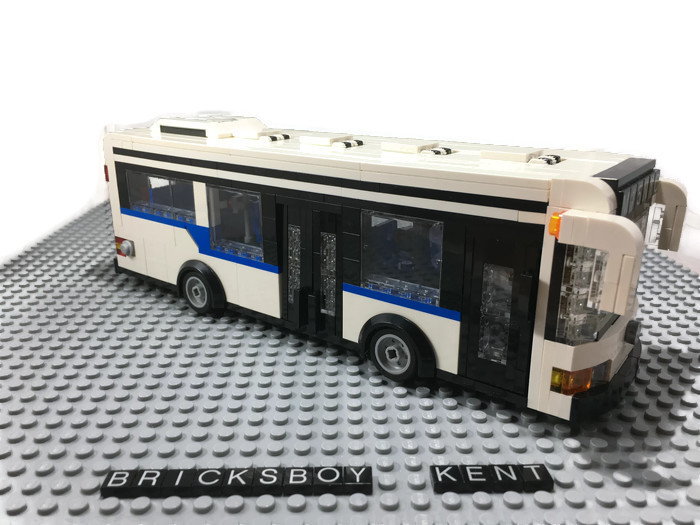
My model is a city bus with New York City MTA livery. I have put more detail on this model comparing to the lego buses in current or past city sets. The reason to build this bus is to provide Lego fans specially to kids to have a Lego bus with the more realistic look. Bus is a popular vehicle type among children. I remember when I was a child, I always wanted to own a great looking lego bus. I believe I am not the only one who has same wish. I submit the project to LEGO Ideas. More pictures can be seen in the Lego Ideas link. I also uploaded the tutorial video to Youtube. I hope you like it and support my project. Thanks you :) Lego Ideas Link Youtube tutorial link My other MOC models: [MOC] New York City Police (NYPD) Car [MOC] Lego Mini Cooper [MOC] Japan Tokyo Taxi vol.1 東京無線タクシー [MOC] Ice Cream Truck [MOC] LEGO California Highway Patrol [MOC] LEGO Police Car [MOC] Police Motorcycle [MOC] New York City Taxi / Cab [MOC] LEGO NYC News Stand [MOC] New York City Transit Bus [MOC] Newspaper Rack [MOC] Coke/Beverage Cooler Initial D AE86 Racer AC Transit Bus AC Transit Bus Short Version Ice Cream Van
-
Well, I took parts and ideas from several sets and built a transit center. Now my lego city residents have one downtown station for access to monorail to the airport, red passenger local trains and horizon express commuter trains. You enter the station through one entry point and then proceed to either purchase tickets or directly to one of three separate platforms via a sky bridge. The station also has a city bus stop and bicycle parking. I though it turned out nice. The set 60050 train station released this year has some nice parts. What do you think?