Search the Community
Showing results for tags '12v'.
-
Hello! Has anyone ever tried to open up the 4180 brick with train wheels for the old 12V system? I would like to get inside without doing a lot of damage. Regards Janco https://www.bricklink.com/v2/catalog/catalogitem.page?P=4180c01#T=P&C=11
-
I had a whole stack of broken 12v light bricks where the bulb had gone. In particular they don't last that long when set in lamp posts. Sick of buying more so needed a way of replacing the bulb with a longer lasting LED. The first difficultly was finding the right LED with a built in resistor so they can run straight off the 12v power supply. I hadn't found 3mm white/clear LEDs before, just coloured ones, but found a supplier here for what I needed. These should also work fine for 9v. Then the other tricky bit was to open up the light brick without breaking it. This wasn't as difficult as I first thought, so here is the guide - no soldering and no glue! The tools used (almost common household items!) excluding the light brick and LED are : 1. A micro-screwdriver. 2. A bent curtain hook. 3. Some sharp nail scissors. https://savourous-eulah-autohypnotically.ngrok-free.dev/bulb/photo1.jpg Step 1. Using the screwdriver scrape off the plastic tab that helps hold into place the inner part of the light brick : https://savourous-eulah-autohypnotically.ngrok-free.dev/bulb/photo2.jpg Step 2. Using the holes for the plug as an anchor lever out the inner part of the light brick with the sharp end of the bent curtain hook until you can get under it : https://savourous-eulah-autohypnotically.ngrok-free.dev/bulb/photo3.jpg Step 3. If the inner part is still not loose rotate the other end of the curtain hook in the space made at the bottom : https://savourous-eulah-autohypnotically.ngrok-free.dev/bulb/photo4.jpg Step 4. Take out the inner part : https://savourous-eulah-autohypnotically.ngrok-free.dev/bulb/photo5.jpg Step 5. Use the micro srewdriver to remove the old bulb and contacts until the inner part is clear : https://savourous-eulah-autohypnotically.ngrok-free.dev/bulb/photo6.jpg Step 6. Throw away the old bulb and wiring and Insert the LED : https://savourous-eulah-autohypnotically.ngrok-free.dev/bulb/photo7.jpg Step 7. Bend the LED wires around the light brick making sure the LED is centred : https://savourous-eulah-autohypnotically.ngrok-free.dev/bulb/photo8.jpg Step 8. With the screwdriver continue to bend the LED wires into the plug contact holes : https://savourous-eulah-autohypnotically.ngrok-free.dev/bulb/photo9.jpg Step 9. Re-insert the metal contacts. This may take some force, but it will be this additional friction which means the removal of the plastic tab earlier doesn't matter : https://savourous-eulah-autohypnotically.ngrok-free.dev/bulb/photo10.jpg Step 10. Trim off the excess LED wires with the scissors : https://savourous-eulah-autohypnotically.ngrok-free.dev/bulb/photo11.jpg Step 11. Re-join the central part of the light brick with the cover (remember which way is up!) : https://savourous-eulah-autohypnotically.ngrok-free.dev/bulb/photo12.jpg Complete! Remember as it's an LED it won't work plugged in either way to the power supply, but that doesn't bother me in the slightest as you just turn the plug around / swap the pins if it doesn't work For train lights where the power will be reversed when you reverse the train I can recommend Janco's light bricks which are superb
-
-Mini.thumb.jpg.03594ed3626ab4a4b625a32af4d03d5f.jpg) (Click to skip to the post with the latest photos) The Backstory: For years I've wanted to be able to display my 12v collection at shows/exhibitions/libraries or wherever, but the wiring is a challenge - I reckon on my last full layout there was 250 to 300 feet (75-90 metres) of the stuff, which on a static layout is one thing, but one built in modules for transport is a challenge. Three or four months ago I came up with a solution (more on that below) and the dreaming started. After much playing in Bluebrick, and nostalgic posts appearing here about older era trains, I settled on a plan. I still had a bunch of my old blue track from the 4.5v era, but no motors. Off we go to Bricklink then! The Layout So, here's the plan. Ten years ago I had a small portable layout on 4 modules, each 3x5 baseplates, and over the years have simply added more of these. Following my Bricklink spree, I now have 2 working 4.5v motors, so rebuilt the loco from set 183 and I have the loco from 7720 in progress. These 2 will feature on the 4.5v loop below, which is 3 of those modules. Next to the 4.5v loop will be the showpiece, the main 12v loops. 12v Lower by andyglascott, on Flickr And on the right of the layout will be the 9v loops. Unlike the other 2 eras, I will have 9v track left over, so this is likely to be expanded in due course, particularly as @michaelgale releases motors, power supply etc. 9v Loops by andyglascott, on Flickr Lastly, there will be another 12v loop, elevated, which will run across the back of all three eras. 12v Upper by andyglascott, on Flickr Putting all of those together looks like this (the white baseplates are roughly where the mountains, tunnels etc will be for the elevated sections. The green and grey sections are simply so I could keep track of where the 3x5 modules were to try and avoid having curves/points on more than one module. When it all comes together, in most likely a couple of years, I'll be able to run 6 trains at a time. Whole Layout by andyglascott, on Flickr The Beginning After all the planning, and clearing away of my last (incomplete) layout, I've finally started building the first module, part of the 4.5v loop. I decided to start here as this will be the quickest era to build, and to a large extent, each era can also be displayed as a stand-alone smaller layout. These three modules will be countryside/farmland, and the trains will reflect the farming side of it when they get built. Module 01 Pic 02 by andyglascott, on Flickr The 12v Wiring The solution that I've come up with is fairly simple, but does involve taking a drill to some baseplates.... At each of the 12v points or signals I'll drill a small hole through the baseplate and the wood for each module, thread the wire through and attach either the original Lego plugs or a quick connect/release plug/connector so that when the layout is set up I'll use already measured lengths of wire to go from that point to the control panels, which will be on their own module. This is going to be a heck of a journey, and build, I'll post updates from time to time, particularly at landmark moments such as completing an "era". I always said, growing up, I was keeping my Lego for my kids. It was really only an excuse, and I'm really glad I didn't sell my old blue track even though I didn't, for years, think I'd use it. Sadly my original 4.5v motors, battery boxes, lights and even signals are long gone, but I was only 7 or 8 when I got 7720....
(Click to skip to the post with the latest photos) The Backstory: For years I've wanted to be able to display my 12v collection at shows/exhibitions/libraries or wherever, but the wiring is a challenge - I reckon on my last full layout there was 250 to 300 feet (75-90 metres) of the stuff, which on a static layout is one thing, but one built in modules for transport is a challenge. Three or four months ago I came up with a solution (more on that below) and the dreaming started. After much playing in Bluebrick, and nostalgic posts appearing here about older era trains, I settled on a plan. I still had a bunch of my old blue track from the 4.5v era, but no motors. Off we go to Bricklink then! The Layout So, here's the plan. Ten years ago I had a small portable layout on 4 modules, each 3x5 baseplates, and over the years have simply added more of these. Following my Bricklink spree, I now have 2 working 4.5v motors, so rebuilt the loco from set 183 and I have the loco from 7720 in progress. These 2 will feature on the 4.5v loop below, which is 3 of those modules. Next to the 4.5v loop will be the showpiece, the main 12v loops. 12v Lower by andyglascott, on Flickr And on the right of the layout will be the 9v loops. Unlike the other 2 eras, I will have 9v track left over, so this is likely to be expanded in due course, particularly as @michaelgale releases motors, power supply etc. 9v Loops by andyglascott, on Flickr Lastly, there will be another 12v loop, elevated, which will run across the back of all three eras. 12v Upper by andyglascott, on Flickr Putting all of those together looks like this (the white baseplates are roughly where the mountains, tunnels etc will be for the elevated sections. The green and grey sections are simply so I could keep track of where the 3x5 modules were to try and avoid having curves/points on more than one module. When it all comes together, in most likely a couple of years, I'll be able to run 6 trains at a time. Whole Layout by andyglascott, on Flickr The Beginning After all the planning, and clearing away of my last (incomplete) layout, I've finally started building the first module, part of the 4.5v loop. I decided to start here as this will be the quickest era to build, and to a large extent, each era can also be displayed as a stand-alone smaller layout. These three modules will be countryside/farmland, and the trains will reflect the farming side of it when they get built. Module 01 Pic 02 by andyglascott, on Flickr The 12v Wiring The solution that I've come up with is fairly simple, but does involve taking a drill to some baseplates.... At each of the 12v points or signals I'll drill a small hole through the baseplate and the wood for each module, thread the wire through and attach either the original Lego plugs or a quick connect/release plug/connector so that when the layout is set up I'll use already measured lengths of wire to go from that point to the control panels, which will be on their own module. This is going to be a heck of a journey, and build, I'll post updates from time to time, particularly at landmark moments such as completing an "era". I always said, growing up, I was keeping my Lego for my kids. It was really only an excuse, and I'm really glad I didn't sell my old blue track even though I didn't, for years, think I'd use it. Sadly my original 4.5v motors, battery boxes, lights and even signals are long gone, but I was only 7 or 8 when I got 7720.... -
Hi all, I've started to use again the 3D printer after a big time it was unused (I had to re-align it and still has some work to do). Thinking about a model of @Evans (a large steamer in 12v style with old 12v medium size wheels - those of 7750 , but in black), I tried to recreate the original 12v medium wheels design and I also tried to go further, enlarging them to 37mm size. The new wheels feature 10 spokes as the original old wheels, angled at 36° each. I used Tinkercad since it is easy and more than sufficient for my projects. And this is the result ,printed both in black and red (red filament is new - I have to understand why there is black filament residual - I'm still a total noob on 3D printing ). I printed on a medium quality setting for the red ones. The black wheels were printed on draft setting. The filament I used is PLA - a medium cost one but it works fine. The red color is somewhat between the red one used for new Large wheels and the old red of the 80s. I think there are darker and lighter red filaments, but it's really difficult to tell if the printed result will be of the correct color (the raw filament color is quite the same as the original Lego wheels, but once printed...they are a bit brighter). I used a pair of normal red wheels (the ones used on wagons - like in 7720) I removed the original wheels, kept the "red axle" and used it with my 3d printed wheel. Then I locked again in place the red pin on the black wheel holder brick - and that's all. I'll post here all my experiments - there's a lot to improve! If you have any ideas or suggestions - feel free to comment! Ciao! Davide
-
Hi all, I gave another try to the new 12-wheeler chassis, and this time I could not resist to recreate another iconic locomotive. The real DB E03 is based on a CoCo wheel arrangement, so the 7740 locomotive was more accurate on this aspect. But I'm in the "Blue Era" , so I am a bit limited to the 4,5v/12v motor size and "rigidity". Therefore, my DB E03 is still a 12-wheeler, but in a BoBoBo-like arrangement. Don't tell anyone! This is my first DB E03 - I've never built one in other styles or sizes, apart the 7740. I chosed the first one produced since i liked that silver middle line separating the red and the yellow parts. It can be built also as a DB E103, removing the gray line in the middle of the body, adding a second line of lateral grilles, and changing the pantographs to the one-armed model (it was already used in the late 70s - so it fits the Blue Era). The correct wagons for this one could easily be the Rheingold ones, but in red/yellow color scheme. They should be a bit longer too. In this case, they would be also a lot heavier, I wonder if the 12v motor can pull such heavy things on highly-uneffective wheels lof the time. I hope you like it! Ciao! Davide
-
 In 1980 the golden (grey) age of LEGO trains started. The Grey Era was lounged with a firework of great sets like #7740 and #7750 and the train station #7822 and the entire rail system with remote controlled switches, signals and later level crossing and decoupling unit. After collecting the missing sets over the last years, I thought of building some MOCs in the classic grey era style, maybe using some newer colours and elements. But to keep the characteristics of the original sets. @Paperinik77pk already came up with a lot of extraordinary stuff for the grey and blue era. So I took the social isolation time this weekend, lowered the blinds and got the photo equipment ready for some shots. Mallet Steam Engine (inspired by #7750 and the Baureihe 99 … I just wanted to build a "large" 12V style steam engine without copying the great work of @Paperinik77pk or the large steam engine in #7777) It opens like #7750 Rear view: Full side view: With historic cars: I build 3 of these cars, inspired by Hofzug Kaiser Wilhelms II. The cars are longer then the classic 6x28 train base plate. I added a 2x6 plate at each end. This requires a special way to lengthen the couplers and buffers. The bogie plate can not be moved outer due the limitations of the train base plate. And see the simple solution to fix the minifigure shield which I use as logo of the train: V100 diesel engine (based on #7755 with shorter base and 5-wide body) V100 diesel engine and so called "Silberlinge", very typical local train in Germany in the 1970s/1980s: Trains like this were able to operate in both directions due to a steering post in the end car: Side view of the "Silberlinge": Classic 12V style interior in both cars: Small electric engine in medium/blue and hopper car #4536 in brown, ready for the 12 volt system: Small electric engine in green/red hopper cars #4536 in brown, ready for the 12 volt system: Green electric locomotive with a red 12 volt motor inspired by Baureihe E 44: Green electric locomotive inspired by Baureihe E44: Enjoy and stay healthy these days! Best regards, Holger
 -
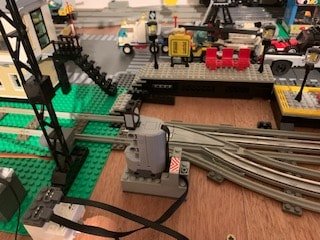
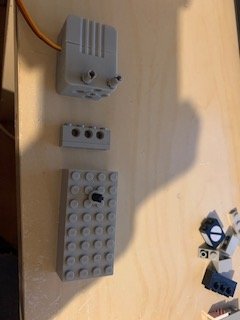
Hello All, So I've finally got my act together and started building my layout however due to space the Lego 12v points are my only option as the 9V/PF switches take to much room. However an electronic pair will set you back around £90-£110 with all the switch boxes etc. So my challenge was can I do it cheaper? The answer was Yes. My first design (first image) was to use the Lego servo motor as it turns 90 degrees however these are around £20, then you'd need a Sbrick or another way to control it. It works but it looks bulky. So as I use Ncontrol from 4D Brix, I like the interface, click options and Tom is really helpful. So after a quick chat he wrote some code for me to limit the movement to 90 degrees and I purchased a Monorail Switch. It is very simple, looks neat and above all works. You have to purchase the quad motor control module but the beauty is that this will do four switches. So if you have 4 switches you save £30 on the second pair. So your first pair will cost you £80 but the next pair will only cost £50. This is the cost Lego 12 Volt Points Pair @ £100 My Second Design @ £80 Lego 12volt points not motor > £20 2x 4D Brix Motors > £25 4x 1 Meter Cables > £5 4D Brix Quad Control > £30 The only downside is you lose the turning symbol but I can see that in the software so it doesn't bother me. Andy
-
Hi Lego train fans, I have recently bought a 7740 set and was told that there are two versions of green tray of early 12v trains sets' packaging. The early one has no side support in every corner of the green tray with relatively narrower top surface, whereas later version has thicker top surface and triangle support in each corner. In terms of tray's wall, I was told that early version is thinner and later versions. Any detail or knowledge train tech fans know about the difference of 12v train boxes packaging?
-
Hi all! After the projects, it was time for some real building. I am in "12v phase" so I concentrated on the BR50 I draw during Christmas Holidays: Since there are many expensive parts, I used what I already had at home. I ordered the two front 1x1x2 windows and a pair of big wheels. Here's the final result: It is similar to che project, but it's quite different in some parts: - Front bogie was redesigned completely - while perfectly working from turning radius point of view, its overhang made the locomotive to hit the 12v switch remote control! Now the lower part is turning according to bogie, the buffer turns too. - Chassis is higher, in order to accomodate some details (by the way, the BR50 had small wheels so I needed to increase the space between the wheels and the body. - Flexible Pneumatic tubes instead of black "antennas" to reproduce side pipes (I found this solution more...7777-ish) - Cabin is half stud lower and has a longer roof to cover part of Tender. - Some details are different, and were thought directly "on the run" - Tender is a bit longer, the one I designed was wrongly shaped. Bogies worked fine with the central ladder, but I did not remember the motor has rubber bands on it (and they get stuck on the ladders). - The connection between the thender and the locomotive is using a very very vintage part from the 60s - 12v Motor is now in the rear part of the Tender, since the unpowered bogie was easier to modify in order to accomodate the fixed bar coupling. ...and now some photos: In general, it was built thanks to some incomplete spare sets: a 7715 (doors, two red buffers, boiler parts and some wheels) , a 7810 (two windows, red ladders and black parts) and a 7710 (black parts, some plates...). It was a real fun to build it!!! I hope you like it!!! Ciao! Davide
-
Hi all, My croc arrived a couple of weeks ago and got built last week. I put one of the 12v Technic motors (image below) in it and improvised a working, albeit imperfect, power pickup for the 12v centre rail. When I apply power I can hear the motor is wanting to work, and when I lift the centre unit (I haven't attached the end units in tests yet) off the tracks and supply power directly to the motor, it works fine and the wheels turn. Put it on the tracks, with power directly from the 12v power supply and it won't move, so my guess is that the rather old motor just doesn't have the power to get this wonderful loco moving.... Any insights or suggestions would be welcome. Thanks, Andy
-
Hi all, another appeal to the collective EB mind, maybe particularly to my fellow 12v enthusiasts. I'm installing all the wiring and controls on my new layout, and the lights on the level crossing don't flash. The flashing is controlled by this piece, and I suspect it's just getting old.... (I probably bought it 35 years ago.) Have any other 12v fans had this issue? Is it solvable? I've tried the usual checks of reversing the plugs, connected a light directly to the unit on a single short wire etc, but they will only come on and stay on rather than flash. While I'd rather not open it, if it's possibly repairable I'm willing to try, because I don't need it to just have the lights on. Alternatively, is there a simple piece of electronics I could wire in between the control unit and the lights to add flash back in? (I have little to no soldering skills.) Thanks, Andy Ok, update already.... When I looked at this listing for a replacement the seller mentioned turning the unit upside-down. And the light flashes..... Any thoughts? Update 2 - The control buttons are a distance away from the 12v power pack, so connected via a wire. Switch the plugs on that around and the lights flash.... Feeling slightly dumb, but rather than remove the post I'll leave it up to hopefully help others out.
-
12 Volt Roundhouse full front view Back in April I presented some will received train MOCs in 12 Volt grey era style. Recently the Brick Train Awards caught my attention and this contest was a good reason to pick up on my 12 Volt Roundhouse project which started 2016/2017 but was never finished. So time was limited, the deadline came closer. But I made it. Now it's time to share the 12 Volt Roundhouse with you folks. I named the Roundhouse "Bamberg", the city I live in. And close to my place there is the ruin of the real Roundhouse. Nothing more to see there and the place is prohibited to visit. So my Roundhouse is just a phantasy model, like the 12 Volt grey era trains sets are also "phantasy", but pretty close to Deutsche Bundesbahn locomotives and waggons. The Roundhouse has 7 segments, one for each official steam engine of the Grey Era from 1980 - 1986 which are: 7710, 7715, 7722, 7727, 7730, 7750 and 7810. The side and back walls are build entirely with 1x2 and 1x1 plates in red and dark-red to model the characteristics of red brick walls. The segments are modular in a 3-1-3 configuration for easy transportation. The turntable is operated remote controlled using a Electric, Train 12V Remote Control 8 x 10 with 2 Circled Arrows Pattern which fits nicely with the more standard remote controls for signals and switches. An old 12 Volt Technic motor is integrated in the bottom of the turntable. The 2 cables are used to power the motor and the electric middle rail on the turntable. The cables are not placed well, the should go in the centre of the rotation point. Hmm, I need to think of a purist solution for this issue. If you build a turntable, the complete track level has to be elevated. So the complete layout (except the roundhouse and the turntable) is elevated by 2-3 layers of brick. This is really eating my basics and plates in old dark grey, dark tan and black. But it was worth it. Using an elevated brick build ground it was easy to hide all the cables for the good old 12 light posts and the power supply for the tracks in the Roundhouse. Finally some typical 1980's style vehicles and other accessory bring back the typical charm from this time. Trucks were only 4 studs wide ... long time ago. Enjoy the video and the pictures :-) Stay safe and healtyh and keep 12 Volt alive! Holger #7730 and #7727meet just outside the Roundhouse The blue workers are busy unloading the new #7750 train wheel from a #7720 platform waggon. A MOC diesel V36 engine brought in the valuable delivery. No social distancing required for LEGO blue work-men The backyard has an additional access by rail and by road. Can you spot the statue of the founder of the Roundhouse? Back door view through the Roundhouse. Can you identify the steamer on the turntable? My green Mallet steam engine on the turntable. #7750 (derailed, opps) is getting fresh coals. This graphic shows the wiring diagram. The 12 Volt trafo powers the turntable and the selected track. The V36 MOC engine has some trouble. The hood was lifted off so the blue mechanic man can fix this issue. It's getting late, but the blue workers are still busy. Not very secure to keep the lights on while weltering the mast? Top view of the Roundhouse at night. All pictures also in my Flickr album https://www.flickr.com/photos/holgermatthes/albums/72157715067356186
-
Two great trains are dueling on 12v gray track: the British Railways HST 125 vs the Deutsche Bahn BR403 "Donald Duck"! Two big countries with high expertise on trains,two different power sources (Diesel vs Electric), same speed (above 200km/h or 125mph). Who will win this Lego contest? None of them, since they both are built on the same Lego platform and shape - I created first the "Donald Duck" in Lufthansa colors and then I modified it a little to recall the HST125. So same power cars ,and same wagons, only with a different paint scheme . I've always focused on standard trains, and this is my first experiment with fast ones. After all , during "gray Era" we've seen a lot of steamers, diesels, electric trains...but only one example of fast train. So here's a shot of the DB403, with an applied sticker on front "window" to simulate double windscreens... ...and one of the "Screaming Valenta" - here the sticker is a bit different, but you can easily tell it is only a bigger one! Both are using parts available in the last years of "Gray Era" (so they could have been made starting from 1987). The HST could be a bit older than the 403 - since it's using the old style blue window in the cabin. I could also recreate a yellow sticker to cover the outer part of the trans-clear headlight, but I preferred to keep it as it is (just imagine the sticker detaching when the glue is old...I HATE that sensation ) Both could have working headlights, the DB403 can use a 12v light brick on top headlight. For the HST125 the problem is how to diffuse light from light brick to transparent slopes. But both trains could also leverage on 9V lights, which were already available at the time. The 9v Battery box fits easily in both bodies. Finally the 7745 has some internal competition!!! Hope you like these two! Ciao! Davide
-
Hi all, this time I propose a real build, it's not completely new - many of you surely has seen it in some of my digital renderings, but was never built. I finished it yesterday, when the red motor finally was repaired and the missing rare 2x2 black window arrived. To create this one, my third copy of 7810 was used as donor for the baseplate and black windows. So I decided to keep the 7810 number when I chose the stickers (the renderings have 7730 decals). Just to explain, all my MOC locomotives keep numbering of original Lego sets from which are derived in terms of parts. To celebrate its arrival, I used my small 12v test track. As you can see is a very simple build, standardized in 12v style adding the black side doors (absolutely not present in the prototype), and 5 2x2 black windows. The red motor was a must- I tried to use the black one - but it wasn't the same thing!!! This motor was not running anymore, so I bought a black one in bad aesthetic conditions as donor. I removed the electric motor from black shell, cleaned all inner parts, reinforced the red shell internally with some superglue (it had some cracks), changed axles (using the ones from black motor) and performed a test. Once the test was ok - I finally glued the two parts of the red shell. Even if the chassis is common to other locomotives, it seems very small. The inside is small aswell, and I only could fit a lever in 7750 style. You can see the 12v light brick and its cables. I bought some 12v light microbulbs - maybe I will succeed to light up also the rear headlight when going in reverse. Even if it has no weight bricks, it still has a decent pulling power and runs fine with small wagons. Now it needs its own set of cars. I hope you like it!!! Ciao, Davide
-
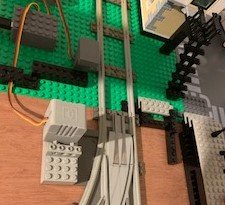
So, I'm curious... Does anyone else have a stage of a build, whether it be a building, rolling stock or, as in my case, complete layout that they have a love-hate relationship with? We move house too often for our liking, so recently I've been building new layouts every 2 to 3 years, and being a 12v based layout it involves a lot of wiring (see below for a bit of it). Much as I love the end result, the wiring drives me nuts and I really slow down in my progress when I get to the point of needing to do it all. Anyone else got "pet peeves" so to speak that are part of the fun? 20200927_115339 by andyglascott, on Flickr
-
 Lego 12v Half Straights With my current addiction to old 12v trains I found myself looking to create more complex layouts. One piece I hadn't used yet was the (1) crossover piece in my collection. Using Bluebrick it became apparent that using only one crossing sometimes results in a half track offset, so I decided to cut 3 of my worst straight tracks in half. Note that I am not the first person to do this, but I have not found any documentation of it being done with blue era track, or many examples of geometry possibilities. To cut the conductors I used a handheld rotary tool with a cutoff wheel to get through the metal rails, and a thin hacksaw to go through the plastic. As you can see, I severely cracked one of my half straights by clamping it too hard in the vise. Oops! Cutting the rails is much easier, I simply marked the center and used the hacksaw to make the cut. As you might know, blue era conductive rails are slightly different than grey era rails. One of the changes between blue and grey era was the addition of mid rail sleepers in the grey era. While it seems like you can simply attach a 2x8 plate to the center of a blue era rail, there is actually a couple plastic supports (seen below in rendering) blocking where the studs would go. When creating a half straight out of blue era conductors, these supports much be removed. I used a handheld rotary tool with a sanding bit to carefully carve them away. I recreated the electrical connection tabs using rolled up aluminum foil. I'm sure I'll have to replace these whenever I change my layout, but its really not too difficult and requires very little aluminum foil. This is the finished product! Works perfectly! Here are some interesting geometry possibilities that are opened up with half straights on hand: *Bluebrick does not have a 12v half straight, so I used a 9v one in its place* Thanks for looking! If anyone else uses custom cut half straights (of any track type), feel free to post pictures of interesting layout possibilities! Unfinished_Projects
 -
Hello, I bought some blue era remote points in rough shape, that need to be opened and repaired. Has anyone attempted this before? Is there any tips or tricks I should know about? Also, I do not own an original transformer, so I will be using a generic power supply for these. Will 12v DC work, or do I need higher voltage? Thanks, Unfinished_Projects
-
So last week I needed to open up a 12v 80's era signal unit as the green LED was starting to fail and I wanted to see if I could repair the unit, as second hand ones are close to £20 delivered to me. First job, break out the scalpel and unseal the unit... This gives us the components - front , back and circuit board... The red LED was working fine... The green one not so... It's a simple circuit design with 2 LED's and one resistor to drop the voltage to 2.2v Sourced some replacement LED's from eBay which will work around the 2.2v area... And then proceeded to unsolder the old green LED and replace with the new one.. Then time for a test.... All was good so the unit was resealed and ready for further duty. I've never seen the insides of one of these units or even any pictures on the web, so here you go.. Jonathan
-
Last night I completed a refurbishment of a rather poorly 12v train motor. The contacts had worn giving intermittent working and the bushes were squealing like a pig so it was time to open up the case... First off made a jig to hold everything secure... I used my scalpel to cut into the case as shown on the red lines here... Then flipped the jig over and pushed down on the axles which released the two halves of the case leaving this in the jig... And the motor part in all its grotty glory.... Took the metal blocks out and started stripping down the axles and motor - +30 years of grime.... Also noticed that a wiring disc had become unsoldered - another cause of the rough running... The contacts were removed - you can see how uneven the wear has been... Got two bb53's from Bricklink specifically for their pickups... And split them open... The bb53 contacts have "nipples" on them which the motor contacts do not so these were filed flat... After that everything was cleaned with methylated spirits , the wiring plate resoldered, greased and reassembled.... Then glued and clamped.. And then after an hour taken for a test run.... https://i.imgur.com/CCPQZyD.mp4 I think the patient will live !!! Joff
-
Hello, I'm creating this write-up to share my experience buying and operating a set of old 12v track in the US. I had been wanting some 12v track and motors since I was in middle school (and I'm in college right now, so yes my tastes in Lego have always been old and expensive haha) but hadn't found the right lot until about a week ago. I managed to score the following lot on ebay for a good price: It is a decent amount of stuff, but some key things are missing: motor (the blue one in picture is 4.5v and doesn't work), transformer, and the piece for connecting to the track. My goal was to have an operating train for as cheaply as possible. Hopefully these ideas can help someone else out who wants to make use of older track without spending a fortune. FOR PURISTS: I handled all of these missing components in an unorthodox way that includes modification of vintage parts, so consider yourself warned Motor: Instead of buying original 12v motors, which are only available for crazy amounts of money on bricklink, I chose to use @bricks n bolts method of picking up track power and using it to drive PF motors (https://www.eurobricks.com/forum/index.php?/forums/topic/63535-mod-7745-to-use-the-pf-motor-still-on-12v-track/ I know it was a little while ago, but thank you @bricks n bolts for sharing! ) The process of cutting down the pins was pretty straightforward. I used a dremel with a cutoff wheel to make the initial cut and a sanding wheel to finish things up. If anyone attempts to do this, try to keep the pin cool, as I melted the plastic a bit on one of my pick-ups. I also ended up cutting off the curved section of one pick-up, to accommodate for the magnet assembly. Connecting to track: To connect to the track, I simply soldered some wire to the little tabs on the bottom of the rail. The correct part for connecting to these blue rails isn't that expensive on bricklink...if you don't factor in overseas shipping. Transformer: Since I live in the US, using an original transformer would require a converter (I had no luck finding the 110v version on bricklink or ebay). I originally thought of using a model train transformer of some kind, but wasn't sure so I asked here on the train tech. @dr_spock suggested a cheap DC motor controller and a generic 12v DC wall adapter (Thanks! ). This ended up working perfectly, and was quite cheap. Only downside is no reverse, but I'm ok with that for how much I spent. Final Result: With everything together I swapped out one of the motors on my Powered Boxcar (https://www.eurobricks.com/forum/index.php?/forums/topic/169681-moc-powered-boxcar-power-functions/) with the completed pick-up bogie and turned on the speed controller. It worked perfectly! I now have a functioning 12v loop that powers my newer trains! I do however have to watch out that I don't over-power the PF stuff. I suppose I could have used a 9v power adapter, but I'm leaving room for a 7740 that I hope will join my collection if I find a good deal ^These last 2 are videos, you just have to click on them There's a few more pictures of this project here if interested: https://flic.kr/s/aHskR5KZX3 Thanks for looking! Unfinished_Projects
-
Hello, I have 4.5v train motor (https://www.bricklink.com/v2/catalog/catalogitem.page?P=bb07pb01&name=Electric, Motor 4.5V Type A 12 x 4 x 4 with 4.5V stamped on front&category=[Electric, Motor]#T=C) that needs wheels. I have access to a 3D printer and 3D modeling software/knowledge. My question is, does anyone have dimensions for "wheel2a" ?(https://www.bricklink.com/v2/catalog/catalogitem.page?P=wheel2a&name=Train Wheel Spoked for Motor&category=[Wheel]#T=C) I would like to try to make something that goes into this motor and gives it a technic axle, or just recreate the wheel (either all plastic, or using purchased metal rod). Unfinished_Projects
-
I have recently discovered the beatiful world that is the 12V, grey era, train system. It began when I bought a lot on a garage sale in Denmark, while I was attending Skearbaek Fan Weekend. For 40 euro's I had a box that contained lots of material, a complete 7725 passenger train amongst other things. So I've started MOCing with the loose parts I've got . First production is a shunting locomotive with working lights. Instructions are available on ReBrickable I had also began working on a PoweredUp shunting locomotive but that one didn't really work out (see below) I hope you like it! I'm brainstorming about a 12V layout now but I'm struggling with the approach. I don't really have the space so I need some kind of modular way of setting it up.
-
I searched for this website around here, but couldn't find anything about it. It explains a lot only about the 12v trains form 1980 till 1990, with the grey 12v track, that explains the name of this website. Now I collect also these trains, but have them quite a time complete already and start to moc/build a little with trains running at 12v. This is not mine website, I came it along searching for people at facebook who has the same interest in this system. Some of them want only use those bricks at that area time available. Some people really make very goodlooking models with newer bricks after that area. What me interest most are his moc's including free instructions. I did what I never thought possible, I made all this moc's, with a little rebuild of mine own. I always wanted a real model where the 7740 was based on, the Baureihe 103. I build one in tan/darkred as showcase in mine livingroom and build one yellow/red for mine layout together with the 7740. I already build 2 extra wagons and 6 wagons are too heavy for 2x 12v motors, they can burn broken when pulling too much. Now every train has 3 wagons to pull and an awesome sight to see them running together. I also made a video of that: Baureihe 103 and 7740 together running. And the tan/darkred one in mine livingroom: The 2d train what got mine interest is a dutch train the icm or nickname koploper (headwalker, because you can walk thought the head). I studied his instruction and others at rebrickable and started to pick the best parts of all designs in what I think it will look right beside to the other 12v trains. This is what I came up with: How does it looks beside the 7740? What was also a nice cute train and afterwards not easy to build, the NS600. It was a better version of the NS500, what dutch railways got from England after WO2 and still used this day by several big compagny's. I modified it a little with modern parts to look it more realistic. And than set 727, which I always liked. Only there was no minifig inside what will look odd beside the 12v grey area trains. Why not build a minifig one? Here we go: And than the last, but not least. The Baureihe 41 or would I say the ultimate 7777 in mine opnion. A friend loved it right away and wanted one. After I build it, I used the wheel set-up for mine 7750. After the ultimate 7777 was parked at mine layout for a while I started to like that one and thought, what the heck. Build one for myself. Only the big red wheels was painfull in mine wallet. And also made a video of it. And the 7750 XL has improved a lot with the longer wheel setup: Too bad I never met the person who made this site, but I own him a lot that these awesome trains find a way in mine layout. Exspecially the Baureihe 41 or ultimate 7777 looks awesome. A true steam engine through it basic colors. Still looking better than the emerald night (or flying scottmann) and bigboy. The bigboy is ugly as ugly, but awesome through it's size.
-
Over the last18 months I've picked up a couple more 12v and 9v train motors, so have been slowly working on adding to my loco collection - my aim is to have 3 locos or trains for each loop on my layout so that at shows I'm not running any one train/loco for more than 20 to 30 minutes at a time - got to look after these vintage machines! The BR Class 20 is the third loco for my freight loop, and while I can't find any photos of one in this colour scheme, there are so many of these still about of the original 228, and they've been running for so long (coming up to 70 years!) there's a good chance one did appear in something like this. The closest I've found is this one. The colour scheme and design are based on this Rebrickable design which cleverly incorporates a newer battery box into the colour scheme. The 12v motor limits the detail you can add to the bogies, but I can live with that. Sadly, I can't get Flickr to play ball tonight and insert images so here's a link to the photostream, specifically the first of 3 pics of the loco... Might be time for a different image hosting account...
-
Hey Eurobricks! I've been away from my 12V trains for a bit to focus on school, but recently I took a trip to Denmark with my family, and by some miracle, we walked into a games and collectibles shop, Faraos Cigarer, which happened to have purchased the largest privately owned LEGO collection in Denmark that week. I'm releasing a YouTube series about the entire story, and just published the third part, which details the crazy collection and what I ended up buying (spoiler alert, it's an ultra rare Scandinavian box variant!). Check out this video and the rest of the series on my channel, and I'll be releasing more content soon!