

gyenesvi
-
Posts
2,391 -
Joined
-
Last visited
Content Type
Profiles
Forums
Gallery
Everything posted by gyenesvi
-
 Glad you find my suggestions/link useful. I am not sure what you are referring to here. Is it with open or with closed diff? I am guessing open diff, because otherwise there would be no power transfer from one axle to the other when one is stuck. But that's actually a disadvantage of the open diff, not an advantage. Power always gets transferred towards the least traction, away from wheels that have traction, which seems like the car is trying hard, but trying at the wrong spot. So in the end it's not useful. Or do I misunderstand something? Also, I guess sand does not work well even with tractor tires because once the sand gets into the cracks of the tires, it behaves like a big slick tire, which is not great.. Wet sand may require tire with special tread pattern / material that does not let the sand fill up the tread.
 -
I guess it allows reaching ultimate speeds without worrying about melting parts. Maybe also it allows for ways of controlling speed of wheels separately to create under/overs-steer. But I guess you are questioning the point of it because it removes the drivetrain, hence much of the realism modeling aspect. I tend to agree, I mean I like to build the drivetrains, but I guess you could say the in-wheel drive will also become kind of realistic of EVs. That's a nice looking effort! Here's how I see it. I think using an RC system adds value to both brushed and brushless setups because of the good physical, configurable, precise control, plus the option to use proper servos. Also, it has the advantage of more powerful batteries compared to lego ones and even to Buwizz. Brushed RC electronics can be used with lego motors, buggy motors or Buwizz motors, so adding a brushed RC motor is not necessary. True that you could have a single more powerful motor, but then it is worth more to go brushless; it is a more efficient, more modern system with more active development I'd guess. Then it is possible to bring out the true power of modern RC systems, a single, small drive motor in better form factor than lego/buggy/buwizz motors. While brushless motors have the potential to be overly powerful for lego parts and destroy everything, they also hide an opportunity: powerful smaller / lighter models. By looking at many MOCs of the past and going to Buwizz competitions, I believe we have converged to a sweet spot of using max 4 Buwizz motors (powered by 2 Buwizz units), split into 2 pairs for front/rear axles. Even coupling 4 motors on a single axle has proven to be too much for the plastic (tried by different people on multiple occasions). Part of this is because building 4 buwizz motors and 2 buwizz units into a model already requires a fairly large scale and results in significant weight, and even when possible, it consumes a significant part of the space available / restricts drivetrain and suspension types. Also, the resulting speed already poses controllability problems, at least for off-roaders, where higher speeds can lead to more crashes and even just more stress on the parts due to bumps, which is again amplified by larger weight. So more precise control becomes more important. Having the same amount of power at smaller/lighter models and more control over speed/steering could potentially push the limit further without melting/breaking the plastic. With powerful small brushless motors we have the potential to build models that are not just a big chunk of electronics, but also have space for more interesting/realistic drivetrain/suspension details and more aesthetic bodyworks as a few hundred grams of extra weight may not be an issue when a base is light enough. My last build, the small Defender was an entirely different playing experience for me than my previous lego models, and it uses the smallest possible brushless motor I could find, is already too fast for my control capabilities and then I realized that my ESC wasn't even controlling it at full speed.. now imagine that in medium sized build where I can flesh out more complex suspension/drivetrain/bodywork.. So I guess what I'm saying is that if I already take the effort to use RC electronics, then restricting myself to poorly shaped buggy motors does not make too much sense if I have the option to use small powerful brushless motors too because now the limit with buggy motors is the power to size ratio. That's not to say I won't build with buwizz motors any more, but I guess I'll keep those for buwizz competitions.
-
I tend to agree with this, lots of possibilities for improving parts and building techniques within cars. Wanted to ask the same, but just let it go..
-
No, dark ages is when you don't build any more, not when you don't buy sets. So no problem here, keep on doing it, maybe buy some sets for the parts, and don't get disappointed about the sets; after you reach a certain level in designing your own stuff, it's natural that anything that TLG makes will not be so satisfying to you as it used to be. That's just how it is.
-
That all makes sense :) Then maybe you could include this one in the comparison, a Unimog built from the Zetros, specifically to improve capabilities (locked diffs, higher speed, better steering, softer suspension, lighter weight) :D
-
Thanks, that explains the hinge mechanism, I didn't quite get how the L shape is used, but now it's clear. Now the only thing I don't get is how the L shape is connected to the door panels themselves, I guess somehow on the inside, but I don't see any pins in the panels, and they don't have other free connection points either..
-
So nicely finished all around, great use of large panels and also system pieces where required! I like the A pillar solution. That door hinge mechanism looks like a nice trick, I checked it out in the Lancer video, but I am not sure I understand how that works, can you maybe show just the linkage without the door on it?
-
Gold Fever at Legoworld Utrecht
gyenesvi replied to mahjqa's topic in LEGO Technic, Mindstorms, Model Team and Scale Modeling
It's really mesmerizing to watch them all! I wonder what's the principle of the piece separator to separate out the gold. Is it based on piece size / shape? -
These two look really great, and are really compact! Nice design of printed components, even though there's not too much lego left in the chassis :D
-
Well, I'm not sure I agree that this is what playability means. Sure, you can drive it on sand. But taking 12 minutes to complete such a track would get me really bored. And the fact that it is not really turning would get me irritated sooner. Furthermore, on the capabilities of the set. The problem is that most of the technicalities in the set are useless gimmicks when it comes to trial and play. Take for instance the diff locks. In any practical RC trial truck there would be no diffs, all would be locked, saving a lot of gears and space, allowing for better ground clearance for example. Second, the suspension, it is practically not articulating too much. So, my guess would be that the truck would perform almost equally if you just ditched all the diffs and locks, and maybe even the whole suspension and just made it rigid, or one of the axles pendular. It would be interesting to see a comparison with those modifications in place.
-
Technic General Discussion
gyenesvi replied to Jim's topic in LEGO Technic, Mindstorms, Model Team and Scale Modeling
Not so much a surprise as that's the most useful one in both lineups in terms of power / form factor / size. Not to mention that in PU, the L motor serves the purpose of servo as well. -
Nice car design, curious about the footage! Can you show more details of your suspension arm design? I guess it's hard to draw the line where it becomes too much of printed parts to call it lego.. I guess as long as the spirit remains the same, that is building things from reusable parts, it's quite arbitrary which parts are official and which are not. But I'd agree that in @vergogneless's design there are many purpose made parts that would not be reusable for too many other things..
-
Technic General Discussion
gyenesvi replied to Jim's topic in LEGO Technic, Mindstorms, Model Team and Scale Modeling
Not sure what you guys would expect from all the race cars being split out to a different theme? The amount of true technic models would not increase by that. We get more sets these years because we get more cars that are all very similar and simple, so they are easy to do one after the other. If you take those out, what's left is similar to how it was 10 years ago, as @kbalage notes above too. Maybe today there's somewhat less focus on the details of the more function-rich models, that's an unfortunate side-effect, true. But we have to accept that cars sell, and it does not really matter which theme they are in. So I think the way of improvement would rather be making those cars more functionally interesting. And not all cars need to be function rich, it's not possible to cram much more into the smallest ones. However, there's room for improvement on the mid and larger scales. That's where I'd put my hopes and wishes. And even there, there's no need to invent convoluted new functions. Just make the basic functions better: more realistic and more compact suspension and drivetrain components! That would already make a big difference for me. So many possibilities there! Some examples: portal and planetary hubs were great ideas implemented in a bad form factor, time to update the molds! Lego springs are either too small/strong or waste a lot of space, time to make longer/softer ones. And then suspension geometry, gears in different sizes, etc.. For the record, we recently got some new suspension arms in the McLaren and the F1 cars. Nice, nice, but when you try to build something different than what they are designed for, you realize they are not so versatile.. More focus should be on generic reusable parts than on one-off pieces. And systematicity. When they come out with a 7L suspension arm, that needs a 7L steering link too to match.. Luckily the new suspension parts in the Bronco / Nissan are more versatile/reusable, so I hope that that direction continues! -
AM5 old mobile crane
gyenesvi replied to Pufarine's topic in LEGO Technic, Mindstorms, Model Team and Scale Modeling
This looks really great, love the old brick built style, and the old tires. I wonder how that round tube thingy is shaped on the front? Is it bent somehow? What holds it in place at the top? -
Oh, I forgot, using the planetary hub explains the slow speed :) That's a nice design, sounds compact as well!
-
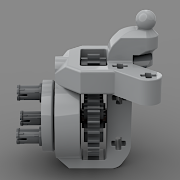
Okay, so quite some time after designing this on paper, I finally have the first version of this working in real life. I went with the simpler version that's an alternation of the existing lego portal hub into a variant that fits into the Defender rims, shortens the wheel mount insert and this way brings the steering axis 2 studs closer to the center of the wheel, while still keeping the steering axis vertical for simplicity. It can accommodate both 8:24 and 12:20 gearing. As @Zerobricks also proposed, I decided to integrate the towball into the hub and go with large CV joint instead of U-joint. Instead of printing the towball, I printed a 3.2mm hole, and pushed a towball-on-a-bar piece into it. I cut 1.5mm from the bar so that it gives space for the CV joint's head. It does not need to be glued into the hole, it's tight enough to not come out by itself, but it can still be taken out. Furthermore, I use a 8x22x7mm bearing (inner x outer x thickness) to hold the wheel mount insert. The bearing also does not need glueing, the tolerances are such that the bearing fits tightly to the ring (from the inside), but can be removed, and the same with the wheel mount insert (from the outside). The insert has 2mm deep inverse studs printed at the outer face, so half pins can be pushed into it, which will hold the wheel. The half pins also sit tight in the inverse stud holes, again, no glue needed, as the rim disengages earlier that the pins would fall out from the 3d printed insert (although over time that connection weakens, so some glue might be useful there, or just use 6 pins instead of 3). Here is the printed result with the bearing, towball and pins inserted. The printing does not need extra support and is printed at a 45 degree angle at the bottom next to the ring (it does need a brim to stick to the bed reliably). A thin internal support for the two vertical axle holes is built into the model and needs to be cut out after printing. And here it is built into a some prototype suspension. If needed, some 5x8x2.5mm bearings could also be integrated for the incoming CV joint axle, but I'll see if that area gets worn out. I might try to make a U-joint compatible version as well with the original axle-hole design for the upper mounting point.. I think Lego could easily upgrade the existing portal hub to some variation of this piece.
-
Looks really interesting, solving the down-gearing without huge gears that would result in loosing ground clearance at the bottom, totally like in an RC transmission, nice! I wonder how those printed gears will hold up!? In your previous model, did the gears wear a lot at the teeth? Also, I don't get how a 1:9 down-gearing can be too slow for you, I can't even control my 1:24 :) What's the kv rating of that motor you are using? At the output, is there an axle hole inside that tube?
-
Thanks, I see how it's used now, I thought somehow it would be driven into the pins, but I see it simply goes through.
-
Well, setting the Running Brake level to 10 did not solve it, rather it may have even made things a bit worse I think.. I tried somewhere in the middle, like 5, and maybe it is a bit better.. which is weird in itself, it should not effect things I guess. However, after playing around with more settings, I think I FIGURED IT out!! It started with noticing that reverse felt somewhat faster than forward, which I didn't even try in the beginning.. The key is the Low and High Thresholds on the Input window. These were set to 750 and 2100 respectively (I guess they mean Hz), while the Servo Neutral was set to 1502 by default (weird value). As far as I understand, the throttle signal should be between 1000 and 2000 Hz, with 1500 being the neutral, so I set it to these values, and viola, now it is spinning much faster, in both directions. Oddly enough, if I change the low threshold, the forward max speed changes, but I think this may be because the throttle is reversed on my transmitter, so the low threshold is actually for forward now.. And this also effects my Injora motors, they are spinning faster too!! (If they weren't crazy enough already) That's another nice level of engineering @vergogneless I understand about MTP connectors, they indeed are a good idea/design. About M3 screws and washers, it's not clear for me how you would use them in lego connectors. What do you mean? Can you illustrate it with a standalone example? By the way, I like the use of the even smaller GeekServo!
-
That's a really nice video, lots of great building techniques in there, good explanation, and the final truck looks awesome! Great work!
-
I can only post it later, I have no access to it now.. However, first I'll try this, because the Running Brake Level is at 9 now (that was the default setting for some reason), and I only tried lowering it, not pushing it up to 10. Previously I only experienced that it does not work well for value 1 (screws up sine startup).
-
[MOC] Pegaso 7222
gyenesvi replied to _Electro_'s topic in LEGO Technic, Mindstorms, Model Team and Scale Modeling
Looks nice and interesting! I like the simplicity of the 4 motor drive, but can't the added power brake the U-joints? Maybe due to the planetary hubs it is not an issue. Can you show more of the axles, how the steering and diff locking is implemented? Is the back occupied by the batteries, or is it mostly empty? -
Well, I was just curious, would not expect better results than on its own SurpassHobby ESC.. besides, that's what I am doing with the Injora ESC as it is AM32 based.. but I also recently ordered a bare AM32 board from Ali, so will test that as well. Do you think that the same programming board and software can be used for all AM32 ESCs? I have it for the Injora and did not order separately, from the videos it looks like the same software being used.
-
Yes, just measured, it's at 12.3V now. They are AM32 based, so they are configurable, and I have tried many different settings (motor poles, KV value, turning variable PWM on/off and setting PWM frequency to different values, turning sinusoidal startup on/off, turning brake on/off, etc). Checked that, but it should not be an issue as it seems to work fine with Injora motors Yes, but the startup is not the problem, that is quite smooth actually. Yes, Injora motors are sensorless too. Well that's interesting to hear, so maybe this is how they work normally? Which would be kind of weird. I'll try to borrow a SurpassHobby ESC for testing to see how it works with that.. Was it the same on AM32 ESC? Have you tested that?
-
According to the specs, the 3300 kv 2435 draws 22-24 A max, and the Injora ESC can deliver 25 A continuously, and 60 A peak, so I don't think it's that (the battery is 75C). And the ESC also works fine with the bigger Injora Fat Viper motor, which peaks at 50 A (even the 1721 peaks at 30 A). Also, a SurpassHobby ESC is rated at 25 A.