


Giottist
-
Posts
125 -
Joined
-
Last visited
Content Type
Profiles
Forums
Gallery
Everything posted by Giottist
-
Hmm? Crystal sphere on - Noise - Crystal sphere off. What do you like to ask us? I guess: If you like to know what are the mechanical limits of a (long) cross axle look here. You can be sure that the torque of any LEGO motor is away from that limit by magnitudes.
-
Hello High_Admiral, I know your designs from MOCpages.com, welcome here! Discussion and image size on MOCpages.com are somewhat awkward so I am happy to get information here. Thank you a lot for joining Eurobricks. I have to confess your desings are inspiration for me. Please keep in mind there is a difference between a digital design and running trains in reality. It was a long development process and a matter of countless runs on my test track until even the longest locomitives stopped derailing.
-
50,- € or $ for the hub is incredible to much. It seems LEGO tries to squeeze us out as much as they can. To look for reduced sets on the free market und rip them becomes a neat idea, i.e. the clumsy batmobil which delivers two PU M motors and a hub among perhaps useful wheels, tires, plates, wedges and slopes. We can throw the batman figure into the bay. In some cases LEGO learns the lesson, ok, in tiny steps: The really poor set 75201 was officially reduced by 20% after LEGO noticed the sale rates tended to zero. A bad example, I know. The PU hub is essential, a bad StarWars set not. I think the only way to tell LEGO the price policy is not ok is to look for third party offers like bricklink or rip reduced sets. I do not wait for any official rechargable solution, therfore my experiments with 6F22 blocks ... Later more with pictures, promised
-
Unfortunately not. I've checked it. Both types have real capacities of about 450 to 500 mAh. Do not believe what's printed on it, thats pure marketing. The real davantage of Li-Ion technology is the reliable recharge process. Rechargeble AAA cells are based on NiMH and they are really difficult to charge. I've checked more than a dozend chargers but they all destroyed the cells after 5 to 10 recharges. I've never destroyed any LiIon battery. They become weaker of course but only after several hundred cycles. Avoid NiMH.if you like to use rechargable batteries.
-
This is a technical discussion. I've for my own got a hub via bricklink for an affordable price. (Ok, more than one in the case, I would destroy one ...) 49,- $ or € are out of any discussion, 20,- would be reasonable. Btw: I've found 6F22 battery blocks fit perfectly into the hub. On Ebay are many Li-Ion-batteries in this form available. Just modify a clip dedicated for 9V blocks. By opportunity I will post some images how to do that. There is no need any more for expensive and environment polluting AAA cells.
-
Ah, thank you for the valuable hint. I've found the datasheet for the device: It is able to handle 1A with a max. power dissipation of 800 mW. Thats sufficient to run hard loads. The limiting factor is the battery capacity. Triple A cells have only about 500 mAh, same LiIon Packs in 6F22 packs. Using a hub for every motor is a good idea to have enogh battery power. It seems easy to connect two hubs with one app or controller. Since hubs beome available on Bricklink for affordable prices there is no urgent need for modifications. Btw, I got the lights 88005 direct from the lego online shop: The recent version of the powered up app switches them to full brightness if the motor turns in any direction with any speed -> very comfortable.
-
It seems we have to be patient. In an interview with zusammengebaut.de LEGO promised to offer PUP parts in early 2019. I trust LEGO because the PUP lights 88005 are available in the official store. You can find it there with the search function, not directly. Everything dealing with PUP seems unfinished, I for myself do nothing until LEGO offers us a full spectrum of PUP parts.
-
Ok, for switches that's definetely true. Hopefully we have switch alternatives in the future.
-
This image is a misuse. In this case the tracks was forced with violence into a position not ment for. The same would happen with injection moulded parts. Sorry to be honest. Try to combine rails instead of tracks with sleepers together with original 2 x 8 plates and you will be amazed.
-
The spring mechanisms of my switch samples are rather stiff. All my switches need some force to bring them into position. I explain this by the tolerances of the 3d printing process. The small adapter piece is just a 1/4 length straight rail (4 studs long). In my eyes it can be turned by 180° because its straight and therefore symmetric. So there is no diference for right or left switches. The problems can be caused by the printing tolerances. Please talk with Jacek or Lukasz: They are very nice and will exchange the defect part. For myself I exchanged all my R40 switches with R104 stuff. For R104 no adapters are needed, so I have no problems with them. My samples are well printed and my trains have a smooth ride.
-
Do you allow a different opinion? As LEGO Train 12 Volts I'm using different R104 switches and a lot of curved rails and I'm as satified as well. My trains have a smooth ride even at high speeds. The only alternative in existance for long radius switches is 4DBrix and their products are 3D printed too. Injection molding of large switches is so expensive due to the large forms and the market for such stuff is too small to be economic. BrickTracks tried it to finance such an enterprise but gained not enough people willing to buy the switches. Perhaps it is not well known enough. There is a workaround for curves: Just buy the curved rails and add original 2x8 plates as sleepers. You combine original LEGO precision with long radii from R56 to R120. It's also much less expensive, I for myself ordered just 320 plates on bricklink ...
-
It seems the PU firmware is only in a very early development state. LEGO itself announced there will be several updates in the future to enable programing comparable to Boost. (Source: interviews with the developers at promobricks and Zusammengebaut.com) but we still have to wait until 2019. I hope this will solve the problem with the running modes of the different motors. At the moment the firmware can only deliver dedicated solutions for the stubby batmobil and the two trains. Neither the Hogwarts Express nor the holiday train with large wheels have original motorization ...
-
@Lok24: The determination, what's plugged into the hub makes sense. Most important will be distinguishing between the train motor (continuous running) and motor with tacho sensor (running only when a button is pressed). Any "booster" or better multiplexer is a little bit optimistic. Since the microcontroller inside the hub offers four ports another solution with four plugs is imaginable. I do not count on extra multiplexing hardware since all LEGO trains ever are powered only by one motor. LEGO has no need to introduce a more complex solution. By the way, it is no problem to switch two train motors in parallel since the ID wires are only a combination of VCC and GND. But please, this is only a solution for for very experienced electronic experts. Do not try this If you are unsure what you are doing
-
Just find a very interesting article about powered up on Zusammengebaut.com. It is in german so I like to translate the most important statements into english: The PU elements like hubs, motors, sensors etc will be available in the LEGO online shop early in 2019. The prices are not fixed. It is not possible to stack plugs but LEGO developers think about firmware logic to couple different ports. But the work is still in progress, we have to wait. (Replied multiple times) There will be more or less frequent updates of apps and firmware in the future. The plug type is a proprietary design by LEGO and not available on the free market. The actual hub for the trains and the stubby batmobile has only two ports, but PU supports 4 ports. We can reckon with other hubs .... (But no release time was specified) The Boost hub has four ports, two internal, two external. Powered Up, BOOST, WeDo 2.0 and Duplo depends on the same hardware, but only PU, BOOST and Duplo can (and will?) be updated. It seems we need some patience and let the development team more time ... Duplo has some functionality using a colour sensor, this is promising for all who wait for a real signal function. And we can only hope for extension cables to gain LEGO plugs for own projects.
-
According to SBricks website we have wait until next march (hopefully ...)
-
Thank you for sharing your solution Can you tell us, how well this works? I'm a little bit afraid the H-bridges in the hub are not strong enough for two motors at full load but of course this has to be tested. @ all other readers: Everything described here is on your own risk. Having experience in soldering thin wires is a really good idea! A short check with JopieKs images from the interior of the train motor shows, that it is riskless to switch two motors parallel, since ID pin 1 is connected to VCC and ID pin 2 to GND. The only effect to the hub will be a lower wire resistance for the two ID pins. It is no need to exchange the original wires with a 6 wire flat cable if the original cables are long enough. Ok, for more more lenght they are neccesary. Just cut both cables a few cm behind the plug, remove insulation for 4 to 5 mm, solder both cables wire by wire together and add on of the original plug. And be extremely careful not to turn one or more cable upside down, otherwise a short will be the result which can destroy the hub in milliseconds. If everything went well the gain is a spare plug for further use (Arduino, I'm calling ...) BTW, the plug ... Up to now I haven't found the type of the plug. Does anybody have further information what the hell the plug type is? Or is it a custom design for LEGO? Uh oh, Please put both motors with the cable one to one parallel on the table when you solder them together: Wire No1 / motor 1 and wire No 1 / motor 2 to wire No 1 of the plug and so on. If you turn one motor by 180 degree you will change the enumeration of the wires a fatal short will be the result. The only way to change the motor direction is to exchange wire 1 with wire 2 in the motor housing as correctly described by duifkelego.
-
Such a solution exists: TrixBrix uses 3d printing on a very high quality level, they are not so expensive and very reliable in delivery. I for my own ordered a bunch of narrow gauge adapters to connect original LEGO curves with straight rails from the 12V era. Unfortunately grey curves from LEGO are nearly unobtainable and TrixBrix curves are a very early product with too few sleepers. TrixBrix may not add sleepers because otherwise they will violate LEGOs rights. But the combination of their dedicated curved rails, annotated as R40+1/2 and R40-1/2 with outer and inner curved rails from the 12V era are really convincing.
-
Exactly the same as a standard 9V block Type "6F22". I've just tested it: 2 studs is possible but very tight.
-
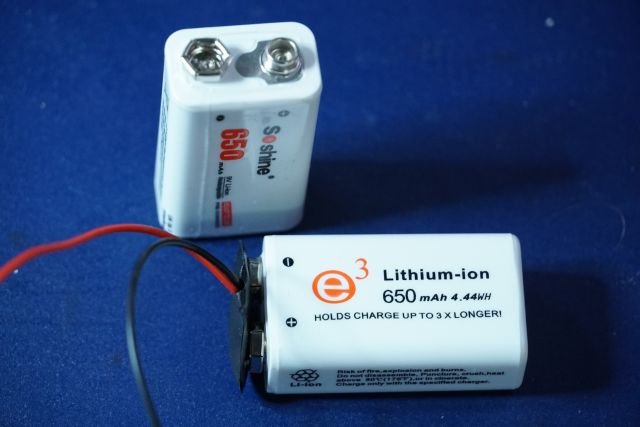
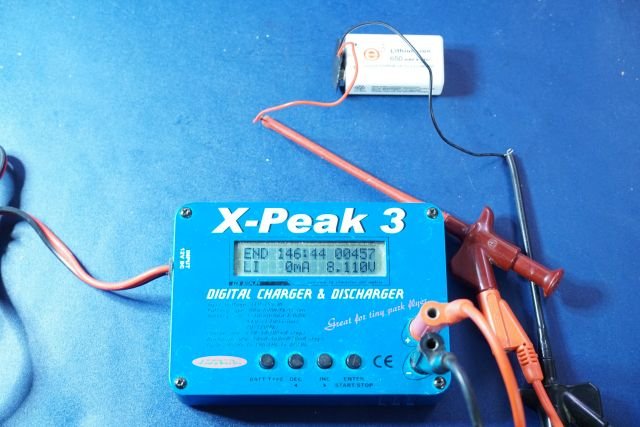
Hi Folks, I promised to report my experiences with the Li-Ion 9V Blocks I've found at ebay. Not only ebay sells these batteries but there are a lot more online stores, but the battery is allways the same type: Brandname Soshine, nominal capacity 650 mAh, two cells with 7.4V, no internal step-up converter, made in China I tested the electrical data with my sophisticated charger, which is also able to test the capacity. The voltage is ok and like two healthy Li-ion cells 7.4V. I discharged it with 250 mA (typical for pure LEGO train operation) and charged it with 200 mA which is rather quick. The capacity is about 460 mAh which is quite reasonable and expectable for the battery size, 650 mAh is only a doubtfull ad promise. Perhaps we can charge it slower with 100 mA and the capacity will increase a little bit but 650 mAh printed on the battery is phantasy. But with 70% we are well served. And I've found the internal resistance is very low, common for Li-Ion batteries. This meansour trains will move as fast as with normal AAA non rechargeable batteries. We will notice no or only minor performance drop despite the missing 1.6 V. The real capacity will operate a LEGO train for 90 min to 2 hours depending on the load. This is satisfying. Please keep in mind the batteries of this type are cheap and are real Li-Ion types rechargeable multiple times. Conclusion: A recommendable alternative for AAA cells and much more environment friendly
-
Same here. I'm confident LEGO will offer them in the future. One part is yet available: The lights 88005. You can find it in the online shop only using the search function. It seems LEGO creates a new subsite for PU parts, but they need a lot of time to do so. PU, Boost and WeDo seem to be compatible but the whole software is in a very early development state ... On the other hand, 60051 and 7938 are not so exciting at a first glance but they can become classics like the horizon express or the metroliner ... Let's imagine a distance of a couple of years.
-
I've found them on Ebay and ordered some for testing. I will report the results when they arrive (they come from China, it takes a couple of days ...) I expect a voltage of only 7.4V but with a very low internal resistance but perhaps a step up converter is included in those batteries - we will see. If you like to know more use "Li Ion 9V" or "Li ion 6F22" for searching.
-
The drawbacks are not severe... The battery holder can be removed so the bottom can be mounted again. Source here The 9V block is available as Li-ion battery and can be recharged. The capacity is comparable with a standard AAA cell. Let's look for a low profile clip for the 9V block which fits into the hub to make the mod foolproof.
-

BOOK REVIEW: THE LEGO TRAINS BOOK by Holger Matthes
Giottist replied to Toastie's topic in LEGO Train Tech
A wonderful review. I not only own the book, I've read it multiple times so it begins to show using marks. It's full of valuable hints, tips and tricks. A very important book for LEGO train enthusiasts. And Holger is a very nice and helpful guy, you can learn a lot from him if you have the opportunity for a chat. I've met him at Völklingen in 2016 and saw his MOCs several time at different LEGO exhibitions, particular @ Sankt Augustin (Germany) at the "Absolut Steinchen" event. Perhaps he is the ignition spark to become an active participant to LEGO events ... -
Train MOCs and Builders - Who/What is Your Inspiration?
Giottist replied to Digger of Bricks's topic in LEGO Train Tech
I am a fan of RealRailPunk! My dark ages were finished by the whish to create locos and rolling stock just out of my imagination - and more or less far away from reality. There are at least three sites to get inpiration from: Sam Berliners phantastic designs but please, this is heap of very oddball (old fashioned?) designed websites, but filled with a wealth of rail phantasies ... Douglas Selfs collection of unusual locomotives real existing ones in comparison with Sam Berliner (and carefully maintained!) and last but not least the collection of Luke Bradley on Flickr Enjoy (and then raiding BrickLink for rare train parts ) -
BrickTracks: R104 Switch Kickstarter is LIVE!
Giottist replied to coaster's topic in LEGO Train Tech
Preparing for injection molding is expensive. The injection form needs a lot of extreme precise machining. Still 100k is a risk. On the other hand: I saw BT rails at the "Absolut Steinchen" exhibition at St. Augustin (Germany) at June and was impressed by the precision and surface quality - can't be reached with 3D printing. But perhaps the precision is not neccesary for train operation. My 3D printed switches doing well even with ong rolling stock and high speed. Only ME rails failed, their rail foot are too thick forming a step between original LEGO and ME rails. Derailment is programmed. This occures neither with BT rails nor 3D printed rails from other manufacturers.