

TechnicSummse
-
Posts
249 -
Joined
-
Last visited
Content Type
Profiles
Forums
Gallery
Everything posted by TechnicSummse
-
 I also trust my steering... but i dont trust me... especially i wouldnt, if i had to cycle at the same time :D I ordered some new parts, to have more options soon ;) Using a bigger front-wheel is also planned... but i still did not found a usable solution to steer with a big wheel. Your current frontwheel is also included in my order... so we maybe gonna exchange the frontwheels to each other? :D I also wanted to order a few of those, because i dont own them :( But i didnt find a seller who sells all my wanted parts together
 -
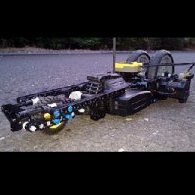
After my last crash, i redesigned the car again, with some good results so far. A 37,3 kph-run was the best result today. But im really really sure, it could be faster on a longer track. It seems at the end i will also need a GPS-devce to get a usefull speed-graph. This is pretty much the same design then my 38,7kph-car, but with some improvements on stability and a totally new gearing. Total weight including speed computer -> 1046g Batterybox attached between the wheels, but behind the axle Gearing: -> ???? Who can guess it? (you have to think a bit outside of the box ) -> The one who guesses it first, gets a cookie -> If you can guess it, please post it in a spoiler ;)
-
I would love to have such a track... BUT, and thats a big BUT... are you not afraid of running too far to the left side, to the street and loose your car under a real cars wheels? This would be a to dangerous track for me :O
-
We talked allready about this... evryone of us would like to have a 300m gym or something to drive in... but you have to take, what you got... And i am designing my wheel-setup as good as possible to my track. In a gym, i could use a pulley-wheel as front-wheel... but this would never work at my current track. Suspension does not make sense... we all tested this allready. Since we mostly use just 2 beams at the frontend, we got something like a suspension there... the beams are bending, and acting like a spring. At the rear... there is a lot of ballooned rubber on the wheels, wich also gives some suspension. A bigger sized but thin frontwheel would be better... sure... but this would mean a huge construcion to keep it in place. The bigger the wheel, the more you have to build arround it :( My frontwheel is defenetly a compromise... its relativly small and as big as i could use it with my steering setup.
-
Sadly there is not much to see in the video... but it seems to be fast :D How did you meassure... can you give us any close up pictures?
-
I tried this at an early stage of my car, like 2 month ago... with not really a good result... except it sucks dirt like hell, producing even more friction, and scratching trenches into the pinholes, and the axles. @Marxpek i hope you can save your motor :(
-
I used a steering system pretty similar to this :D Thin triangle-beams are just awsome
-
You will need this "point" a little bit earlier then your wished top-speed. But thats exactly what i did, while comparing all "so far"-speed records. The motor-rpm at top speed was between 900 and 1100 at all of them. This will only help, to shorten the required track, but this would mean additional gear-friction, additional axle/beam-friction (because you need at least 1 additional axle for that) and some additional weight. Also this comes in here: Construction will give some problems here. But... as long as you dont know exactly your rolling resistance, and all other friction-factors, there is no sense of knowing exact dynographs. Because you can only calculate a usefull gearing, if you calculate with all those numbers. Lets say you have a total friction of "X"... and you can reach 38kph with a 2:1 gearing. Now you double the friction to "2*X" and your topspeed will be, lets say.... 29 kph. But if you take the same "2*X" friction and gear is 1,66666:1, you will be able to reach 34 kph. You cannot define one perfect fact (for example gearing) without knowing all the other facts. In our case this means testing, testing, testing, and even more testing... with different wheels, axle-constructions, gearings... and so on. We are pretty close to the limits, since we testet allmost every possible setup :)
-
Steering can be seen here:
-
Thats what i wrote yesterday :) Nice chart :) What you forgot here is... rolling resistance and air resistance wich will grow extremely at higher speed. To give you a simple example... lets say you own a car with 50hp, it can drive ~150 kph. -> did you ever see a 100hp -car wich could drive 300 kph? :O And there is not even the weight doubled in this sample... both cars will use the pretty much same weight. Well... did you add these : to you front-setup, to compensate the not existing outer bearings? I mean did you hope to prevent the axle-bending with these... and did it help? :D
-
yes... Wires are bad allready long time, i think since the first crash. But evrything is fine... maybe i gonna add some silicone to the computer soon. If streamlining means to add more weigt, or fragile construcitons... it can be something negative... :D Im looking for one.. but this isnt really easy... the track should be close to my house (~10-15min with a car)
-
Well theoretically not... but physically... As you may notice... i could run a 2-motor car with 34,8 kph.... adding 2 motors was an increasement of ~4 kph so far. Maybe you can get 40kph from 4 motors... But i think you can see, how this diagram would look like... -> 2 Motors -> 0-35kph +35kph -> 4 Motors -> 35-40kph + 5 kph -> 6 Motors -> 40-41,5??? kph? + 1,5 kph? I think this will even end with lower speed at some point...
-
I guess the airpressure is stored in LEGO-Air-tanks? And pumped by a LEGO-compressor? ;) I think this is pretty much the same, then removing the current-limit from battery-boxes, or to modify the motors. But... sure... if others are using the same method, you can compare with them, on the same level ;)
-
You are using my wished gearing...basicly the same then my first 38+ setup... but with bigger gears... but sadly i own just one 36 teeth-gear. I ordered another one yesterday... hope it will arrive until the weekend.. Narrow design sounds good... but i think 2 frontwheels, and the rear-wheels profile will brake way too much. Did you try to exchange the outer support at the frontwheels vs the pulley as stabilization?
-
My predicted problem catched me.... I was doing some testdriving... you can see the result below... I also shreddered a 20t gear while i tried to brake... it just slipped and lost some teeth :D The Machine I will rebuild with wheels closer to each other again.... :( I have the feeling, friction is the key... since i testet some streamliner-design without any good result. But the faster we are driving, the more important air-resistance will become. Since The Machine 's steering did not work, i have to go another way again anyway
-
Ahh.. thats what i meant how you should use it :D Im just a little bit confused of that, because you wrote the following to my 40:20 gearing: Maybe, i just misunderstood you :) ______________________________________________ BUT... you are using the lower pinholes... you should use the upper pinholes of the motor... and center of gravity-problem is solved ;) Sounds promising again :D Cant wait to see some more of your nice and clean pictures... i need a big white paper and some LEDs...
-
But... 2 motors + battery-box is allready ~320g....+cables + micromotor+ 9v switch... There is NO chance, using 4 motors with a total weight less then 1000g. Im pretty sure, i can reduce this to something like ~1050g. The car of @Marxpek weights pretty much the same. But while finding the limits, there is allways to improve 1 thing, at the cost of something else. In this case it was reducing gears-friction vs. weight. By the way... it seemed to steer pretty bad when i testet indoor yesterday... now i know why :D The rearwheels are to far from away from each other... i would need a differential... but no way... i wont add friction I hope i can do some tests at the evening Even if the wheel pops up at start... this wont be a problem... it could become a problem, if the front will jump up at a little stone or something while driving... then i wont be able to steer for a short time. But i tested pushing at the battery box... it seems to be pretty ok balanced. Maybe i gonna change the battery-box-position. Thaught about that... but it fits so nice at the back :D
-
Im sure, you can reduce more :D My record-reacer weights 620g. But at one point i realised, the biggest weigth difference comes from wheels. Beams are really leightweight compared to that. You can reduce from 2 to 1 wheel at the front, wich would also help you reducing rolling resistance. Congratulations, you are on the right way :D you have a verry short wheelbase, the way you mounted the motors. A longer wheelbase means your car will be more stable. Also center of gravity seems verry high at the pictures. Think about these 2 points... this will help you getting your car stable on the street :) You are using 40:20, right? Try a 24:12 here, and use the motors pinholes to go trough with the axle. Like this you can easily reduce your center of gravitiy
-
After building another few hours... i have a completely new design, with a good feeling... not testet yet. My chaos :D The new design... i will call it: The Machine ~1080g - 6 half beams at the rear axle - just 2 gears in use (40:20) This was a really hard way to design the 40:20 gearing while using only 1 pair of gears. I will redesign and lighten everything a little bit tomorrow :D But im pretty sure, this could give some nice results :)
-
You CAN start moving your car in the 5th gear... well this would cause some smelly clutch problems... :D But at the end you can start driving in the 5th gear... this will just take hours of acceleration, wich is not really good, if you drive to another road... sometimes you should be quick here... other cars could come along :D But in your car you are using a combustion-engine. Combustion engines need a minimum rpm to not go out. DC or AC motors can theoretically run with 1 rpm, thats the difference. But to look at it from your point of view... why you dont gear up 5:1... because this will lower your top speed. But at 5:1 you will still be able to start the car.
-
Well... your car can easy reach ... lets say 25 kph. Now lets say your car is driving along the road with 25 kph, and accelerates more... why do you think there is a difference if it reaches the 25 kph point by its own, or if you pulled it with your bike to those given 25 kph. The result is the same... the car is driving with 25 kph, and its going faster from there by its own motorpower. The start is something different. You need way more power (torque) to start the car, compared to it allready beeing in movement. We are gearing up, because the motors output rpm is lower then our wanted wheel rpm ;) Long time ago, when i started this project, i checked all so far records, and the gearing-setup there. I calculated speed + wheel diameter + gearing at all those models... what i endet at, was a output rpm of 900-1100 on each of them; meaning the limit is at about 3/4 of the maximum unloaded motor-rpm. I set my wanted speed to something between 35-40 with my given numbers, and got a usefull gearing-range as result. something between 1,66666 and 2,5 (at the high speed output). One times i used the pretty much same frame-setup with 3 different gearings. 40:20 / 36:12(at the low speed output) and 40:16 => this is 2,0:1 2,2:1 2,5:1. The topspeed was exactly the same at all 3 gearings -> ~33 kph At the end higher gearing will mean even lower speed, since there is not enough torque left to overcome all the resistances. The aim is, to hit the perfect gearing fitting to your chassis resistances.
-
By using the pullback-motor you just store the pushing-energy. There is no difference if you give it a little push by hand, or if you pull up the pullbackmotor BY HAND... At the end it is not a full RC-usable car anymore. You will allways need a special setup to start it. You could use a little downhill ramp at the start, you could use a pullback-motor, a gearbox, a little push by hand.... all this wont change anything at the top speed, but help in acceleration. Even if you would pull the car with your bike up to 30 kph... the topspeed would be the same then if its drivin from start on, with his own motors. The only thing wich would matter here... is the battery freshness. Whith a high gearing you suck alot of power from the batteries at the start. If you are doing a flying start, you need less power in total, but the friction, air resistance, rolling resistance... evrything stays the same... so there is no difference at top-speed... again... just a shorter track would be needed.
-
I'm using the same method for my runs ;) Sometimes i tried to give the car a little push... if you start running full speed immediately, this should work. But if you use a 2-stage-system, the pullback-car wont affect the rc-racers weight... it just makes things more complicated... you need to take care, not to overrun the pullback-car. And you will also need to pull back and launch the car... if you dont launch it with the auxilary-ouput (wich would mean additional weight for the mechanism) you will still need to start running parallel to the car ;)
-
You could just psuh the car by hand at the start... would bring the same result (shortening the required track until topspeed). This will save the pullback motors weight ;)
-
:D nice word I found a dry hour here, and testet my latest setup: 1036g battery-box flat mounted infront of the rear-wheels. 40:12 gearing (3 gears in total) (pretty much the same then postet yesterday, except mounting the battery-box flat) => 36,2 kph... i guess the problem is: the 12 tooth-gear is beeing sucked between the two 40 tooth-gears and beeing impactet there, producing a lot of friction. Also i realised... i need a longer track... i think there is some energy left, but i need to stop at the tracks end. Well for now this means i have to rework the gearing again... i will go again closer to the 24:8 idea wich was the best so far.