Sven J
-
Posts
789 -
Joined
-
Last visited
Content Type
Profiles
Forums
Gallery
Everything posted by Sven J
-
Amtrak GE B32-8WH /w Passenger Consist - WIP!
Sven J replied to legoman666's topic in LEGO Train Tech
How could it happen that I completely missed this beautiful model until now?! Magnificent work! I especially like the "nose" of the engine, the detailing on the bottom and how you managed to fit all the electronics into it. -
I really begin to feel embarrassed by all this praise... @ zephyr1934: The coupling device is actually very simple, consisting of two hooks and a thin 1x6 Technic liftarm as a link. If a more rigid connection is required, you can add a 1/2 Technic pin: @ monai: "are you using live steam inside your home?" Ahem... I have to admit that yes, on (rare) occasions, I do... but cleaning up the floor afterwards is a bit annoying... Just one thing I forgot to mention in my last reply: If you'd like to have larger wheels with lower flanges than LEGO or BBB, could 3D printing be an option?
-
Thank you, too! The stickers are white-on-transparent Dymo labels, printed with a „Labelmanager wireless PnP“.
-
First of all, thanks a lot for all your nice comments! I am very happy about this overwhelming appreciation. Sorry, no chance for American stuff... While I'm deeply impressed by giant machines like Big Boys, Challengers or N&W Mallets, I simply don't know those US prototypes well enough for building them according to my own standards of accuracy. Besides, as far as I know, their wheel diameter is too large (see below). Regarding my layout, there really is not much to show - just the bare rails lying on the floor, as you can see in the video. That's quite an important point. In my chosen 1:33 scale, BBB wheel size limits the prototype range to engines with wheels no larger than 1250-1300 mm. But personally, I have no intention to use other wheels; since my main interest is in industrial railways with mostly small-wheeled locomotives, the size limitation with BBB drivers is ok for me. The flange problem is only a minor issue for me, too, as I need the LGB rails anyway (for a 1:20 Accucraft Live Steam Engine) - and unfortunately, I have neither room nor money for yet another layout with low-profile gauge 1 track... Well, while of course it would have been a nice feature to have openable doors, I simply found no way to achieve this without sacrificing good looks and/or stability (which isn't too high, anyway...).
-
Hello again, after so many requests to show some wagons for my GHH G7.1 - finally, here they are! Both wagons are in 1:33 scale. They feature detachable roofs and detailed interior. Although LEGO's large drive wheels are identical in diameter, I used BBB L drivers once again, as the counterweight on the LEGO wheels made them inappropriate for the use on cars. The first one is a third-class passenger car for the GHH pitmen: The interior: A rendering of the interior, showing the... eh... "silent little place", as we say in German: Furthermore, I built an old-fashioned little passenger car with brakeman's cab. I modeled this one after a photo I happened to see on ebay, showing a GHH G7.1 pulling such a wagon, and I have to say that I am quite proud of the result. Sadly, I didn't manage to get the mentioned photo, so I can't show it here. Another rendering: As usual, you can find larger versions of the images here. Last but not least, here is a video link showing the whole train running. Hope you liked it, best regards Sven
-
Well, of course I know those LGB couplings – but they look really awkward, don’t they? For my G7.1 and the wagons, I used a 1x2 plate with hook on each vehicle and a thin Technic liftarm as a link – comparably unobtrusive, simple, suitable for high pulling powers (and easy to decouple, too). But when designing the Knapsack, my ambition was to make a pure display model which comes as close to the prototype as possible, regardless of functionality, so I don’t really want to exchange the fake couplings.
-
Thanks again! For my Knapsack, there aren't any waggons, I'm sorry - since she has no functional couplings, it would make no sense, even on display. But as soon as I had an opportunity to make a video of the running train (tomorrow or Tuesday, I hope), I will show two matching passenger cars for my G7.1.
-
What do you do when there's a part you need in a color that isn
Sven J replied to Beck's topic in LEGO Train Tech
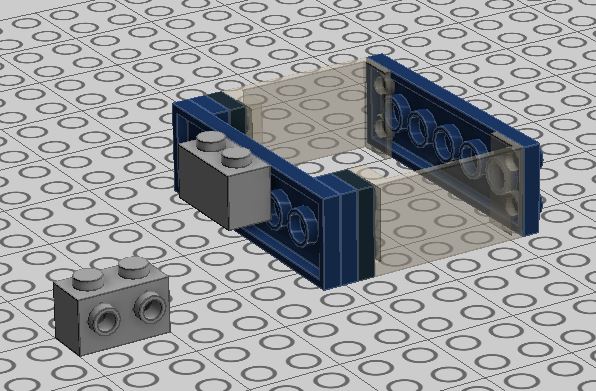
To stabilize the long row of windows, you may also connect both sides by a 2x6 plate (or two layers consisting of one 2x3 and one 2x4 plate if it's a 7-wide model, I can't really tell), and fasten it in the middle:
-
Next MOC: 1:33 GHH G7.1 (0-8-0) steam locomotive with PF
Sven J replied to Sven J's topic in LEGO Train Tech
Thanks for your appreciation! The wheels are mounted on a 7L Technic axle. The engine frame is only 4 studs wide, so that the wheels can be adjusted to 45 mm track width: The tender chassis is designed in the same way, the outer bearings being only a fake. Of course, this solution applies to wagons, too (as I will show soon… ). -
Trainstation "Bricktopia" - my first trainstation MOC
Sven J replied to Meisterschnorrer's topic in LEGO Train Tech
This is absolutely great!!! :thumbup: I am really looking forward to seeing it in real bricks. -
There are some more industrial locomotives I would like to build in 1:33. One of them is yet another Krupp type, the heavy 0-8-0 tank engine „Bergbau“; besides, I think I will try to model this archaic-looking electro-diesel locomotive.
-
Next MOC: 1:33 GHH G7.1 (0-8-0) steam locomotive with PF
Sven J replied to Sven J's topic in LEGO Train Tech
I feel really honored to get this positive feedback by such outstanding train builders as you are. Thank you very much! -
Next MOC: 1:33 GHH G7.1 (0-8-0) steam locomotive with PF
Sven J replied to Sven J's topic in LEGO Train Tech
Many thanks. Length over buffers is just under 51 cm with close-coupled tender. Thank you very much! I will present some rolling stock as soon as I had the opportunity to make a short video. Currently, due to the weather, the light is too low for that. -
Next MOC: 1:33 GHH G7.1 (0-8-0) steam locomotive with PF
Sven J replied to Sven J's topic in LEGO Train Tech
Thank you very much for your appreciation! Well, you may call it a personal quirk of mine; but while I quickly accepted using BBB wheels, simply because there’s no real alternative, I took it as a challenge to build the rods with genuine LEGO parts only. I know there are custom rods available, but that would be just too easy… Thanks a lot! I have been tinkering with it for about 18 months (including the acquisition of all the parts) until I was really happy with the result. The first version had two M-motors and was much too slow, which meant I had to completely redesign the tender. In the second version, the torque of the L-motors tore the drivetrain to pieces, so I had to revise it again… this is the third version now, and it is finally working! -
Hello AFOLS, the next MOC I would like to share is this 1:33 scale 0-8-0 steam engine similar to the Prussian type G 7.1 (https://en.wikipedia.../Prussian_G_7.1). The "Gutehoffnungshütte" (GHH) colliery and iron works company in my home town Oberhausen, Germany, had a total of 13 of these simple and reliable locomotives, which differed from the Prussian State Railways engines by having a slightly increased boiler pressure and therefore being a bit more powerful. They were used for hauling ore trains from the Rhine harbour in Walsum to the iron works as well as for pulling shuttle trains for the GHH workers. Sadly, none of the GHH G 7.1 locomotives has survived. Finally, I moved into an apartment where I have room for a track layout, so the model features two PF L-motors, a rechargeable battery pack and a V2 IR receiver. As I wanted to create a highly detailed frame for the locomotive, all PF components are squeezed into the tender; to achieve this, while still retaining a realistic outer shape, was quite a challenge, but I think I found a very satisfying solution. The drivetrain layout enables the engine to reach a true-to-scale maximum speed of about 0,5 m/s, which is equivalent to approx. 60 km/h. As the prototype had Allan valve gear inside the frame, only the main and side rods are visible on the model, too (for German steam engines, it's quite unusual to have the side rods painted black, but it's authentic for this particular prototype). The model runs on standard LGB track (45 mm) and is capable of negotiating R3 curves and switches. The distance between locomotive and tender can be adjusted (the photos show the prototypic close-coupled adjustment suitable for display). I used a few non-LEGO-parts: BBB XL drivers (engine), BBB L drivers (tender), rubber band around the smokebox door, thin PVC washers on the crankpins (to prevent the side rod bearings from jamming at the wheel rim), and homemade stickers. And now the pictures: Not quite purist, but I like this photo: The engine frame, showing leaf springs and brake rigging: A glimpse of the cab interior: Boiler backhead: Tender internals: More and larger pictures can be found here. Finally, here is a video link for those of you who would like to see the model in action. I apologize for the poor quality, but unfortunately I do not have a tripod. Some rolling stock will come soon. Best regards, Sven
-
I just looked up the LEGO Ideas guidelines. They clearly state that „proposals for new LEGO parts (of any material), competing brand building bricks, or “aftermarket” elements manufactured and sold by any third party are not allowed“. To replace the wheels by original LEGO parts won’t work, as even their largest drivers would look ridiculously small. Nevertheless: Many thanks for your appreciation!
-
Thanks for the compliments. Well, I thought about it; but since such important parts as the wheels are non-LEGO products, I don't think it would be accepted.
-
Hello AFOLs, thank you very, very much for this cordial welcome here at Eurobricks, for your compliments and your interest in my model. In my wildest dreams I never would have imagined to make it to the EB front page with my first post. So, after this encouraging start, more large scale train models will follow! With best wishes, Sven
-
You are right, gauge 1 is 1:32. But the diameter of the BBB XL drivers ist exactly 1/30 of the prototype's 1100 mm, so I chose that scale. I admit that, by doing so, track width is a little too narrow for the locomotive (45 mm in 1:30 being equivalent to 1350 mm in reality, instead of 1435 mm); but this minor difference - less than 3 mm - is almost unnoticeable, especially as the engine is displayed in a showcase on its own, without direct comparison to other models. The flange problem occurs with LEGO wheels, too, maybe even a little worse. Because of that, my models are displayed on Märklin track (yes, it's code 200) and, as far as the PF-driven ones are concerned, operated on LGB track (no "gartenbahn", just a large layout on the floor of my attic). I know that LGB rails are way too high as they are actually meant for narrow gauge, but it is the only (affordable) possibility to get the models running. By the way, PF models (the first one coming soon - just have to take a few photographs ) will be in 1:33 scale, again due to the prototype's wheel diameter.
-
I'm sorry, but I have to disappoint you... I have just set up a large LGB 45 mm track layout, so I think I'll stick to that. PF is a different issue - there are some things to come... As I am very fond of this little industrial steamer, I definitely would like to see you build an 8-wide Knapsack!
-
Wow - this is really cool!
-
This is a truly great model of an impressive prototype. Thanks for sharing!
-
Oh, just a little bit... It's Märklin gauge 1 track. But due to the low rail profile, it is suitable for display only, as the wheel flanges hit the rail ties. For motorized models, I have to use the higher LGB track. Yes, I saw your astonishing Mallet. Your model was an encouragement for me to post this topic, as I became aware that I am not the only guy who builds LEGO locomotives larger than the usual style. So, double thanks!
-
No, it's unmotorized, as I wanted it for display only. But some PF-driven models are in the making...
-
Dear AFOL community, after reading this forum for quite a long time, I decided to present some of my MOCs. Being a railroad enthusiast and model collector, I found that some of my favourite locomotives were not available from model train manufacturers. So two or three years ago, my "dark ages" were over (after nearly 20 years), and I began designing and building my own locomotive models with LEGO bricks. The first MOC I would like to show is my 1:30 scale model of the little Krupp "Knapsack" 0-6-0T industrial steam locomotive, as operated by the Hespertalbahn museum railway in Essen (Germany), not far from my home town (for engine details, you might want to take a look at the German web page https://de.wikipedia.../Krupp_Knapsack). At the time of designing this MOC, I did not have enough space for a track layout, so I chose to build it as an unmotorized static display model, which helped make the engine frame as detailed as possible. In order to achieve a more prototypical look, I used a couple of non-LEGO parts: BBB XL drive wheels, self-made stickers and a black rubber band around the "smokebox door" to hide the gap between the two parabolic dishes. The lamp glasses are glued into place, purists may forgive me... So here are the pictures: The cab interior: Larger versions of the images can be found here: http://bricksafe.com...derlok/knapsack I hope you'll enjoy, best wishes Sven