

Sven J
-
Posts
789 -
Joined
-
Last visited
Content Type
Profiles
Forums
Gallery
Everything posted by Sven J
-
A beautiful model! :thumbup: How boring is today's motor racing compared to these monsters from the 60's and 70's... And an ingenious solution for the steering. Can it be operated by the steering wheel, or do you have to adjust the wheels by hand?
-
MOC: 1/33 Swedish 0-8-2T with three (!) working cylinders
Sven J replied to Sven J's topic in LEGO Train Tech
Thank you too, LEGO Train 12 Volts, zephyr1934 and Captain Green Hair ! I am very happy about receiving all these compliments, especially by such experienced builders. I have shown it to a few friends and family members who do conventional scale modeling. Most of them couldn't believe that adult persons spend their time and money building scale models from LEGO... But feedback was entirely positive. Do you mean the windshields? Yes, I used clear jumper plates to build them. The 2x2 window frames are a bit too small, both regarding height and width... As for the buffers: It used to be a feature of most German and Scandinavian railway vehicles that the right buffer (in the direction af travel) is convex, the left one flat (if you look very closely, you can see it in the prototype drawing, too). By means of this, when two vehicles are coupled, there is always a flat buffer opposing a convex one. This reduces the tendency of opposing buffers to slide off each other, especially when going through curves, as the convex buffer can „roll“ over the surface of the flat one. -
MOC: 1/33 Swedish 0-8-2T with three (!) working cylinders
Sven J replied to Sven J's topic in LEGO Train Tech
A thousand thanks to all of you for these tons of praise! Special thanks to an expert builder like you, Holger! Well, I haven't tested it yet; but my Hohenzollern 0-6-0T has about 60% of the weight and pulls two Lego waggons plus three LGB ones with ease, so it should be no problem for the M3a either. The rechargeable battery box lasts for about one hour. Traction is fairly good even without traction tires, due to an adhesive weight of approx. 1.2 kg. The gauge is 45 mm (gauge 1). Unfortunately, living in an apartment on the third and fourth floor, I don't have a garden... Well, a functional valve gear would have required more customized parts - and you know I'm a bit reluctant about that... As for openable doors, they would make no sense for this model: to be prototypical, they would have to open inwards, which is impossible due to the position of the battery box. But I promise I will make an engine with opening doors some day... One of my all-time favourites! Build it, please!!! -
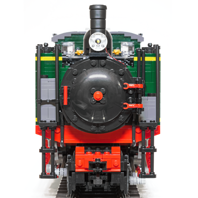
Dear fellow AFOLs, it’s been quite a long time since my last MOC, but finally, I am proud to present another one. And I dare say that the waiting was quite worth it… But let’s take one thing at a time: I’ve always loved Swedish steam locomotives for their clean, elegant lines, their beautiful colour scheme and those massive snowploughs ; so when the Mallet project I announced a few months ago had failed, I thought it was time for an old Scandinavian lady in 1/33 scale – the TGOJ M3a No. 104. The prototype is a three-cylinder 0-8-2 tank engine (did I mention that I love tank engines, too?). Four of these locomotives were built between 1928 and 1930 by Nydqvist & Holm AB (NOHAB) in Trollhättan, Sweden, and delivered to Frövi-Ludvika railway, where they were classified as Litt. M3a, nos. 101–104. From 1931 on, the engines were operated by TGOJ (Trafikaktiebolaget Grängesberg–Oxelösunds Järnvägar). They were used primarily in freight service, e.g. for hauling ore trains to the harbours on the Baltic Sea. While engines 102–104 were scrapped in 1975, no. 101 is preserved at the railway museum in Grängesberg. The model consists of ca. 2100 parts and weighs about 1.4 kg. It features a working reproduction of the inner cylinder and a realistic frame with prototypic cutouts, inside-mounted equalizing beams, and brakes. The cab interior is as detailed as possible, given that the battery box is placed inside the cab. Two L-motors, controlled via one IR receiver (V2), are working directly on the fourth axle; the first to third axles are driven by the side rods. All the rods were made to measure by zephyr1934 (and I really want to thank him for this great job!), while the wheels are BBB XL and Medium ones. Enough said, here are the pictures: The frame during construction, showing the prototypical inclination (approx. 6,7°) of the middle cylinder, which allows the connecting rod to clear the first axle: Two more views of the frame. You can see the equalizing beam between the first and second axle as well as the one between the third and fourth: The motors are situated in the side tanks and in the lower half of the boiler: A longitudinal section (render). The red boat weight brick improves weight distribution: Some cab side detail. Note the small windshield glass between the windows: Self-made stickers: The rear windows are barred, to prevent them from being damaged while taking coal: The roof is detachable for easy access to the on/off switch and the charging socket. You can also see the rudimentary cab interior: Finally, here’s a video, showing the locomotive in action. Despite its long wheelbase, the model is able to negotiate LGB R3 curves and switches, as the trailing axle (Bissell type) swings out both radially and laterally (Note: The brakes between third and fourth axle are for display only. In operation, they have to be removed; otherwise, they rub against the fourth axle’s flange and make a terrible noise). As usual, you will find larger versions of the pictures in my Bricksafe folder. You can also download the LXF there. Thanks for your kind interest! Best wishes, Sven Edit: New videos here!
-
You’re right, there’s a little teaser in my signature… It’s a Swedish three-cylinder 0-8-2T, class M3a. The model, which will feature a working middle cylinder, is nearly finished. I hope that the last parts will arrive soon, so I should be able to complete the engine and to take pictures within the next four weeks. Of course I will post here, so stay tuned!
-
Thanks a lot! The LDD files for all my MOCs are available in their respective Bricksafe folders. Feel free to use them for building your own copies of my models - but please credit me in case that you should want to show or post them elsewhere.
-
WOW!!!! This is gorgeous! :wub_drool: Is it possible to show some more detail photos?
-
Unfortunately, yes. I still don't receive notifications.
-
Another wonderful model of yours with so many fine details. Awesome! :thumbup: Just to please my curiosity: What is the purpose of that vertical fin in front of the cab windows?
-
I'm sorry to dig this up; but I just noticed that, once again, I do not receive any notifications. I would really be glad if this could be fixed. Maybe a change of email address would help; but I don't dare to do so, for I fear that the re-activation email won't arrive...
-
This is a breathtaking model, with incredible attention to detail! :thumbup: And the idea to reproduce the screw conveyor in the tender, instead of just modeling a heap of coal, is really amazing!
-
I have to admit that usually I'm not very fond of electric locomotives. But this thing looks great! And the detailing is fantastic!
-
Thanks for the compliments. But (especially when considering that your locomotives are built to a much smaller scale than mine), I find it absolutely amazing how you manage to reproduce all those details AND maintain functionality. Unfortunately, the 2-4-4-2 Mallet I announced nearly 3 months ago has been put aside for the moment, as the intended level of detailing caused serious structural problems. But I'm working on another project...
-
A magnificent rendition of a legendary prototype. Well done!
-
WOW!!! Another stunning piece of engineering art. Every time I look at the pictures, I find more interesting details. Thank you so much for sharing! I really hope you’ll change your mind, there are so many „Baureihen“ left… Or how about the German-inspired Bulgarian class 46? As far as I know, not even model railroad manufacturers have dared to reproduce this behemoth – but I am sure you could do it! Happy Easter to all of you!
-
That's a very nice model! You've captured the prototype's distinctive shape very well. The wagon ends and the bogies are just great! I'd love to see some more pictures of the whole train, including your BR 55. The windows look a bit small, though. Did you consider to build just four windows in a row, and to make them larger? I could imagine that your models would look even better then. (I know the prototype has five, but as I read on your Flickr account, you've shortened the wagons anyway.)
-
MOC: " Mocanita" on Vaser Valley (Maramures County - Romania)
Sven J replied to badgogo's topic in LEGO Train Tech
What a beautiful MOC! :wub: So many details, and some inspiring building techniques. Thank you very much for sharing! -
I cannot find words to express my admiration for your loco. A truly, truly great model! :drool: :drool: As others wrote before, I would also like to see you building a steam engine at the same scale!
-
Seems to be working again. Many thanks for your efforts!
-
Still, notifications don't arrive. Both the spam folder and my regular mailbox stay empty.
-
It still doesn't work for me. I use GMX.
-
Same for me, too.
-
Here's another one: For one of my projects, I needed a boiler with exactly 17 plates diameter. But I'm not quite happy with the use of hinge plates to get a more rounded shape, so I abandoned the project for the moment.
-
Finally, here's the photo you asked for: Bullfrog Snot was applied to the flanged driver on the right.
-
Unfortunately, at this time of year it’s too dark for taking pictures when I come home from work (and using a flashlight would be no good due to all the reflections). But I will have a try next weekend. What I can say right now is that Bullfrog Snot almost completely loses its color when it dries up. It simply looks like a slightly shiny, transparent rubber band.