

Sven J
-
Posts
789 -
Joined
-
Last visited
Content Type
Profiles
Forums
Gallery
Everything posted by Sven J
-
MOC: 1:33 Hohenzollern Oberhausen 0-6-0T with PF
Sven J replied to Sven J's topic in LEGO Train Tech
Thanks Sylvian, brickblues, Crossbones, Asper and Rob for your praise! While the white lettering is made with transparent DYMO labels, the "Gutehoffnungshütte" emblems and the number plates are printed on self-adhesive metallic inkjet foil. However, I couldn't cut out the elliptic builder's plates precisely enough, so I ordered these parts by Thomas Beckert, custom-made with prototypical factory number and year of construction: They are held in place by a small piece of double-sided adhesive film and can be removed without any harm to the LEGO bricks. I used following wheels for my train MOCs: Hohenzollern 0-6-0T: LEGO large driving wheels G7.1 0-8-0: BBB XL drivers (engine), BBB L drivers (tender) Krupp Knapsack: BBB XL drivers Wagons: BBB L drivers Sorry, just the photos on my Bricksafe account. And the LXF files, of course. You might like to hear that my next MOC will actually be a 1:22.5, fully LGB-compatible narrow gauge 2-4-4-2 Mallet locomotive. Designing this monster (4 L motors, 2 battery boxes, 2 IR receivers) just turns out to be much more complex than I had expected, but I hope that the engine will be ready in March/April... -
[MOC] German Regional-Express with doubledeck coaches and Vectron engi
Sven J replied to HoMa's topic in LEGO Train Tech
What a great MOC! Instantly recognizable, and some very inspiring building techniques. Thanks for sharing! -
Dear Lego Train 12 Volts, you’ve knocked me flat! Another one of my favorite locomotives (41 360 is in fact stationed in my home town Oberhausen, Germany! Thank you!! ). And what a model! :wub: Everything about it is gorgeous, but I especially love those nice little details like the cab roof vents and the slanted cab sides. And the tender is simply brilliant, with its very realistic twisted oil piping (41 360 is an oil-burning engine) and these detailed bogies. Would you mind telling which part you used for the ladders on the tender back, as I hadn’t been able to find something like that when I needed it? One small suggestion (but again, this is nitpicking): Would it be possible to add brakes between the driving wheels? There seems to be enough space for that. Merry Christmas and a happy new year (with many new locomotives, I hope ) Sven
-
MOC: 1:33 Hohenzollern Oberhausen 0-6-0T with PF
Sven J replied to Sven J's topic in LEGO Train Tech
Thanks again for your appreciation! A bit too good, to be honest… The prototype was restricted to a maximum permitted speed of 30 km/h (ca. 19 mph), for it had very poor running characteristics due to its short wheelbase. The model, however, is able to run at a speed of about 0.4 m/s (with not too heavy trains), which would be just under 50 km/h in reality. So the miniature engine driver should better not let his locomotive run at full throttle, or he’ll risk a substantial fine… -
MOC: 1:33 Hohenzollern Oberhausen 0-6-0T with PF
Sven J replied to Sven J's topic in LEGO Train Tech
Thanks to all of you for your kind words! Yes, the prototype had quite large sun visors above the cab windows. These were slightly rounded on top, which I tried to represent by using studded plates instead of tiles. It’s a single central gear train. After several rebuilds, the current version (as represented in the LXF file) works perfectly and indeed more reliable than the tender drive of my 0-8-0. It’s important, though, to use the newer reinforced 8-tooth gear wheels, as the older ones tend to slip out of meshing. I’ll definitely keep on designing and building train MOCs, I just can’t say how long it will take until a new one is finished. Unfortunately, I have to spend quite an amount of time for such ugly things as working and earning money… Next, I would like to have a small articulated locomotive, maybe a Saxon I TV or a Bavarian BB II, but I don’t know yet how to get it right. Perhaps I’ll get some inspiration during Christmas holidays. I’m sorry, but due to license issues I can’t show a photo of the prototype here in this forum. I sent you a PM. Yes, that would be fine. But honestly, I have no idea how to make it... -
Do you mean this one? It's an experimental high-pressure locomotive which was rebuilt from a Class 45 2-10-2 by the Deutsche Reichsbahn in East Germany.
-
The black painting of boilers, cabs and tenders was introduced in the 1920s because it was easier to maintain than the previous green livery with black and red striping. Wheels and frames were painted red as it was thought that the bright color would make it easier to detect cracks.
-
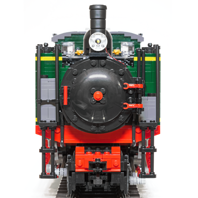
Hello everyone, this time I would like to show you my latest PF-driven 1:33 scale model – it’s yet another industrial German 0-6-0T locomotive: During WW I, the „Gutehoffnungshütte“ in Oberhausen, Germany, commissioned a new locomotive for pulling trains loaded with slag from the company’s iron works to the nearby slag heap. The engine had to be able to negotiate very tight curves, so Hohenzollern locomotive works in Düsseldorf came up with a compact, yet powerful 0-6-0T with an extremely short wheelbase (2500 mm!). As a reference to the customer, the new engines were designated the „Oberhausen“ type. The model features two L-motors, a rechargeable battery box and a V2 IR receiver. In order to allow access to the on/off switch and the charging socket, the central part of the roof is detachable. Unlike my previous locomotives, there is no detailed cab interior, for the PF components require most of the space. At least, this is my first LEGO model with movable Walschaerts valve gear (though I have to admit that I had to cut some „3L Technic axles with stud“ to make it work). The motors are geared to the second axle only; the first and third axle are driven by the side rods. Initially, I had some doubts whether this solution would work, but happily it does very well. The only non-LEGO parts I used for this model are the stickers and custom made builder’s plates (photo-etched brass parts from Beckert-Modellbau). But let’s stop talking, here are the pictures: Note the prototypic buffers: In each driving direction, the left one is flat and the right one curved. Two boat weights help to increase adhesion weight and pulling power; besides, they compensate for the heavy PF components in the rear. For the complete drivetrain layout, please check the LXF file: The whole train: Of course, there is a video, too. I was somewhat in a hurry while taking it, so please excuse the camera shake. Perhaps I should ask Santa for a tripod… Thanks for your interest, best wishes Sven
-
Next MOC: 1:33 GHH G7.1 (0-8-0) steam locomotive with PF
Sven J replied to Sven J's topic in LEGO Train Tech
Every time I think that a model is finished, new information comes to light… In this case, I received some detail photos and drawings of the 3-axle Prussian tender, showing that its top was not just flat, as I had modeled it. This meant that I had to rebuild it again, albeit at the cost that the shrouding cannot be detached any more. So this is what the tender looks like from above now, with the poker stowed alongside the coal: Tender front, now with water gauge: Access to on/off switch and charging socket: The lxf file can be found here. Thanks for your interest, best wishes Sven -
I found that the LEGO O-rings don't have a constant cross-section, so that the entire wheel gets out of roundness - with the consequence that the engine runs quite roughly. With Bullfrog Snot, this is much better (only when it is applied evenly, of course). Btw: This pneumatic thing looks mighty impressive!
-
I agree - otherwise the curvature radius would be too large.
-
What a wonderful MOC again! :wub: The BR 38 is one of my special favorites, for one of these engines is regularly operated by the railway museum in Bochum, quite near my home town; so I am particularly happy that you’ve built such a fine model. As you said, the „Wannentender“ (bathtub tender) is especially elegant, and you’ve captured its looks very well. It’s also nice to see that you didn’t even forget the brakes between the second and third drive axle (btw: the gap you mentioned is to give room for the firebox, which extends down between the frame). The design of the front part of the frame seems to be very ingenious, too. I’m very, very curious which BR will come next!
-
A cute little engine and another great model of yours! :thumbup: The design of the leading truck and its articulation to the main frame is really clever. I also like the way you snotted the cab windows and the firebox sides. I'm looking forward to see your last two BR steamers! (Just one thing - it's really nitpicking, forgive me, but the BR14 never carried DB signs, for all engines were retired until 1926. )
-
WOW!!!!! :thumbup: :thumbup: This is one of the best LEGO models I've ever seen. Your careful attention to every little detail is absolutely unbelievable. Not only the interior, also the undercarriage looks great. Do you plan to build it in real bricks? Best regards Sven
-
@ Hrw-Amen: I got mine from here. They ship to UK, but shipping costs will be quite high (17 €). There is also a seller on ebay.
-
Indeed, it feels a little bit sticky when dry, and as a consequence, it gathers some dust when the wheels are running on dirty track. But that doesn't bother me much, for most of the dust can be wiped off - and a rubber ring would also collect dirt.
-
Sorry for bumping an old topic, but I just tried Bullfrog Snot and thought you might be interested in the results. Having severe traction problems with my 0-8-0 when pulling more than one car, I temporarily used LEGO wheels equipped with traction rings on one tender axle. But LEGO’s large drivers have counterweights, so they didn’t seem appropriate for a tender chassis. Therefore, I looked for a solution that would provide more grip for BBB L wheels, and after some web searching I decided to have a try with Bullfrog Snot (although it is not easy to get in Germany). All I can say is that it works perfectly! I applied Bullfrog Snot to the wheels on the first tender axle only, and traction problems have completely disappeared. Besides, concentricity is much better than with LEGO’s somewhat bumpy O-rings. Application is a bit tricky, though. Different sources suggested to use a toothpick; but I found that this would only work for N or H0 scale wheels, as you simply can’t pick up enough stuff. Instead, I used the square end of a match to get quite satisfying results. To get an even surface, it is important to keep the wheel turning not only while applying Bullfrog Snot, but at least 15 minutes longer. I built this simple device: In case that you should mess up something, Bullfrog Snot can be removed with warm water (as long as it hasn’t dried up) or with lighter fuel. As a conclusion, I would really recommend Bullfrog Snot if you want to pull heavy trains on metal rails or through narrow curves (and I am not related to the manufacturer… ).
-
Somehow I completely missed this wonderful model until now… As previous posters already wrote, you did an outstanding job modeling all those complex slopes and curves. Absolutely fantastic! :thumbup: The bogie skirtings and the front air vents are very well done, too. But I also like the recessed doors and how you modeled the exhaust pipes (?) on the roof. Just one thing: Why does the side lettering say „Burliington“ with double „i“? P.S. Sorry if I seem to be a smarta**, but I have to take up the cudgels for German engineering: The world’s first diesel-electric train was indeed the Royal Saxon DET 1/2; and when it comes to streamlined, lightweight high-speed trains, the „Flying Hamburger“, DRG class SVT 877, was built two years bevor the Zephyr…
-
Thanks to you, too! The wheels are BBB L drivers. Lego Emerald Night drivers would also fit, but since they have counterweights, I do not like to use them on wagons. The pictures show the wagon standing on Märklin gauge 1 rails; but due to the high flanges of BBB wheels, this is for display only. In operation, my models are running on LGB track (45 mm). A detailed discussion of the rail-and-flange problem can be found in my post on the Knapsack 0-6-0T.
-
Thanks everyone for your compliments! I feel honored by your confidence. As my models represent industrial vehicles belonging to a colliery and ironworks company, I already thought about building a headframe as a background for my railway. However, it would be an extraordinary challenge to model such a thing correctly, and in my chosen scale, it would be almost 2 m tall… But never say never, so let’s see what the future will bring. That sounds promising. Please show them when they are finished! There are video links in the postings on my passenger cars and my 0-8-0. Or just visit my Bricksafe folders.
-
Hello once more, after EB member 6ix spotted it in one of my videos, I decided do present another MOC – though it’s not a great piece of art, to be honest. Just a quickie that I built when I was actually working on my 0-8-0, as I didn’t want her to feel too alone in her showcase… But perhaps one or two of you might like it nonetheless. It’s a saddle-bottomed, self-discharging ore wagon, based loosely on the DRG standard type. The side flaps are movable, but I forgot to take photos with open flaps initially. When I remembered, I had already filled the wagon with circa 1000 black 1x1 round plates, so I don’t really want to open it anymore… The model on Bricksafe, including LDD file Best wishes Sven
-
Next MOC: 1:33 GHH G7.1 (0-8-0) steam locomotive with PF
Sven J replied to Sven J's topic in LEGO Train Tech
Hello everybody, thanks again for your kind feedback. In case that some of you should like to reproduce, modify or improve my models, or just to take a closer look, I added the LDD files to their respective Bricksafe folders. They do not represent the final versions of the models, mainly because of three reasons: - changes becoming necessary during the building process, due to the lack of parts or stability issues; - some parts are unavailable in LDD – BBB wheels, L-motors, flex cables or minifig hands, for example; - certain building techniques, as the one I used for the smoke stacks of my engines, are not permitted there. But nevertheless, I think the files provide a good overview. Best regards Sven -
Thanks for the additional information! Now that I know some prototype photos, I like your model even better. Great! :thumbup:
-
I don't know anything about the prototype, but this model looks very interesting! Please let me pose two questions: Is this car able to negotiate curves? And how on earth did you build this beautifully curved roof?
-
Thanks for your appreciation – and for the link! It left me absolutely speechless for quite a while… While I normally don’t like the appearance of Garratt locomotives very much, this one surely is one of the most gorgeous models I have ever seen.