

Hod Carrier
-
Posts
1,008 -
Joined
-
Last visited
Content Type
Profiles
Forums
Gallery
Everything posted by Hod Carrier
-
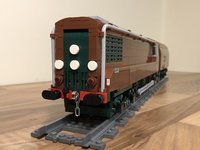
A little treat for everyone for Easter. I've been working away quietly on my first full-size loco, and just this week I completed it. It's a D800 Class "Warship" diesel-hydraulic loco used by the Western Region of British Railways during the 1960s. My model is of D812 Royal Naval Reserve 1859-1959, one of only two members of the class not to carry the name of a Royal Navy warship (see Prototype Notes below). Although the normal convention for British models is 7-wide, I was forced to build this as an 8-wide model which makes it rather large. On the plus side, this model scales at around 1:42 or 13.5 inches per stud, which brings it very close to UK O Scale. The benefit of this scale is that instead of having to create my own graphics I was able to use the excellent range of O Scale waterslide graphics for all markings, crests and numbering. I was even able to lavish this model with etched nameplates and works plates. As far as possible I have tried to keep everything to scale, and this extends to the bogies. They are a tad long to comfortably traverse standard LEGO curves, but they will go round even though the wheels are partially covered. Purists may be disappointed to see that some LEGO was hurt in this area of the model, but I wasn't going to give up on the sloped sideskirt ends. The uncompromising head-on view shows the use of coloured vinyl to recreate the yellow warning panel and the windscreens. Admittedly the screens should be larger and extend to the roofline, but this is one of those compromises you make when you build with LEGO. Silver window frames have been achieved using a metallic silver Sharpie. This is just a taster of the details of this loco as there is more to reveal in the coming months. Prototype Notes:
-
Thanks guys. @coghilla I did have another look at your electrification train to see if I could gain inspiration for the piling equipment. Feel free to copy whatever you wish to add to your models.
-
[MOC] Diesel British Rail Class 04 Shunter Inspired
Hod Carrier replied to charlesp1138's topic in LEGO Train Tech
The shape isn’t too far away from the Class 04 but I can see that the length and wheel arrangement is a bit off to be a faithful replica. I don’t think you’d need to make too many changes to bring it closer to your inspiration if you wanted to. All that said, she’s a handsome looking devil and would make a good shunter/trip loco on any layout. -
Ha ha!! Brilliant!! I think the loco exhaust will be fine, as it should just land on the deck behind the prime mover. Alternatively you could place a planter with roses in which I’m sure would do very nicely.
-
I rather carelessly dropped something that I had been building onto my kitchen floor. In that horrible moment where everything happens in slow-motion I made sure I watched as all the various parts fanned out and skittered across the floor so that I would know where they all ended up. After gathering up the pieces and rebuilding what had moments before been utterly devastated I noticed that I was still missing a couple of parts. Given the number of small parts like tiles, clips and bars, I was very surprised to notice that I was actually missing a 1x3 plate and a 1x4 brick. How could two relatively large parts have vanished so completely? I’ve turned my kitchen upside down, moved the furniture and looked under the appliances but they are still nowhere to be found. I’ve come to the conclusion that they must have been taken by the LEGO Fairies and that I will have to replace them. Have you also been a victim of the LEGO Fairies? What’s the largest part that has inexplicably gone missing?
-
That’s a fantastic layout, and good to see a classic layout like Minories still having an influence into the 21st Century.
-
Oh wow!! You put a lot of trust in string. I’m not sure I would want to hang track like that and not be worried it would all fall down. But you have shown how people can still have a layout even in a very small space.
-
Good lord!! I’m still soaking up the details and enjoying your build. I wasn’t aware the numbers were brick-built the first time I looked, but they show some serious skills and imagination. The overall size and operating features add up to make this an impressive build. Love it!!
-
Unauthorized selling of instructions for MOCs
Hod Carrier replied to Sven J's topic in LEGO Train Tech
Ah heck!! Not again. @Tenderlok Sorry to hear that you’ve been a victim of this yet again. I hope we can have a mature response again from the community with regards to this and get things straightened out in a fair way. It’s fine when you can easily identify who the originator of a model might be, but it’s harder when a model cannot be identified. I can see how someone who isn’t necessarily part of this community could be duped into paying for work that doesn’t belong to the vendor. We do rely heavily on the community ethos and the goodwill that goes with it, but it does make us vulnerable to IP theft. It would be a great shame if we had to consider deploying digital security methods each time we publish. -
@ProvenceTristram What a beast!!! I agree that powering a model that small would be asking the impossible. I’m not sure you’d squeeze a motor in there, never mind anything else. I’m guessing you actually want the road wheels to be lifted as part of the model rather than simply having two configurations you can swap between.
-
Thanks for the positive feedback, guys. I wanted to try and get the details right. There are no motorised functions and parts of the model are quite fragile. For example, the arm cannot hold the weight of the accessories at full stretch. @ProvenceTristram That’s an interesting prototype. What’s your intention for modelling it? Are you hoping to have any motorised features?
-
This is a little distraction project that I've been working on as a break from other things. I've always liked these little road-rail excavators and other on-track plant, so I thought I'd have a go at building one. I'd settled on the PW160 wheeled excavator built by Komatsu as a fairly common model in use with several contractors, including VolkerRail. These are converted to road-rail use by Rexquote. In the course of my research I discovered that another builder had already created a LEGO PW160, which can be found here. So, rather than reinvent the wheel, I opted to reverse engineer and modify this model to create my own version. Credit goes to Y Aki, the original designer and builder. My model features opening engine cover and side lockers showing internal details. The construction on the rear deck behind the cab is the automatic lubricating device. Working on the track in the company of a trolley-mounted container. As this machine occupies the track when operating, the line must be taken under possession. Therefore, a protected worksite has been set up with possession and worksite limit boards and detonator protection. These machines, together with the trolleys, are very versatile and can be put to a variety of uses, including piling. Transporting the piles to the location where they will be installed, a special attachment grabs and places each pile in precisely the right location and then begins to vibrate it into the ground. It's good to see the boys are using the correct PPE, including ear defenders. Another adaptation that is needed for piling is the use of a cantilevered counterweight at the rear of the body to maintain stability. The second stage is to drive the pile to the required depth, a job that can be done using an excavator-mounted piling rig. As the pile goes deeper the piling rig moves down the vertical guide until it reaches the required depth. The entire set, including trolleys, buckets, attachment, track signs, piles and piling equipment.
-
[MOC] 1:48 Southern Railway / Bulleid Leader
Hod Carrier replied to Commander Wolf's topic in LEGO Train Tech
Whoops!! My bad. So you do. I couldn’t see the yellow lion against the grey background in the photos. I must get to the optician. -
[MOC] 1:48 Southern Railway / Bulleid Leader
Hod Carrier replied to Commander Wolf's topic in LEGO Train Tech
Congratulations on pulling off a very complex build full of innovative features. I particularly like the clever bogie articulation you’ve come up with. She may not run very well at the moment but she’s a looker for sure. You’ve got the proportions pretty much spot-on, which isn’t always easy on a loco like this one when you’re trying to include a working drivetrain. The Leader Class was very much the wrong loco at the wrong time. The theory was sound in that it was immensely powerful and the double-ended design gave the same flexibility of operation as a diesel loco, but it was overly complicated and unpopular with crews, especially firemen who were located in a separate compartment in the centre of the loco without adequate ventilation. Ultimately the diesel designs that were coming through at about the same time were cheaper and easier to operate. I hope you’re not going to give up on her just yet. She deserves to live, even if only as a static model complete with number and lining. I should point out that I think you’ve got the wrong BR emblem. What you have there is the later “ferret and dartboard” logo, but the Leader should have the “unicycling lion”. -
Vehicle Dynamics Laboratory investigates the Castering Effect
Hod Carrier replied to Hod Carrier's topic in LEGO Train Tech
@Unfinished_Projects You’re most welcome. A note on the elastic bands for the couplers. I use small bands which are sold in the UK at least as “loom bands” and can be bought cheaply in vast numbers from craft and toy shops (they are sold to children as a craft activity to be looped and braided together to make friendship bands, etc). These are smaller than normal stationery bands and exert a strong pull on the couplers once installed. -
Vehicle Dynamics Laboratory investigates the Castering Effect
Hod Carrier replied to Hod Carrier's topic in LEGO Train Tech
@Unfinished_Projects I've hacked my way back into my Bricksafe pages so that you can now download the file. I hope this is helpful. -
Vehicle Dynamics Laboratory investigates the Castering Effect
Hod Carrier replied to Hod Carrier's topic in LEGO Train Tech
At the end of this investigation I think it's time to sum-up everything that I have learned. I started out trying to find out whether or not the Castering Effect could be used in LEGO trains to enable long wheelbase vehicles to be run but the investigation quickly expanded into a more general quest to find the best solution for running vehicles of this type. Having looked at various methods from springing to passive steering to just leaving things to physics to sort out, I finally arrived at a solution that I believe to be the best possible. Before delving into the mechanics of the solution it is probably a good idea to give a brief explanation of the problem. One of the biggest issues with running long wheelbase vehicles on LEGO track is friction between the wheels and the rails. Fixed non-articulating axles impose a natural limit on how long a vehicle's wheelbase can be before friction becomes so great that it starts to affect the running of the train. The reason for this is that when the vehicle enters a bend the axle is no longer perpendicular to the rail where it is contact with the wheels, as it would be on a straight section of track. This turns the wheels such that they are no longer following the direction of the rail and are, in effect, being driven across the direction of the rail. This forces the inside faces of the wheels to scrub or bind against the inside faces of the rails generating friction. The longer the wheelbase of the vehicle, the more that the wheels are turned across the rails and the more friction is generated. The perfect solution would be to find a way to keep the axles perpendicular to the rail through bends as well as on straights, and for this the axles would need to articulate. While articulating bogies naturally follow the curves of the track due to having more than one axle, a single articulating axle requires some degree of external control in order to ensure smooth running. This usually takes the form of some sort of centring to bring the axles back to the straight-ahead position on straight track. Initially I hoped that the natural trail created by offsetting the pivot point from the line of the axle would be sufficient to cause the axles to caster, much as the wheels on a shopping trolley do, but the forces proved to be insufficient to cause this to happen reliably. I then considered using passive steering where the axles were linked together mechanically to transfer the steering impetus from one axle to the next but, while this worked well on simple curves, it caused derailments on points/switches due to the fact that at certain times on complex track configurations it is necessary for the axles to steer in opposite directions, which is something that this system did not permit. Following this I tried the solution most commonly tried by other builders which was to use elastic bands to pull the axles back into a centred position, but I discovered that this prevented the axles articulating as much as I wished them to while still not being able to reliably centre them. What all of these different approaches failed to permit was pushing of the wagons due to a phenomenon I referred to as "bunching" where all the axles are deflected causing high levels of friction. The solution that I have settled on, and the one that I recommend to all train builders, came about almost by accident. However, it is the most reliable method that I have tried and the only one that permits these wagons to be pushed without "bunching". As anyone who has followed this thread will know already, the solution is to employ self-centring couplers attached to the axle assemblies. This method reliably brings the axles back to a central position on straight track while still permitting the full range of articulation on bends. It also allows each axle to steer itself fully independently and holds the couplers straight when the train is being pushed. Vehicles with this feature can safely traverse points/switches both in forward and reverse and, with the use of a small bogie under the last vehicle in any train, does not require coupling to a conventional vehicle. Above is a render of the basic components of a long-wheelbase vehicle. (It is, in fact, the chassis used for my VGA vans.) The axle assembly at the left of the image is an articulating axle while the assembly at the right of the image is the low profile bogie used at the tail of the train. The free-castering axle assembly. These pivot freely around the 2x2 turntable plate and do not require any springing to return them to the centre position. The red 1x2 plates are the restrictors that are attached to the underside of the body of the wagon to prevent over-articulation. The size, type and position of these can be varied to allow different amounts of articulation depending on wheelbase and minimum curve radius. This configuration works well for my VGA vans which have a 24 stud wheelbase and are required to traverse standard LEGO R40 radius curves. The low-profile bogie which is needed if a long-wheelbase vehicle is at the rear of the train. Unless it is coupled to another vehicle the free-castering axles do not behave themselves correctly and can cause running problems. In particular, the train cannot be pushed without risking a derailment and it cannot take points/switches. Note that, as this is a bogie and will naturally follow the curvature of the track, no restrictors are needed, hence they have been omitted. The construction is very simple and just requires a few parts to be added to the existing assembly. The blue 2x2 plates are there simply to represent the number of layers between the axle assembly and the wheel holder and can be used for detailing if necessary. On the VGA vans I have used these layers to represent the spring hangers for the suspension. With the axle assembly removed it is possible to see the restrictors fixed to the bottom of the van chassis. Annoyingly they are black on black, but they should be more visible in the next photo. It should be easier to see the restrictors now and to see also how they limit the amount of articulation. This is important because, to reduce the friction between the wheels and the rails, you want to keep the axles as close to 90 degrees to the rail where the wheels make contact. Over-articulation is just as bad as under-articulation, therefore it is important to tune these restrictors as much as possible to suit your vehicle and layout. This is the other key component that makes the whole system work. It's the self-centring coupler. Exerting a force to centre the couplers is all that is required to centre the axles also. A strong force, such as is exerted using these small elastic bands, is enough to make it possible for these wagons to be both pulled and pushed and even take complex track layouts and points/switches. Centring couplers are only required on vehicles of this type. If you want to run wagons like these mixed in with conventional fixed axle or bogie wagons it is not necessary to add the bands to their couplers also. -
Vehicle Dynamics Laboratory investigates the Castering Effect
Hod Carrier replied to Hod Carrier's topic in LEGO Train Tech
@bogieman Hi Dave. Thanks for the background information. Being UK-based I'm not very familiar with American practice and equipment, although I was made aware of the problem of jack-knifing a few years ago after chatting with an American engineer and took away an appreciation for the differences in train handling. Here in the UK freight trains are generally more modestly proportioned and the risk of jack-knifing is much lower so the methods of coupling are different. That said, the trend with multiple unit passenger trains has, since the 1980s, been to use various types of autocouplers, all of which employ centring springs to hold them straight and level to help ensure good alignment when coupling. In common with your switchers, this can make things tricky when trying to couple on a curve. However, we don't have to get between the units and physically force the couplers into alignment because the couplers themselves have features that align the coupler heads as they come together, such as gathering horns or "nose and pocket" arrangements. -
Vehicle Dynamics Laboratory investigates the Castering Effect
Hod Carrier replied to Hod Carrier's topic in LEGO Train Tech
@Man with a hat I think it's simply that the entire train only needs one pair of small wheels. If there were more the friction might become a problem, but as only one of these bogies is needed it's manageable. But they seem to roll fairly well on their holders, and I have seen entire trains running on small wheels at shows without too many issues. -
Vehicle Dynamics Laboratory investigates the Castering Effect
Hod Carrier replied to Hod Carrier's topic in LEGO Train Tech
@Unfinished_Projects Thanks. I was thinking of posting up an exploded view of all the critical components once I’ve rendered one, but I could make a file available too. The mechanisms are actually quite straightforward. @Matt Dawson I tried the elastic band method and found it less effective. The problem is that any force that acts to centre the axles must be overcome in order to make them steer. If you take the elastic bands off the axles and put them on the couplers instead it will cause the axles to centre without affecting the steering and has the bonus of eliminating “bunching” when the wagons are being pushed. Any attempt to either “spring” the axles or to link them together causes more problems than it solves. Using self-centring couplers rather than axles together with a bogie at the uncoupled end is the only reliable way to run these wagons both forwards and backwards, and taking points/switches without derailing. -
Vehicle Dynamics Laboratory investigates the Castering Effect
Hod Carrier replied to Hod Carrier's topic in LEGO Train Tech
Time enough for a quick update, I think. After having designed a discreet power bogie for the Ferrobus I wondered if the principle could also be applied to a long wheelbase wagon. If you were following this discussion last year you may remember that I was still struggling with how to control the last axle without having to run it coupled to a conventional vehicle in order to give the necessary steering inputs. If I turned it into a bogie the problem would go away, but how to do so without it being obvious? Can you see it? Here it is!! Admittedly it would be even less obvious if I hadn’t used a dark bley plate, but I hadn’t got a black one to hand. A quick look underneath shows the simplicity of the design and construction. I’ve also been able to remove the plates that would normally limit the amount of articulation at this end of the wagon. So how does it run? Really well!! Using free castering axles, self-centring couplers and this bogie at the very rear of the train it is able to run forwards, backwards and through points/switches without binding, derailing or catching on anything. If the small train wheels add any friction it is barely noticeable and has no discernible impact on performance. If you’ll permit a little immodesty on my part, I think I’ve finally cracked it!! -
The thread in it’s entirety can be read here, including all the discussion and video links, but it is quite a long thread. The executive summary is that you CAN make long wheelbase cars that work, even when being pushed, by having self-centring coupling magnets and free castering axles. You do need to restrict the amount of movement to prevent excessive steering, but I found that this technique is the most reliable method that results in the least number of derailments. It’s funny that this topic should come up again now, as I’m in the early stages of testing a small update that deals with the problem of the last axle. More on that in a day or two.
-
We don’t yet know that this is definitely going to be the case, or that the existing part with the metal axle is going to be retired. Let’s wait and see.
-
Performance is likely to depend on how the axle bearings are designed. Most model rail manufacturers get good results from plastic axles by using pinpoint bearings at each end (basically the axle tapering to a point which locates inside a dimple moulded into the bogie frame). If TLG follow this principle we should be OK, but we’ll have to wait and see.
-
That’s like a Wickham trolley reimagined by The Jetsons. Great fun!!