

SimplyLegoTechnic
-
Posts
28 -
Joined
-
Last visited
Content Type
Profiles
Forums
Gallery
Everything posted by SimplyLegoTechnic
-
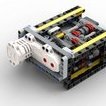 Maybe-maybe)) It depends on what kind of exterior you put on this chassis)
 -
Thank you! This is one of the most compact and functional MOCs I've ever built. I finally managed to keep it under one kilogram and still have enough traction for a single buggy motor. Why a PF-Servo? Because it's a BuWizz... BuWizz 3.0 more or less controls the steering system using LEGO PU-motors. That is, if you can accurately calibrate the steering. There's no fine-tuning option. And in RWD models, very precise zero-point adjustment is essential. I managed to calibrate it after the 125th try... However, BuWizz still doesn't have a proper fixed-angle switch (see here). For dynamic play in real conditions, the precise position of the shaft with the clutch switch in the gearbox is important. Therefore, the only RELIABLE and truly functional option on the road is a PF servo with its precise 90-degree rotation. It's worth mentioning that, when combined with a gamepad, the Buwizz app allowed for quite adequate control of a fairly fast model. Fast for LEGO of course. To address the problem of growling at high speed, I rebuilt the front suspension, adding negative Caster. It looks more than decent, but I didn't bother redoing all the videos and renderings.
-
Oh yeah, I was hoping someone else remembered what different parts of Formula 1 cars looked like in different eras))) Thank you!
-
Привет! Более 30 лет назад я начал заниматься Формулой-1. Еще до этого я начал строить из деталей старых металлических конструкторов. Сегодня я по-прежнему смотрю «Формулу-1» и имею возможность строить что-то из деталей LEGO, а также использовать некоторые электрические компоненты других брендов. Здесь я демонстрирую шасси, которое, по моему мнению, отлично подходит для сборки радиоуправляемых моделей LEGO Formula 1. Бесплатная инструкция: https://reb.li/m/235929 Вот простой пример внешнего дизайна. Вы можете посмотреть короткое демонстрационное видео: Я не ставил перед собой цели создать точную копию — элементы моего дизайна черпают вдохновение из разных лет, от начала 1980-х до 2010-х годов. Шасси в этом масштабе (с задними колесами 68,8x36 мм и передними колесами 56x28 мм) оказалось довольно легким и надежным, весом около 650 г. После добавления внешних элементов дизайна модель весит около 900–925 г. Характеристики модели шасси Формулы 1: - 3-ступенчатая коробка передач; - независимая подвеска всех колес; - рулевое управление с рабочим рулевым колесом. Для электрических деталей я использовал: - питание и управление от BuWizz 3.0 Pro; - BuWizz-мотор/MouldKing-Baggy-мотор для движения; - Серводвигатель LEGO PF для переключения передач; - Двигатель LEGO PU L для рулевой системы. Бесплатная инструкция: https://reb.li/m/235929
-
Hello everyone! In the process of preparing the content about my modified MOC mining dump truck, I had the great pleasure of reassembling the 42100 Liebherr R 9800 set. With minor cosmetic changes to the original design, designed to make it a little easier to lift the boom. And also to cover the largest holes in the body and the boom itself. The most interesting stage was working with the control profile in Control+. In my opinion, this profile and the model itself are an unrivaled example of realistic playability among all standard LEGO Technic RC sets. True, for this you need to understand the details and features that are hidden in the depths of the programmable control settings of this excavator. So far, I have used simple approaches. And yet, the 42100 Liebherr R 9800 in the stock version realistically loads the mining dump truck with beans. The entire process is programmed using standard and custom blocks. The latter are created very simply: you need to move the boom and cabin to the desired exact positions using standard blocks and record key points in the user block. Between the recorded points, the boom and cabin will move using all motors simultaneously!!! The spectacle is magnificent: In conclusion, a link to a video where loading a quarry dump truck looks quite realistic: Thank you for your attention!
-
Sure! The model slows down when shifting gears, especially if there's more rolling resistance. Without rolling inertia, the transmission stops after the clutch, which is clear in bench tests where big wheels spin small rollers. The solution will be a dual-clutch gearbox (DCG), but that'll come later, likely in 1:8 scale. This will be my first time using it, and I’ve realized that filming faster models (6-8 km/h and above) without an operator isn’t a good idea.
-
Thank you! If the YT link isn't opening, it might be because the video is blocked in certain regions due to copyright issues. For the steering mechanism, it's possible. For shifting gears in this design, you need an additional mechanism that converts the 90-degree turns of the PF servo into 360-degree rotations.
-
Thank you so much! I’m glad you liked it! Right now, I’m waiting for a gamepad delivery so I can try controlling the model properly at higher speeds. Unfortunately, without an operator and a good camera, it’s hard to make a colorful video of these tests. The model drives out of the frame too fast, and the cheap action camera shakes way too much!
-
Of course, the car continues to drive if there is enough inertia or on a flat surface, during the gear shift, like a real car)) The whole point of my latest MOCs is exactly this. And the video also tells and shows the game in motion with gear shifting. You probably just need to watch it :) I hope I understood your question correctly.
-
Thank you! I'm really glad you liked it :) Of course, it’s a very challenging model to build, but it’s so interesting to see it in action!
-
Thanks for the feedback! About the clutch. If it wasn’t necessary, real cars wouldn’t have it either, right?))) In my previous MOC (https://reb.li/m/190094), I showed in this video (https://youtu.be/8Zy2hgXiuh4) that shifting gears without a clutch isn’t exactly smooth. Since I build models to last for hundreds of hours with minimal wear, I need every bit of reliability I can get. Plus, moving the complexities of shifting from a complicated gearbox to a simple clutch mechanism just makes sense. Thanks! In this MOC, the BuWizz motor and the entire transmission have come together surprisingly well. I’ve never enjoyed playing so much before!
-
Hey everyone! I’d like to share the results of my latest creation: the Outdoor RC LEGO with Gearbox. On one hand, it’s an evolutionary upgrade of my previous MOC (https://reb.li/m/190094) since it uses the same sequential 3-speed gearbox. On the other hand, it’s a completely new model. I’ve added a synchronized clutch mechanism and completely redesigned the gear-shifting system. It now uses BuWizz 3.0 and a BuWizz motor instead of the standard LEGO hub and LEGO PU L-motors. Surprisingly, the transmission works great, despite the glitches with BuWizz 3.0. For those just interested in the presentation: YT. For those who care about the build details, free instructions: https://reb.li/m/191991.
-
Thank you for your response! I don't see much point in making paid instructions, because my MOCs are quite complex, and are not copy models and do not have a stunning appearance. It's not a mass product to try to make money on it. Paybricks is interesting, but so far I prefer a minimum of third-party devices.
-
https://reb.li/m/190094 Rebrickable approved the instructions. They are now completely free to access. Maybe there was no point in making these instructions since they use a very rare part: the red 24-tooth gear for the gearbox...
-
Hello! Here's my MOC RC Car with GearBox. I picked a roadster body since it's light and doesn't need many parts. This keeps the chassis fast, maneuverable, and the gearbox working smoothly. It's a rear-wheel drive car. Like in my other MOCs (https://reb.li/m/186485, https://reb.li/m/186574), I didn’t focus on detailing non-functional stuff like fake engines or steering. The main goal is functionality, playability, and reliability. Free instruction: https://reb.li/m/190094 . A short video with the bilding and testing of the gearbox and the entire model. https://youtu.be/8Zy2hgXiuh4 The model uses 4 PU LEGO L-motors: 2 paired motors to drive the wheels, 1 for shifting gears, 1 for steering. It uses a standard PU LEGO Hub. Since there's no clutch, the model needs to be under 1.5 kg for the gearbox to work properly while moving (my MOC is about 1.2 kg). This build isn't perfect and might have its quirks, but it works great if you stick to the recommended specs. Gearbox details: 1st gear: 5/9 (9 motor turns in give 5 turns out), 2nd gear: 1/1 (5 motor turns in give 5 turns out), 3rd gear: 5/3 (3 motor turns in give 5 turns out) This gives gear ratios of 0.56, 1.00, and 1.67. The speed difference between 1st and 3rd gear is three times. So, it can move pretty fast on flat surfaces, and the low gear has enough power for any incline with good traction. Low gears are also great for slow, precise maneuvers. The suspension is quite stiff since it has low ground clearance, meant for smooth surfaces. The front wheel camber and toe are set for max maneuverability and easy turning. The turning radius is small, and the different angles for inner and outer front wheels make sense. The rear axle and suspension are complex but reliable. No clutch means you shouldn't shift gears while reversing under heavy loads. It's just how it's designed. You control the model using the Controlz app on your smartphone, which is free on the AppStore and GooglePlay. There are detailed step-by-step instructions for setting up the control profile. Thank you for your attention! I'd be happy to answer your questions, share details about this MOC, and discuss the specifics of how the LEGO gearbox works while the model is moving. And sorry for the many pictures and renders.
-
Awesome job! You packed so many features into such a small scale while keeping the original car's look! But I have a question about BuWizz. Sure, switching between two gears is easier than three or four. How do you feel about using the standard LEGO PU L-motor with the BuWizz 3.0 power unit? I’ve dealt with this issue before and had some frustrating experiences with BuWizz 3.0. The battery life is super short, and it shuts down with two BuWizz motors under sudden load. Even the glitches when calibrating the steering system were something I could tolerate. The main disappointment was the mode where you need to turn the motor shaft to a specific angle for semi-automatic gearbox operation. In my first model with BuWizz-motors https://youtu.be/jYv_sIpuESY?si=PCMg3kit-Y835ClE, I used the original LEGO PU hub for steering and gearbox shifting, and it worked perfectly. (https://www.eurobricks.com/forum/index.php?/forums/topic/196222-ready-to-go-lego-building-blocks-for-mocs-gearboxes-axles-and-more/) But the LEGO hub is big and heavy. In a speed model https://youtu.be/Zi_6nXqfC8M?si=QNg_EhfYjqb7Hf85, I had to rely only on BuWizz 3.0... The smartphone interface is terrible. Setting up a 4-speed gearbox is tricky, controlling a speed model is incredibly hard, and the settings keep messing up... These are just my personal thoughts. They come from comparing the LEGO PU hub to BuWizz 3.0. But really, you can't compare a big company like LEGO to a small one like BuWizz...
-
Oh, absolutely! You’ve got tons of experience in this area! It's awesome to read such insightful comments. In this case, I worked with a friend who wanted a competitive LEGO MOC for competitions. I aimed for simplicity and reliability over a theoretically perfect design. If you look closely, you'll see the rear axle even uses the play in LEGO parts to adjust the axles precisely, so nothing wobbles. It’s not exactly by the book, but practical tests often show that compact and reliable solutions win out. After kilometers of testing, the most obvious takeaway is simple: the model’s effectiveness depends more on weight than on the perfection of the build. Of course, I’m not talking about amateur-level building. I always want to make it look good, perfect, and efficient. It’s a tough challenge! That's why I love LEGO Technic! Thanks again for your comments!
-
Advanced question!))) This is a bit tricky, so I'll try to explain it clearly. Why do we need three links, or three attachment points, for the axle to the frame? The shock absorbers don’t count since they have two degrees of freedom and there's some play and bending. We need three links to keep the axle fixed relative to three axes: the two from the motors and one from the rear axle differential to the driveshaft on the front axle. This prevents the situation where one or two of these axes act as the connection point where they enter the axle. Previous versions with two-link mounting caused this issue, and the axles at the friction points didn't look good. The third link at the bottom almost completely solved this problem. Plus, the model performs better in situations needing maximum power, like steep climbs. Sure, the bottom link reduces ground clearance at the approach to the axle. Even though the attachment point isn't below the level of the large yellow gear of the rear axle differential, it still affects clearance. I tried to make this part of the model as smooth as possible for potential obstacles like tree roots. Why didn’t I use wheel hubs at the rear? Initially, I wanted to build the model without using rare and expensive parts. Unfortunately, that didn’t work out))) But I didn’t use hubs in the rear axle because the construction was strong enough even in extreme conditions. Nothing slipped or fell off.
-
https://reb.li/m/186875 And little video with Climbing:
-
This version with three Lego PU L-motors works with the original Lego Control+ profile for set 42160. But it takes 10-15 tries to get the calibration right. The free instructions: https://reb.li/m/186574 This might be because the steering L-motor in my MOC is positioned differently than in the original 42160 set. It's much easier to control with the Controlz app...
-
Thanks so much for your kind words! The grey soft shock absorbers are more than enough, though they're a bit on the stiff side. When I was developing this model, I tried three different gear ratios from the motor to the wheels: 20:20, or 1:1 - the fast version; 12:20 - the main version; 12:28 - the slow version, which is the one climbing the 35% incline in the video. The fast version doesn't have enough power with just two Lego PU L-motors((( The 12:20 ratio works well for moderate off-roading. The 12:28 ratio is a bit slower, but I was really impressed with its off-road capability and playability. The instructions have detailed photos of this version. I'll be making extra instructions for the rear axle with this gear ratio soon.
-
Amazingly, none of the motors or hubs got damaged))) The model came out simple and fun to play with, which is the best part.
-
A lightweight and compact model for moderate off-road fun. The main feature is its unique all-wheel drive system that powers both rear wheels and the front axle differential. This MOC is my take on what Lego Technic should be. It skips unnecessary details of non-working features and focuses on making the driving and steering systems as effective as possible.Weighing about 1.2 kilograms, this model has a speed similar to the stock Lego Technic 42160 set but with way better off-road capabilities and playability, all with the same number of motors.The free detailed instructions https://reb.li/m/186485 include a step-by-step guide for setting up the control profile in the free Controlz app, which I think is the best free app out there for this. A short demonstration video: I hope you enjoyed it!
-
It looks more interesting than what you were doing before! What is the control mechanism? Can I see the model's control profile? And, 2 BuWizz 3 units and 4 BuWizz motors would already cost 480 euros... Can we expect something similar with 1 BuWizz 3 and 2 BuWizz motors within a model budget of around 300 euros?
-
A compact, all-in-one kit for motorizing medium-sized LEGO models. Key features: 1. 4x4 drive with a central differential (BuWizz motor). 2. Semi-automatic 4-speed sequential gearbox (LEGO L-motor). 3. LEGO L-motor for steering control. 4. Powered and operated by BuWizz 3.0. 5. Easy control via the BuWizz smartphone app. This setup's functionality and reliability have been put to the test with real-world street trials. It allows you to construct moderately fast models with convenient, highly precise, and, most importantly, engaging control using your everyday smartphone. Free instruction manual here (3 variants): - 4X4 with central diff: https://reb.li/m/161603 - 4X4 without central diff: https://reb.li/m/161598 - Rear Drive version: https://reb.li/m/161605 Demonstration video and guide for setting up the control profile in the BuWizz app: