

Marxpek
-
Posts
450 -
Joined
-
Last visited
Content Type
Profiles
Forums
Gallery
Everything posted by Marxpek
-
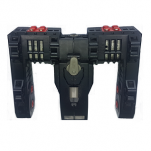 I have been experimenting a bit with these pullbacks earlier, they are fun but do not expect miracles from them, 2 of the newest version can work great with 62mm wheels, but they will have problems with anything larger, they do not have the torque, more motors will get more torque of course, fun project but it has some limitations, but to find the limit within these limitations is another great challenge!
 -
[AMS-1] Voting (Finally)
Marxpek replied to letsbuild's topic in LEGO Technic, Mindstorms, Model Team and Scale Modeling
1. MangaNOID 2. LXF 3. ZBLJ This was great fun! great entries and exiting idea's! -
My setup does not require one on a perfect track, it will self-center without a return to center spring purely from it caster setup, without any wobble at high speed. (35+) Just when i hit a rock or something, the center position is found way faster, making it easier to steer, so the return to center spring helps, but i can work just as well without (on a perfect track)
-
I tried it for the exact same reason, but i never tested it since i found them too wobbly: Well i decided to not test them because i do not own a lot of these diffs and these are the only ones that work well on a 90 degree angle and a linear mesh, so i wanted to save these diffs, but i must admit i never suspected this result. I have some of these turntables z56 lying around, i already started with the idea before i mentioned it in this topic, (that's why i sayd: don't tell me.. i was doing the same at that very moment ;D) but the gear will become at least 3 studs wide and i will need a rebuild for that. Did you get the 36t gears? im a bit let down by the results with the 36-12 gearing.. my old 40-16 seems better. Btw do you think we should use the slow output at all? effectively we are using a extra set of (loaded) gears in the system.
-
I tried the exact same thing with the differential... did not like it. Since it made the construction too wide. And the gear itself can start to wobble. These ancient gears arent realky solid..
-
@TechnicSummse ahw im a bit disapointed by your riddle.. a differential is far from a out of the box solution. And what makes you think i did not try that? I have ?
-
Hmmm you are using a tire in stead of a gear?
-
don't tell me you used a turntable...
-
yeah just noticed that was not an option.. must be 24:12 then?
-
1:1.8 from the fast output?
-
This track is about a 2 minute bike ride from home and it is the access road to my old track, i always considered it too dangerous for this exact reason, there is about 30 cm of grass, then some moderately dense bushes (the racer could slip through at certain points though) then a hardcore busy road as you can see, landing there would indeed mean total destruction. But this is how much faith i have in my new steering now ;D today i did new tests on the same track with ,despite the replaced buggy motor, only slightly better results. but the track further away from home with the raised edge in the middle but with the same surface, will give better results most likely, its much cleaner and more straight/flat, but i still think i need to solve the front, the axle just has to spin too fast, maybe your double bearing front wheel will has to be applied here, but i really do not like the tire and its off center hub, i would rather decrease the axle speed with a motorcycle wheel. I also have a rigorous new idea in which i can use a big wheel for the steering, but bracing the wheel still proves difficult which is kind of vital to steering..
-
this is reason enough for me to change my vote to no. but the reasons @mocbuild101 mentions (except the axle wear here..) are solid also, so no lubes. This is a problem in caster in general i think, just the shopping cart is the best example, it has to easily steer so it need a small trailing distance, i want to barely steer so i use a large trailing distance. My steering currently works very well, besides the caster i have added a return-to-center hockey-spring in the front, and it really works well, this not too great track has a big bump in it (0:20 in the vid) and it managed to survive that bump and dodge grandpa on the roadside right after. this is a 35,1km/h run with 1 broken buggy motor. However i do need to work on the front.. the axles and bearing start to melt and/or eat into the halfbeams after only 1 or 2 runs..
-
sorry for reposting but looking into my own posts i found this: the picture shows there already was an issue before testing, the red bushing inside the buggy motor on the top left is cracked, that is gonna need some fancy glue if possible at all, it will probably never run like it did before sadly... I think fixing this might do the trick.. but i guess we will discuss this.
-
hmm no.. it is a good idea yeah.. @TechnicSummse @mocbuild101 do you use this? shall we allow it? i kind of feel it could help save on Lego, these racers eat axles and halfbeams...i vote yes, but only when you agree.
-
I have found the problem to my speed issues, while taking my car apart i decided to test all 4 buggy motors and it seems one of the buggy motors has met an early retirement, at least until revision, if possible..., it has a clicking sound... i hope i can save it.... But for now the racer has been rebuilt the exact same way as it was with the units in the center but the motor was replaced of course, since my current design was not fully tested (and who knows how many of my other tests...) I have had this in previous setups, it helps with steering, but not with speed, so suspension was ditched, we do not aim to make a well steering car, we aim to make a car capable of minor adjustments, a good track is certainly needed here. And my current setup has caster by the way.
-
Todays tests barely exceeded 35km/h, the 4 wheel system gives problems with steering, it wants to roll over when steering, (don't worry i did not use the motor cross tires ;D) so i stopped using it quickly I brought the old steering which now has a return to center hockey spring built in as well (with the small glued ZR wheel) and got similar speeds, but way more stable steering, I managed to do a 290 meter run (35,1 kmh) without a crash for the first time, and another of 200 meter (34,9) with a crash into the grass, but both with over 150m of acceleration, strangely in both occasions the gps curve shows a sudden drop in acceleration, i see 2 options here: i was too far out of range with the controller, twice in a similar fashion, which i find unlikely (i have it all on video and was not exceptionally far from the racer), or: this was the actual top speed and the motors just work at their top. most likely the weight distribution thing that i tried (put both rc units in the middle) did not work and causes it to slow down, or the longer wires are bad for results, either way, the 2nd rc unit has to be in the back again for further testing. Back to the build!
-
The axle bending was never in the front, only in the rear. but yes i tried them on the bikelane track, with and without suspension, they roll great but steering is nearly impossible they just lack the grip. This is the key, testing, we can never determine every variable so we have to test, up to a certain point theorycrafting works, but in real conditions we might find different results. Yesterday i have done some tweaks one of the issues with my new racer was that it was lifting the front under its acceleration (back-heavy), so i had to shift the COG. which made me think: weight distribution can help with reducing friction/pressure on the bearings (halfbeams), in my case this meant: 6 bearings total, 4 in the back, 2 in the front, so i would guess a 67% rear and 33% back weight distribution might help, so i'll try that, (not taking into account how rpm of an axle influences friction) With some luck i can do some tests later today.
-
gps data can show this, just look closely at your time-speed graphic and extrapolate the graph from where you crashed, dc motors generally show a near perfect half parabolic curve in this graph (on a straight run) did you drop the rear as well? I don't think it is any use to lower the front but not the back.. 1 stud should be no problem but i would not go under and always check your track for debris. Be careful with the 3 wheel setup, think about what will happen when it tilts/crashes (hitting buggy motors or the unit unit on the ground at 30 km/h will cause severe scrapings or even worse, i'm always most worried about the battery lid getting hit) i have used axle outriggers, 3L pins and the smallest wheels i could find for protecting key position on the car so none of these items can get hit, or at least take some impact away from them... here is an idea for weight reduction: remove the wristband from the watch..
-
I think i will try this with mine, i could make a tutorial video on it maybe. but might take me some time...
-
You probably are missing it, there is steering, exactly the same as before, just the axle was raised over the black liftarms now. Still.. my power to weight ratio is better, and one of the "tweaks" might save about 100 grams ;) One of the tweaks might be loosing the double front wheel, but i haven't worked it out yet, i might tonight. First of all this is not a real competition, just our personal need to break the speed records ;) but for me: the only rule is: go as fast as you can by any means, but with 100% unmodified Lego and be able to stop, start and steering. i still have more buggy motors lying around (but no more rc units) so i could easily try technicsummse's 3 motors on 1 rc unit and double that..., but i don't know about that yet... i don't want to risk the electrics (yet). Having 3 rc units might be very problematic, i never mentioned this before but this is a real issue when using 2 units: the units interfere with each other, sometimes when both units are on and i do nothing, it can steer or drive on its own, something is giving it a rc input, most likely the other unit on the same channel is causing the interference, having 3 units will most likely cause 3x more interference. But i found that building a car with 2 motors is fairly easy, but with 4 motors, the construction increases also, and with every added motor you will add more weight and construction, there is a point where its not viable to add more motors i think, and i think we are close to it. @Epic Technic i'm very interested in your LPE record racer, but i feel it has a lot of non-lego or modified parts, even if it is accepted in the community, it is "the easy way" and i think it would be a more fun record with 100% unmodified Lego which is more accessible to people and easier to compare to others since it is not about how you modified the parts but how you used them. sorry i don't understand, what do you exactly mean?
-
32km/h on air? how? launch it like an air powered rocket or something? i'm impressed!! can we get some pictures please?
-
Update on the progress / rebuild mayor rebuild, 2 studs more narrow design and more earodynamic profile No tests done, just pictures for now. 4 halfbeams of friction in the back (3x5 curved halfbeam), 2 halfbeams of friction in the front. still some minor tweaks need to be done, this is the heaviest one yet at a whopping 1128 gram! (i added a few more pieces after the pictures) but i have high hopes! Sadly i will not be able to do runs today or tomorrow, more soon!
-
Sadly.. a familiar image there... maybe I jinxed it.. Steering has always been my biggest problem, any small over correction might destroy the car, finding a track without a curb might help, i assume you crashed into that? Did your speed computer survive? i noticed it already had bad wires before (just like mine). Streamlining can never hurt.. also resistance / air friction
-
One of my setups was under this weight , including the gps device, but the wheels had no outer support so axles started bending, bad idea.. but all of my newer setups are around 1040-1060, my current rebuild which is not done yet, will be one of the heavier models probably. Hmmm aren't these actually the same thing? , we are reducing the weight on the bearings and thus the friction, by the logic in your previous statement; weight does not influence the maximum speed (except for the added friction on the bearings), it just takes more time/track to reach the same speed and it will drain the batteries more/faster. But what about air resistance? you go to all this friction reducing to make it twice as wide... i cannot imagine this being better, but as always the tests might prove me wrong. I experienced this in my front end with suspension, after a small rock or bump you have no steering when you need it most, kind of dangerous.
-
Most dc motors have their maximum power at 75% of their maximum rpm, so that sounds about right. It is like a gearbox, me cycling would be like first gear and the motors on the car are like the 2nd gear, the car cannot drive away on its own in the 2nd gear because it needs more torque, which is doesn't have available. Should i bring it up to speed with a bike it will need less torque to get the gears turning since it already is in motion, this is the whole reason we are using gearboxes in cars right? to get a car moving up to a certain speed then use another gear ratio and repeat. But who knows maybe i'm looking at it wrong, of course there is a top on the power any motor can deliver and resistances will grow with speed..