

gyenesvi
-
Posts
2,396 -
Joined
-
Last visited
Content Type
Profiles
Forums
Gallery
Everything posted by gyenesvi
-
42177 Mercedes G500 4X4
gyenesvi replied to SNIPE's topic in LEGO Technic, Mindstorms, Model Team and Scale Modeling
I think at least the looks of it will be pretty close to this one.. -
This! This thing is huge and way too specific for one narrow category of products.
-
Thank you guys for all the positive feedback! Thanks for getting back, all good now. Thanks, really honored to hear that :) Thank you very much for the kind words, I really appreciate it!
-
General Part Discussion
gyenesvi replied to Polo-Freak's topic in LEGO Technic, Mindstorms, Model Team and Scale Modeling
And what would that contraption be useful for? I guess you can always find a usage that requires a specific part, sure. But I guess probably it would be easier to find more uses for a pinhole with 2L axle. If we call a connection that connects two things in whatever way a basic connection (most existing connectors are like that), then the next logical class off connectors is one that merges two basic connectors into one. And in this case, that would be one unit longer axle or pin on the pinhole. -
Thanks, glad to hear that :) Oh I wanted to respond to this as well, but I forgot. Do you mean the thickness of it, or some other proportions? I do agree that one stud of thickness together with the window frame is a bit too much, but that's what you can do with technic parts if you want to build both the door/window frame and the top separately and in a removable way. But I think that the accidental fact that the windshield arrives to a half stud lower point helps it a bit, kind of rounds it off at the front meeting point, and also looks kind of realistic when the top is off that the rollbar is a half stud lower. Btw, I never saw any model that could solve this problem in a better way, but let me know if anyone knows of any. @Milan, I don't actually see this on the front page. Or is it only scheduled?
-
General Part Discussion
gyenesvi replied to Polo-Freak's topic in LEGO Technic, Mindstorms, Model Team and Scale Modeling
I do sometimes (frequently) find myself in need for a pinhole with a 2L axle or a 2L pin. But not so much a 3L axle yet.. So probably better than nothig, but not as good as if things were systematic and progressing in proper steps. I wonder though if these are only templates, and the actual patents cover a family of parts in different sizes, instead of just exactly one size. Patents tend to be as generic as possible. The 3x13 frame does definitely seem useful for smaller models where the 3x19 is too long to fit. The diagonal thing is also interesting, but seems large at first sight. -
Nice Jeep, glad to see you could make use of my bodywork design :) Looks good in yellow. I also plan to make an update on it once in the future without part restrictions. That multiple steerig mode feature on the FlySky transmitter is neat, I have that too, a GT5, but haven’t had a chance to test it yet. Maybe when I get to build my first model with custom electronics and GeekServos.. I like how you put the electronics under the hood, great idea! And that video with all the fresh snow looks cool too!
-
Why do you wish that, what’s wrong with Rebrickable?
-
That must be a pretty small receiver then! Is that some technological novelty? Would that mean connecting the receiver through a cable, or is it a more direct connection, something like in RCBrick on the bottom? That's kind of an interesting solution, though not sure how many receivers it is compatible with. That sounds good, you mean it would be shorter because of the removed receiver? Interesting to know, I'll test that!
-
Thanks a lot! Thank you guys! These are the hinge parts: https://www.bricklink.com/v2/catalog/catalogitem.page?P=53923#T=S&O={"iconly":0} https://www.bricklink.com/v2/catalog/catalogitem.page?P=57360#T=S&O={"iconly":0} There's also an older version of them with slide slots, which are not so nice I think because you can see the axle color (often red) through it. Thanks, well the original idea is not mine, probably from Madoca. I just saw the opportunity to make it in orange instead of black, which I think does make a big difference in terms of how complete the face is. Thank you! Well actually I was aiming a bit for the more classic look. The modern version is a bit more rounded here and there (for example the face is not straight but bent), which is kind of impossible to recreate in lego. So I'm okay with the retro vibe. Besides, my other option was LBG, which I felt a bit dull. Silver could be nice, but pretty expensive. Black could have been good, but does not exist, though I'm sure I have seen it on some MOCs.. Thanks! Well I am not yet sure if it will survive until the Buwizz camp, because I might need the motors from it to build my entries.. Will see, but I might keep it a bit longer than other models :)
-
Hello Eurobrickers, The time has finally come for me to post a model that I have been wanting to build for a long time: RC Jeep Wrangler in 1:13 scale. This is a special one for me because I like Wranglers a lot, and also because the builds and videos of @Madoca 1977 and @rm8 had a major impact on getting me back to Lego Technic. Ever since I saw those videos, I knew I wanted to build my version of the Wrangler. So this is also kind of a tribute to them. Also, there is a third very good Wrangler variant from @ArsMan064, which is actually more accurately scaled than the others, and my version is more like that one in terms of scaling. On the other hand, I wanted my version to be different for a couple reasons. Time has passed since those models, and the lego electronics has changed, so I definitely wanted to build a Powered Up version, which has its own challenges. Also, I wanted to use my own chassis design, and I wanted to change quite a few details on the exterior as well. So this model is the result of all that. To start off, here's an action video: Features all wheel drive with 2L motors, good speed / torque ratio steering by L motor via linkage powered by Technic hub, hidden in the back live axle suspension on both axles, good articulation configurable: easily removable top, doors and rollbar clean exterior and interior openable doors and hood manual winch Design challenges The design of this model has taken a long time and many lessons learned from my previous models. I believe the Wrangler is hard to build in a good scale and in a clean way, mainly because the nose is short and low, so there is little space to work with. Another difficulty is that if one wants a good looking open configuration (which is popular in reality), then the electronics must be hidden well in the chassis, so that reduces the space even further. The original build of Madoca uses a few tricks to mitigate the problem with the nose. On one hand his body is lifted to accommodate the extreme suspension flex, which gives more space under the hood. Furthermore, the nose is one stud longer and the front axle is one stud more to the front than would be accurate when scaled to the wheel size (In this regard, the version of ArsMan is most precise; lower, shorter nose). Furthermore all previous versions route the chassis rail to the front bumper through the bottom of the front face, which prohibits building a completely shaped front face. As the shape of the front face is very characteristic of the Wrangler, I definitely wanted to build it cleanly, but that meant even more space is required for running the chassis rail under it. That left really little space for the front axle, so little that it became impossible to link the steering in front of the axle, so it had to go behind it, which meant that the steering servo had to go further back. And that detail basically defines the whole chassis structure. Chassis structure So it all started off with the design of the front axle, as usual :) I am using a fairly simple one with the steering linkage behind the axle, but that meant that the springs can go either in the center of the axle, or in front. Well, as detailed above, there was not enough space for it in front, so I made a design that has the spring in the center, which required mounting the wheel hub in a bit of unorthodox way, but it works surprisingly well! A dedicated L shaped connector (like this part without one side of the T shape) could be useful here though (and in many other places, I find). Anyways, the axle has attachment points for 4 links plus a panhard rod. Given this front axle, I built a chassis with the steering motor in the middle, protruding a bit into the middle console, and the two drive motors under the seats. The rear suspension is built with the usual positive caster and uses only two links and a panhard rod, with the springs lowered behind it. This was also a crucial point, because of the Technic hub. This large hub can only be positioned above low the rear axle in a way to avoid taking up too much space in the interior, and the springs also need to go around it. Here is the complete chassis, it is quite dense with electronics, they are also structural elements. However, I think it turned out structurally quite clean and light weight, and the axles have quite a good amount of flex and are responsive. Interior I really like the look of Jeeps without the roof and doors, with just a rollbar or even without that. So I wanted to have the interior as clean as possible. Obviously, as the big Technic hub takes the space in the back, that's as good as it can get (and the cables do clutter the looks), but at least the front seats and the area in between and in front remained clean. Luckily, much of the steering motor is covered by the dashboard, and I built the middle console such that it allows the motor to blend in. The drive motors serve as the floor, gears hidden under the seats. I made brick built seats because I wanted to shape them nicely, and also bricks gave me some color options that technic parts would have not allowed. Bodywork There's a simple reason why I built this Jeep is in orange. The key piece to build the front grille in a nice way only exists in black and orange (which is a pity). And as I wanted to have the front built nicely, I had not much choice. Furthermore, I wanted to capture the curved shape of the face, so I had to resort to a brick built solution there. It took a lot of fiddling to let the curvature continue smoothly to the side of the hood, but I am pretty satisfied with the result there. On the top of the hood, Madoca used a few tiles and long panels, which is a neat idea, but I did not like the clutter it took to connect the tiles to the technic pieces, so I used more system pieces for the connection, and turned it into a bulge, which also gives it a bit of texture and opportunity to use a different color, and the border between the brick built and the technic parts became quite smooth I think. The hood hinge point had to be carefully positioned (raised and moved forward a bit) in order to let the hood open without getting blocked (it's not completely smooth though, but good enough). I also made sure the front fenders blend nicely with the tapered nose and the face. Another area I wanted to build differently is the sides / doors. Technic doors are notoriously hard to build nicely (without cluttered look) because of the lack of panels (or even beams) in more sizes, and also it's hard to build the hinge line cleanly (and make the door removable). Here, I experimented with vertical beam stacking instead of horizontal for the sides around the fenders, which turned out quite clean I think. Besides the door itself, the window frame is also a difficult one, and on many models it is unfinished at the front of the door near the mirrors, because it is hard to arrive there at the right position / angle, while also allowing the door to open. That part also took quite some fiddling to get right, but I stumbled on a quite simple solution that even let me fix the mirror in a good position. The point where the side and front windows meet seems tight, but the doors open smoothly without getting blocked. The rollbar is another area I set out to beautify. I wanted to make it slim, tubular looking and uniform, removable, while at the same time properly connected to the chassis and the windshield, and also allowing the top to be connected. Those posable angled connectors came very handy, I think they look better than regular angled connectors, wish they were used more in official sets. Finally, the top follows mainly the shaping of the Madoca version, while I tried to smooth it out as much as possible reducing clutter to the minimum. The top only connects to the rollbar, other than that it only sits on the bodywork, but this way the meeting of the main body and the side of the top / rear window is quite smooth. The rear window can actually be opened if the spare wheel is off. I tried to make the spare wheel foldable, but that made its connection weak, which would have always unfolded during play, so I just simply fixed it. Also, I could not make the tailgate openable, because that's what holds the curved parts on the rear, and the tail lights would have also been in the way, which I definitely wanted to capture nicely. Finally, I added an optional mini winch and a bullbar (which actually uses a flex axle, but could not get that work in Studio, so I used a flexible hose here). Here are some photos of the real build. It's perfect scale for the technic guy :) More renders and photos are available on Bricksafe. Building instructions are available on Rebrickable. Let me know how you like it! Cheers, Viktor PS: a final note about RC control. The development of Pybricks that allows the use of an Xbox controller came recently and I have tested it with this model. I made a program that allows very precise slow speed control (after speed calibration) using the speed servo mode of motors, and also the steering is very smooth; great play experience. Unfortunately at the time of recoding the video I did not have that yet, it would have come handy in some places for precise maneuvers. In the video, I often go much slower than would be possible (it has good amount of torque) just to avoid sudden jumps. I became extra careful after the model accidentally ran off a cliff on the first test day, fell 5 meters and broke into pieces in the middle of a bush.. that hurt.
-
The receiver looks like this, and is 11 x 25 mm size. How does that compare to the one in RC Deck? One thing about the bind button, I am guessing that binding might need to done more often than one would think, for example if the transmitter is used with other models or one buys two RC decks. I guess then it will always need to be rebound to the one being used. So you might be useful to have that button on the outside, though not sure how that could be done. The split cable is interesting, so then no stacking is needed, but one FP plug still needs to handle the amps of two motors. Maybe it can better do so when they are not stacked though. Thanks for the info on the battery!
-
Looks nice! Is the receiver on the PCB or is it separate? Any chance that I can swap that out to a FLySky by re-soldering wires? I just bought a small 4-channel FlySky receiver and works nicely with my transmitter. (In general, what's on the PCB and what's separate, if you are okay with sharing such things?) How did you power 4 buggy motors? Did you stack two plugs on one port for that? Didn't that ever melt the plugs for you? Some people reported such things. What's the electronics right where the battery is connected? That seems to take up quite some space, and next to it there seems to be quite a bit of empty space. Do you have a link to the batteries you are using? I mostly find 3s LiPos with larger connectors, like XT 30/60, and often only 2s comes with JST (I guess you are using 3s).
-
[HELP] Generic Building Help Topic
gyenesvi replied to Jim's topic in LEGO Technic, Mindstorms, Model Team and Scale Modeling
Quite a bit harder, I'd say more than double; just compared squeezing 2 of the yellow ones vs a big blue one, and still the blue one feels harder to me. -
The solution I meant has a similar range of motion than the above solution, and is also similar to that of @Stereo An example is here: and more details are in this thread: But yeah, I also thought about those 1x1 bricks with axle holes but thought they would be too edgy and get stuck. Interesting to know that it actually works okay.
-
Those aren't really solving any problem that was not solvable before as they require the same amount of space. They are just not small enough. Plus are unrealistic and have more friction. Thanks TLG. It does get you a slightly better firing order, but not too much. Plus this problem. I wish instead of the Kawasaki pistons, TLG produced something more generic and useful, like a 1.5L crankshaft piece (1.5L liftarm with 2 axle holes), or a 2L axle with stop. Both could have helped here and would have been useful for other purposes as well.. On a more constructive note, @Divitis have you seen crankshaft designs that use rotated 1x1 plates with a bar through them? And the pistons could be half pins with tiles on top, held by half plates. Although that only works up to V10 using a 7L half liftarms to hold 5 of them on one side.
-
Interesting to hear about those copyright issues, can you (or others) explain a bit more in detail? Is it the case that TLG has copyright protection on certain parts only? Which ones, and any ideas why? Has the others already expired? Are parts protected in groups, for example the same type of part in all sizes? Does CaDa also do copyright protection of the innovated parts?
-
1:21 DAF XG Truck
gyenesvi replied to MCD's topic in LEGO Technic, Mindstorms, Model Team and Scale Modeling
Really nice work, I like how smooth the lines / surfaces are, good usage of larger panels where possible. Even all those stacked beams look nice as they result in little clutter. -
On the Pybricks website, the sample place where you can install Pybricks, you can reinstall the original lego firmware. No need to save anything externally. All you need to to is open the Pybricks website in a BT compatible browser, and you can install firmware and load the programs to the hubs from there. Not sure what plug you mean here? Are you talking about external lights or the one inside the hub? For external lights, you need to buy they PU lights from lego.com, and then just plug it into one of the ports. As for the programming, it is easier than you would think. You don't need to learn programming in general. It really is just a few lines of code that you need to gather from the examples. It is all about configuring which ports you use for motors / lights, and then telling what action should happen on which input. And Python is really meant to be an easily readable/understandable high level language for people who don't necessarily have deep programming knowledge, that's why it's ideal for this task. So give it a try :)
-
These are interesting findings, good to know. So I guess the problem could be that the ESC uses a different PWM frequency than the servo needs. But alternatively it can be tricked by using proportional voltage.
-
Okay, I see. That's weird then..
-
But is it an original Lego servo or is it a 3rd party one? Only original Lego ones are capable of proportional turning, none of the 3rd parties.
-
This. As far as I understand, it's exactly the C1 and C2 signals that are shared by regular DC motors and the servo. When you drive a regular DC motor using an ESC, you need to connect the ESC output to C1 and C2, and can leave 0V/9V disconnected. That's what @MisterCreators Custom MOCs did here, that's how he can multiplex two signals into one wire. For the servo, you need to connect 0V/9V as well. The difference is I think, that the DC motors use C1 and C2 for driving the motor directly, and the speed/power will become proportional to the PWM fill rate. But for the servo, C1 and C2 are not enough, it also needs 0V/9V which is used for driving the motor, as it needs full power to move, and C1 and C2 only encode for left/right angles separately (only one of them can be nonzero). 0% PWM signal on both means center position, and 100% PWM signal on C1 or C2 is max left/right. It cannot use the C1 and C2 for driving the motor itself, because then for example when it is turned completely to one side, and then you give it a signal of 0 on both C1 and C2, there would be no power to move back to the center. And as far as I understand, the output of an H-Bridge driver has roughly the same encoding as that of an ESC, it's just that ESCs are more sophisticated in terms of precise speed control (use back EMF and more sophisticated algorithms), and can also handle more amps / more powerful motors. What I don't know though is whether the H-Bridge can be driven by the same input signal from the receiver as an ESC. I wonder if it would be possible to modify a Lego receiver by removing the IR receiver and putting a small 4CH RC receiver into it instead, and wiring it up to the H-Bridge controller. Anyone?
-
42177 Mercedes G500 4X4
gyenesvi replied to SNIPE's topic in LEGO Technic, Mindstorms, Model Team and Scale Modeling
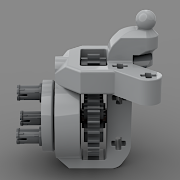
Do you consider that compact? The Defender gearbox is built on a similar scheme and it did not exactly end up being compact.. That reference only shows the core, but it is yet to be framed properly, so it's deceiving. The devil is in the details. With framing it would become 13 units in length and 9 units in width. In my mind a compact gearbox would have only two shafts and 4 pairs of gears. In length, it could take 11 units using the new shorter clutch ring, with support in the middle and on the two ends. As for the width all gears would be centered, but the shifter mechanism would need to be on one side probably. It's not clear to me how much space it would require with the new shifter parts, but as a start, sounds simpler and cleaner, so hopefully more compact. Do you think that would fly in an official set in 2024? That's kind of 80s style.. -
Yes, the gearbox is asymmetrical in the sense that the actual 2-speed switcher is on one side and the FWD/RWD switcher is on the other side, and hence the front driveshaft is offset 2 studs from the center. I also think that this asymmetry is required if you want to operate it with one switcher. Here is a picture of the bottom, hope it helps: