

LiLmeFromDaFuture
-
Posts
811 -
Joined
-
Last visited
Content Type
Profiles
Forums
Gallery
Everything posted by LiLmeFromDaFuture
-
LiLme's T-47 Airspeeder (+ Instructions & Part list)
LiLmeFromDaFuture replied to LiLmeFromDaFuture's topic in LEGO Star Wars
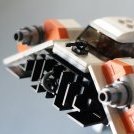
I'd appreciate it; I don't have those parts on hand at the moment and playing around with the many angles on LDD or STUD.io is awkward! -
LiLme's T-47 Airspeeder (+ Instructions & Part list)
LiLmeFromDaFuture replied to LiLmeFromDaFuture's topic in LEGO Star Wars
@Wurger49 Yes, those are the parts. You raise a good point that the angles are different on my design and I think it's partly due to the 6 x 3 wedge plates, but to change them may be out of the question with how the wings are designed, perhaps? -
LiLme's T-47 Airspeeder (+ Instructions & Part list)
LiLmeFromDaFuture replied to LiLmeFromDaFuture's topic in LEGO Star Wars
@Wurger49 Great use of the curved 1 x 2 slopes, they cover the gaps left under the cockpit quite nicely! Tiling the nose does polish its appearance but affects the profile since the extra plate height, so I wonder if those triangular tiles could work better here like on the BV Snowspeeder? -
LiLme's T-47 Airspeeder (+ Instructions & Part list)
LiLmeFromDaFuture replied to LiLmeFromDaFuture's topic in LEGO Star Wars
@Wurger49 Very nice line up! It's been a while since I last updated the model, but it's certainly due for one. Particularly, I'd like to improve the nose area (those round tiles do cause trouble and the proportions look off compared to the other creation), aesthetics of the underside, redesign the cockpit, and add a working tow cable. The sophistication of the wings certainly makes assembling it tedious and also delicate like in the area you mentioned, but that is the downside of SNOT for wings. In response to this, I thought of creating a more simple-designed version, as well smaller, because the scale is a bit large for minifigures. I fancied the idea of creating my own A-Wing design, as well other ships, but at this point only time will tell! Thank you for sharing your photos; it's nice to see the comparison between two creations of the same vehicle! -
LiLme's T-47 Airspeeder (+ Instructions & Part list)
LiLmeFromDaFuture replied to LiLmeFromDaFuture's topic in LEGO Star Wars
I as well Time continues to pass as do the many updates necessary to improve the design of this walker. LDD is great tool for designing and editing a model, but many factors outside the limitations of the program revealed flaw after flaw and one area of improvement after the other. In particular, the neck needed another critical improvement, otherwise its structural shortcomings would threaten the realization of the project. Early on, I aspired to take a creative, fun approach to the idea of the AT-AT as a transport and design the project as if LEGO would. I settled on the concept of a detachable section at the middle of the walker so to access all the minifigures (deployed on benches like 4483) without needing to remove much of the panelling. Considering the substantial gap through the middle of the hull, necessary for the play feature, the ambitious idea raised serious structural complications at the neck against establishing a resilient design well capable of supporting the head and front section of the hull. Without the proper support, the weight of the head, neck and front hull would droop away from the rest of the walker, causing gaps between the front and middle hull. As of late, I determined solve this situation, while also avoiding the possibility of compromising the vision for the project. So, with the challenge and the limited space given to work with before me, I pursued to implement the structural advantage of triangles as much possible. The limited lengths of Technic beams also proved itself a complication. So to work around this, I switched to Technic bricks and created longer lengths by sandwiching two 1 x 12 Technic bricks, with another and two layers of plates stacked on top, and then the three bricks connected together by a T-beam. The neck now features a longer structure and a simple truss design made of thin Technic beams through the middle of the neck and along the sides, and I am confident it will get the job done better than previous designs. -
LiLme's T-47 Airspeeder (+ Instructions & Part list)
LiLmeFromDaFuture replied to LiLmeFromDaFuture's topic in LEGO Star Wars
Glad to hear! Let me know if you have any questions or comments! T-47 Airspeeder Building Guide -
Wow! The updated roof polishes up its appearance quite nicely! Now, the only thing holding you back (perhaps) are those studded wedge plates! The waist is a perfect recreation of the actual fictional vehicle—top notch! The feet are a nice improvement too, especially the assembly of the fence cutters!
-
I wanted to say the same
-


Ideally, I aspired to design my AT-AT project as if LEGO would themselves. Early on, I understood if I stayed true to this direction then I could recreate many details faithfully, so this ambition at the focus of the project even inspired me to explore creative possibilities with the idea of an AT-AT as a transport. Following closely in the footsteps of LEGO, I modeled the core element of my creation in the spirit of the first official AT-AT set (4483).
4483 uses sliding benches to store and remove minifigures with great ease, and also space for a Speederbike. Unlike its successors, 4483 served as the best example of the AT-AT in an abstract, yet fun, way. To this regard, I took to the idea of implementing 4483's system for storing minifigures quite well and considering my desire to build as LEGO and take a creative approach with my project, it worked perfectly. With these two factors at the helm of this project, little guesswork remained for how I would fill the inside based on 4483, though what did remain left space for imagination to introduce new ideas along with creative ways to interact with each.


In the front and rear of my walker stay a small bench with seats for four minifigures, blasters for each, and accessory crates between them. The middle features a large bench with seats for eight minifigures and blasters for each.


With a larger scale to work with, I knew I could fit at least a dozen and some more minifigures than 4483, though not solely in the middle of the body, and I did not want to require removing several panels to just access the minifigures only to reattach them again when stowing away the minifigures. If I alternatively planned for a detailed interior, removing panels would not bother so much, as it would allow detailed-observation of the interior, but since I made other plans, this fashion of accessing the minifigures would prove tedious and not fun.
So with quite the task before me, the immediate solution pointed towards a removable middle section (which I will now refer to as the box), so the troop benches I would place in the front and rear can slide out to the now void middle. This direction would then lead to a fun solution for how to remove the box from the rest of the walker. Like I wanted a convenient, manageable solution for accessing the minifigures, I likewise desired the same for removing the box than to grasp it from wherever, leading to possible damages. So then came 10178.


The motorized walking AT-AT (10178), features a collapsible handle atop its body to move the walker wherever desired. Though implementing a similar design on my walker may not manage to lift 6000+ parts with ease, the handle allows just what I need for an easy way to remove the box.
-
UCS T-70 X-Wing (Resistance and Poe Dameron)
LiLmeFromDaFuture replied to Anio's topic in LEGO Star Wars
I agree with you, the Resistance color scheme is much more palatable than the lackluster black and orange. In addition to this, it's easier to make out the details and techniques present. Though I am not particularly fond of the T-70, the rear fuselage looks pleasing smooth on this model, likewise, the intakes and the gunmetal macaroni tubing leading into the thrusters adds a nice mechanical touch! The modularity is the icing on the cake! -
Emperor Vader & Jedi Master Anakin
LiLmeFromDaFuture replied to ProvenceTristram's topic in LEGO Star Wars
How so, or at what point? He seemed pretty content with it. He showed more emotion for cutting off Windu's hand than killing younglings. -
Emperor Vader & Jedi Master Anakin
LiLmeFromDaFuture replied to ProvenceTristram's topic in LEGO Star Wars
The Jedi Master Anakin turned out quite nicely, but I can't imagine Vader/Anakin with a beard like that -
@Rufus Well, if LEGO ever considers remaking this shuttle they should take note from this—it's fantastic! Though, it would probably be gear operated to reduce the labor involved to engage it and so it does simultaneously.
-
@Rufus How easy is it to engage the landing gear, it looks fairly manual?
-
@Arkeeos Cool! I look forward to seeing some photos of it!
-
Impressive! And most impressive landing gear!
-
@Arkeeos You built it physically or a prototype? By the way, thanks for the additional views.
-
Nice! His design captures the slenderness of the legs quite well!
-
I am fond of white X-Wings. I believe this decision contrasts well with other aspects of the ship like the nose, cannons, and engines I would like it even better if you made the engines entirely gray but to each their own opinion
-
Wow! The overall appearance looks much cleaner than the previous iterations—nice improvement indeed!
-
Ha! Boba's trying to mount the B-Wing like a Slave 1! Landing must be very confusing to him too!
-
Lego Star Wars Minifigure scaled weapons
LiLmeFromDaFuture replied to Cylo's topic in LEGO Star Wars
Nice use of the transparent bar piece on the E-Web cannon! -

This render offers a good perspective of how well (and not so well) the proportions turned out. Unlike my previous attempt, I did not focus hard on nailing the proportions and details perfectly. This time, I purposed structure to take preeminence in this project, and the details take whatever they can get within reason. From this render, the effect of this decision shows most in the legs. So details, in particular, look simple, but I am pleased with how nice they and the proportions turned out!

Designing the engine-esque Greebling took quite some time to figure out. Detail like this, most often involve illegal techniques or weak assemblies. Well, since I am building this walker as if LEGO would release themselves, I required of myself to avoid this. I needed the detail to work within system, easy to assemble, not use obscure elements, but at the same time, not look plain and repetitive (like some sets). Eventually, I managed to accomplish my goal and will share the detail of details later.
-
Curiosity Broke Its Neck by LiLmeFromDaFuture, on Flickr

(The Means to a Solution)
I designed my AT-AT as a homage to build style of LEGO sets, and many aspects of this project reflect the engineering of official walker sets. The neck, for example, featured a similar yet improved design of the recent AT-M6 (75189) and its predecessors. To compensate for the larger scale, I used a Technic 1 x 15 liftarm (32278) as the base for the neck. Yes, the longest and just one, but with several other Technic elements structured around it, to likewise compensate for the load it will bear. Counteracting the stress, ideally meant to preserve the mold of the liftarm, by minimizing the chance of it flexing as best possible. The objective found its solution in the form of a sandwiching-technique with half liftarms around the middle of the 1 x 15 liftarm, between a box made of Technic bricks, pinned together with a length 4 axle and stop (87083).
(Learn by Playing)
So far, it looked adequate and integrated well between the connections to the head and infrastructure planned for the body. Though, I always held doubts about how well the design will perform in the long term. Since I needed space to install the access tube design (built similar like the sets), a few gaps existed where I could not extend the reach of the Technic-sandwich. Then recently, I fiddled with a 1 x 15 liftarm and observed its durability between my hands. To my surprise, I notice the face (the side with pinholes) bends to the power of the force more so than its sides. I do not know if any of you already knew this, but ever since I committed to building like LEGO, I learned so much about engineering this toy into impressive structures.(Drop the Sandwich)
The Technic-sandwich idea worked logically and even looked appealing in a structural kind of way. However, committing to this LEGO standard of building also bears dilemmas, when doing it the "right way" must precede the "cool way." This applies better to other aspects of the project, but since the Technic-sandwich could not work so effectively as planned, I completely redesigned the neck with the liftarms in the direction consistent with the whole build. I did the new design in LDD first (not fully weened off yet) and will replicate the changes in STUD.io, then share them later. -
I don't know what else to say besides these look fantastic! I like the red one the most, it favorably captures the simplistic styling of the OG trilogy!