
Search the Community
Showing results for tags 'gbc'.
-
 Update: Information regarding modules from 2018 onwards are represented after @Blakbird's original post. I want to keep BlakBird's section of the post as he left it, to honour the immense amount of work he put into it. ( @Ankoku @9v system) ----------------------------------------------------------------------------- Original Post Start ----------------------------------------------------------------------------- G%$ #@&% it. Thanks to Akiyuki, The Rebricker, and the rest of you &%$*ers, I've now caught the GBC bug and it is going to cost me a lot of time and money. It all started with Akiyuki. Well, GBC didn't start with Akiyuki, but I was more or less "meh" on the whole concept until he came along. His ingenious mechanical solutions are mesmerizing, perplexing, and wonderful. Although I admired them from the start, I figured there was more or less no chance of me replicating them from the videos, especially since the one I was most interested in was also the most complicated: the ball factory. My involvement therefore remained stagnant (and non-existent) for a couple of years until The ReBricker showed up and proved that you really could reverse engineer the Ball Factory and then went one step further and posted video instructions for the whole thing. "Fine", I thought, "I'll just build that one." A few months of LDraw modeling, part collecting, building, testing, and display case building later I was hooked. It was one of the greatest building experiences I've ever had. This forum has repeatedly wished for a comprehensive set of instructions for the GBC modules of Akiyuki, and I've decided it is my responsibility to help make your dreams come true. With that in mind, I've compiled a list of all of Akiyuki's 31 non-Mindstorms modules with the goal of creating and/or finding complete PDF instructions for as many of them as possible and compiling the resources here. I've made a lot of progress already. Here is the list along with whatever I know about building material available. (currently 31 of 31 complete) Pinball PDF instructions available from Blakbird and Courbet 992 parts Presentation Topic IO file Zigzag Stairs PDF instructions available from Courbet 481 parts Presentation Topic IO file Cup to Cup - Type 1 v1 PDF instructions available from djm v2 PDF instructions available from Blakbird 1089 parts Presentation Topic Cup to Cup - Type 2 PDF instructions available from Courbet 1222 Parts Presentation topic IO file Elevator Module PDF instructions available from Blakbird and Courbet 1621 parts Presentation Topic IO file Marble Run PDF instructions available from Blakbird and legolijtje 1140 parts Presentation Topic IO file Catch and Release PDF instructions available from Blakbird and jesuskyr 711 parts Presentation topic IO file Ball Factory https://www.bricksafe.com/files/blakbird/Renders/MOCs/Ball Factory/iso.jpg/200x112.jpg Video instructions available from The Rebricker PDF instructions available from Blakbird 4428 parts Detailed review by Blakbird Spiral Lift Short Version 876 parts PDF instructions available from Blakbird Presentation Topic IO file Tall Version 1455 parts PDF instructions available from Blakbird and 9V System Presentation Topic Pneumatic Module PDF instructions available from Blakbird and jesuskyr 543 parts Presentation Topic IO file Archimedes Screw - Type 1 PDF instructions available from Blakbird and Courbet 995 parts Presentation Topic IO file Archimedes Screw - Type 2 PDF instructions available from Blakbird and Courbet 739 parts Presentation Topic IO file Archimedes Screw - Type 3 PDF instructions available from Blakbird and Courbet 768 parts Presentation Topic IO file Zig-Zag Lift PDF instructions available from Blakbird and jesuskyr 800 parts Presentation Topic IO file Basket Shooter V1 PDF instructions available from Blakbird and djm V2 file from 9v system 2226 Parts Presentation Topic Train Module - Type 1 PDF instructions available from Blakbird and Courbet Motor (157 parts) Switch (167 parts) Unloader (324 parts) Siding (106 parts) Loader (603 parts) Crane (3046 parts) Complete Set (4569 parts) Presentation Topic IO file of full layout Train Module - Type 2 PDF instructions available from Courbet Motor (160 parts) Unloader (751 parts) Siding (178 parts) Loader (835 parts) Presentation Topic Wheel and Steps PDF instructions available from Blakbird and Courbet 1198 parts Presentation Topic IO file Step Module V1PDF instructions available from Blakbird and jesuskyr V2PDF instructions available from Ankoku and 9v system 1785 parts Presentation Topic IO file Fork PDF instructions available from Blakbird 878 parts Presentation Topic IO file Six Heads PDF instructions available from Blakbird 1696 parts Presentation Topic IO file Bucket Wheel Tower PDF instructions available from Blakbird 1415 parts Presentation topic IO file for 8 bucket version Lifter Triggered by a Stuck Ball Video instructions available from The Rebricker PDF instructions available from Blakbird 1068 parts Presentation topic IO file Spiral Staircase PDF instructions available from Blakbird and jesuskyr 1923 parts Presentation topic IO file Tilted Rotors PDF instructions available from Blakbird 1223 parts Presentation topic IO file Invisible Lift Video instructions available from The Rebricker PDF instructions available from Blakbird 3203 parts Presentation topic IO file Cycloidal Drive PDF instructions available from Blakbird and jesuskyr 2081 parts Presentation topic IO file Fork to Fork http://www.bricksafe.com/files/blakbird/Renders/MOCs/fork-to-fork/iso.jpg/200x112.jpg PDF instructions available from Blakbird and jesuskyr 1743 parts Presentation topic IO file Planets http://www.bricksafe.com/files/blakbird/Renders/MOCs/planets/iso.jpg/200x112.jpg PDF instructions available from Blakbird and Courbet 1558 Parts Presentation topic IO file Strain Wave Gearing http://bricksafe.com/files/blakbird/Renders/MOCs/strain-wave/iso.jpg/200x112.jpg PDF instructions available from Blakbird and Courbet 2789 Parts Presentation topic IO file Zig Zag stairs V1 PDF instructions available from 9v system 469 parts IO file Here's a montage of some of the LDraw work I've done so far which also gives you an idea of the relative scale of the modules: http://bricksafe.com/files/blakbird/Miscellaneous/akiyuki montage.jpg/800x410.jpg I'm not going to post any actual instruction files until I (or someone else) has tested them by physically building the model and proving that it works. I'm a stickler for accuracy, so I'm trying to get as close to Akiyuki's originals as possible. I already have PDF instructions ready for 4 of them and just need to test them out. As I build each model, I'll post a mini review about what I've learned and then I'll post links to the instructions and parts lists so anyone else can build them too. (Update: See bulleted list above for which instruction files are currently available.) As always, help is welcome. If you have successfully built any of these modules and are willing to share your information, please let me know here. In particular, I need LDraw files to make instructions. In a pinch, I can make them myself if you have detailed photos. In an even tighter pinch, I'm making everything myself from the videos, but it is slow going. Enjoy! Akiyuki GBC modules with instructions available to buy from the man himself ( In 2018, Akiyuki started to create instructions for some of his modules. Some for free, some require payment. For anyone who has tried to reverse engineer one of his modules, the price he charges is more than worth it. ) Hockey Stick Lift (2018) https://akiyuki.jp/en/works/1234 Catch and Spin Robots (2019) https://akiyuki.jp/en/works/1423 Heart Chain (2019) https://akiyuki.jp/en/works/1509 Peanut (2019) https://akiyuki.jp/en/works/1587 Akiyuki GBC modules with free instructions Cars with adaptive cruise control (2019) https://akiyuki.jp/en/works/1667 Spiral Lift GBC module compact type (2020) instructions by @FernandoQ https://akiyuki.jp/en/works/1841 New modules which currently don't have instructions available there are currently no new Akiyuki modules that need instructions Modules that were inspired or modified from this project Marble run update: this updated version of the marble run contains more track with gentler turns to reduce ball spills as per Akiyukis 2012 layout video Modules by @Berthil Related threads Train System @Doug72 has created a dedicated thread for the Train System here: It contains many improvements, mods, additions etc. which anyone interested in the train system should check out! EV3 @9v system has created a dedicated thread for Akiyuki's EV3 modules: A thread dedicated to modules like the Ball Cleaner, Container Transporter and Fast Ball Sorter Robot.
 -
 The Ballkirk Wheel is a GBC based on the Falkirk Wheel ship lift near Falkirk, Scotland. If you want to see it in action, go straight to the video: Conception I love the concept of GBC and I wanted to build an original GBC module. Ten years ago I got the idea of using the Falkirk wheel. Its continuous mechanism should be just as good at lifting balls as it is at is at lifting ships. Unfortunately back then the inner hole of a large turntable was not large enough to accommodate a 14mm ball plus lane. The only alternative was to use Hailfire Droid wheels but since I was not quite ready to sell a kidney to support my hobby, I dropped the idea. Fast forward ten years and I revisited the idea. @jojoguy10 built a LEGO version of the Falkirk wheel, but noone had made a GBC module out of it yet. The new large studless turntables have no gears in the centre hole, which means that it's (just) large enough to fit through a lane with balls. So I ordered six of them from Bricklink and started building. Building Process When prototyping I tend to use a mix of colors. This limits search time and makes it easier to discern individual bricks. Once a module is finalised, I recreate it in Stud.io so I know how to rebuild it when my BrickLink orders arrive. This is the first time I used a CAD program during the building process. I had no experience with MLCad or LDD and I started out with the newest kid on the block, Stud.io. There are still a few kinks to iron out but I think Stud.io has a great balance of simplicity and power. Gondola orientation The orienting mechanism makes sure that both gondolas stay upright during the entire rotation. This prevents balls and boats from being spilled. The principle is demonstrated by this video: LEGO was actually used by the designers to demonstrate the mechanism for the Fallkirk Wheel. My implementation is very straightforward. The center turntable gear stays stationary. As the wheel revolves, the smaller gears between the center turntable and the outer turntables cancel out the rotation of the gondola, thus keeping it upright: Retarding Mechanism The most challenging part of the build was the intermittent rotation mechanism. The wheel needs to pause shortly to load and unload the balls. Initially, I wanted to use a mechanical solution for this. I have experimented with many different solutions, none of them satisfactory. I started out using a rotating cam that would temporarily block the rotation of the wheel. This did work but it was very imprecise and jerky: In movie projectors and watches something called a Geneva Drive is used, but I did not succeed in creating a version with sufficient angular precision to reliable loading of the balls. Another possibility involves a sliding mechanism on a piston driver, thus first converting rotating motion into intermittent linear motion and then back to intermittent rotating motion. Although motion was smoother than with the cam mechanism or the Geneva drive, it was even less precise and more bulky. Eventually I caved and just used a Mindstorms NXT to drive the wheel. The program is exceedingly simple: Rotate 900 degrees at 80% power Wait for 1500ms Repeat I'd be really interested if someone comes up with a mechanical mechanism, because using software to solve this issue feels like cheating to me. Loading Hopper Since the mechanism completes one cycle every three seconds, on average three balls should be lifted during each cycle to comply with the capacity of 1 ball per second which is required by the standard. For this, a pusher is located at the bottom of the hopper like in Akiyuki's Ball Cleaner. For the mechanism, I took my inspiration from @Lasse D's ball pump. A counterweight on the back of the hopper smooths pusher movement. I currently feel the pusher is the weak point in the contraption. Because it is driven by the same motor as the wheel, it spends half the time not loading any balls, thus limiting capacity. Since 5 balls fit on the piston simultaneously, theoretical maximum capacity is 1.66 balls per second. But when multiple balls are stacked in the hopper, the pusher loads less balls per cycle, limiting capacity. One solution would be to use a second motor to continuously drive the pusher but I prefer the contraption to be driven by a single motor. Controlling Ball Flow The balls move through the wheel because the entire assembly is tilted. The incline is 1 brick per 15 studs, or 1 plate per 5 studs. This corresponds to an angle of 8% or about 5°. The balls should only move when the wheel runs are oriented with the input and output runs. For this both the input run and the gondola runs are equipped with gates that are closed when the wheel is in transit: As usual, the simplest solution turned out to be the most reliable. A sliding gate is held town by gravity. The input gate is opened by two 42610c02 wheels [LINK] mounted at the end of the arms, which sadly are not available in Stud.IO. The output gates are opened by the gears of the orienting mechanism, as illustrated in the following image: Reliability The biggest challenge of a GBC is making it reliable. Those little balls have a mind of their own and tend to find every nook and cranny of your contraption to escape it, jam it or even break it altogether. I tested the contraption with beads with large holes which get stuck easier than the standard balls. The Ballkirk Wheel has gone through several revisions to improve reliability: Incread the incline to prevent balls from stopping in the middle of a run Like 7 versions of the input and output gates Enlarged the hopper and the pusher for greater capacity Several modifications to the pusher to reduce friction and increase reliability Addition of a counterweight to the pusher for smoother operation Added a shield to prevent ball spillage at the exit lane Added a bumper at the foot of the back support to push back balls that have missed the exit Together, these improvements have resulted in a fairly reliable GBC. I have tested the Ballkirk Wheel for an hour of continuous operation with no blockages and only one ball spilled. Maximum throughput is about 1.4 balls per second. Summary Thanks for reading this far, I hope you enjoyed it! Please let me know what you think! I haven't gotten around to creating instructions and I'm not sure I ever will. However, if you'd like to recreate this contraption, you can download the stud.io file: Ballkirk Wheel.io - Stud.io file.
 -
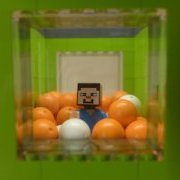 Hey Guys, Here's my latest GBC module D.R.O.P (dark red olive pusher). It's not the most exciting module, nor did I do the original engineering of the mechanics. I did however choose the colours and changed up the original design so that this is a bit more sleek looking. It's kind of slow, and somewhat unexciting, but I did manage to hook it up to a shared power system (later in the video) which runs 3 modules off 1 M motor with a simple axle chain using universal joints. Its reliable up to around 22 balls, any more and the arm may not be able to get underneath the balls to sweep them out. Having said that it *should* be able to clear the 1BPS rate of the GBC standard. I'm planning on running this at BrickCan next week and if the module does seem a bit slow I will regear it from 8-40 to 24-40 at the lift-arm.
 -
 All mechanical and 100% LEGO Ball Counter. Numbers do not always line up perfectly because of backlash in LEGO gears but it counts every ball. I tried to minimize amount of gears but as many of you know, backlash is almost unavoidable. The wheels can be taken out the GBC to set to zero. 1:10 ratio mechanism by Parax77.
 -
 This lego GBC miniloop uses three technic lift arms to push the marbles up a ramp, then they fall onto another ramp. When a second marble falls onto that ramp it tips them down another set of ramps and back down to the start again. It is quite reliable if you place all the 1x1 "cheese" slopes straight but it can get stuck if they are not straight. (using 2x2 cheese slopes would fix this problem but I did not have enough in dark grey) The instructions are here. I also have a LDD file for it but I can not find any place to upload the file as it is not a standard file type, any suggestions?
 -
Here is the video for my latest module Tilt-Shift. It is a fully technic built module, that lifts the balls using a tilting-stairs type mechanism. The ball agitator is super-janky because I added it as the last powered mechanism of the build. The module works great, and I will be running it at an upcoming public display. I have no doubts that it will shake itself apart at some point. Images and video below.
-
This lego great ball contraption miniloop uses a spinning wheel to lift the balls up onto a set of ramps. Then the balls role down the ramps and back to the start again. I have remade this in lego digital designer but can't find any good way of making PDF instructions from it, any suggestions on how to do this? Exporting the instructions as a HTML building guide does not seem to work very well (it does not show a parts list for each step) the instructions are on reabrickable here.
-
 hi all, I'm new to the forum, I need help, I should create instructions from a file lxf, but with ldd are not created correctly, can someone help me? the instructions are on the conveyor belt of the quanix pneumatic ball factory module and the ldd file is krisbrix https://sites.google.com/view/krisbrix/pneumatic-ball-factory-v1-by-quanix the file in here thank so much
 -
So a few months ago I made a smaller version of Akiyuki's invisible lift, the problem was that I didn't have instructions for my version and it was not very reliable. I have now made a new version which is more reliable and uses less pieces.
-
[WIP] Cipher Wheel
Berthil posted a topic in LEGO Technic, Mindstorms, Model Team and Scale Modeling
I'm busy making a mechanical ball counter GBC and designed the below cipher wheel. There will be 5 of them so counting to 99.999 because per event day about 26.000 balls can run through a GBC. Each cipher wheel can be taken out to set to zero because I don't want to turn the wheels back 26.000 times and the end of the day. The mechanism to pass on 1 turn per 10 turns is an excellent design from Pallax. When more parts arrive I hope to finish it soon and present a video. -
Hey everyone, Here is a very simple, yet elegant GBC module using the old Skateboard Ramps, and the newer large ring gears. It clears balls very quickly, and is rock solid reliable.
-
Hey guys, I'm back with another module. This time it's 3 small modules that can be run separately, or you can combine them into one module that uses 1 motor. The modules feature a tipping ramp and double ball pump mechanisms. When combined they use a long sketchy gear chain to pass power to the next module. This will be the first thing I need to fix in the next version. A small tweak to the input bins of the tipping ramp modules is also in order as they are a bit shallow. Here are a few images of the modules. Here is the video.
-
This lego great ball contraption module uses a three sided wheel with "forks" to lift the marbles to the next module. The module is surprisingly reliable but it can take some time to get it running well. The stepper used to load the main mechanism works fairly well but it could still use some work, as you can see at 0:50 in the video it does not always work perfectly. The instructions, LDD file and part list are here. I used 1x3 technic half beams instead of the correct 1x5 ones in the instructions becuase LDD does not have them. The differential gear is not essential, it is only to make it easier to set the timming of the loading mechanism.
-
I forgot to post this last week, here's my latest module Upslide. It uses a helical pusher to push balls up a friends slide, and it's powered by a PF M Motor. I tried to run it at BrickCan this weekend, but it only performed for a few hours before having a bunch of issues I'll need to fix. I need to reinforce the input bin walls, tweak the output at the top of the slide, and fix a small gearing issue for the helical drive. Stay tuned for a version 2.
-
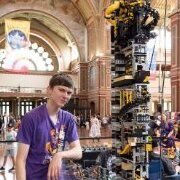 after watching the brickworld gbc videos i saw that the workshop module is a ball pump and a stepper for 2019, does anyone know where i can find the instructions for the ball pump? thanks
 -
This Lego great ball contraption miniloop uses a screw made of technic flex tube to lift the marbles up, then they role down the ramp and back to the start again. The ramp is made of "cheese slopes" and hinge bricks wich make it flexible. The ramp can is flexible but if you want to bend it more than about 15 degrees you have to swap one of the 1x2 slopes for a 1x1 slope. It works well for short distances but might need to be supported if it is made longer. The LDD file is here. Some of the parts for the screw are missing because they are not in LDD, the screw should look like this: More photos here.
-
This lego great ball contraption miniloop uses a Cardan mechanism to lift the marbles up, after that they role down the strings and back to the start again. It is very reliable and can be powered by a motor or a hand crank. If you want the free video instructions they are here.
-
 GBC Carousel During the last few weeks lead up to Brickvention 2018, in January, I decided to have a quick attempt at building a module I have seen on other GBC videos I take no credit for it's general invention, and I actually can't remember where I saw it.... it's just one of those 'cool ideas' that sticks in your head, and you decide to sit down and recreate it from memory! If I find a video, I will link it.. or if anyone knows who built it first.. please post, so I can credit them! For my version, I decided to use the smaller Lego tracks, from the Indiana Jones minecart.. they are fairly cheap on BL, and work very well, and doesn't take up too much space on the table The main ring is made of fairly basic pieces... always a great chance to use those less popular colours! I was quite happy with the red and yellow - giving it a circus-like feel The inverted slopes are fairly new, and worked very well at helping balls slip down the holes I had a bit of fun with some mixel faces, and eyes on the outer ring, as you can see in the video! The track is supported by a nice sturdy frame.. I can pick the whole thing up in one hand, and it doesn't flex. It is driven by train wheels, at each quarter/axis. With the first prototype, it didn't drive very well, and I needed all 4 corners to be driven. But I was testing with bare track, which is very light. Once I added the bricks/plates, it became heavier, and I only needed 2 driving wheels to operate it.. This simplified the design I needed to make it GBC standard, so a simple input + conveyor was added. If balls happen to drop, as the holes are passing, the large tile/catcher underneath sends them straight through. If they land on the wheel, then they go for a ride, accumulating in a pile, before the holes come around again, and they drop down The input rate is just right, so that not too many balls accumulate to 'overflow', and spill..occasionally balls don't fall down the hole, and they just wait for the next loop. For a bit of fun, I decorated the 'engine' in the middle. Note that I have 2 Motor inputs. This lets me alternate between an XL, and M motor, without having to alter power. I wasn't sure at the time which motor would be best (or what I had spare to use) It turned out to be a very reliable module, and I'm quite proud of how it came out. It's nice that there's no major timings to work out, and I think it's reasonably interesting to watch aaaaand... here's the video! :)
 -
Hello, this is the first GBC that I have ever made. It just has a shooter, which shoots the balls about 10cm high and 7cm far and a basket where the balls should go in. Its powered by the L motor, it has one battery box. It can´t be powered manually because the panels which stretch the shooter need the same speed all the time. Otherwise, the shooter will shoot the balls with different power.
-
Hey everyone, Today I present the video for the G-Model of the 42062 Container Yard set. It is a simple tipping ramp mechanism that can be hand cranked (why???) or upgraded with a motor for GBC layout use. Tires are used as counter-weights and as a bumper for the tipping input bin.
-
This lego great ball contraption module uses two "minecarts" and a conveyor belt to lift the marbles. The module is quite reliable even though it has so many gears and moving parts. The carts have extra plates on the bottom to make them heavy enough to pull the strings down, as these strings are quite stiff. The Instructions and part list is on rebrickable here. ↑↑↑ This mechanism with the two 2L technic beams is what makes the carts stop at the top to let the marbles in. The PF switch is attached to the servo motor witch flips the gearbox direction, this way the main XL motor always runs in the same direction.
-

BWE - C model (GBC)
doug72 posted a topic in LEGO Technic, Mindstorms, Model Team and Scale Modeling
PV Productions now have instructions for a C model LEGO GBC 15 – 7 Modules – 42055. Looks good. http://pv-productions.com/product/lego-gbc-15-42055-building-instructions/ -
 My old red GBC wheel has been repurposed as a hamster wheel. This was only natural since kids kept referring to the hamsterless wheel as a hamster wheel at LEGO World a some years ago (2011). I really liked the module since it captured balls and mysteriously delivered them somewhere else. However. It was not very interesting for the audience because it was difficult to relate to, and hid the balls from view. Kids who were following a ball around the layout would thus lose interest when the ball came to this module. This upgrade should change this! I go through the details of the module in the video, but here are some additional pictures: Here you can see both the mechanism for pushing balls in from the side, the non-geared XL motor and the water bottle. It is quite exhausting to run, so water is necessary: The inbox is completely standard for GBC and this module should fit into a layout just well: A better picture of the Sarie... hamster: She really likes to run :) The old wheel can be seen in this video at 6:46: Here is a picture of the old wheel for comparison:
 -
For some time I have been trying to develop a mechanism to allow intermittent rotation for various GBC modules I have built or plan to build. A Geneva mechanism would be ideal but its not easy to build using Lego, and some solutions are quite large. I have developed a fairly small version which uses a rotating arm to intermittently turn the black gear with 4 rollers. Indexing is acheived by using a 24T gear with four blue pin/axles. As the wheel rotates and drive arm disengages the 24T gear & wheel is held stationary by an arm kept in contact with two of the blue pins by a shock absorber with a soft spring. I tried using knob gears but due to them being slighty smaller diameter the indexing is no longer exactly 0, 90, 180, 270, degs. The two black 36T gears are only used to hold the rollers and drive arm as along with the 24T gear as they are the only lego parts which 4 equally space holes in line with the axle hole. At the moment the output axle stops every 90 degs but could be made to stop at 180 degs if use a 12T gear meshed the the 24T indexing gear to give a1:2 step up. (An alternative would be to use a 20T meshing with a 40T gear holding the drive rollers.) Hope that makes sense. Timings should be adjustable via varying the drive input / output gear ratios and choice of PF motors. Video will make it clearer how it works. Next step to try and make it more compact and see if I can use it for my build of DaFokka's Ballkirk Wheel GBC Lift.
-
 Holy moly the GBC at Brickvention Australia was Huge. Brickvention if one of the largest Lego conventions in Australia, It's composed of builders from all over the country. This year the GBC team went above and beyond making a fantastic display. Rohah - The co-ordinator of the GBC walked me through all the different modules and explained what everything was. He was a fantastic speaker so all credit to him Without further ado, The Brickvention 2017 GBC!
