Aanchir
-
Posts
11,930 -
Joined
-
Last visited
Content Type
Profiles
Forums
Gallery
Everything posted by Aanchir
-
 Oh, that looks incredible! I hadn't really even considered the sort of possibilities this style of brick-built sails (with a studded front surface) would have for custom patterns!
 -
Honestly, something I'd love to see the new road plates used for is a new wave of Construction sets focusing on road construction/maintenance! Some possibilities that come to mind include: At the highest price point, a Bridge/Overpass Construction set featuring a a tower crane, a ground level mobile office for the site foreman, enough road plates and support columns to make a bridge/overpass about 96 modules long from end to end, and a flatbed truck which can carry either the mobile office or the overpass sections. Some of the trusses on the crane itself could even be built from recolored roller coaster tracks (25059) for a realistic square cross-section. A Road Grader and Paver set with the aforementioned vehicles, a few road plates, and an unfinished section of road (with plates in a color like Brick Yellow or Sand Yellow representing the unpaved surface, and maybe some tiles that can be placed over top to represent the paver's progress). A new Road Roller set with one 16x16 road plate, four end ramps, a walk-behind line striper, and a few road marking tiles. This would be a great opportunity to reuse part 68327 as the roller's drum, since it would be slightly smaller and much smoother than previous LEGO road roller drums. a small Road Maintenance set — featuring traffic barricades, a "broken" section of street using parts like cheese slopes to show the uneven surface, manhole cover (either on a hinge, as in the TMNT sets, or fully removable), and two or three maintenance workers with accessories like a wheelbarrow and jackhammer.
-
Lego City 2021 Rumours, information and discussion
Aanchir replied to Powered by Bricks's topic in LEGO Town
Lately City tends to get at least one science and exploration focused subtheme per year, even years when the summer releases also include other subthemes like Airport, Coast Guard, and Trains. Even this year, the summer sets that we've heard about so far include both a Wildlife Rescue subtheme and a Stunt Show subtheme. Plus, last year's Ocean Explorers sets were fairly animal-focused themselves! So even if there's no guarantee that next year's exploration-type subtheme would be one with lots of animals, I don't think it's all that unlikely. -
Lego City 2021 Rumours, information and discussion
Aanchir replied to Powered by Bricks's topic in LEGO Town
I don't think it's really a cost issue. Keep in mind that LEGO hasn't had any other City sets/subthemes lately with a jungle setting where tigers, leopards, or panthers would make sense. I mean, look at the sets we've seen other big cats in — lions and lionesses have shown up in sets based on African savannah settings, the puma/mountain lion appeared in sets based on American mountain settings, and the frozen sabre-toothed cat appeared in sets based on an arctic setting. Also, note that none of these designs have continued to appear in sets for more than one wave. So I suspect the priority of the designers has been on introducing different biomes (and different wildlife endemic to those biomes) to keep things feeling fresh and exciting, and only circle back to jungle-based sets after they feel like it's been long enough for them to feel "fresh" again — sort of like how the Friends theme didn't get a second Jungle Rescue wave until summer 2020, six years after the original Jungle Rescue wave in summer 2014. How long it takes before they decide the market's ready for another wave of sets similar to a previous one is not fixed, of course! The gap between the 2015 Deep Sea Explorers and 2020 Ocean Explorers sets was only five years, and the gap between the 2014 and 2018 Arctic sets was a year shorter than that! But regardless, it'll probably be at LEAST another year before LEGO is ready to take a chance on a second jungle-based City subtheme. In the meantime, I'm glad they've continued to find new uses for some of those same animal molds so we don't have to worry about them abruptly retiring them. Also, for what it's worth, next year's Chinese zodiac animal is the tiger! So it's not implausible that we might see a tiger in one of that year's Chinese Festival sets well before we know whether or not LEGO has any plans for jungle-related City sets the following summer. Only time will tell, I guess. That could have been neat (LEGO did do that for the adult elephant in last year's Friends sets). But of course, they probably would have needed to make back when they introduced this trunk piece for the mammoth in the 2018 Arctic sets. I feel like it'd be a bit of a waste to introduce a second trunk mold after that when this one works so nicely for both species. I also wouldn't be surprised if they wanted to include a stud connection so that a piece could be attached to represent a spray of water, since that's one of the iconic things elephants do with their trunks sometimes. In the Friends sets, the baby elephant had a 1.5mm hole at the end of its trunk for that same purpose. In the City sets, on the other hand the baby elephant's trunk is the one that's clip-shaped to grasp a horizontal 3.2mm bar. -
[Opinion] Review of the new road plates system (2021)
Aanchir replied to The Lego Room's topic in LEGO Town
Agreed — especially for racetracks, since those tend to be a lot "curvier" than a lot of City streets, and would likely be every bit as "cool" to City-loving kids as ordinary roads are. During my childhood in the 90s, there were loads of racing-related sets in the Town theme. Lately, between last year's Turbo Wheels subtheme and this year's Stunt Show subtheme, the City theme has been getting more into that sort of stuff as well. And truth be told, I'd be especially excited for a more gradual curve option that opens up the possibility of more varied road or racetrack layouts, like you've always been able to do with LEGO train tracks (or with the racetrack system from the 2002–2003 Racers sets). That said, "off-grid" layouts present a lot of issues for building sidewalks and other roadside features or expanding the width of the roads themselves. So I wouldn't be entirely surprised if LEGO continued to stick with 90-degree curves just for simplicity's sake. Regardless, after hoping for a new road system for so long and getting one that surpassed most of my expectations, I can't help but have high hopes for the future of this road system, particularly its potential to enable new creative options that traditional road baseplates never really allowed for. -
They could be releasing in different months in different countries. It isn't all that uncommon for new waves of sets to have slightly different release schedules in different parts of the world — for instance, with stores in Europe getting a wave a month or two earlier or later than stores in North America. But sites reporting on new sets can sometimes be a bit lax in acknowledging these discrepancies between countries.
-
Brick-built Animals VS Molded Animals
Aanchir replied to Lego David's topic in General LEGO Discussion
Presumably, the connection between this elephant's head and body molds would be the same as the mammoth from the 2018 Arctic sets (which is, in turn, the same as how the heads attach to larger Jurassic World dinos like the T. Rex or Indominus Rex, or to 2007–2013 LEGO Castle dragons). So the easiest way to attach it to a brick-built torso would be with a piece like 48370. I suspect that legs hinged with Technic pins might not have been particularly feasible on an elephant this size, since there is so small a gap between the right and left legs. LEGO animals whose legs attach to the SIDES of the torso (like most Jurassic World dinos) tend to have a much larger gap between their left and right legs. So if this elephant mold had been designed with hinged rear legs, they'd likely have needed to be permanently integrated in the same way as the rear legs of recent LEGO bears, big cats, and horses. That sort of added complexity would not be impossible, but it WOULD add to the already substantial cost of a large, pre-assembled torso component like this one, potentially even enough require sacrificing some of the other new elements from this wave. Considering how many other great new animal molds/recolors/reprints are appearing in those two sets, it may be for the best that LEGO made that particular judgment call. After all, as you point out, brick-built options are still available for sets or MOCs where lifelike proportions are a lower priority. -
[Opinion] Review of the new road plates system (2021)
Aanchir replied to The Lego Room's topic in LEGO Town
At least two of the Wildlife Rescue sets DO include the 8x16 road plates as rivers and mudflats, in colors like Sand Yellow and Dark Azure. Moreover, there are still a LOT of summer sets we haven’t seen yet, including at least one more Wildlife Rescue set and the entire Stunt Show subtheme — the latter of which I think would be especially likely to use new road plates for stuff like dirt tracks or stunt ramps. And anyhow, the designs for this year’s summer sets would have been set in stone long before LEGO had any sort of knowledge of how the first wave was performing! So it’s a bit early to draw any conclusions from the lack of road plates in sets which, for the most part, would not have any reason to include roads! Plus, the old road baseplates haven’t appeared in ANY sets besides the stand-alone supplementary packs for more than a decade. So if a lack of appearances in new sets were an indictment of this system, the same could surely be said for the one it replaced as well. -
Lego City 2021 Rumours, information and discussion
Aanchir replied to Powered by Bricks's topic in LEGO Town
That one is a chimpanzee rather than a monkey — the most obvious distinction is the lack of a tail (which is why chimpanzees are classified as apes rather than monkeys) I definitely have a lot of nostalgia for the old monkey, particularly the cleverness of using minifig arms for its arms and legs. That said, there's also a lot of stuff I prefer about the new monkey: The smoother printed face feels more appropriate for a distant relative of "human" minifigs than the unprinted, elaborately molded face of the classic LEGO monkey. The shape of the tail and the part's distribution of weight seem to allow it to swing or dangle from trees in more varied ways than the old monkey could. The back legs now have an anti-stud so the new monkey can attach more securely to models in a conventional sitting/standing pose, instead of only being able to balance loosely on a surface or clip to a bar. Finally, this monkey is much smaller than the traditional one, closer to the size of LEGO dogs and cats. This definitely feels a lot more realistic, since the previous LEGO monkey was closer to the size of the standard minifigure, or even the new baby elephant! I also suspect that the new monkey being a single mold makes it a lot less costly to include in sets, to the point that even one of this year's polybag sets is able to include a monkey, a minifigure, AND a reasonably substantial vehicle build. Compare that to 6235, in which the build itself was negligible, and the emphasis was on the figures and accessories. Similarly, 60300 is apparently priced at just 10 Euros, but includes a minifigure, three fairly decent builds, a scorpion, and TWO monkeys! Whereas there has NEVER been a set with more than one classic LEGO monkey. In general, this subtheme seems to have a big emphasis on animal groups/families, I wouldn't be surprised if the possibility of including more monkeys per set was a factor in deciding to introduce a new monkey design. And considering that the LEGO monkey has largely disappeared from sets for over a decade at this point (the 2015 Pirates sets had no monkeys at all, and even the Ninjago's Monkey Wretch only ever appeared in two sets), it certainly seems like a single-piece monkey design like this would have much stronger chances of appearing more frequently in the future. And from a MOCist perspective, it wouldn't be too hard to use this newer monkey design to represent a different species of monkey than the classic one — after all, as mentioned, this one is considerably smaller than that one was! This wave does feel a lot different from the Safari Off-Roader, but I don't see anything especially unrealistic about it. If anything, I was a little surprised that this wave went with such a subdued color scheme for its vehicles compared to earlier exploration-focused waves like the Arctic, Deep Sea, Jungle, Volcano, and Ocean Explorers subthemes, which were heavily criticized for their color schemes back when they were first announced. Even the one 4+ set from this subtheme, 60301, feels surprisingly detailed and authentic compared to previous 4+ City sets. I feel like a lot of the differences from the Safari Off-Roader stem from this subtheme being more exploration/rescue focused, and thus having color schemes, designs, and graphics suited to heavy-duty work vehicles. The Safari Off-Roader, by contrast, seemed much more vacation/leisure focused, with a zebra-striped paint job that felt geared towards a safari park setting than the open wilderness. Additionally, I think it's important to note that a lot of the parts used for molded dinosaurs are used across MULTIPLE dinosaurs. So there's a lot of opportunity to reuse the molds even if each particular dinosaur only shows up every now and then. Elephants are a different story. LEGO has had several dinosaur-focused themes over the years, but never an elephant-focused theme. And there are not a whole lot of different species with the same size and body plan as an African elephant — even other large quadrupeds like hippos and rhinos are much smaller, with a very different shape and appearance. So specific elephant molds would really only be able to show up when there happens to be a subtheme that calls for elephants — and even then, likely only in one or two large sets from that subtheme. And as @Lyichir brought up, there are some implicit limitations of the new elephant's proportions. The old elephant's bowlegged design had an 8x10 footprint, which is why it was even possible for the pre-assembled leg piece to attach via sides of the torso rather than the bottom, this one has a 4x10 footprint. In other words, much like the LEGO horse, the gap between the right and left legs of the new elephant is negligible, and would not really be conducive to having separate right leg, left leg, and torso pieces like we see on larger Jurassic World dinosaurs. Even a hypothetical version of this elephant with posable back legs would likely need to be pre-assembled like the current LEGO horse — likely adding quite a bit to the cost for just one additional point of articulation and just as few alternate uses as the current design. And as nice as that might've been, I can definitely see why LEGO didn't want to tack on that additional expense to these two sets, when they could put that money towards including more animals OTHER than elephants. -
[Opinion] Review of the new road plates system (2021)
Aanchir replied to The Lego Room's topic in LEGO Town
New Elementary recently shared an interview they conducted with the LEGO City and element design teams about the development process for the new road plates. It's got some very good insights about why they saw a need for a new road system and what sort of considerations went into its development. Apparently, the process of developing a new road system was in the works for over a decade. Some of the big concerns were that road baseplates were too large to include in sets with smaller boxes, and that City sets in general tend to be built on standard-thickness plates rather than baseplates. The article also helps allay some worries by confirming that there are not currently any plans to stop producing standard baseplates, even though the City theme no longer uses them. -
Classic base plates being retired by February 2022
Aanchir replied to wesker's topic in General LEGO Discussion
The rumor emerged primarily because apparently somebody with insider knowledge of some kind saw something saying the LEGO Classic baseplate SETS are apparently scheduled to retire. But again, that could just be a sign that they're going to be re-released with a different set number and/or different theme branding, as they have been at various points in the past — or updated to use a different material, or sold two to a pack, or packaged differently as part of LEGO's efforts to cut down on single-use plastic bags, or with slight updates to the mold like a different radius on the rounded corners. In other words, there are numerous reasons that LEGO could retire these particular sets that don't involve the entire baseplate category being permanently retired. -
[MOC] She-Ra and the Princesses of Power (WIP)
Aanchir replied to elfprince13's topic in LEGO Historic Themes
(1) Potentially! But I'd also recommend experimenting with other parts entirely that might come closer to that shape. I just browsed some parts on BrickLink for a bit, and 98347 is a similar-sized wing piece that might be worth trying out. I even tested it myself with stud.io, and it looks like it'd be just as accurately scaled to your model as the wing you're currently using (2) One part that immediately springs to mind is 92944 from the LEGO Atlantis theme! Sadly, though, it doesn't look like anybody has bothered to model it for LDraw. Same with bb0534 which would also be a very fitting choice. -
[MOC] She-Ra and the Princesses of Power (WIP)
Aanchir replied to elfprince13's topic in LEGO Historic Themes
Oh wow! This looks very good so far! Brightmoon Castle has a lot of very complex shapes that I would have felt way too intimidated to even ATTEMPT building out of LEGO, and yet your recreation appears to be well on its way! While they are a nice, simple approximation of the feather-like flying buttresses on the side of the castle, I have to wonder if you might be able to more closely match shaping and the differences in their height using a more custom solution, perhaps one involving curved slopes such as 13731. The use of the standard bird wing piece from the Legends of Chima sets for the wing motifs on its steeple also feels somewhat out of proportion with the rest of the model, and also loses the stylized curvature of the original. But in that case, I'm not so sure what sorts of parts might allow a more accurate end result. Best of luck with completing this model! I'm really excited to see how it progresses! -
Latest impact of other themes on historic themes
Aanchir replied to Wardancer's topic in LEGO Historic Themes
This is a good point, actually! Certainly this could be an interesting use for them. This wouldn't really be possible with traditional half-thickness baseplates. The vacuum forming technique used for baseplates only really works if the shape can be formed from a flat sheet that is "pulled" vertically onto a single-surface mold — so it wouldn't allow for details or connection points that project horizontally or diagonally from the part's surface. -
Classic base plates being retired by February 2022
Aanchir replied to wesker's topic in General LEGO Discussion
Slight correction — the plant-based polyethene that LEGO is currently using in sets is derived from sugar cane, not soy. That said, this is honestly a good point, and a possibility I hadn't considered. I don't think that the stability issues of using four 16x16 plates compared to a 32x32 baseplate are as big an issue as a lot of folks make them out to be. After all, Cafe Corner, Green Grocer, and Fire Brigade were all built on a pair of 16x32 baseplates instead of a single 32x32 baseplate, and it didn't result in any noticeable design constraints or stability issues compared to later buildings! Likewise, the upper floors of Modular Buildings have all been built on assemblies of standard plates from the very beginning, and it generally hasn't resulted in any noticeable structural flaws or design limitations. And outside the Modular Buildings, there have been numerous "expert-level" sets with full-thickness plates as their foundations, including the Fairground Collection Haunted House, Monster Fighters Haunted House, Roller Coaster, Carousel, Ferris Wheel, Temple of Airjitzu, Barracuda Bay, Medieval Blacksmith, and the entire The Simpsons theme and Winter Village Collection. A lot of the time, set designers even seem to prefer these sorts of foundations over baseplates — so I don't see any reason to think they'd feel creatively limited by them. Even in sets like Modular Buildings that are locked to a rectangular footprint by virtue of their grid layout, they would open up a number of new possibilities (like, say, bases that are 24 studs wide,instead of just multiples of 16, or buildings with different floor colors between the "backyard" and the different rooms of the ground floor). -
Latest impact of other themes on historic themes
Aanchir replied to Wardancer's topic in LEGO Historic Themes
I suspect they wanted them to match the surface finish of the standard tiles and plates used to link them together. I'm not especially bothered by it, but regardless, I agree that for historic uses like dirt or cobblestone roads, studded surfaces will likely be preferable to smooth tiled surfaces most of the time. Even for surfaces like inclined roads/paths which would have been studless back in the days of raised baseplates, I honestly feel that studded surfaces would usually be preferable, especially since it would allow for more secure attachment points for minifigs and horses. That's not to say the new road plate system would be useless in historic themes, any more than other large tiles would be — but it probably wouldn't be especially suitable for roads in those contexts. -
I'm not so sure the skeleton has anything to do with those limitations — I mean, back in the 90s when I was growing up, skeletons were every bit as common in Castle sets as in Pirates ones! So it's quite possible the designers just figured that a skeleton would be a feature that kids would really enjoy, and a natural fit for sets like this castle or last year's pirate ship. Otherwise, though, you're correct about a lot of the stuff that's less likely to show up in Creator 3-in-1 sets than in "play themes" like City, Castle, Pirates, Ninjago, etc. Creator sets in general are a lot more focused on brick-built detail and the building experience itself than about figures and accessories. And while I don't think it's a bad thing from a set design standpoint, it's definitely not meant to satisfy the same tastes/interests/expectations as "play themes" are.
-
Latest impact of other themes on historic themes
Aanchir replied to Wardancer's topic in LEGO Historic Themes
You're in luck — the new road plates appear in Dark Tan in at least one upcoming City set, 60302, and possibly others that we haven't seen pics of yet (I wouldn't be at all surprised to see them used more widely in the upcoming LEGO City "stunt show" sets as dirt tracks or "demolition derby" style arenas). -
Classic base plates being retired by February 2022
Aanchir replied to wesker's topic in General LEGO Discussion
Yeah, it's definitely no coincidence that baseplates started to disappear from most sets just shortly after the 8x16 and 16x16 plates were introduced. And while I understand some folks' worries that having to use four smaller plates instead of one 32x32 baseplate will be less sturdy, it doesn't take too many pieces to lock them together securely, from my experience. Furthermore, sometimes models are honestly EASIER to transport, store, or relocate if you can separate them into more sections. For example, models like Main Street with large empty spaces between structural elements can be tricky to carry without some of the assemblies coming loose due to the uneven weight distribution and the flexibility of the empty parts of the base. By comparison, a model like Town Centre lets you separate the road modules from the buildings and "stack" them, with the buildings at the top of each stack — not unlike how convention exhibitors with Modular Building layouts tend to keep their road baseplates mostly unadorned, and separate the buildings from the roads and from each other for transport. -
Classic base plates being retired by February 2022
Aanchir replied to wesker's topic in General LEGO Discussion
Perhaps they'll start selling standard thickness plates in their place. Judging from the price on LEGO Customer Service's Bricks & Pieces site, it likely wouldn't be too hard for them to release a 4-pack of 16x16 plates (perhaps even with a few other plates to connect them with) for the same price that 32x32 baseplates are currently sold at. Alternatively, they could just be preparing to roll out baseplates of the same size and thickness as current ones, just with updated set numbers and a different type of plastic that helps further their sustainable materials efforts. Or maybe instead of outsourcing baseplate production but then selling them as a standard LEGO product, they'll just entrust the production AND distribution to a third-party licensor, same as they do with "lifestyle" products like clothing, housewares, and stationery. There are lots of possibilities, but one way or another, I doubt they're planning to discontinue baseplates without anything new to take their place. The 9-volt train system is a BIT of a different case since, like magnets, that had more to do with changes in toy safety regulations than with any of LEGO's internal workings or the interests of their buyers. But I agree that LEGO probably knows the size of the market for baseplates better than any of us do, and it's entirely possible that it's not as big as a lot of us tend to imagine. After all, back in the 80s and 90s, baseplates were frequently included in sets from most themes, especially larger sets. But since 2012, the vast majority of sets and themes have eschewed baseplates in favor of standard-thickness plates, and it doesn't seem to have hurt the sales of those sets and themes — or the success and popularity of LEGO in general — one bit. Of particular note, the Friends theme has been a rousing success since its launch, even though baseplates have NEVER been included in any sets from that theme. So it's entirely possible that if LEGO switched to selling packs of standard-thickness plates in the Classic theme instead of baseplates, it'd be the same way, and the majority of buyers would have no issue with the switch. Whereas if it DOES turn out to be a mistake, I don't see any reason they couldn't just reverse course and re-introduce traditional baseplates, considering that they don't manufacture them in-house to begin with. -
Latest impact of other themes on historic themes
Aanchir replied to Wardancer's topic in LEGO Historic Themes
I'm not talking about bending from lifting the set, I'm talking about the corners of the baseplate warping just from the combined stresses of the pieces attached to them (which can happen even if you keep the set on display exactly where you built it to begin with). It's the same reason that the underside of a standard 16x16 plate has so many extra support structures underneath compared to other standard plates — plates and baseplates that large are prone to deforming from the combined stresses of so many stud connections unless they are carefully reinforced. Err… not really, no. Building craters is pretty easy and doesn't take many parts at all, especially with how many round bricks, plates, and tiles there are to choose from these days. And cliffs and mountains can be just as easy to build with only a smallish number of parts if you use BURPs/mountain bricks (which are availabile in many more sets at much more affordable prices than raised baseplates, which only ever appeared in high priced sets, and usually with only one or two per set). But regardless, LEGO stopped putting raised baseplates in sets a decade ago. And most historic themes never used road baseplates to begin with, except as printed waterways and wagon trails (which hardly ever even lined up correctly from one set to the next). So while I realize we all have our own preferences about what sort of foundations we prefer to build on, there's not much point debating the merits of these sorts of long-retired "special" baseplates in a topic about how current and future parts, sets, and themes might impact historic themes. -
Perhaps that might be true for some of them, but many of them certainly wouldn't have been out of production yet when this set was in development. I mean, the Gamer's Market is still available from LEGO.com in North America, and only recently sold out in Europe. And both the Skull Sorcerer's Dungeons and the Disney Castle are still available on LEGO.com in both America and Europe. So it likely wouldn't have been much trouble for the Creator 3-in-1 team to keep those parts in production a little while longer, knowing they'd be needed again very soon.
-
Latest impact of other themes on historic themes
Aanchir replied to Wardancer's topic in LEGO Historic Themes
So you've never encountered an instance where the corners of modular buildings start to bend upward when the weight is distributed unevenly, as described here? Because from what I've seen, that's a pretty well-known issue, and is often brought up in modular building reviews and/or the comments of those reviews. And adding a full layer of plates on top of a baseplate just to keep it from bending or warping pretty much renders the baseplate redundant — you could just as easily build your model on full-thickness plates WITHOUT baseplates underneath, just like the vast majority of LEGO sets 2012 (and many others long before that). Isn't the fact that you felt compelled to choose BETWEEN traditional baseplates and standard plates a pretty strong sign that baseplates are needlessly restrictive? This isn't a case of LEGO introducing incompatibility that wasn't there before. Rather, baseplates were ALWAYS less compatible with the rest of the LEGO system than standard plates — and now, LEGO is increasingly introducing options without those inconsistencies. In my opinion, that's a good thing. To put it another way: If LEGO still used baseplates as widely today as they did in the 1980s, they'd still have the same compatibility issues with standard plates as they've always had — including in sets like 6080 and 6040 that were DESIGNED to be linked together. Whereas if all LEGO sets had been built on standard-thickness plates (like the bases of all Friends, City, and Creator sets since 2012) and/or on double-thickness plates (like the 4+/Juniors bases and the new road system), those compatibility issues would never have existed in the first place — these types of bases can be linked together without any issues or any need for elaborate workarounds. In other words, most of these compatibility issues are not the fault of these newer parts or systems, but rather of traditional baseplates for having a different thickness from the rest of the LEGO System in the first place. To circle back to the topic of historic stuff… some of the new City Wildlife Rescue sets include 8x16 road plates in Sand Yellow and Dark Azure as mudflats and bodies of water. Both those parts could have similar uses in historic layouts! -
Lego Ideas Support Thread - Historical/Castle
Aanchir replied to leafan's topic in LEGO Historic Themes
It likely wouldn't be "so early" when the set is actually released. Don't forget, the Medieval Blacksmith was approved in the second 2019 review. So even if a medieval project gets approved in this current review period, it may not actually hit shelves until 2023. -
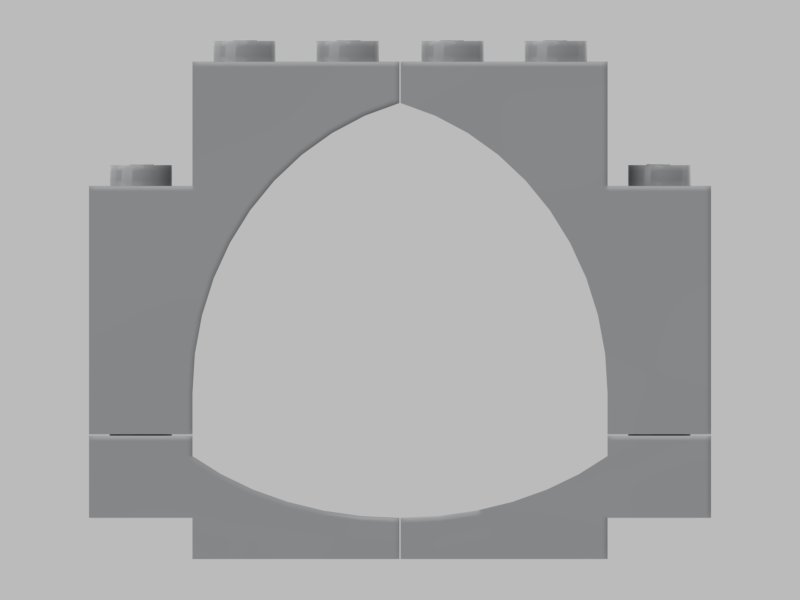
I agree that smooth, quarter-circle or half-circle curves can be very useful, but I think there's still a lot of value to having curves that result in "corners", especially ones like 70681 that belong to a larger family of parts. Some of the other with the same "profile" as 70681 include 92950, 93273, 93604, 11477, 24201, 29119, 29120, 32803, 41854, 66956, 73682, 88930, the inside AND outside curves of 47755, the top and bottom of 35300, and the flat sides of 30602, 44675, and 62361. And there are probably others that I'm either forgetting or haven't discovered yet! Others have already mentioned examples of instances where it can be useful to have arches that AREN'T a perfectly smooth curve, such as gothic arches, but I should also add that 13965 and 70681 can be combined to create a beautiful approximation of a Reuleaux Triangle, with an opening 4 studs wide by 10 plates tall (32mm by 32mm):