

Selander
-
Posts
648 -
Joined
-
Last visited
Content Type
Profiles
Forums
Gallery
Everything posted by Selander
-
MOC: DSB My 1100 - 6wide Power Functions locomotive.
Selander replied to Selander's topic in LEGO Train Tech
Did you keep the 1:1 gearing when changing to XL-motors? Or......? -
MOC: DSB My 1100 - 6wide Power Functions locomotive.
Selander replied to Selander's topic in LEGO Train Tech
Thanks everyone for your kind words. About pulling power, so far I only made a simple test the other day, by hooking up seven My-Own-Train wagons, and that was a piece of cake to handle for the loco (but I don't think that load was particulary severe). I guess I should try with more and heavier rolling stock to find out more.... In theory it should have a good pulling power, having two Medium motors, a low 1:1 gearing and "8-wheel-drive" with grippy o-rings. -
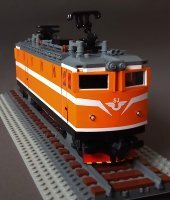
Swedish company NOHAB built this locomotive in the 1950-1960:s for DSB (Danish national railways). Here presented as a 6-wide and approximately 32 studs long, power functions version with 3-axle boogies, like in the original NOHAB design. Thanks to using PF-elements and a brick-built powertrain, it has been possible to make a locomotive with a design and functionality much more similar to the original, compared to using the 2-axle 9Volt or PF-train motor. Cab has the characteristic round nose, which is pretty awkward to copy in lego, and also features working PF-LED lights (one end only). A big part of the cab structure is SNOT:ed, and hand rails are hold in place by tile clips, to sit as near the body as possible. I built two 3-axle boogies (trucks) in a "lego-train-motor-design", basically using the same concept as in my previously presented compact shunter DB 365 V60. Changed o-rings makes it manage points and curves without any problems. In each boogie, two axles are powered by a vertical Medium PF-motor placed right over the mid axle. Gearing is 1:1, so each boogie has seven 12-tooth gears. Lower part of black mid section consists of SNOT:ed black tiles, which are supposed to replicate the "corrugated plate" design of prototype, and makes it easy to fit four round "windows". Behind those sides you'll find, apart from the two PF-motors, a non-rechargable battery box and IR receiver. Loco has no modified parts except for changed o-rings, and decals. Any comments are welcome.
-
Nice version. I am also building this locomotive, but as a PF version since the PF-bug has bit me. Today I put together two 3-axles boogies which are powered by two medium size PF motors in a verticle position, (one motor in each end of locomotive). I also built a chassis 6studs wide and approx 32 studs long, and one red cab with working PF lights integrated. More info and pictures to follow later ;-)
-
Simply beautiful.
-
Superb selection of freight waggons. Also nice solution to the articulation of 2-axle chassis, I think I'll try that.
-
MOC: E444 - The Turtle - Electric FS Locomotive
Selander replied to helos's topic in LEGO Train Tech
Beautiful train set. So many nice technics used, and estetically perfect. Very well done indeed. -
We also had in Sweden (when I was young) a loco called "Rapidlok" which has a similar look. Like in this link: Rapidlok .
-
Great model !!! Also I like your courage to go for PP3 battery, switch and soldered LED:s. This is engineering.
-
Great idea.
-
It's a nice locomotive, with a characterstic design which shouldn't be too difficult to build in lego. Colours are easy to replicate. Estetically I'd say the front windows are the most difficult to build accurately as they are rounded in two dimensions. Technically it can be a challenge for you to build 3 axle trucks, at least if you intend to do a motorized loco, then you have to build a power function based solution which requires some skills. Good luck.
-
Great job on the locomotive, it's an impressive powertrain you squeezed in. I've built a few of the Swedish original design (class RC-locomotoves), and really appreciate your AEM-7.
-
Amazing houses, the weathering is excellent. Also the backyard is very realistic. Well done.
-
Thanks a lot, everyone. @Leg Godt Gud: I actually already got a detailed proposal from Flickr user Shuppiluliumas, to do just what you propose: These forums are really a great help for sharing ideas Let's see where this ends. @grennmtvince: No plans to add rods for this narrow version. I already tried BBB medium wheels but they don't look correct on this 6-wide version. If you include rods on those BBB wheels you are (at least) on 7-wide, so that would mean I have to redesign the whole loco body to an 8-wide version. Then I could also build much more details around the battery box, to add some interesting surfaces similar to those of the prototype. But I think 6-wide is more fun, and a bigger challenge to work with, to my point-of-view @Sokratesz: I don't want a faster engine. For a railyard shunter is just an advantage to be slow, but strong.
-
Thanks peterab and all, I acknowledge it was a challenge to fit all PF-stuff and still maintain the "sleek" look of prototype within 4/6 wide, especially considering the bulky battery box ! My goal was to make a PF-based loco with the 4/6 wide proportions from locomotives like 7760 / 4564 etc.
-
This is a build I've wanted to do for a long time: A compact 6-wide, Power functions based shunter, like a modern version of the classic 7760. My main problem was to create an elegant and well-functioning 3-axle brick-built chassis (truck). Since I had no experience of such (except for assembling my Emerald Night) I had to start from zero. After a long trial and error process (from which I 've leard a lot) I finalized the below 3-axle chassis with 2 powered axles and a vertical PF medium size motor. Initially I used BBB medium size wheels, (flanged+blind+flanged) but I wanted to use normal PF-trains wheels as they are better in size (especially width) for my "narrow" shunter. But 3 of those PF train wheels in a static design cannot manage curves! I found the solution for this problem in a Railbricks article + advice from Flickr user Shuppiliumas, about replacing PF train wheels stock rubber with slightly bigger o-rings for the two powered wheels, and to remove stock rubber from mid-wheel to give the little clearence needed to manage points and curves for a static 3-axle chassis design. This set-up works real good ! Battery box and IR-receiver are integrated as compact as possible, filling the driver's cabin with motor + cabling and a part of the IR receiver. Since the motor powers the axles "direct", the loco is quite slow, but I think that is only appropriate for a train yard shunter. Having a fully functional base, I could now start dressing it with a body with the aim to keep the design from prototype as closely as the limited scale allows. The nose is only 4 studs wide by using the new red 4-wide battery box as part of the structure. I applied (rather ugly) red stripes to hide the light grey upper part of battery box. The rear is partly slightly wider having big 4x4 tiles to cover sides of the grey IR-receiver. Windows are old TrClear from Santa Fe since I had a few extras as spares. Since it is a 3-axle static design, the loco pivots over mid axle, and since mid axle is NOT physically placed at the mid-point of locomotive, I had to make a special assembly for front magnet so it rotates on a short technic beam to allow following rolling stock in curves, otherwise it can push waggons to derail. Last I enclose a picture of the prototype.
-
Nice build Peterab. Br103 is one of my favorite locos and you have made a great job with your version. Let uss see some pictures showing how you powered it.
-
MG Midget with it's appropriate owner. Built from new CARS elements + some old stuff I already had. Rear view - notice the "fat" exhaust pipe. License plate is fit to cover original "smile" in CARS element.... Reference picture - MG Midget 1964. Comments are welcome.
-
MOCs: Locomotives of the Texas State Railroad
Selander replied to SavaTheAggie's topic in LEGO Train Tech
Awesome collection, Tony. -
Thanks Staalis Here's a shot of my MOC Swedish RC-class locomotive, in a color scheme which is quite close to those of the prototype. TLG also sold several locomotives in th "My Own Train"-series in blue color: namely KT103, KT203, KT303 and KT403.
-
Thanks fyrmedhatt and others for your kind comments. I don't if you observed that steering wheel is a moc design as well, beeing positioned a bit left of center......oriented towards the driver. Thanks fyrmedhatt and others for your kind comments. I don't know if you observed that steering wheel is a moc design as well, beeing positioned a bit left of center......oriented towards the driver.
-
Building cars in 4-wide represents a challenge due to the small dimensions.... I've wanted to make a nice own 4-wide design for quite some time. After getting some new TLG "cars-theme" parts, I made this low red open sports car, by combining those new and some "old" elements I already had. Infleunces comes from Porsche, and traditional english sport cars like MG and Triumph. Any comments are welcome.
-
Fantastic display. Really nice layout. What a job to bring all that stuff !!
-
Excellent locomotive. I recall "Bricktrix" built a similar engine, perhaps he has been a source of inspiration for you ?
-
Fantastic Scania Vabis bus - looks like the real thing Also I like the photo with all three vehicles together, however I have a feeling the bus is on the small side scalewise compared to the Citroëns. Let your great creation keep on coming !!