

Hopey
-
Posts
209 -
Joined
-
Last visited
Content Type
Profiles
Forums
Gallery
Everything posted by Hopey
-
Autopump
Hopey replied to Zerobricks's topic in LEGO Technic, Mindstorms, Model Team and Scale Modeling
They're on the same axle. There's no place that two gears of different sizes mesh (not counting the worm gear 8T, which doesn't turn). All 3 axles turn at the same speed. The 16 and 24 tooth gears on the middle axle would have to be swapped (and the axle alignment changed appropriately) for there to be reduction. -
Autopump
Hopey replied to Zerobricks's topic in LEGO Technic, Mindstorms, Model Team and Scale Modeling
Right, but there's no reduction. 24T drives 24T, 16T drives 16T. So the result is 1:1; the compressor is driven at the output speed of the M motor. -
Autopump
Hopey replied to Zerobricks's topic in LEGO Technic, Mindstorms, Model Team and Scale Modeling
This looks very useful. I'm planning an MOC for which I've got a spare IR channel, and might use this concept. Any particular reason for the gearing? It doesn't provide any reduction, and it seems you could make it smaller (though longer) if you just attached the motor directly to the shaft with the worm gear on it. You could certainly make it rather compact if built into some larger structure. -
Lego Technic 2013 sets & info
Hopey replied to captainmib's topic in LEGO Technic, Mindstorms, Model Team and Scale Modeling
I'm pretty sure that's just the rear stabiliser, which overlaps from the main image into the "power functions" side panel. I see just a battery pack and a motor, I think it's an L, but could just be an M. Sorry to burst your bubble, but it's not pneumatic. There's a white and yellow "pneumatic" logo which is used, for example, on the unimog box, centre bottom: It's clearly visible in the bottom left of the green truck's box, but is nowhere to be seen on the crane. I guess you can alway mod it if you hate linear actuators so much, or just not buy it :) -
New F1 available at Argos
Hopey replied to stan_the_man's topic in LEGO Technic, Mindstorms, Model Team and Scale Modeling
So are there 5L half beams (+OOO+) on the back of the front steering? -
New F1 available at Argos
Hopey replied to stan_the_man's topic in LEGO Technic, Mindstorms, Model Team and Scale Modeling
Hmmm, is part 6030286 (in black, 2nd page, 2nd column, 4th from the bottom) a 5L half beam, the +OOO+ beam that was speculated when the pictures were leaked in the ebay auction a few months ago? -
New F1 available at Argos
Hopey replied to stan_the_man's topic in LEGO Technic, Mindstorms, Model Team and Scale Modeling
http://www.argos.co.uk/static/Product/partNumber/9111213.htm -
New F1 available at Argos
Hopey replied to stan_the_man's topic in LEGO Technic, Mindstorms, Model Team and Scale Modeling
£79.99 at Argos in the UK. Wish I had that to spare... -
Got a 9396 helicopter, huzzah. The kids also a bunch of stuff (city, dino etc), so much that even the wife joined in with the building yesterday :)
-
Vityaz DT-10
Hopey replied to Sariel's topic in LEGO Technic, Mindstorms, Model Team and Scale Modeling
Cool. So how does the steering work? Do you control the left & right tracks separately, or does it just turn by virtue of being bent in the middle? -
Hang on, how do you expect it to work in reverse? From what I understand, you want to do something like extend stabilisers and run a PTO. With the stabilisers retracted, you turn the motor on in the "forwards direction". The PTO doesn't move and the stabilisers extend. When they're fully extended, the PTO is then driven indefinitely. But what's supposed to happen when you reverse the motor? Should the stabilisers retract immediately? What happens when they're fully retracted?
-
You could use a differential with some added friction on the one you want to happen second, which won't be overcome until the first one hits a stop. Trouble is, the second function has to always work against this. You could again use a differential and create some kind of fancy linkage that stops the second function from turning until the first one has reached its full extent. I think you might also be able to use a sliding worm gear, although I can't quite wrap my brain around it at the moment.
-
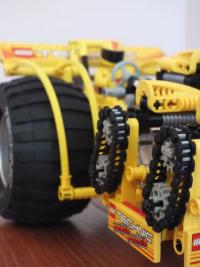
So I got this yesterday, turns out is is complete, with all the stickers and everything, and is in very good condition, hooray. I built it, and I have to say, wow, it's very cool. Even bigger than I expected, and just crazy. Up until now, I've not really weighed in on the "golden age" debate, although I was leaning towards it being now, due to the wonderful complexity of sets like the 8043. But this has made me think again. I don't know how this ever got produced. Someone conceived and designed this ridiculous vehicle, with massive wheels and five engines, and it actually made it all the way through development and into production. I'm amazed. I've not seen anything nearly as crazy before or since. I think I'm going to have to keep it. The steering is terrible though...
-
Supercars MOC Collection
Hopey replied to xikin's topic in LEGO Technic, Mindstorms, Model Team and Scale Modeling
Just... wow. -
Building muscle car. Need help.
Hopey replied to rm8's topic in LEGO Technic, Mindstorms, Model Team and Scale Modeling
My personal opinion is that they're all a bit too rectangular and flat. There certainly were muscle cars with pretty much rectangular grilles: However, I'd say the majority achieve a more dynamic shape by having the grille taper towards the centre or having the centre protrude somewhat: I'd say that given the limitations of using Lego as a medium, one thing you're going to struggle with is avoiding the whole thing looking "boxy", and having a flat grille kind of puts you behind the eight ball in this regard. Consider this model, with the grille based on a Holden Statesman (an Australian car not entirely unlike American muscle cars): The grille is about the only part that doesn't look boxy. That's my two cents anyway. -
edit - whoops, ignore me.
-
Not sure which is worse form; resurrecting such an old thread, or posting a new one for a rather trivial topic. Oh well. I was just having a browse of eBay and on a whim, put a £50 bid on a supposedly complete power puller set, and bugger me if I didn't win it; £54 including delivery. I understand this is something of a bargain. Problem is, I've kind of gone over my agreed budget with this, and Wifey's not going to be pleased. Now, I put the bid on mainly because I know of its value, and not because I particularly wanted any of the parts; the wheels are awesome but just two of them isn't particularly useful, and I haven't yet found a situation where my 6L half beams just have to be yellow. So, my options are to convince Wifey that it's worth keeping as a collectors item, or sell it on hopefully for a bit of a profit. I'm a little torn, any suggestions?
-
How have you fitted the differential? If it's one of the new 3-stud-wide 28 tooth diffs, you typically drive it with a 20-tooth double bevel gear, resulting in a 1:1.4 gearing down. If you don't compensate for this, it'll be slower (but with more torque). The diff itself won't introduce any significant amount of friction/drag when it's going in a straight line; you should be able to gear it up more (or down less, I'm not sure what gearing you've got already) and get the speed back. Edit: I just had a looksie at the photos, and you do still have a 5:1 reduction, so I'm not sure where the speed's gone. Could just be friction in the extra gears; perhaps try a silicon lubricant? Also, changing the drive wheels is an easy way to play with the effective gear ratio; i.e. increasing the diameter of the wheels by 50% is equivalent to adding an extra 1.5:1 gearing up.
-
42006 Available from 14 Dec?
Hopey replied to rumpletump's topic in LEGO Technic, Mindstorms, Model Team and Scale Modeling
Yes, it is. Much clearer in this image: -
Is this the one: http://www.bricklink.com/catalogItem.asp?S=8886-1 ? And just to be clear (so I don't go buying things that won't work), I can just plug one end directly onto the buggy motor, and the other onto a PF battery pack or IR receiver (preferably V2)?
-
As a slight hijack: If I were to buy a buggy motor or two from bricklink, what other parts would I need to make it work with a PF battery / IR receiver? A cable of some sort? Anything else?
-
Fair enough, withdrawn. I think he made it without the 9398 chassis, then re-did it with the right chassis. If he didn't submit the compliant one, it's his loss. Do we need 3 copies of the same model in different colour schemes?
-
Just thinking out loud here... A not-quite-good-enough setup: Start with a series of hinged parts, with a channel above and below through which a flex cable / pneumatic tube / piece of string can run. Here's a very poorly-designed example to show what I mean (obviously one could do a lot better): The yellow axles are the hinges, the cable would run through the grey parts. You'd need to put another set on the other side of course, to make it bend the other way. You'd run a cable through each side and fix it to the tail end. At the body end, you'd have two 180 degree offset cams which pulled each cable in turn. This would not, of course, have the desired effect; it'd be a simple flexing motion. How to get the wavelike motion? One option is to cross the cables over to the other side at the midpoint. With this, pulling one cable would produce an S shape, then cycling to the other cable would produce the reverse S, which might look cool, but there's be no directionality to it; the wave wouldn't propagate backwards. Another alternative is to run a second set of cables that only extend halfway along the tail. Pull these with another set of cams that are 90 degrees ahead of the other two. Maybe construct it so that the full-length cables don't affect the first half, although I'm not sure this is necessary. If the scribblings I've just done on an envelope are correct, then this should produce a wavelike motion. You might have to play with the synchronisation between the two, and perhap experiment with stepping so that only one set of cams is moving at a time, but I think that'd result in a less fluid motion. You could theoretically have as many such sections as you like, I guess.
-
Tumbler Batmobile
Hopey replied to Sariel's topic in LEGO Technic, Mindstorms, Model Team and Scale Modeling
Cool. The front suspension is really interesting. Although it's rather moot for this particular model (cool as it is, but everything's pretty much orthogonal), I'm curious how such an inverted system affects the requirements of the various characteristics of the steering/suspension geometry. Intuitively, I think much of it would be reversed, but I'm not sure. For example, would it require a slight toe-out to get the effect normally produced by a slight toe-in? What about caster / camber / that-thing-where-the-angle-of-the-wheel-changes-when-the-suspension's-compressed-so-that-the-contact-patch-stays-large / bump steering / ackerman steering / etc? Is there any actual benefit to such a system, other than looking cool?