


Fabulous Fox
-
Posts
15 -
Joined
-
Last visited
Content Type
Profiles
Forums
Gallery
Everything posted by Fabulous Fox
-
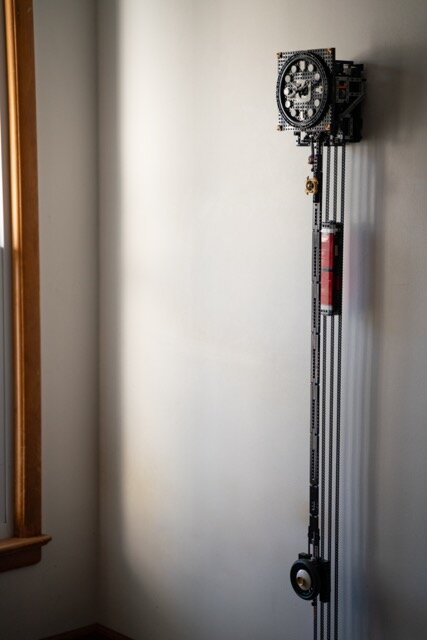
 At long last...here is a proper video for this clock...and a make over! This clock has been more than six months in the making. All the details are in the video! https://youtu.be/_qaTfnDf9tE?si=DJuZshMsHK1cAtvv
 -
History For years now I have been following all content related to Lego clocks online. My love for real life clocks, with all their mechanical complexity and beauty, pairs perfectly with the art of Lego. I have even built a few Lego clocks by others over the years, (notably, some from @nico71, @KEvron , and Dillon Sharlet's recent wall clock on YouTube) but most of them did not end up working very reliably aside from KEvron's. It's insane the amount of hours I spent tinkering with their clocks years ago, for good reasons, though. These clocks were great and were a great accomplishment in of themselves, but they were not the most practical. Some you had to balance on the edge of a table and some you had to design your own wooden bracing so they could be held to the wall. Then came along Darrel Aldrich on YouTube with his wall clock designs. His clocks are designed to simply hand on one screw on the wall (using the Lego Art mosaic set hanger piece) and are designed around a few main "frame" pieces which allow you to place various axles to your heart's content. Not only do these frame pieces make it easy to design a relatively strong structure (still not as strong as Lego Technic bricks I don't think, as KEvron commonly used, but enough nonetheless), but they make it easy to place the axles and gears all on one plate, similar to a real clock. It uses a grasshopper escapement, which does not (theoretically) have friction when the pallets work with the escapement, which is good for Lego parts and just a great/interesting mechanism all around. After a few more years of not making any Lego clocks, this spring I finally built Aldrich's most recent automatic wall clock. Now, once again I spent a long time tinkering with the grasshopper escapement he used and ultimately, it was too finicky for me. Plus, at that point I also wanted the clock to be fully manual so that I could sleep knowing there was no electricity in it whatsoever. So two months or so after the first version, I re-designed the clock to his manual version of the wall clock and put in a grasshopper escapement from @Davidz90. David is the ultimate Lego clock wizard. He's made countless clocks and knows every bit about the physics involved in them. In fact, he even wrote a book, "Guide to Lego clocks: Science of measuring time with bricks," which can be found on Amazon. I read his book and asked him (way too many) questions about his various grasshoppers and clock physics. It even got me to start reading more articles and papers on clock physics/history, which I love. Again, a couple months later and (many) more versions tested and re-tested later, I arrived at the current version the clock is in. Intro The clock is meant to be fairly accurate, easy to mount, easy to adjust, and decently-good-looking. It can be within a minute accurate per week (definitely more if you really fine-tune the pendulum length) and runs for around 48 hours on a weight and chain system designed by Aldrich. I eventually want to design a proper box/face for it in the future and add more complications, but for now this is sufficient. Below is the video I recently made of the clock. It is not meant to be an elaborate video, just more of a quick review of Aldrich's and Ziemkiewicz's combined into my own clock. In the video description is a list of great Lego clock topics and YouTube channels worth looking into. I only posted one image to here because it won't let me upload more file sizes Specifications: 100% manual (no electronics), 100% Lego, 100% non-modified parts, only hung by one screw. Pendulum is two seconds and has been a few seconds accurate a day in my week of testing this version (under a minute each week). It runs for around 48 hours on an H-loop chain system (by Aldrich), where the chain is simply pulled up by a chain when needed. Escapement is a grasshopper from Ziemkiewicz. Pendulum is around 240 grams. Weight is around 860 grams. Gear ratio from 24 tooth chain gear to the 40 tooth escapement is 1:75. Honorable Mentions The following people have either helped me build Lego clocks or greatly inspired me to get into the craft (YouTube handles): @darrellaldrich8334 @davidziemkiewicz1350 @KEvronista @DillonSharlet Videos Mainly Used to Make this Clock
-
At 1:04 he switches it into a higher gear ratio and it cracks/slips until he reinforces it with his hands, which the structure should be doing anyway. This is what happens when I attach a motor or push it along a surface long enough (like 3 feet) to cause the cracking. Most people just stop at moving it a foot or so and don’t realize all the friction that builds up if you push it further, which is why I theorize there isn’t a lot of talk about this.
-
I want to bring something to attention, even though many will not care or notice, this set came out some time ago. The drive train in this set is NOT braced properly, it is not structurally secure enough for all the axles and gears. In the high gear, when I push the vehicle forward more than a foot or so or attach a motor to the engine - basically anything that moves the drivetrain more than just a few seconds - the gears slip and crack massively. This is quite unfortunate considering the gearbox was already dumbed down in this one. I always make sure to check spacing on axles and gears when building and my build certainly is fine in that regard. Everything is built correctly. I’ve encountered this problem on many sets and MOCs over the years, particularly the previous Land Rover and Lamborghini in their higher gears. Most people do not push the sets further than a foot, where the friction builds up enough to cause slipping. The variances in Lego parts (gears and axles) will cause friction build up throughout the system. Some people get lucky with their parts, some don’t. This is why this is happening. The designer unfortunately did not design the build in such a way that axles and gears are very securely braced - that way any part variances will not stop the gears from working. @Didumos69 is someone whose MOCs are excellent in this regard - the axles are always properly braced. The new engine parts in this build have WAY more friction than the previous, regular piston blocks and crankshaft. This may be a big reason for the friction as well. I don’t like this one's looks either. Lego needs to start designing their sets better for their big part variances. The video in this review has this problem. It was the only thing I could find on the internet of someone having friction problems with this drivetrain. https://youtu.be/g5gDEUiiv-0?feature=shared
-
I never thought of refining a sketch-like model over and over again and not worrying about being 20 steps ahead all the time, I think this may help. I remember Markus showing all the prototypes in the bulldozer video but for some reason I never thought of doing that for MOCs. Funny you mention the 8043, it was my first flagship and one of my favorite Technic sets to this day. Best Christmas Present ever
-
I guess I should have clarified my question a little bit. I don’t think I have a problem with coming up with the initial idea for a model, functions, and general steps to take to design it nor not having enough knowledge of parts. I know most Technic parts off the top of my head (how they can connect to other parts too) and have all my Technic parts sorted pretty well. I’ve been building official sets and MOCs for years now. Mostly from 2005 to present. I should say that I try making alternate models from the bigger sets way more than I ever have tried freestyle ones, I don’t really know why (maybe this is my problem). What my problem is, is in ACTUALITY designing it, part-by-part. The part where you’re using your brain to figure out which parts to attach. You know, the part where you sit down with a part and think, “What do I need to connect to this? What should connect to this so that it makes sense to connect to this I need 10 steps down the line and also be braced properly?” I can TELL you how to brace parts and how to make certain mechanisms. But when I have to really sit down and connect the parts, it just doesn’t click. For some reference, when I’m sitting down and I’m figuring out which part to connect next, I tend to think to myself all the parts that would remotely make sense to connect to it, and mentally go over each one in my head until I find one that makes sense and ALSO gives me most potential connections for future parts. But the problem is, I don’t know which parts I will need to connect 10 steps down the line yet. Am I supposed to just guess and keep changing things as I see fit? That sounds like I would need to change parts 50 times each before finding the right combination. An example of this is, say I want to insert an axle. If I don’t know exactly how the build will go 20 steps down the line, how am I supposed to know which length or type to use? If I decide to just use any length for a placeholder, I’d imagine I would have to change it at least five times or so before finding the right one. Maybe this is a mindset shift I need? Maybe it just takes longer than I think? If you guys had unlimited time to build, say a 2,000 piece Technic alternate build, how many hours do you think it would take you? (Just the model not the instructions or anything else).
-
I appreciate the detailed response! I actually already do a lot of these things, especially looking at older instructions and thinking about their decisions , except I didn’t think of having different iterations of the same thing. I used to watch that video a lot when I was younger, it’s a lot of what inspired me to get into Technic.
-
So I have a question that’s always bothered me and I’m hoping some of you on here can give your thoughts since many of you are pretty experienced MOC builders. I’m horrible at designing Technic MOCs. I’m totally fine with designing system MOCs. I’ve been building Lego and Lego Technic sets and others’ MOCs for years and years, from the simplest to the most complex. I’ve watched countless videos and read countless topics on Technic. I have and have read Sariel’s book. I understand all the basic mechanical principles and part types. I understand how to brace gears and build strong. But for some reason, when I sit down to start a MOC, my brain just doesn’t seem to work. I can’t really think more than two steps ahead, which I know you need to with Technic. It’s not like this with system. Now, I can design super small MOCs, like micro scale, and even small mechanisms (I made a custom differential once), but as soon as I need to design a full vehicle it’s over. Recently, I built 42131 and some alternate builds, and I was motivated to make a wheel loader out of its parts (adding tires and one more differential ofc). I sat down to start and my brain just couldn’t, beyond putting the differentials in and connecting them by a few beams and a turntable in the middle. It’s been like this every time I’ve tried to design a vehicle in Technic. When you guys are designing Technic MOCs, what’s your process like? Does it really just take tons of thinking, brain power, and time, trial and error, more than I think? Or is it relatively straight forward for you guys? I think I could if I REALLY had to, it would just take months probably. At the end of the day it’s not a big deal, because I love building from instructions so much.
-
(I literately just posted this today in the main 2025 Technic topic, not realizing this topic existed, so I'm posting it here). I've been reading so much of the Technic topics and set reviews on this website recently (and a lot in the past) and I know it's wishful thinking, but personally, I would like Lego to give us something great - something challenging. I have built so many sets, alternate builds, Mocs, and most of the flagships since the 8421, and I have rarely felt challenged. Don't get me wrong, I ADORE some of the greats like 8421, 42009, 42043, 8043, 8258, etc. Something with a little bit of everything. No simple functions, but complex, realistic ones that are also structurally sound and VERY difficult to build with proper instructions. I want to REALLY STRUGGLE putting it together. I want to have to struggle with tons of pneumatic spaghetti, struggle with rigging string, struggle with 100 different things going on in a chassis while also needing high dexterity to put things together. I want it to feel like I’m accomplishing something huge. I want wires everywhere, a maze of parts, a maze that is hard to navigate. I want to spend days upon days upon days on a single set and still not be done. The ONLY times I’ve EVER had a remotely difficult time putting an official LEGO set together was maybe with the 42043’s pneumatic tubing and the 8043’s wires. And the only set builds that have felt truly "long" to me was the 42082. Imagine a huge mobile crane like 42009 or a huge tow truck like 8285, but with full RC, realistic suspension with proper geometry, a transmission with new parts that reduce space and friction, complex steering, lights, fun controls, challenging building, new parts, pneumatics AND LAs, more powerful motors, ones that FEEL powerful like the RC buggy motor or the PF XL motor, new electronics, new motors for activating the pneumatic switches, good looks, demanding presence, big, detailed box, new solutions that minimize friction, etc. All while having 3000-4000 parts like recent flagships. Also make tons of interesting designer videos on the full development of the set, like the 8275 had. I remember watching those videos over and over again when I was younger. Not many Technic sets do that now. So be it if they're expensive. I understand it's difficult to get companies to think like this long-term, and it may not even be the right decision in the first place, but it's just what I personally wish (as I'm sure we all do). Oh, and while they’re at it, give me a B model as well. Not only a B model, but other images of suggestions of alternate builds. Actually no, scratch 3-4K pieces, give me a 10K+ piece Technic flagship mobile crane that costs $1,000. Wouldn’t that feel so good?
-
I know it's wishful thinking, but personally, I would like Lego to give us something great - something challenging. Something with a little bit of everything. Not simple functions, but complex, realistic ones that are also structurally sound and difficult to build with proper instructions. I want to STRUGGLE putting it together. I want to have to struggle with pneumatic spaghetti, struggle with rigging string, struggle with 100 different things going on in a chassis while also needing high dexterity to put things together. I want it to feel like I’m accomplishing something huge. I want wires everywhere, a maze of parts, a maze that is hard to navigate. The ONLY times I’ve EVER had a remotely difficult time putting an official LEGO set together was maybe with the 42043’s pneumatic tubing and the 8043’s wires. Imagine a huge mobile crane like 42009 or a huge tow truck like 8285, but with full RC, realistic suspension with proper geometry, a transmission with new parts that reduce space and friction, lights, fun controls, challenging building, new parts, pneumatics AND LAs, more powerful motors, electronics, and parts for driving, new motors for activating the pneumatic switches, good looks, demanding presence, big, detailed box, new solutions that minimize friction, etc. All while having 3000-4000 parts like recent flagships. So be it if they're expensive. I understand it's difficult to get companies to think like this long-term, and it may not even be the right decision in the first place, but it's just what I personally wish (as I'm sure we all do). Oh, and while they’re at it, give me a B model as well. Actually no, scratch 3-4K pieces, give me a 10K+ piece Technic flagship that costs $1,000. Wouldn’t that feel so good?
-
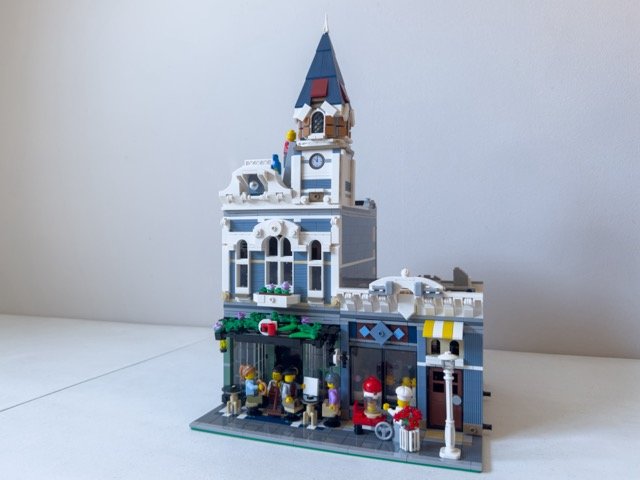
Hello! This is my first form post to Eurobricks! I recently have been inspired by the architecture of many historic small towns/buildings in my area, and couldn't resist creating a Lego modular building. I figured the 10255 Assembly Square was a good candidate for a plethora of different parts to choose from, since I do not have my own collection sorted. So I created an alternate build! It features a quaint little coffee shop (high quality of course) on the left of the first floor, a popcorn shop with amazing smells on the right, an elegant architect's office on the second floor, and a historic clock tower on the top! It was more lengthy of a process than I initially imagined, but it was worth it in the end, because I got to release that architectural energy! Also being a fan of all things coffee shops, I knew a coffee shop was the way to go. I based a lot of the architectural details on buildings I've seen in real life, but the buildings are not a direct copy. Initially, the popcorn shop was also supposed to have a second floor, but I quickly realized that Assembly Square did not have as many bricks a I thought, so I had to do one floor. I also think a tiny building on the left and right of the coffee shop/clock tower would have been interesting - like the 10278 Police Station - but I'm still satisfied with the result. The buildings cannot be separated as built here, but they are made to be easily modifiable to do so, like in the 10218 Pet Shop. I'm a huge fan of arched windows and clocks on buildings - we as a society need to do that more. There are more detailed images in the link below, because Eurobricks has a small image size limit. Link to the Rebrickable here. Let me know what you think!
-
42172 - McLaren P1
Fabulous Fox replied to Ngoc Nguyen's topic in LEGO Technic, Mindstorms, Model Team and Scale Modeling
I apologize if I worded it wrongly. I meant pushing it along a surface with your hands or using motors with the wheels off the ground, not using motors to actually drive the thing. -
42172 - McLaren P1
Fabulous Fox replied to Ngoc Nguyen's topic in LEGO Technic, Mindstorms, Model Team and Scale Modeling
I have yet to see someone mention how the friction in the drivetrain holds up at all different speeds in this set. We’ve seen a motor connected just to the gearbox itself, but not a full test of driving the car on the ground, both ways - through all gears - like how RacingBrick did for the Land Rover. (Neither could I find such test for the previous Daytona). I say this because when I had the Lambo, it would consistently bind up on one or two gears when pushing it manually (only in one direction weirdly enough), and we know the designers have a history of neglecting friction problems. I know we have new gears with less friction now, but I’m still curious.