

gyenesvi
-
Posts
2,396 -
Joined
-
Last visited
Content Type
Profiles
Forums
Gallery
Everything posted by gyenesvi
-
General Part Discussion
gyenesvi replied to Polo-Freak's topic in LEGO Technic, Mindstorms, Model Team and Scale Modeling
Thanks for the references, indeed I thought it would be possible with independent suspension at larger scale, though I have never seen these older models using it. But my question is primarily using it in a live axle, smaller scale. True that a 5L suspension arm is another a possibility, but these scales are already too big for me, these are 17 wide. I'm looking for usage in 13 or 15 wide axles, where it actually makes a difference to use these as opposed to the 5 tall newer hubs in terms of ground clearance. And at those scales a driven independent suspension would not even be possible anyway. Not quite, as that is independent suspension as well, and it's huge, 21 wide. So far I have only seen one 13 wide live axle with it, but it did not have a proper differential neither a differential frame, and the steering linkage was enormously complex. -
General Part Discussion
gyenesvi replied to Polo-Freak's topic in LEGO Technic, Mindstorms, Model Team and Scale Modeling
Has anyone built / seen a usage of this wheel hub in a steered and driven live axle (or even in an independent suspension)? I suppose it's designed for smaller scales, but I just can't really imagine how to use this properly in a compact build, the main problem being the steering linkage. It can only connect with 6L or 9L links in one position, and if the axle is driven, then there's not enough space for connecting the other end of the steering link to a tie rod because of the differential and its frame (or any gearing) being in the way.. Unless the wheel base is super wide and the scale is large, in which case this tighter part is not that useful as a bigger hub will also do.. -
Thank you guys! Yes, that is a really simple linkage. Here is a render about its details. One of my goals was to test how a linkage based steering can work in a model of this scale. A few things about it. First, as you see here, the bottom of the servo horn is only 1/2 studs away from the tie rod. So if you push down the suspension, it cannot achieve its full 1 stud of travel given by the springs, only 1/2 studs. However, when the axle articulates, it sort of goes around the servo horn, so it is able to achieve its full 1 stud of articulation at the springs, so that is a good compromise I think, as articulation matters more. Second, the Panhard rod is parallel to the steering link, which minimizes bump steer. Although the movement range of the servo horn is about 35-40 degrees only, proportional steering still works fine with this PU motor, and even with the Control+ app because of the calibration finding the end points automatically. However, the system has a drawback; as the servo horn is 2 studs long, that decreases its leverage on the wheel hub, so the power of the steering system is weaker than in case of rack based steering with a 12T gear, which can be thought of roughly like a 1 stud long servo horn. So the power is halved compared to that, and that can be felt off-road. With all the weight of the model, it is too weak to steer in place on sticky rocks. But when the model is moving, it works fine as seen on the video. On flat surface, it can steer in place as well.
-
True, but that's just one quite special use case, though more similar ones will probably emerge, such as sandwiching 3x5 full beams, or the recent 2x3x5 curved panel from the Ferrari in between two of these. Regarding the axle hole in the corner, I wonder which side gets it (if any)! Or even better, I have been wondering about such part design in general, if it would be possible to put two axle holes from both directions in the same amount of space. I have seen experimental parts with beams having pinholes from both sides in the same position (so not alternating), but that was probably too weak for a hole beam, removing too much material. So I wondered if it could work with axle holes (less material removed), especially if that's just in a single position in a bigger part. I think it would be doable with this one, though don't believe they actually did it.
-
Indeed, that could have been useful. Are you saying it could be connected downwards from the inside? That indeed seems plausible, with various types of connectors, because the wall is thin, so there's fair amount of space inside!
-
Hello Folks! Recently I have revisited a previous MOC of mine, the Willys Jeep alternate of the Defender. By adding the Zetros set's parts into the mix, I have built an RC version of it, so now I'd like to share the design of it. Features - all wheel drive with two drivetrain options: off-road with planetary wheel hubs, slower gearing, possibly locked differentials and off-road wheels, and street variant with faster gearing and street wheels - floating axle suspension with imitated leaf springs with extra links and Panhard rods for stability - linkage based steering and connected functional steering wheel - remote controlled two-speed gearbox, functional gearstick as indicator - openable hood, foldable windshield, removable soft top, clean interior, jerry can and spare wheel Goals This build has been in the back of my head ever since the building of the manual version, however I wanted to make a proper RC version, completely rebuilding the internals instead of just throwing a few motors in here and there. In particular I wanted to keep the spirit of the original. I set the following goals (besides keeping the body intact): - keep the original's suspension which is live axles with 'imitated' leaf springs. At the same time, make the axles narrower if possible as the manual version is a bit too wide. That meant some constraints on how the axles can be linked to the chassis. - keep the AWD drivetrain including some form of simplified gearbox, preferably an RC one - keep the functional steering wheel - keep the interior clean of motors, gears and batteries. This means that the available space is much less than it seems because the car is open and the interior is fully visible - use better wheels than what the Defender set has to offer, something that better matches an off-roader A further dilemma was whether to use planetary wheel hubs in the motorization or not. On one hand it seems natural because it's an off-roader, on the other hand many builds with those hubs come out too slow, but I also wanted a playable speed. It's not a rock crawler after all. The resolution of all these constraints is nicely solved by the Zetros set. It has enough electronics for the complete motorization, including an RC gearbox, and drivetrain components like the planetary hubs and heavy-duty diffs and CV joints. Furthermore, it has off-road wheels that are the same size as those of the Defender, so match the scale. And also some it's regular parts are a useful addition (interestingly I discovered that the Zetros uses the same color coding for parts as the Defender, probably because they have the same designer, so in the end I had more of the same parts in the same color). Furthermore I decided to try and make it work with the official Zetros profile of the Control+ app. Layout of the electronics I started with laying out the placement of the drivetrain and the electronics. Luckily, the the length of the Willys was just perfect to fit in the drivetrain with double CV-joints going to the axles, and a two-speed gearbox in the middle, so I concluded that the gearbox is probably possible. The big question was how to place all the motors and the battery. I figured that there are only two meaningful possibilities to place the battery: at the front under the hood or at the back as cargo or under the rear seats (the middle is not possible if I want a gearbox or even just a clean interior as the floor is so low). If I put it under the hood that would have left me with only awkward motor placements (either on the back, or under the seats, but because of the RC gearbox, the would have had to be placed too far out with a gear-train cutting the chassis structure), so the battery in the back - motors at the front seemed like a better idea. For the steering I also considered two options: on axle or off axle servo. I did not like the on-axle variant though as then it would have collided with the drive motors placed above the axle under the hood. Also, making a functional steering wheel seemed easier if the servo is off the axle. For that case, there were also two options; linkage based or joints based routing. A joints based routing would have probably required to place the steering motor somewhere in the floor, which would have collided with the gearbox/drivetrain, so I rather experimented with a linkage based one, which was something I wanted to try for a while to see how it actually performs. So the key was whether it's possible to somehow place 2 drive motors and one steering motor all under the hood and route both the drivetrain and the steering. Sandwiching the steering motor between the drive motors with an offset seemed like a possibility. This way the steering motor was low enough for linking the steering, but not too low to collide with the axle, while the drive motors could be comfortably placed higher to give way to the chassis frame itself. And later this even enabled good gearing options towards the gearbox. Drivetrain options The next thing was to decide on the gearing. The mix of Defender and Zetros components available gave me an interesting possibility: it seemed that both a slow, off-road drivetrain (using planetary hubs) and a faster drivetrain (using vanilla hubs) are buildable from the available parts. Also, two types of differentials are available in the two sets, so what I did is I coupled the planetary hubs with the older (faster 20:28) diffs, and the vanilla hubs with the heavy duty diffs (12:28). This way, the off-road setup is faster than in case of the Zetros, and the vanilla setup is more powerful than with old diffs. To further enhance the situation, the gearing from the motors towards the gearbox is also adapted: in case of planetary axles, it is built with a slight up-gearing (20:16), and in case of vanilla axles, it is built with a slight down gearing (16:20). The gearbox itself is 1:1 in low gear and 20:12 in high gear. These speeds turned out to be quite playable, both fast enough and powerful enough where needed. A further advantage of matching the planetary hubs with old diffs is that those diffs can be simply built locked, which is useful for actual off-roading at least in the rear axle. To top it up, the off-road axle can take the Zetros wheels, while the vanilla axle can take the Defender wheels, hence I named this the 'street' version. Note that as the Defender rims are deeper, these axles need to be built 2 studs wider to get the same actual looks. Gearbox The gearbox itself is quite simple, but making it RC is not trivial with the medium PU motor of the Zetros set, as it needs many more components (first down-gearing, then a safety clutch, then physical limiters, besides the orange selector). Luckily it was not that hard to lay this all out flat on the floor under the middle console and the seats. Which left the space above the driving ring to the manual selector, that could this way be made functional to actually indicate the selected gear. Chassis structure and axles I wanted to keep the nice somewhat realistic chassis structure of the manual model. However, the frame had to be widened to make space for both the motors in the front and the battery in the back, and at the same time making the leaf spring attachment positions narrower to make room for the wheels in the narrower axle. As a result, routing of the functional steering wheel was the most difficult problem because both the motors and the main frame of the chassis is straight in its line, so I had to use a series of 4 U-joints to route it around the frame. At the same time, the whole suspension was stabilized compared to the manual version; both axles actually have two upper links as well and a further Panhard rod. The axles are somewhat different builds in case of the different hubs, and I had to make things such that the spring attachments are compatible with both axles, which also presented some complication and had quite limited the possibilities. The battery hub is lowered between the frame but can be easily taken out for replacing batteries. Furthermore it sits low enough not to obscure the internals too much, so I was able to build some rear seats on top of it that's only 1 stud higher than the manual version. Some shortcomings Although I think the final chassis came out quite well, there are a couple details that I am not completely satisfied with. The main one is that due to the wide position of the springs (due to the space requirements of the motors and the battery), and the usage of hard springs, the suspension is too stiff for hard-core off-roading. The sets only have two soft springs, but even if they had four, it would not help; with soft springs the suspension just sags under the weight of the model. Doubled up soft springs would be optimal (in the front it's actually easy to install, but in the rear it would be quite problematic due to the shape of the planetary hubs). But I think it's an okay compromise, as the model still rides very well on tough terrain, just doesn't articulate that much. Another minor thing I could not fix is that the movement of the steering wheel is not that realistic, it was not possible to gear it up more. The root of the problem is that because of the linkage based steering, the servo range is not 90 degrees to start with, but rather around 35-40 degrees, and even though its doubled at the steering wheel, that's still not much. Anyway, at least the construction of the steering system is somewhat like in reality, from the steering wheel to the steering gearbox, then through the linkage to the tie rod. Bodywork The bodywork is the same as for the manual version. But I think it looks much better with the Zetros wheels. Here are some renders and photos with both axle/wheel variants and with/without the detachable soft top. And finally, one of my favorite options; with the Zetros rims and the narrower axles it became possible to put on old 80mm diameter, narrower foam tires, which best match the real vehicle I think. And it's even not that bad at off-roading! Many more photos are available on my Bricksafe page. Building instructions are available on Rebrickable. Let me know how you like it! Cheers, Viktor
-
42154 - 2022 Ford GT
gyenesvi replied to Ngoc Nguyen's topic in LEGO Technic, Mindstorms, Model Team and Scale Modeling
This is exactly something I have also been wondering, one of the signs why I think the missing parts in technic are not really a problem of resources. I think either the first or the third or the fourth would also be acceptable, especially in manual models. Even in RC models, if the wheel rubs the fenders at max articulation and steering is acceptable because that is a rare situation, doesn't really happen during playing, and in case of street tires with flat pattern it does not block the wheels even if it happens momentarily. Such a construction would not be acceptable though in an RC off-roader, where max articulation and steering happens more often and can often block the wheel/car from moving. These as well. It's not even something unheard of, as there are 6.5 long steering arms in existence. Furthermore, the fender parts have a 1/2 stud wall, they could actually maybe have very thin outer wall, behind which the wheel could sink in more easily slightly. I tend to believe that the raised geometry posted by @jura93 above would be doable with about 1 stud travel, combining all these things, maybe the wheel touching the fender at max articulation and steering. Would be totally accepted by people I guess. That's a cool solution for a manual model, especially if the rubbed hose would have an axle hole in it! Could work for small range of flex. But yeah, not really useful for RC models. This is a solution I don't quite like, I also don't think it's solid enough, even if it is, it probably results in a lot of wear on the parts, although I have seen this before used in an RC Creator style Hummer! Not sure how solid it was, the build was going more for the looks than the performance I guess.. -
42154 - 2022 Ford GT
gyenesvi replied to Ngoc Nguyen's topic in LEGO Technic, Mindstorms, Model Team and Scale Modeling
Your point is equally valid though! After writing my comment I kept thinking, and came to similar conclusions. If they go for cars mostly then be it, but then do it as if only the best was good enough :) They keep improving the paneling, and it's visibly better and better, but there's a lot to improve technically as well (steering/suspension/drivetrain), and that should not be neglected, because in the end, it also effects the looks! I was actually thinking the same that the creator mustang's steering system sits deeper in the rim then this one on a larger scale (it got a new rim for that)! And it's the same with off-roaders, bulky steering/suspension/drivetrain parts are effecting the looks in many ways at medium scales, for example many cars need to be lifted up too high. I've recently seen the video of @kbalage about Speed Champions design (watch it if you haven't, really good). I was blown about the amount of dedication to accurate scaling, the attention to customer feedback, and the amount of optimized new parts that they are bringing out to improve every year, and it really shows. True, that's a smaller scale, with less diverse directions and more focus on doing one thing right, but still, I wish technic would have more dedication like that towards realistic mechanisms (and more communication like that between the design team and the fans). I still don't get the reason for not releasing certain improved parts for example. It was said in some recent interview that it's actually not the lack of resources (which we also kind of see from the proliferation of recent panels), but that certain parts are not released because they were not required so far. LOL. There are a bunch of released models that were just not good enough mechanically, and there are a bunch of things that simply cannot be built properly, so I can't wrap my head around that. -
42154 - 2022 Ford GT
gyenesvi replied to Ngoc Nguyen's topic in LEGO Technic, Mindstorms, Model Team and Scale Modeling
I think if they scaled it like that it would be worse at least with these wheels, because it does not play well with the stud system, it does not fill a 9 wide gap nicely, and they'll never release a wheel arch with 8 wide gap (I guess it would be better to scale to the wheel arches, which is probably what they did). And as you say, even if this would be solved with a properly sized new wheel, then the next problem would be no room for steering and suspension. I guess deeper rims at this scale would help with the steering a bit, and those would be quite useful indeed for many other models. Not sure if the suspension could be kept functional if the wheels would get closer to the arches though, maybe only if they could sink inside the wall of the wheel arch when the wheel is straight (and could hit it when steered). Actually, I think what's more off here is the length, which is short by quite a few studs, and the nose is too long (probably they wanted to use that new headlight piece, that's what made it longer, and the length is to compensate for that maybe). But let's not complain about the shape so much, this is technic, and the whole thing inherently looks like broken china anyway :) But I still like it among the sportscars, and it will bring us a lot of new parts in a nice color, and hopefully some technical advances as well! -
42154 - 2022 Ford GT
gyenesvi replied to Ngoc Nguyen's topic in LEGO Technic, Mindstorms, Model Team and Scale Modeling
Whoaa, that picture tells it all! It's 15 wide, and there's a frame in the middle, so something new must be involved. And it's probably with the old CV joint, because the new one would not fit in between those connectors. Did they just use something like Cada has? Or maybe it's a U-joint with two 2L axles? That would be really nice, but I checked the build virtually and it seems to add up nicely with the 6.5 length.. I also suspected that something must be going on here, because neither this, nor the Batbike would really warrant a new black color. My guess was that they would be medium hard. This time the steering geometry is also correct, because the front uses 6L arms! So all the negative reviews about the Raptor being RWD only finally had its effect and they seem to have listened :) Can you guys make out what diff it has? It's probably an old DBG one as far as I can tell. I was trying to figure out the routing of the drivetrain, it probably goes backwards first through a 20T tan bevel gear and then comes back to the pistons. But what is that DBG gear there in the back? It should be a 12T sitting above the 20T, but it's neither black, nor LBG, nor blue.. And not an 8T in DBG.. -
42154 - 2022 Ford GT
gyenesvi replied to Ngoc Nguyen's topic in LEGO Technic, Mindstorms, Model Team and Scale Modeling
Exactly, that's what I am waiting for as well! Though it would be great to have a variant of this with the newer CV joint with a 2L axle on both the female and the male part (but this older one would be interesting and better than nothing as well, those Cada ones have 2.5L axles if I'm not mistaken). -
Do you mean 16T gears? 3 of them above each other, with the middle one being a free spinning one to let the drive pass through? I guess because the pistons are shorter, they were required for a smoother running engine. This way the shaft has more wide ends that hit the pistons easier I guess.
-
Thanks, good to know!
-
42154 - 2022 Ford GT
gyenesvi replied to Ngoc Nguyen's topic in LEGO Technic, Mindstorms, Model Team and Scale Modeling
Are you guys saying that at this body width the suspension needs to be 15 studs wide, at which it would not be possible to build a driven independent suspension with current joints, only with a floating differential, which may not be the way to go in an official set so we are hoping for new CV joints that would allow for narrower suspension? :) I am really holding my breath for this, because I figured that the upcoming Audi may also need such a setup for its (hopefully driven) front independent suspension, which may also need to be 15 wide with buggy wheels.. -
Oh, it's the other way around, my bad then, I misunderstood that. You use an interesting piece for the front grill. What's that? Is it Cada? Tracks?
-
Wow that has a pretty interesting mechanism! Before seeing the video, I thought the whole arm would be lifted by the winch, but this is more cool! Great looks as well. And those micromotors are quite powerful for their size!
-
Technic 2023 Set Discussion
gyenesvi replied to Dami's topic in LEGO Technic, Mindstorms, Model Team and Scale Modeling
I’d also prefer Zetros tires and scale. It does not need to be too big, rather packed with functions, and less than 1500 parts is not that big. Also, it’s probably not Control+ next tothe Liebherr, rather pneumatic. The green color is great, and luckily many sets with it recently :) I really hope that it’s not the Peugeot that would be the motorized car but the Audi. That has more potential to be interesting mechanically. -
That’s got an insane speed :) Which part is not buildable with lego? Do you mean the motors?
-
Looks nice overall, but the fender part sticking out in the air behind the front wheel looks a bit ugly to me. However, the mini V8 in the front is interesting! Wonder how smooth that runs, and how the drivetrain is routed without colliding with the HoG steering.
-
Technic 2023 Set Discussion
gyenesvi replied to Dami's topic in LEGO Technic, Mindstorms, Model Team and Scale Modeling
That Ford looks awesome indeed! Great color, and many nice panels! The headlights seem to be a new 2x3x5 corner piece in transparent in the Ford, and also in yellow in the airplane. Interesting that the front wheels are not mounted to a wheel hub, so there might be some non-traditional suspension build in there! The black springs in the Batbike are also interesting. I wonder how hard the small ones are. I tend to think that they are not soft, because then an LBG version could have been used as well, it would fit the color scheme nicely, so there would be no good enough reason to release it in a new color for this model I think. The spiralling does not look like on a hard one either, so I hope it's something different, a medium hard would be welcome! -
Efferman's Custom Parts
gyenesvi replied to efferman's topic in LEGO Technic, Mindstorms, Model Team and Scale Modeling
That's a nice design as well, I never saw that one. Have you tested it in real life? So that has the extra half stud of width as well, but it's distributed differently. However, the new design we are discussing has the theoretical possibility of having both a half stud narrower and wider version. So what do you think of making the inner spinning part from two halves as I described? Or any other way to make the spinning part interchangeable, to have an option for both wider and narrower version for different tires? Well, I'm afraid that might be true, just thought it may be possible to come up with a partial solution that's usable in some situations, like lower angles of the suspension arm. The CV joint does not sound like a good solution due to its limited steering angle, especially when it is in an independent suspension when it also needs to be angled upwards (becomes even more limited). -
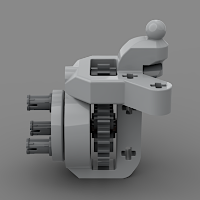
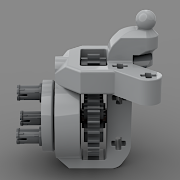
It's getting pretty good! Yes, such a steering link mount is necessary because otherwise it is impossible to build anything there for connecting the steering link. Indeed, with standard tires on Defender rims, we could even get rid of that extra half stud on the wheel mount itself, and that's great because the whole part then becomes 1.5 studs thinner than the lego version. However, I checked it with 56mm 6 spoke rims, and that does not work in that case. The reason is that the spokes in that rim are slanted a bit inwards on the inside, and those hit the upper part of the portal hub where the 3L axle with stop of the incoming U-joint would be. So for that rim, the extra half stud is also required. I can see that your idea for the inner rotating piece that holds the pins is to make it insertable from the inside, right? So that only works if it's 1 stud thick, if it was 1.5 studs thick, it would not be possible to insert it from the inside.. I was wondering what could be a way to have both 1 stud and 1.5 studs thick options. For example, if that part could instead be made of two halves, one inserted from the inside, the other from the outside, and jointed together by the 2L friction pins themselves. Then, another option would be to joint the two halves with 3 half pins, add a 6-hole pulley wheel as spacer, and put 2L friction pins into the remaining 3 holes of the pulley wheel, connecting the pulley wheel and the outer half of the rotating piece (first image). That way the Defender rim could be added with a half stud offset as well. Still that would not work for 56mm rims, because of the extrusion on the inside in the center would collide with the spacer pulley wheel. At least it could work for the Defender rim, which is where the whole thing makes the most sense. Another area that may be improved is the mounting point on the top. I was wondering if it could be a good idea to use an axle hole there instead of a pinhole. A frictionless axle-pin provides a more solid connection than a simple frictionless pin. Furthermore, another interesting way to use this hub would be with independent suspension, as in a hummer. However, that would require the U-joint to bend upwards, which needs a bit of clearance. Do you think it would be possible to cut off a corner of the upper mounting point to make space for the U-joint (second image)? The axle with towball would sit a bit higher anyway, as that part cannot be fully inserted into axle holes. BTW, we are really off-topic in this thread, maybe we should move this discussion to your custom parts thread?
-
[MOC] 1:8 Lamborghini Huracan
gyenesvi replied to mihao's topic in LEGO Technic, Mindstorms, Model Team and Scale Modeling
Cool looking Lambo, the body looks smooth, although with the black color, the gaps are harder to see anyway :) Not sure I understand this clearly. What did you try to switch the driving ring with? An old style red selector or the orange wave selector? With the orange selector, it should be impossible to make the driving ring slide, and I never had problems with such 2-speed gearboxes, even under high torque. Did you try that? Or is the gearbox manual? Even in that case, you could keep the stick functional, and use a HoG shifter to actually shift. And it would be easy to motorize that as well. As I see, you are using a single PF XL motor. For this car, I'd try two L motors coupled, because they are 2x faster, and even stronger together. There should be enough space for that in such a big body. -
gyroscope unicycle
gyenesvi replied to Diamabolo's topic in LEGO Technic, Mindstorms, Model Team and Scale Modeling
That's a pretty cool idea! -
Technic 2023 Set Discussion
gyenesvi replied to Dami's topic in LEGO Technic, Mindstorms, Model Team and Scale Modeling
Yeah, but that's only true with planetary wheel hubs. I think 42099 was weak because it had to be geared up (after being geared down inside the motors themselves) almost 3x to counter some of the effect of the planetary hub, so that drivetrain was complete nonsense in terms of matching the motors to the wheel hubs, and lost much of its efficiency in all the up-down gearing. But I think this kind of vehicle should be built without planetaries to be fast (it does not need to climb), and not have too much down gearing. Even the last RC Technic buggy was gearing UP from an L motor (36T gear to 28T diff). I would build this one with 2L motors coupled, straight to the yellow diffs, with regular hubs. Yeah, two Buwizz motors with a new red diff and planetaries is still quite fast but very powerful. Actually, I even tried that combo with an old diff (which has a ratio similar to the new yellow diff) and it can still climb everything, but now very fast for a lego offroader :) That would be sad for this one car and the mars rover. But I could imagine this being wrong. The set numbers are just too much in an orderly sequence, that's a bit suspicious for me as well. Usually there are some gaps, no? Indeed, I would do that quite happily. But as I say the problem is that a 15-stud wide driven and steered independent suspension is not possible in a clean way with a diff (only with a floating differential, which may fly for manual models, but not so healthy for fast RC one). Though another option would be a separate left-right drivetrain, which can be built more tight, but that would loose the diffs.